Earthquake – Meaning, Causes, Types, Distribution, Measurement and Effects

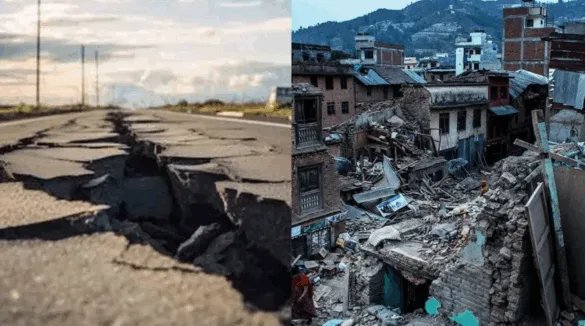
Earthquake is one of the most important natural phenomena studied under geography and disaster management. An earthquake simply means the sudden shaking or trembling of the Earth’s surface caused by the release of energy from inside the Earth. This energy travels in the form of waves, known as seismic waves, and spreads in all directions from the point of origin.
Thank you for reading this post, don't forget to subscribe!Earthquakes are natural events, but their impact can be extremely dangerous. They can destroy buildings, disrupt infrastructure, and cause loss of life within seconds. Understanding earthquakes is very important, especially for countries like India, where many regions are highly prone to seismic activity.
What is an Earthquake?
An earthquake occurs when energy stored in the Earth’s crust is suddenly released. This release of energy generates vibrations called seismic waves. These waves travel through the Earth and are recorded by instruments known as seismographs or seismometers.
There are two important terms related to the origin of an earthquake:
- Hypocenter (Focus): The point inside the Earth where the earthquake originates.
- Epicenter: The point on the Earth’s surface directly above the focus. It is the first place to experience the impact of the earthquake.
Causes of Earthquakes
Earthquakes can occur due to both natural and human-made causes. The main causes are explained below:
1. Fault Zones
A fault is a crack or break in the Earth’s crust where rocks on either side move relative to each other. Over time, stress builds up along these faults due to tectonic forces.
- Rocks get locked due to friction.
- Pressure increases continuously.
- When the pressure exceeds friction, rocks suddenly slip.
- This sudden movement releases energy, causing an earthquake.
This process is known as the elastic rebound theory, which explains how earthquakes occur along fault lines.
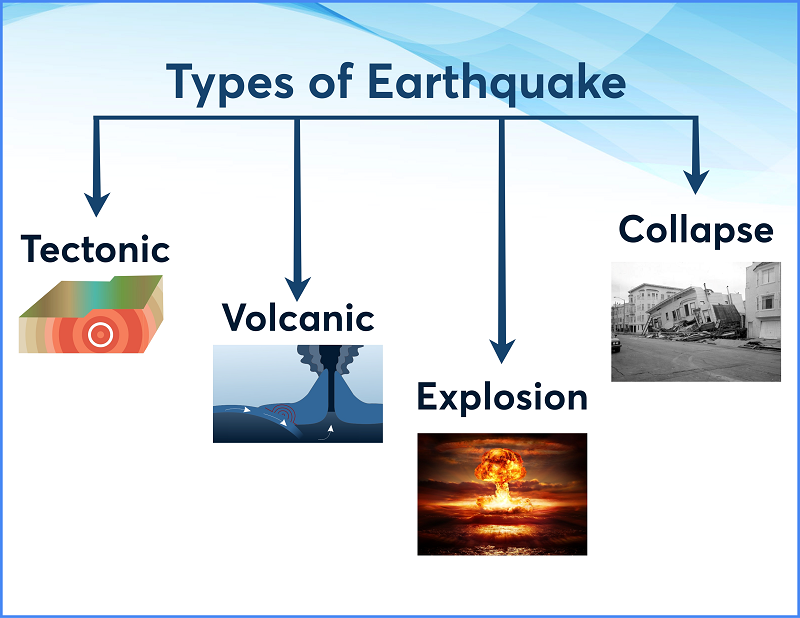
2. Tectonic Earthquakes
Tectonic earthquakes are the most common type of earthquakes. They are caused by the movement of tectonic plates.
The Earth is made up of four main layers:
- Crust
- Mantle
- Outer Core
- Inner Core
The outermost layer, the crust, is divided into several large pieces called tectonic plates. These plates are constantly moving over the semi-fluid mantle.
There are three types of plate boundaries:
- Convergent Boundary: Plates collide
- Divergent Boundary: Plates move apart
- Transform Boundary: Plates slide past each other
When plates move, stress builds up along their boundaries. When this stress is suddenly released, it results in an earthquake.
3. Volcanic Earthquakes
Volcanic earthquakes occur in regions with active volcanoes. These are caused by the movement of magma (molten rock) beneath the Earth’s surface.
- Magma movement creates pressure in surrounding rocks.
- This pressure causes cracks and vibrations.
- As a result, earthquakes occur.
These earthquakes do not always indicate a volcanic eruption but are common in volcanic regions.
4. Human-Induced Earthquakes
Human activities can also trigger earthquakes. These are generally smaller but can still be dangerous.
Examples include:
- Mining activities: Collapse of underground mines
- Nuclear explosions: Artificial tremors caused by testing
- Reservoir-induced earthquakes: Due to large dams and water pressure
- Chemical explosions: Sudden release of energy
Types of Earthquakes Based on Depth
Earthquakes are classified based on the depth of their focus:
- Shallow Focus Earthquakes:
- Depth: 0–70 km
- Most destructive because they are close to the surface
- Intermediate Focus Earthquakes:
- Depth: 70–300 km
- Deep Focus Earthquakes:
- Depth: 300–700 km
- Less destructive but scientifically important
Wadati–Benioff Zone
Deep earthquakes mainly occur in the Wadati–Benioff Zone, which is found in subduction zones.
- One tectonic plate moves beneath another.
- This downward movement causes intense pressure.
- Earthquakes occur along this zone at great depths.
Some of the strongest earthquakes in the world originate from this zone.
Distribution of Earthquakes
Earthquakes are not randomly distributed. They can strike any location at any time, but historical records show that they occur repeatedly in certain well-defined patterns. Most earthquakes are concentrated in three major belts or zones of the world.
1. Circum-Pacific Belt (Ring of Fire)
The Circum-Pacific seismic belt, also known as the “Ring of Fire,” is the largest and most active earthquake zone in the world. It is located along the rim of the Pacific Ocean.
- About 81% of the world’s largest earthquakes occur in this belt.
- It exists along tectonic plate boundaries where oceanic plates are subducting (sinking) beneath other plates.
- Earthquakes in this region are mainly caused by slip between plates and rupture within plates.
- This zone is also associated with intense volcanic activity, making it highly unstable and dangerous.
2. Alpide Belt (Mid-Continental Belt)
The Alpide earthquake belt is the second most important seismic zone.
- It extends from Java and Sumatra, passes through the Himalayas, the Mediterranean region, and reaches into the Atlantic.
- This belt accounts for about 17% of the world’s largest earthquakes.
- Many of the most destructive earthquakes in history have occurred here.
- Since it passes through densely populated regions, the risk to human life and property is very high.
3. Mid-Atlantic Ridge
The third major earthquake zone lies along the Mid-Atlantic Ridge in the Atlantic Ocean.
- It is a divergent plate boundary, where two tectonic plates move away from each other.
- Earthquakes here are caused by the spreading of the ocean floor.
- Most of this ridge is located deep underwater, far from human settlements.
- Therefore, earthquakes in this region are generally less harmful compared to those in other belts.
Measurement of Earthquakes
Earthquakes are measured using special instruments and scales that help scientists understand their strength, location, and impact.
The energy released during an earthquake travels through the Earth in the form of vibrations called seismic waves. These waves are detected and recorded by instruments known as seismometers (or seismographs). A seismometer records these waves as a series of zig-zag lines, which provide valuable information about the earthquake.
From the data recorded by a seismometer, scientists can determine:
- Time of occurrence
- Location of the earthquake
- Depth of focus
- Magnitude (energy released)
- Intensity (level of damage)
In addition, these records also help scientists understand the types of rocks and materials through which the seismic waves have traveled.
Seismometer
A seismometer is a scientific instrument used to detect and record seismic waves generated by earthquakes. It plays a crucial role in earthquake studies and monitoring.
Richter Scale (Magnitude Scale)
The Richter Scale is used to measure the magnitude of an earthquake, which indicates the amount of energy released during the event.
- Magnitude is expressed in absolute numbers ranging from 0 to 10
- Each increase of one unit represents a tenfold increase in wave amplitude
- It helps compare the strength of different earthquakes
Mercalli Scale (Intensity Scale)
The Mercalli Scale, developed by Italian seismologist Mercalli, measures the intensity of an earthquake based on its visible effects and damage.
- The scale ranges from I (not felt) to XII (total destruction)
- It is based on human observations and structural damage
- It varies from place to place depending on the impact
Seismic Waves (Earthquake Waves)
Seismic waves are the energy waves generated during an earthquake. They are of two main types:
1. Body Waves
These travel through the interior of the Earth.
P-Waves (Primary Waves):
- Fastest waves
- First to reach the surface
- Travel through solids, liquids, and gases
S-Waves (Secondary Waves):
- Slower than P-waves
- Travel only through solids
- Cannot pass through liquids
2. Surface Waves
- Travel along the Earth’s surface
- Arrive after body waves
- Cause maximum destruction
Surface waves are responsible for:
- Collapse of buildings
- Ground shaking
- Structural damage
Effects of Earthquakes
Earthquakes can have severe and wide-ranging impacts:
Primary Effects
- Ground shaking
- Surface rupture
- Structural collapse
Secondary Effects
- Landslides and mudslides
- Fires due to gas leaks
- Floods due to dam failure
- Tsunami (in case of underwater earthquakes)
- Avalanches in mountainous regions
Earthquake-Prone Areas in India
India is highly vulnerable to earthquakes due to its geological structure.
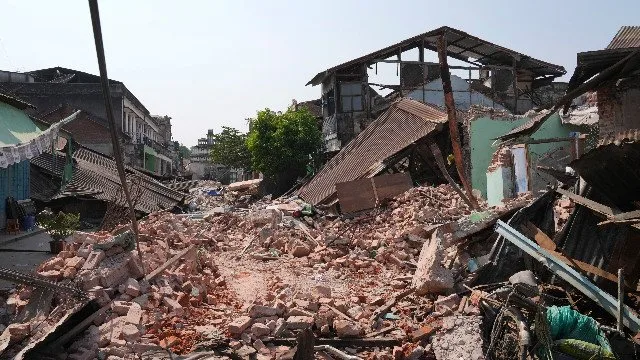
- The Himalayan region is very active because the Indian Plate is colliding with the Eurasian Plate.
- Other vulnerable areas include:
- Northeast India
- Gujarat region
- Indo-Gangetic plains
Seismic Zones of India
India is divided into four seismic zones:
- Zone II: Low risk
- Zone III: Moderate risk
- Zone IV: High risk
- Zone V: Very high risk (most dangerous)
Northeast India and parts of the Himalayas fall under Zone V, making them extremely earthquake-prone.
Importance of Studying Earthquakes
Understanding earthquakes helps in:
- Disaster preparedness
- Safer building construction
- Early warning systems
- Risk reduction and planning
Scientists use seismic data to study the internal structure of the Earth and predict possible earthquake zones.
Conclusion
Earthquake is a powerful natural phenomenon caused mainly by the movement of tectonic plates and the release of energy within the Earth. While it cannot be prevented, its effects can be minimized through proper planning, awareness, and scientific advancements.
With increasing population and urbanization, the impact of earthquakes can be more severe. Therefore, it is essential to understand their causes, types, and effects to reduce risks and ensure safety.
FAQs on Earthquake
1. What is an earthquake?
An earthquake is the sudden shaking of the Earth’s surface caused by the release of energy from inside the Earth, which creates seismic waves.
2. What is the difference between epicenter and focus?
The focus (hypocenter) is the point inside the Earth where the earthquake starts, while the epicenter is the point on the Earth’s surface directly above the focus.
3. What are the main causes of earthquakes?
The main causes include movement of tectonic plates, volcanic activity, faulting in the Earth’s crust, and human activities like mining and explosions.
4. What are seismic waves?
Seismic waves are energy waves produced during an earthquake that travel through the Earth and cause vibrations.
5. What are the types of seismic waves?
Seismic waves are of two main types:
- Body waves (P-waves and S-waves)
- Surface waves
6. Which scale is used to measure earthquakes?
Earthquakes are measured using the Richter Scale (for magnitude) and the Mercalli Scale (for intensity and damage).
7. Which areas are most prone to earthquakes?
Earthquakes mainly occur along tectonic plate boundaries, especially in regions like the Pacific Ring of Fire, the Himalayan belt, and mid-ocean ridges.
8. Why is India prone to earthquakes?
India is prone to earthquakes due to the collision of the Indian Plate with the Eurasian Plate, especially in the Himalayan and Northeast regions.