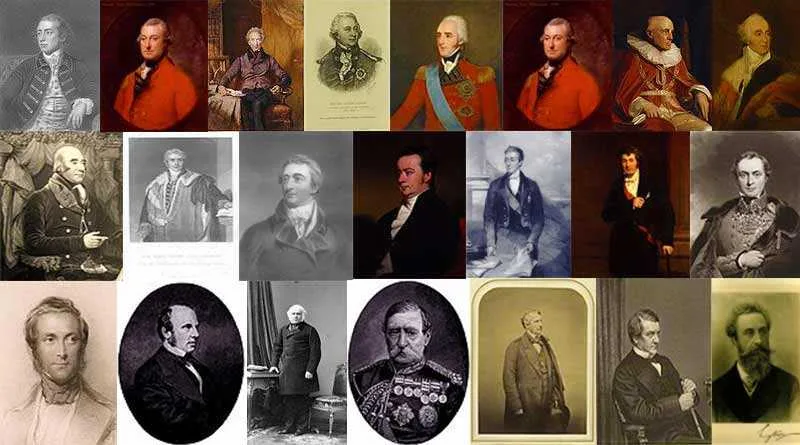
Governors-General & Viceroys of India – Complete History & Key Events

Governors-General & Viceroys of India played a crucial role in shaping the administrative, political, and social structure of colonial India. From the early days of the East India Company to the direct rule of the British Crown, these officials acted as the highest authorities in India. Their policies, decisions, and reforms had a long-lasting impact on Indian society, economy, and the freedom movement.
Thank you for reading this post, don't forget to subscribe!Introduction
The story of British rule in India began with trade but gradually transformed into political domination. On 31 December 1600, the East India Company received a Royal Charter from Queen Elizabeth I, granting it the right to trade with the East. Initially, the Company focused only on commerce, but over time, it began interfering in Indian politics.
Within nearly three centuries, Britain, despite being a small island nation, established one of the largest empires in the world. This expansion was often described by the famous phrase, “the empire on which the sun never sets.” A key reason behind this success was the strong administrative system created by the British in their colonies.
In India, this control was maintained through powerful officials known as Governors, Governors-General, and later Viceroys. These positions evolved over time, reflecting the changing nature of British rule.
Evolution of British Administration in India
Governor of Bengal
Initially, the East India Company divided its Indian territories into three Presidencies Bengal, Bombay, and Madras. Each Presidency was governed by a Governor. The first Governor of Bengal was Robert Clive, who played a major role in establishing British power after the Battle of Plassey in 1757.
However, there was no central authority to control all Presidencies, which often led to administrative confusion.
Governor-General of Bengal (1773–1833)
The British Parliament passed the Regulating Act of 1773 to bring better control over the Company’s activities. This Act created the post of Governor-General of Bengal, making it the highest authority in India.
The first Governor-General of Bengal was Warren Hastings. Under this system:
- Governors of Bombay and Madras worked under the Governor-General of Bengal
- A centralized administration began to develop
This marked the beginning of a unified British rule in India.
Governor-General of India (1833–1858)
The Charter Act of 1833 further centralized power by changing the title to Governor-General of India. This made the office responsible for governing all British territories in India.
The first Governor-General of India was Lord William Bentinck. His period is known for important social reforms.
Viceroy of India (1858–1947)
The Revolt of 1857 changed the course of Indian history. After this rebellion, the British government abolished the East India Company and took direct control of India.
Through the Government of India Act 1858, the post of Governor-General was replaced by the Viceroy of India, who represented the British Crown.
The first Viceroy of India was Lord Canning.
Important Governors-General and Viceroys of India
Warren Hastings (1773–1785)
Warren Hastings was the first Governor-General and laid the foundation of British administration in India.
Key events during his rule:
- Implementation of the Regulating Act of 1773
- Pitt’s India Act of 1784
- Rohilla War (1774)
- First Anglo-Maratha War (1775–82)
- Second Anglo-Mysore War (1780–84)
He strengthened administrative control but also faced criticism for corruption.
Lord Cornwallis (1786–1793)
Lord Cornwallis is known for administrative and revenue reforms.
Major contributions:
- Introduction of the Permanent Settlement of Bengal 1793
- Cornwallis Code (1793)
- Third Anglo-Mysore War (1790–92)
He reformed the civil services and judiciary.
Lord Wellesley (1798–1805)
Lord Wellesley expanded British territories aggressively.
Important policies:
- Introduction of the Subsidiary Alliance System
- Fourth Anglo-Mysore War (1799)
- Second Anglo-Maratha War (1803–05)
His expansionist policy made the Company a dominant power.
Lord Hastings (1813–1823)
Lord Hastings played a key role in ending Maratha power.
Key events:
- Anglo-Nepal War (1814–16)
- Third Anglo-Maratha War (1817–19)
- Introduction of Ryotwari system
Lord William Bentinck (1828–1835)
Lord William Bentinck is remembered for social reforms.
Major reforms:
- Abolition of Sati system in 1829
- Promotion of Western education
- Charter Act of 1833
He is considered one of the most progressive administrators.
Lord Dalhousie (1848–1856)
Lord Dalhousie is known for modernization and annexation policies.
Important developments:
- Doctrine of Lapse
- Introduction of railways (first line in 1853)
- Establishment of Public Works Department
- Second Anglo-Sikh War
His policies indirectly led to dissatisfaction among Indians.
Lord Canning (1856–1862)
Lord Canning was the first Viceroy of India.
Major events:
- Revolt of 1857
- Establishment of universities in Calcutta, Bombay, and Madras
- Indian Councils Act 1861
He handled a very critical phase in Indian history.
Lord Lytton (1876–1880)
Lord Lytton followed repressive policies.
Key actions:
- Vernacular Press Act (1878)
- Arms Act (1878)
- Second Afghan War
His policies created resentment among Indians.
Lord Ripon (1880–1884)
Lord Ripon is known as a liberal ruler.
Major contributions:
- Repeal of Vernacular Press Act
- Introduction of local self-government
- First Factory Act (1881)
- Ilbert Bill controversy
He is often called the “Father of Local Self-Government in India.”
Lord Curzon (1899–1905)
Lord Curzon had a controversial tenure.
Important events:
- Partition of Bengal (1905)
- Universities Act (1904)
- Police reforms
His partition policy led to the rise of nationalism.
Lord Minto II (1905–1910)
Lord Minto II witnessed growing political awareness.
Key developments:
- Formation of the All-India Muslim League (1906)
- Morley-Minto Reforms (1909)
Lord Hardinge II (1910–1916)
Lord Hardinge II made important administrative decisions.
Key actions:
- Transfer of capital from Calcutta to Delhi (1911)
- Annulment of Bengal partition
Lord Chelmsford (1916–1921)
Lord Chelmsford ruled during a critical political phase.
Major events:
- Jallianwala Bagh massacre
- Government of India Act 1919
- Non-Cooperation Movement
Lord Irwin (1926–1931)
Lord Irwin was associated with major nationalist movements.
Important events:
- Dandi March
- Civil Disobedience Movement
- Gandhi-Irwin Pact
Lord Linlithgow (1936–1944)
Lord Linlithgow had the longest tenure.
Key developments:
- Quit India Movement (1942)
- Formation of Indian National Army
- Impact of Second World War
Lord Wavell (1944–1947)
Lord Wavell handled the transition phase.
Important events:
- Cabinet Mission (1946)
- Direct Action Day (1946)
Lord Mountbatten (1947–1948)
Lord Mountbatten was the last Viceroy.
Key achievements:
- Indian Independence (15 August 1947)
- Partition of India
Chakravarti Rajagopalachari (1948–1950)
Chakravarti Rajagopalachari was the last Governor-General of independent India.
After 1950, with the adoption of the Constitution, the post was abolished and replaced by the President of India.
Conclusion
The Governors-General & Viceroys of India were central to the functioning of British rule. They introduced laws, reforms, and policies that deeply influenced Indian society. While some contributed to modernization, others followed oppressive policies that led to resistance.
Their actions played a significant role in shaping the Indian freedom movement. From administrative reforms to repressive laws, every step taken by these officials ultimately contributed to the rise of nationalism and India’s journey toward independence.
FAQs
Q1. Who was the first Governor-General of Bengal?
The first Governor-General of Bengal was Warren Hastings in 1773.
Q2. Who was the first Governor-General of India?
Lord William Bentinck was the first Governor-General of India after the Charter Act of 1833.
Q3. Who was the first Viceroy of India?
The first Viceroy of India was Lord Canning after the Revolt of 1857.
Q4. Who was the last Viceroy of India?
Lord Mountbatten was the last Viceroy of India.
Q5. Who was the last Governor-General of independent India?
Chakravarti Rajagopalachari was the last Governor-General of India.
Q6. What was the main difference between Governor-General and Viceroy?
The Governor-General worked under the East India Company, while the Viceroy represented the British Crown after 1858.
Q7. Which Act created the post of Governor-General of Bengal?
The Regulating Act of 1773 created this post.