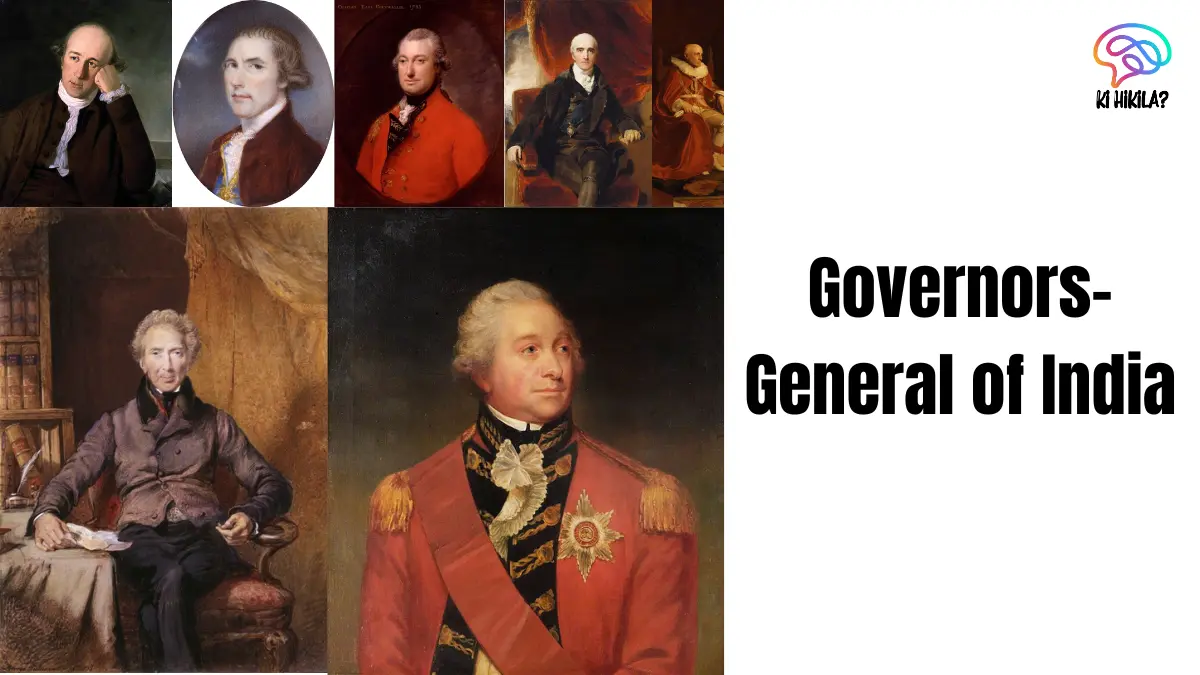
Governors-General of India – Important Events, List & Static GK Notes for Govt Exams

Introduction: Governors-General of India
Did you know that only 20 British administrators ruled India for nearly 200 years? These men, known as the Governors-General of India, played a huge role in shaping the country’s political, economic, and social structure. Their decisions changed how Indians lived, worked, and even how India was governed.
Thank you for reading this post, don't forget to subscribe!For students preparing for UPSC, IAS, SSC, State PSC, and other competitive exams, the topic of Governors-General of India is extremely important. It is not just about memorising names and years. It is about understanding how British rule began in Bengal and slowly expanded to cover the entire subcontinent.
The Governors-General introduced railways, telegraph systems, modern courts, and administrative reforms. At the same time, they followed policies that led to the annexation of Indian kingdoms, economic exploitation, and widespread dissatisfaction. Many of these decisions directly contributed to major events like the Revolt of 1857.
After closely analysing exam trends and thousands of previous year questions, this guide has been designed specially for students. Every important reform, war, policy, and act related to the Governors-General of India has been explained in a simple and clear way.
By the end of this guide, you will clearly know which Governor-General did what, when important laws were passed, and why those events matter for exams. This blog will cover the complete timeline from 1773 to 1950, major administrative and social reforms, important acts and policies, and quick revision points that are especially useful before exams.
What Is a Governor General of India?
The Governor General of India was the highest authority during British rule in India. He acted as the representative of the British monarch and held supreme administrative, political, and military power over British-controlled territories. In simple terms, the Governor General was the most powerful person in India during the British period.
For exam preparation, it is important to understand that the Governors General of India were not just administrators. Their decisions shaped laws, wars, revenue systems, and the future direction of the country.
How Did the Post of Governor General Begin?
The position of Governor General of India began in the year 1773. Before this, the British East India Company controlled only limited regions of India, mainly Bengal. Each major British settlement, such as Bengal, Bombay, and Madras, had its own Governor. There was no single authority to control all British territories.
This changed with the Regulating Act of 1773. This act created the post of Governor General of Bengal. For the first time, one person was given the power to supervise all British possessions in India. This marked the beginning of centralized British administration in India.
Evolution of the Title of Governor General of India
The role and title of the Governor General changed over time as British control expanded. This evolution is very important for competitive exams.
First Phase (1773 to 1833): Governor General of Bengal
During this period, the title was Governor General of Bengal.
- Warren Hastings was the first Governor General of Bengal
- He governed Bengal directly and supervised the Presidencies of Bombay and Madras
- British territorial control was still limited during this phase
- The East India Company remained the main authority
This phase marks the foundation of British political control in India.
Second Phase (1833 to 1858): Governor General of India
The Charter Act of 1833 brought a major change.
- The title was changed to Governor General of India
- Lord William Bentinck became the first Governor General of India
- The Governor General now controlled all British territories in India
- The East India Company continued to run the administration
This phase represents the expansion and consolidation of British rule across India.
Third Phase (1858 to 1947): Viceroy and Governor General
After the Revolt of 1857, British rule in India changed completely.
- The British Crown took direct control of the East India Company
- The Governor General also became known as the Viceroy, meaning the monarch’s representative
- Lord Canning was the first Viceroy of India
- This system continued until India became independent in 1947
This phase shows the shift from company rule to direct Crown rule.
Why Understanding Governors General of India Matters for Your Exam
The topic of Governors General of India is extremely important for competitive exams. Almost every year, UPSC and state-level examinations ask around ten to fifteen questions directly or indirectly from this area. These questions appear in both Prelims and Mains. You may see questions like who abolished Sati, when the Doctrine of Lapse was introduced, or which Governor General started the railway system in India.
However, exam preparation is not just about remembering facts. Understanding the Governors General of India helps you connect different parts of the syllabus. This topic links modern Indian history with the economy, social reforms, administrative changes, and even geography. For example, when you learn that Lord Dalhousie expanded the railway network, you also understand how railways helped the British control India more efficiently and speed up the flow of resources out of the country.
This deeper understanding becomes especially useful in the main answers. Writing a general statement like British policies exploited India does not fetch many marks. A stronger answer uses specific examples. For instance, stating that Lord Cornwallis introduced the Permanent Settlement in 1793, which fixed land revenue permanently, benefited zamindars but harmed peasants who had no ownership rights, shows clarity, accuracy, and analytical thinking.
Knowing who introduced which reform, and why it was introduced, allows you to write answers that are factual, well-explained, and examiner-friendly.
Complete List of Governors General of Bengal (1773 to 1833)
Warren Hastings (1773 to 1785): The Foundation Builder
Warren Hastings was the first Governor General of Bengal and one of the most important early administrators of British India. He laid the foundation of British administration by bringing major changes in governance, law, economy, and culture. Many of his reforms are frequently asked in competitive exams.
Major Administrative Reforms
Warren Hastings introduced several administrative changes to strengthen British control.
- He ended the Dual Government system started by Robert Clive, where the Company had power without responsibility
- The capital was shifted from Murshidabad to Calcutta, which became the centre of British administration
- District collectors were made responsible for collecting land revenue
- Clear rules were framed to bring discipline and structure into government functioning
These reforms helped the British East India Company gain direct administrative control.
Judicial Reforms
Hastings made important changes in the justice system to create a formal legal structure.
- Civil courts, known as Diwani Adalat, and criminal courts, known as Nizamat Adalat, were established
- Two appellate courts were set up at Calcutta
- Indian judges were appointed to handle criminal cases
- A code of Hindu law was prepared for Hindus
- Books on Muslim law were prepared for Muslims
These reforms are important because they introduced a structured judicial system in India.
Economic Changes
To reduce corruption and misuse of power, Hastings introduced economic reforms.
- The system of dastaks, or free trade passes, misused by Company officials, was abolished
- A uniform tax of 2.5 percent was imposed on goods
- Private trade by Company officials was stopped
- Salaries of officials were increased to reduce corruption
These steps helped strengthen the Company’s finances and control.
Important Wars During His Period
Several important wars were fought during Warren Hastings’ tenure.
- Rohilla War in 1774
- First Anglo-Maratha War from 1775 to 1782
- Second Anglo-Mysore War from 1780 to 1784
These wars helped expand British influence but also increased financial pressure.
Cultural Contributions
Warren Hastings supported Indian culture, education, and learning.
- The Asiatic Society of Bengal was founded in 1784 with the help of Sir William Jones
- Calcutta Madrasa was established in 1781 for Islamic studies
- Indian languages, history, and traditions were encouraged and studied
Because of these efforts, Hastings is often seen as a supporter of Oriental learning.
Why Warren Hastings Was Impeached
After returning to England, Warren Hastings faced a long impeachment trial from 1787 to 1795.
- He was accused of corruption and misuse of power
- Edmund Burke led the case against him in the British Parliament
- After eight years of trial, Hastings was found not guilty
- However, the trial damaged his reputation and drained his personal wealth
This impeachment is one of the most famous events related to British administration in India.
Exam Tip
Remember Warren Hastings for four key points:
- First Governor General of Bengal
- Major judicial and administrative reforms
- Founder of the Asiatic Society of Bengal
- Long impeachment trial in England
Sir John Macpherson (1785 to 1786): Acting Governor General
Sir John Macpherson served as the Acting Governor General of Bengal for a very short period after Warren Hastings and before Lord Cornwallis. His tenure lasted for barely one year, and no major reforms or policies were introduced during this time.
For examination purposes, students only need to remember one key point. Sir John Macpherson was an acting Governor General, and his period is mainly important as a transition phase.
Lord Cornwallis (1786 to 1793): The Reformer
Lord Cornwallis is one of the most important Governors General of India. He is often called the Father of Civil Services in India because of the deep and lasting administrative reforms he introduced. Many of his policies continued to shape Indian administration until independence.
The Permanent Settlement of 1793
The Permanent Settlement was the most famous reform introduced by Lord Cornwallis.
Under this system:
- Zamindars were recognised as the owners of land
- Farmers were reduced to tenants
- Zamindars had to pay a fixed amount of land revenue to the British government
The British fixed land revenue permanently, and around 89 percent of the revenue collected from land went to the British authorities.
Advantages for the British:
- Guaranteed and fixed income
- Easier tax collection
- Creation of a class of Zamindars loyal to British rule
Disadvantages for India:
- Zamindars became extremely powerful
- Farmers had no ownership rights and could be evicted at any time
- No relief during famines, floods, or bad harvests
- Large-scale transfer of wealth from India to Britain
This system caused long-term rural poverty and exploitation.
Administrative Reforms
Lord Cornwallis introduced major administrative reforms to reduce corruption and improve efficiency.
- Created the Covenanted Civil Service, which later became the Indian Civil Service
- Provided high salaries to British officials to discourage corruption
- Reserved top administrative posts for Europeans
- Indians were given only lower-level positions
- Clearly separated revenue collection from judicial work
These reforms laid the foundation of modern administration in India.
Judicial Reforms: The Cornwallis Code
The Cornwallis Code reorganised the judicial system.
- Revenue and judicial functions were separated
- Civil and criminal courts were clearly defined
- District courts were established with European judges
- Four circuit courts were set up at Calcutta, Dacca, Murshidabad, and Patna
- Sadar Nizamat Adalat was shifted to Calcutta
This system introduced a structured court hierarchy.
Police Reforms
Cornwallis also reorganised the police system.
- Each district was divided into police circles called thanas
- Each thana covered around 20 square miles
- An Indian officer called a Daroga was appointed for each thana
- Police administration was placed under the supervision of district judges
This helped improve law and order, though the system favoured British interests.
Military Success
During Cornwallis’s tenure, the British achieved a major military victory.
- Won the Third Anglo-Mysore War from 1790 to 1792 against Tipu Sultan
- Tipu Sultan was forced to surrender nearly half of his kingdom
- Cornwallis received the title of Marquess for this victory
Social Reforms
Lord Cornwallis did not introduce major social reforms. He believed that Indians should manage their own social and religious customs. His main focus remained on administrative efficiency and political control rather than social change.
Exam Tip
Remember Lord Cornwallis for three key points:
- Permanent Settlement of 1793
- Foundation of Civil Services
- Judicial reforms under the Cornwallis Code
Sir John Shore (1793 to 1798): The Non-Interventionist
Sir John Shore succeeded Lord Cornwallis as the Governor General of Bengal. He strongly believed in a policy of non-intervention, which means he avoided interfering in the internal affairs of Indian states. His approach was cautious and very different from the expansionist policies followed later.
Policy of Non-Intervention
John Shore believed that the British should not get involved in the political conflicts of Indian rulers unless it was necessary. His goal was to maintain peace and reduce military expenditure.
Important Event During His Tenure
During his period, the Marathas attacked the Nizam of Hyderabad. Even though there was a treaty between the British and the Nizam, John Shore refused to provide military help. This decision damaged the reputation of the British as a reliable ally and weakened their diplomatic position in India.
Acts Passed
- The Charter Act of 1793 was passed during his tenure
- This act renewed the East India Company’s trading rights in India for another 20 years
Exam Tip
Sir John Shore is mainly remembered for:
- Policy of non-intervention
- Charter Act of 1793
Lord Wellesley (1798 to 1805): The Empire Builder
Lord Wellesley followed a completely different policy from John Shore. He believed in aggressive expansion and wanted to establish British supremacy across India. His tenure marked a major phase of British territorial expansion.
Subsidiary Alliance System
The Subsidiary Alliance was Lord Wellesley’s most important policy. It allowed the British to control Indian states without directly annexing them.
Under this system:
- Indian rulers had to keep British troops within their territories
- The ruler had to pay for the maintenance of these troops
- The ruler could not form alliances with foreign powers
- The ruler could not appoint foreign experts without British approval
- In return, the British promised military protection
This system gradually reduced Indian rulers to dependent allies of the British.
States That Accepted the Subsidiary Alliance
- Nizam of Hyderabad was the first to sign in 1798
- Mysore accepted it after the defeat of Tipu Sultan
- Awadh
- Maratha states, including the Peshwa, Bhonsle, and Scindia
Fourth Anglo-Mysore War (1799)
- Tipu Sultan refused to accept the Subsidiary Alliance
- The British attacked Mysore and defeated Tipu Sultan
- Tipu Sultan died fighting bravely at Seringapatam
- Half of Mysore was annexed by the British
- The remaining territory was given back to the old Hindu royal family
Second Anglo Maratha War (1803 to 1805)
- The British defeated several Maratha leaders
- Delhi and large areas of central India came under British control
- The Maratha Peshwa was forced to accept the Subsidiary Alliance
These victories greatly expanded British power in India.
Administrative Reforms
Lord Wellesley also introduced administrative improvements.
- Fort William College was established in Calcutta in 1800 to train civil servants
- A Board of Revenue was created in each province
- Improvements were made in the legal system
- Import of certain foreign goods was restricted
Why Lord Wellesley Resigned
Lord Wellesley’s military campaigns were very expensive. The East India Company’s Court of Directors in London criticised him for excessive spending on wars and expansion. Due to this opposition, Wellesley resigned in 1805 and returned to England.
Exam Tip
Remember Lord Wellesley for:
- Subsidiary Alliance System
- Fourth Anglo-Mysore War
- Death of Tipu Sultan
- Expansion of British territory
Sir George Barlow (1805 to 1807): Acting Period
Sir George Barlow served as the Acting Governor General of India after Lord Wellesley and before Lord Minto. His main aim was to reduce expenses. He focused on cutting military costs and controlling unnecessary spending, as the Company’s finances were under pressure after long wars.
Vellore Mutiny of 1806
The most important event during Barlow’s period was the Vellore Mutiny.
- Indian soldiers revolted at Vellore
- The mutiny was caused by new military rules related to uniforms and religious symbols
- Soldiers felt their religious beliefs were being insulted
- The British crushed the revolt with severe force
Although the mutiny was quickly suppressed, it was an early warning sign. It showed growing dissatisfaction among Indian soldiers and is often seen as a precursor to the Revolt of 1857.
Lord Minto (1807 to 1813): The Consolidator
Lord Minto followed a careful and defensive policy. Unlike Lord Wellesley, he did not focus on aggressive expansion. His goal was to protect and consolidate existing British territories rather than acquire new ones.
Treaty of Amritsar (1809)
One of the most important achievements of Lord Minto was the Treaty of Amritsar, signed in 1809.
- The treaty was signed with Maharaja Ranjit Singh of Punjab
- The Sutlej River was fixed as the boundary
- The British agreed not to interfere in Punjab
- Ranjit Singh agreed not to expand his kingdom south of the Sutlej River
This treaty allowed Punjab to remain independent for nearly forty more years and maintained peace in northwestern India.
Charter Act of 1813
The Charter Act of 1813 was passed during Lord Minto’s tenure.
- The East India Company’s trade rights were renewed for another 20 years
- The Company’s monopoly over Indian trade ended, except for tea and trade with China
- Christian missionaries were allowed to work in India
- Funds were allocated for promoting education in India
This act marked an important step toward social and educational change under British rule.
Exam Tip
Remember Lord Minto for two major points:
- Treaty of Amritsar with Maharaja Ranjit Singh
- Charter Act of 1813
Lord Hastings (1813 to 1823): The Warrior Administrator
Lord Hastings should not be confused with Warren Hastings. Lord Hastings was a powerful military leader who greatly expanded British control in India through wars and conquests. His period marked the final collapse of major Indian powers that still resisted British authority.
Wars and Conquests
Lord Hastings fought several important wars that changed the political map of India.
Gurkha War or Anglo Nepal War (1814 to 1816)
- Fought between the British and the Gurkhas of Nepal
- The British won the war
- The Treaty of Sugauli was signed
- The British gained hill regions such as Shimla, Nainital, and the surrounding areas
Third Anglo Maratha War (1817 to 1818)
- This war completely ended Maratha power in India
- The Maratha Peshwa was removed from power
- He was sent to live at Bithur near Kanpur on a pension
- Large parts of India came under British control
Suppression of the Pindaris (1817 to 1818)
- Pindaris were armed groups that looted villages in central India
- Lord Hastings crushed these groups completely
- This helped the British establish peace and control in central India
Administrative Changes
Along with wars, Lord Hastings introduced important administrative measures.
- The Bombay Presidency was formally created
- The Ryotwari system was introduced in Madras, where revenue was collected directly from farmers instead of zamindars
- Communication systems were improved to strengthen administration
- Hill stations like Shimla were developed for British officials
These changes helped the British manage their growing territories more effectively.
Exam Tip
Remember Lord Hastings for:
- Third Anglo Maratha War
- Suppression of the Pindaris
- Gurkha War and Treaty of Sugauli
Lord Amherst (1823 to 1828): The Burmese War Leader
Lord Amherst’s tenure is mainly remembered for British expansion toward the east. His period was marked by a costly but important war with Burma.
First Anglo-Burmese War (1824 to 1826)
This was the most significant event during Lord Amherst’s rule.
- Burma attacked British-controlled areas in Northeast India
- The British defeated Burma after a long and expensive war
- The Treaty of Yandabo was signed in 1826
- Burma handed over Assam, Manipur, Cachar, Jaintia, and Arakan
- Burma also paid one crore rupees as war compensation
This war brought British influence firmly into Northeast India.
Capture of Bharatpur (1826)
- Bharatpur was a strong Rajput fort believed to be impossible to capture
- The British army successfully captured Bharatpur
- This victory demonstrated British military strength to Indian rulers
Exam Tip
Remember Lord Amherst for:
- First Anglo-Burmese War
- Treaty of Yandabo
- Capture of Bharatpur
Complete List of Governors General of India (1833 to 1858)
Lord William Bentinck (1828 to 1835): The Social Reformer
Lord William Bentinck holds a special place among the Governors General of India. In 1833, he became the first official Governor General of India, after the change in designation from Governor General of Bengal. He is often called the Father of Modern Western Education in India and is best remembered for his strong social reforms, especially the abolition of Sati.
Social Reforms
Lord William Bentinck introduced several bold social reforms that aimed to remove harmful practices from Indian society.
- He abolished the practice of Sati through the Bengal Sati Regulation of 1829
- This law made the burning of widows illegal and punishable
- Bentinck believed that allowing Sati would be a moral failure, both in this world and the next
- He suppressed the practice of Thuggee, which involved ritual murders by robber groups
- This campaign was led by Captain William Sleeman
- Female infanticide was banned
- Human sacrifice among tribal groups in Orissa was stopped
These reforms marked a major shift in British policy toward social intervention.
Education Reforms
Bentinck played a key role in shaping modern education in India.
- English was introduced as the language of higher education and the higher courts
- Persian was removed from official use
- This decision was influenced by Macaulay’s Minute on Education in 1835
- Government funds were provided to colleges teaching Western subjects
- English began to be used widely in government work
- Calcutta Medical College was founded in 1835, becoming the first medical college in Asia
These steps laid the foundation for modern education in India.
Administrative Reforms
Lord William Bentinck also focused on improving administration and reducing unnecessary expenditure.
- Government spending was reduced
- Military expenses were cut
- More lower-level government jobs were opened to Indians
- Salaries of Indian judges were improved
- Revenue administration was made more efficient
These reforms helped strengthen governance while controlling costs.
Charter Act of 1833
The Charter Act of 1833 was passed during Bentinck’s tenure and brought major changes.
- The title was officially changed from Governor General of Bengal to Governor General of India
- The East India Company’s trading activities were ended completely
- The Company became purely an administrative body
- Indians were legally allowed to hold government positions, though this was limited in practice
This act marked an important step in centralising British authority in India.
Why Lord William Bentinck Is Considered Liberal
Lord William Bentinck was influenced by thinkers like Jeremy Bentham and James Mill. He believed that the government should actively improve society and remove harmful customs. Unlike earlier Governors General who avoided social interference, Bentinck openly supported reforms that aimed at social progress.
Exam Tip
Remember Lord William Bentinck for four major reforms:
- Abolition of Sati in 1829
- Introduction of English education in 1835
- Suppression of Thuggee
- Charter Act of 1833
Sir Charles Metcalfe (1835 to 1836): Brief Tenure
Sir Charles Metcalfe served as the Acting Governor General of India for a very short period of about one year. Even though his tenure was brief, he is remembered for one very important reform related to press freedom.
Press Freedom Reforms
- He removed restrictions on the Indian press
- Press censorship that had been in place since 1823 was abolished
- Newspapers in Indian languages were allowed to publish freely
Because of this bold step, Sir Charles Metcalfe is often called the Liberator of the Indian Press.
Exam Tip
Remember Sir Charles Metcalfe mainly for press freedom and the abolition of press censorship.
Lord Auckland (1836 to 1842): The Afghan Disaster
Lord Auckland’s tenure is mainly remembered for one of the biggest military failures in British Indian history, the First Anglo-Afghan War. His foreign policy was driven by fear of Russian expansion toward India.
First Anglo-Afghan War (1838 to 1842)
- The British invaded Afghanistan to prevent Russian influence
- Shah Shuja was placed on the Afghan throne with British support
- Afghan tribes soon revolted against British control
- In January 1842, British forces retreated from Kabul
- Nearly the entire army of around sixteen thousand soldiers was killed
- Only Dr. Brydon survived and reached safety
This disaster taught the British a clear lesson about the dangers of interfering in Afghan affairs.
Other Events During Auckland’s Period
- Expansion of schools and support for education
- Attempts to improve trade relations with other countries
- Slavery was banned in British territories in 1843
Exam Tip
Remember Lord Auckland mainly for the First Anglo-Afghan War and the disastrous retreat from Kabul.
Lord Ellenborough (1842 to 1844): Short and Controversial Tenure
Lord Ellenborough was appointed mainly to deal with the aftermath of the Afghan War failure. His period was short but full of major decisions.
Major Actions
- British forces were completely withdrawn from Afghanistan
- Sindh was defeated and annexed in 1843
- The Gwalior War was fought and won in 1843
Although he achieved military success, Ellenborough made many decisions without consulting the authorities in England. As a result, he was recalled to England.
Exam Tip
Remember Lord Ellenborough for:
- Ending British involvement in Afghanistan
- Annexation of Sindh
- Gwalior War
Lord Hardinge (1844 to 1848): The Sikh War Leader
Lord Hardinge is mainly remembered for leading the British during the First Anglo Sikh War. His tenure was dominated by military conflict in Punjab.
First Anglo Sikh War (1845 to 1846)
After the death of Maharaja Ranjit Singh in 1839, Punjab became politically unstable. Power struggles weakened the Sikh administration, which eventually led to conflict with the British.
- Sikh forces attacked British territories
- The British fought difficult battles at Mudki, Ferozeshah, and Sobraon
- The British emerged victorious
- The Treaty of Lahore was signed in 1846
- Kashmir was sold to Gulab Singh for 75 lakh rupees
This war marked the beginning of British dominance over Sikh territories.
Social Reforms
Lord Hardinge also introduced limited social reforms.
- Slavery was completely abolished in British India in 1843
- Conditions of Indian labourers sent abroad were improved
Exam Tip
Remember Lord Hardinge for:
- First Anglo Sikh War
- Treaty of Lahore
- Abolition of slavery
Lord Dalhousie (1848 to 1856): The Moderniser and Annexer
Lord Dalhousie was one of the most influential Governors General of India. He introduced modern administrative systems but also followed aggressive expansionist policies. While many credit him as the builder of modern infrastructure, his actions created deep resentment and directly contributed to the Revolt of 1857.
Dalhousie believed that railways, telegraph, and postal systems were the three great engines of social improvement.
Doctrine of Lapse
The Doctrine of Lapse was Dalhousie’s most controversial policy.
According to this doctrine:
- If an Indian ruler died without a natural male heir, his kingdom would be annexed
- Adopted sons were not recognised as legal heirs
This policy led to the annexation of several princely states.
States Annexed Under the Doctrine of Lapse
- Satara in 1848, the first state to be annexed
- Jaitpur and Sambalpur in 1849
- Baghat in 1850
- Udaipur in Chhattisgarh in 1852
- Jhansi in 1853, which later became important during the Revolt of 1857
- Nagpur in 1854
- Tanjore and Arcot in 1855
These annexations angered many Indian rulers and elites.
Annexation of Awadh (1856)
Awadh was annexed on the charge of poor governance, not under the Doctrine of Lapse.
- Awadh was one of the last major annexations
- Many nobles and soldiers lost their privileges
- Soldiers from Awadh later played a major role in the Revolt of 1857
This decision deeply hurt Indian sentiment.
Second Anglo Sikh War (1848 to 1849)
- Punjab remained unstable after the First Anglo Sikh War
- Sikh forces rebelled again
- The British won decisive battles at Chillianwala and Gujarat
- Punjab was fully annexed
- Maharaja Duleep Singh, the young ruler, was removed
- Punjab became a British province
This ended Sikh political power in India.
Railway Revolution
Dalhousie introduced the railway system in India.
- The first passenger train ran from Bombay to Thane on April 16, 1853
- It covered a distance of 34 kilometres
- Plans were made for railway lines across India
- Dalhousie is often called the Father of Indian Railways
Railways helped the British move troops quickly and strengthen control.
Telegraph System
- The electric telegraph was introduced in India in 1852
- The first telegraph line connected Calcutta and Agra in 1854
- By 1857, major cities were connected
The telegraph played a crucial role during the Revolt of 1857.
Postal Reforms
Dalhousie modernised the postal system.
- Uniform postage was introduced in 1854
- Postal services became affordable for common people
- Post offices were opened across the country
Public Works Department
- The Public Works Department was established
- Roads, bridges, and canals were constructed
- The Ganga Canal was completed
- The Grand Trunk Road was improved
These projects strengthened administration and trade.
Education Reforms: Wood’s Despatch (1854)
Wood’s Despatch is known as the Magna Carta of English education in India.
- Education in both English and Indian languages was recommended
- Universities in Calcutta, Bombay, and Madras were proposed
- These universities were established in 1857
- Girls’ education was encouraged
- Private schools were supported
Social Reforms
- The Widow Remarriage Act of 1856 legalised the remarriage of Hindu widows
- Female infanticide was banned
- Human sacrifice in tribal areas was stopped
Administrative Changes
- A separate province of Bengal was created with a Lieutenant Governor in 1854
- Legislative councils were improved
- An open competition for civil service jobs was introduced
- Army organisation was reformed
Why the Revolt of 1857 Happened
Dalhousie’s aggressive policies created widespread anger.
- Indian rulers lost their kingdoms
- Soldiers from Awadh lost land and privileges
- Peasants suffered due to revenue changes
- Traditional elites lost power
- Rapid changes created fear and resentment
Dalhousie left India in March 1856, just one year before the great revolt. He died in 1860 at the age of 48, exhausted by his work in India.
Exam Tip
Lord Dalhousie is extremely important for exams. Remember him for:
- Doctrine of Lapse
- Railways in 1853
- Telegraph and postal reforms
- Wood’s Despatch of 1854
- Widow Remarriage Act of 1856
- Second Anglo Sikh War
- Annexation of Awadh
Lord Canning (1856 to 1862): The Last and the First
Lord Canning holds a unique position in Indian history. He was the last Governor General of India from 1856 to 1858 and became the first Viceroy of British India after 1858. This change happened after the Government of India Act of 1858, which ended the rule of the East India Company.
The Great Revolt of 1857
The most important event during Lord Canning’s tenure was the Revolt of 1857, also known as the First War of Independence.
How the Revolt Began
- The revolt began on May 10, 1857, at Meerut
- Indian soldiers rebelled against British officers
- The immediate cause was the introduction of the Enfield rifle
- The cartridges were greased with cow and pig fat
- Soldiers had to bite the cartridges before loading
- This hurt the religious sentiments of both Hindus and Muslims
However, the deeper causes were much more serious.
Deeper Causes of the Revolt
- Annexation of Indian states under Dalhousie
- Discontent among Indian soldiers
- Economic exploitation of peasants and artisans
- Loss of power and privileges of traditional rulers
Spread of the Revolt
The rebellion spread rapidly across northern and central India.
- Delhi became the symbolic centre of the revolt
- Bahadur Shah Zafar was declared the emperor
- Rani Lakshmibai led resistance in Jhansi
- Nana Sahib led the revolt in Kanpur
- Begum Hazrat Mahal played a key role in Lucknow
- Other centres included Bareilly, Arrah, and Faizabad
By the middle of 1858, the British had regained control using superior resources.
Lord Canning’s Response to the Revolt
Lord Canning followed a balanced approach.
- He punished rebels involved in violence
- At the same time, he avoided unnecessary cruelty
- He believed extreme revenge would create future rebellions
- His calm attitude earned him the nickname Clemency Canning, given by his wife
Although many British officials wanted harsh punishment, Canning chose moderation.
Government of India Act, 1858
This act brought a complete change in Indian administration.
- The East India Company’s rule ended after 258 years
- India came under the direct control of the British Crown
- The British monarch became the ruler of India
- The post of Secretary of State for India was created in Britain
- A council of 15 members was formed to assist the Secretary of State
- The Governor General was now called the Viceroy
This marked the beginning of Crown rule in India.
Queen Victoria’s Proclamation (November 1, 1858)
Queen Victoria issued a proclamation announcing the new policy of governance.
- Indian religions and customs would be respected
- Adopted sons would be recognised, ending the Doctrine of Lapse
- The British promised no further annexation of Indian states
- Indians and British were promised equality before the law, though this was rarely practised
- Assurance of good and fair governance was given
This proclamation aimed to restore confidence among Indian rulers and people.
Administrative Reforms Under Lord Canning
Indian Councils Act of 1861
- Indians were included in the Viceroy’s legislative council
- The powers of Indian members were limited
- The portfolio system was introduced, where each council member handled a specific department
- Legislative councils were set up in Bombay, Madras, and Bengal
- First Indians nominated included the Raja of Benares, the Maharaja of Patiala, and Sir Dinkar Rao
Other Important Measures
- The Doctrine of Lapse was officially abolished
- Discrimination in government employment was reduced
- Relations with princely states were improved
- The Indian Penal Code was introduced in 1860, drafted by Lord Macaulay
- Income Tax was introduced in 1860 to deal with post-revolt financial stress
- The first Census of India was conducted in 1861
Why He Was Called Clemency Canning
After the Revolt of 1857, many British officials demanded brutal punishment. Villages were destroyed, and executions were demanded. Lord Canning opposed extreme violence. He believed harsh revenge would only increase hatred and resistance. His relatively humane approach earned him the title Clemency Canning, though some British critics accused him of being too soft.
Exam Tip
Remember Lord Canning for:
- Revolt of 1857
- Last Governor General and first Viceroy
- Government of India Act of 1858
- Queen Victoria’s Proclamation
- Indian Councils Act of 1861
Understanding Viceroys of India (1858 to 1947)
After 1858, the post of Governor General of India was renamed Viceroy of India. The Viceroy acted as the direct representative of the British monarch, who was now the Emperor or Empress of India. This change marked the beginning of direct Crown rule in India.
For competitive exams, it is important to focus on the most influential Viceroys and their key policies.
Lord Elgin (1862 to 1863)
Lord Elgin had a very short tenure and died while in office.
- His period is mainly remembered for activities related to the Wahabi Movement
- The Wahabi Movement began as a religious reform movement
- Over time, some of its activities became militant
Because of his short tenure, Lord Elgin is less important, but the Wahabi Movement is exam-relevant.
Lord Lawrence (1864 to 1869): The Punjab Administrator
Lord Lawrence is often called the Saviour of Punjab because of his earlier administrative work in the region.
Major Contributions
- Continued the moderate policies started by Lord Canning
- Followed the policy of keeping Afghanistan as a buffer state between British India and Russia
- Expanded irrigation facilities by constructing new canals
- Introduced the Indian Forest Act of 1865
- Led the Bhutan War of 1865
- Developed Simla as a hill station and the summer capital of British India
Exam Tip
Remember Lord Lawrence for:
- Simla is the summer capital
- Forest policy
- Buffer state policy for Afghanistan
Lord Mayo (1869 to 1872): The Financial Reformer
Lord Mayo focused mainly on improving financial administration.
Major Reforms
- Introduced financial decentralisation, giving provinces more control over funds
- Started the statistical survey of India
- Established the Rajkot College to educate Indian princes
Assassination
- Lord Mayo was assassinated by a prisoner in the Andaman Islands in 1872
- He was the only Viceroy of India to be assassinated
This incident shocked the British administration.
Lord Lytton (1876 to 1880): The Controversial Viceroy
Lord Lytton’s tenure is remembered for repression, famine, and unpopular laws.
Vernacular Press Act of 1878
- Controlled newspapers published in Indian languages
- Allowed the government to shut down papers critical of British rule
- Indians called it a gagging act
Arms Act of 1878
- Indians were not allowed to keep arms without a license
- British citizens did not need licenses
- This law was openly discriminatory
Royal Titles Act of 1876
- Queen Victoria was declared Empress of India
- A grand Imperial Durbar was held in Delhi
- Large public money were spent on celebrations
Great Famine (1876 to 1878)
- A severe famine hit South India
- Millions died due to starvation
- Lord Lytton was criticised for his poor relief measures
- He continued with expensive celebrations during the famine
Second Anglo-Afghan War (1878 to 1880)
- Another attempt to control Afghanistan
- Ended in failure and heavy financial loss
Exam Tip
Remember Lord Lytton for:
- Vernacular Press Act
- Arms Act
- Royal Titles Act
- Mismanagement of famine
Lord Ripon (1880 to 1884): The Good Viceroy
Lord Ripon was widely respected by Indians for his liberal policies and fair approach.
Local Self-Government Reform (1882)
- Introduced elected local bodies
- Established district boards and municipal committees
- Indians were allowed to manage local affairs
- Called the Magna Carta of Local Self-Government
Factory Act of 1881
This was the first law to protect factory workers.
- Banned child labour below the age of seven
- Limited working hours for children
- Gave workers one weekly holiday
- Provided for factory inspections
Ilbert Bill Controversy (1883 to 1884)
- Proposed that Indian judges could try British citizens
- British residents strongly opposed this
- Violent protests forced dilution of the bill
- Exposed racial discrimination in British rule
Other Important Measures
- Repealed the Vernacular Press Act, restoring press freedom
- Conducted the first proper Census of India in 1881
Exam Tip
Remember Lord Ripon for:
- Local Self-Government
- Factory Act
- Ilbert Bill
- Being known as the Good Viceroy
Lord Dufferin (1884 to 1888): The Congress Years
Lord Dufferin’s tenure is mainly remembered for the birth of the Indian national movement.
Indian National Congress Founded (1885)
- The Indian National Congress was founded in 1885 during Lord Dufferin’s period
- The first session was held in Bombay
- It was attended by 72 delegates
- W C Bonnerjee became the first President of the Congress
At first, the British government supported the Congress. They believed it would act as a safety valve, allowing educated Indians to express their opinions peacefully without challenging British rule. Later, the Congress grew into a powerful national movement.
Third Anglo-Burmese War (1885 to 1886)
- The British fought the Third Anglo-Burmese War
- Upper Burma was annexed
- Burma was made a part of British India
This completed British control over Burma.
Exam Tip
Remember Lord Dufferin mainly for:
- The foundation of the Indian National Congress in 1885
Lord Lansdowne (1888 to 1894)
Lord Lansdowne focused on administrative reforms rather than expansion.
Important Measures
- Second Factory Act of 1891 was passed to improve the condition of workers
- Indian Councils Act of 1892 increased the number of Indian members in legislative councils, but real power remained with the British
- Civil services were divided into Imperial, Provincial, and Subordinate categories
- The Durand Commission was set up in 1893 to fix the boundary between British India and Afghanistan
The Durand Line later became an important international boundary issue.
Lord Elgin II (1894 to 1899)
Lord Elgin the Second had a relatively quiet tenure.
- His administration focused mainly on plague control
- Efforts were made for famine relief
No major political reforms were introduced during this period.
Lord Curzon (1899 to 1905): The Iron-Handed Administrator
Lord Curzon was one of the most active and controversial Viceroy of India. He worked hard and introduced many reforms, but his rigid and arrogant style made him unpopular among Indians.
Partition of Bengal (1905)
This was the most controversial decision taken by Lord Curzon.
- Bengal was divided into East Bengal and West Bengal
- The official reason was administrative convenience
- In reality, the aim was to divide Indians on religious lines
- East Bengal had a Muslim majority
- West Bengal had a Hindu majority
Indians strongly opposed this move. They saw it as a policy of divide and rule. The partition led to widespread protests and the Swadeshi Movement. Due to intense opposition, the partition was finally cancelled in 1911.
Universities Act of 1904
- Increased government control over universities
- Reduced the autonomy and freedom of educational institutions
Ancient Monuments Preservation Act of 1904
- Provided legal protection to historical monuments
- Strengthened the Archaeological Survey of India
Indian Councils Act of 1909 (Morley-Minto Reforms)
Although passed after Curzon resigned, the groundwork was laid during his tenure.
- Increased the number of Indian members in councils
- Introduced separate electorates for Muslims
- Muslims voted for Muslim candidates only
This reform deepened communal divisions in Indian politics.
Police Commission of 1902
- Set up to reform the police system
- Aimed at making police administration more efficient
Why Lord Curzon Resigned
Lord Curzon resigned in 1905 after a serious conflict with Lord Kitchener, the British army commander in India. The British government supported Kitchener instead of Curzon. Feeling insulted and sidelined, Curzon resigned and returned to England.
Exam Tip
Remember Lord Curzon for:
- Partition of Bengal (1905)
- Swadeshi Movement
- Universities Act
- Separate electorates under Morley Minto Reforms
- Resignation due to conflict with Lord Kitchener
Lord Minto II (1905 to 1910)
Lord Minto the Second continued the political reforms started with the help of the Secretary of State, Lord Morley. These reforms are together known as the Morley-Minto Reforms.
Morley-Minto Reforms and the Indian Councils Act of 1909
- Separate electorates were introduced for Muslims
- This meant Muslims voted only for Muslim candidates
- Indian representation in councils was increased
- However, real power remained with the British
These reforms encouraged communal politics in India.
Newspapers (Incitement to Offences) Act, 1908
- This law was passed to control revolutionary newspapers
- It allowed the government to take action against the press
Exam Tip
Remember Lord Minto II for:
- Morley Minto Reforms
- Indian Councils Act of 1909
- Separate electorates for Muslims
Lord Hardinge II (1910 to 1916): The Sympathetic Viceroy
Lord Hardinge followed a relatively moderate approach and tried to reduce tension between Indians and the British.
Partition of Bengal Cancelled (1911)
- Due to strong protests and the Swadeshi Movement, the partition of Bengal was cancelled
- Bengal was reunited
- In the same year, the capital of British India was shifted from Calcutta to Delhi
Delhi Durbar (1911)
- King George V visited India
- Delhi was officially declared the new capital
- This was the only time a ruling British monarch visited India
Delhi Conspiracy Case (1912)
- A bomb was thrown at Lord Hardinge’s procession in Delhi
- He was injured but survived
First World War (1914 to 1918)
- The First World War began during his tenure
- India provided soldiers, money, and resources to support Britain
Exam Tip
Remember Lord Hardinge II for:
- Cancellation of the Bengal partition
- Delhi is becoming the capital
Lord Chelmsford (1916 to 1921)
Lord Chelmsford’s tenure was marked by reforms as well as repression.
Lucknow Pact (1916)
- An agreement between the Congress and the Muslim League
- Aimed at Hindu Muslim unity
- Joint demand for self-rule
Montagu Chelmsford Reforms (1919)
These reforms were introduced through the Government of India Act of 1919.
- Dyarchy was introduced in provinces
- Some subjects, like education and health, were given to Indian ministers
- Important subjects like police and revenue stayed with the British
- A bicameral legislature was introduced at the centre
Rowlatt Act (1919)
- Allowed arrest without trial
- No need for court proceedings
- Indians called it the Black Act
- Mahatma Gandhi started Satyagraha against it
Jallianwala Bagh Massacre (April 13, 1919)
- General Dyer ordered the firing on a peaceful gathering in Amritsar
- Hundreds were killed and injured
- One of the darkest events of British rule
Non-Cooperation Movement (1920 to 1922)
- Launched by Mahatma Gandhi
- Protest against British injustice and repression
Exam Tip
Remember Lord Chelmsford for:
- Montagu Chelmsford Reforms
- Rowlatt Act
- Jallianwala Bagh Massacre
Lord Reading (1921 to 1926)
Lord Reading’s period saw major political and revolutionary developments.
Chauri Chaura Incident (1922)
- Protesters set fire to a police station
- Twenty-two policemen were killed
- Mahatma Gandhi withdrew the Non-Cooperation Movement
Swaraj Party (1923)
- Formed by C R Das and Motilal Nehru
- The aim was to enter the legislative councils
- Wanted to block British policies from inside
Kakori Train Robbery (1925)
- Revolutionary action by the Hindustan Republican Association
- Government money was looted from a train
Lord Irwin (1926 to 1931): The Negotiator
Lord Irwin tried to negotiate with Indian leaders during a period of mass movements.
Simon Commission (1928)
- An all white commission sent to review Indian governance
- No Indian member was included
- Nationwide protests with the slogan Simon Go Back
Nehru Report (1928)
- Prepared by Motilal Nehru
- Proposed a constitutional framework for India
Lahore Session of Congress (1929)
- Held under the leadership of Jawaharlal Nehru
- Purna Swaraj, or complete independence, was declared as the goal
- January 26, 1930, was celebrated as Independence Day
Civil Disobedience Movement (1930)
- Started by Mahatma Gandhi
- Began with the Salt March from Sabarmati Ashram to Dandi on March 12, 1930
- Gandhiji broke the salt law by making salt
Gandhi Irwin Pact (1931)
- Civil Disobedience Movement was suspended
- Political prisoners were released
- Salt making for personal use was allowed
- Congress agreed to attend the Second Round Table Conference
Round Table Conferences (1930 to 1932)
- Held in London to discuss India’s future
- Congress attended only the second conference
- Mahatma Gandhi represented the Congress
Exam Tip
Remember Lord Irwin for:
- Simon Commission
- Lahore Congress Session
- Salt March
- Gandhi Irwin Pact
Lord Willingdon (1931 to 1936): The Hard Liner
Lord Willingdon followed a strict and repressive policy toward the Indian freedom movement. His period saw increased confrontation between the British government and Indian nationalists.
Actions Against the National Movement
- The Civil Disobedience Movement was resumed by Mahatma Gandhi
- Congress leaders were arrested
- The Indian National Congress was banned in many provinces
- Several repressive laws were passed to control political activities
Government of India Act of 1935
This was the most important constitutional law passed before independence.
- Introduced Provincial Autonomy, giving provinces more self-governance
- Abolished dyarchy in the provinces
- Proposed an All India Federation, which was never implemented
- Burma was separated from British India
- The franchise was extended, allowing more Indians to vote
- The Reserve Bank of India was established in 1935
- The Federal Court was set up in 1937
This act laid the foundation for later constitutional developments.
Poona Pact (1932)
- An agreement between Mahatma Gandhi and Dr B R Ambedkar
- Resolved the issue of separate electorates for the depressed classes
- Replaced separate electorates with reserved seats
Exam Tip
Remember Lord Willingdon for:
- Government of India Act of 1935
- Poona Pact
Lord Linlithgow (1936 to 1944): The World War Viceroy
Lord Linlithgow had the longest tenure as Viceroy of India. His period was dominated by the Second World War and mass movements.
Provincial Elections of 1937
- Held under the Government of India Act of 1935
- Congress won in most provinces
- Congress ministries were formed
August Offer (1940)
- Promised Dominion Status after the war
- Congress rejected the offer
Individual Satyagraha (1940 to 1941)
- Launched by Mahatma Gandhi
- Selected leaders spoke against war support
- Volunteers courted arrest peacefully
Cripps Mission (March 1942)
- Sent by the British government under Sir Stafford Cripps
- Promised Dominion Status after the war
- Allowed provinces to opt out of the future union
- Rejected by both the Congress and the Muslim League
Quit India Movement (August 8, 1942)
- Gandhiji gave the call Do or Die
- All major leaders were arrested immediately
- Movement continued without central leadership
- Widespread protests and violence occurred
Bengal Famine (1943)
- A devastating famine struck Bengal
- Around three million people died
- British government’s response was inadequate
Exam Tip
Remember Lord Linlithgow for:
- Longest-serving Viceroy
- Cripps Mission
- Quit India Movement
- Bengal Famine
Lord Wavell (1944 to 1947): The Failed Mediator
Lord Wavell attempted to negotiate a peaceful transfer of power but failed to bridge political divisions.
Simla Conference (1945)
- Aimed to form an Executive Council with Indian leaders
- Failed due to disagreements between the Congress and the Muslim League
Cabinet Mission Plan (1946)
- Three British ministers came to India
- Rejected the demand for Pakistan
- Proposed a three-tier federal structure
- Both Congress and the Muslim League accepted the plan initially
- Failed later due to differences in interpretation
Interim Government (September 1946)
- Formed under Jawaharlal Nehru
- Nehru became Vice President of the Viceroy’s Executive Council
- Muslim League joined later, but it created political instability
Direct Action Day (August 16, 1946)
- Called by the Muslim League
- Led to large-scale communal riots in Calcutta
- Thousands were killed
Royal Indian Navy Mutiny (February 1946)
- Indian sailors revolted in Bombay
- Demonstrated growing dissatisfaction even within the armed forces
Exam Tip
Remember Lord Wavell for:
- Cabinet Mission Plan
- Interim Government
- Direct Action Day
Lord Mountbatten (March 1947 to August 1947): The Last Viceroy
Lord Mountbatten was the last Viceroy of British India. He came with a clear and urgent mission to transfer power quickly and end British rule in India.
Mountbatten Plan (June 3, 1947)
The Mountbatten Plan laid down the roadmap for independence.
- British India would be divided into India and Pakistan
- Princely states were given the choice to join either India or Pakistan
- The provinces of Punjab and Bengal were to be partitioned
- Independence was fixed for August 15, 1947
This plan accepted partition as unavoidable due to growing communal tensions.
Indian Independence Act (July 18, 1947)
The British Parliament passed the Indian Independence Act to give legal effect to the Mountbatten Plan.
- India and Pakistan became independent Dominions
- Each country would have its own Governor General
- The partition of India was formally approved
- Princely states were free to join either dominion
This act officially ended British political authority in India.
Partition of India (August 14 to 15, 1947)
- Pakistan became independent on August 14, 1947
- India became independent on August 15, 1947
- The partition led to massive communal violence
- Millions of people were forced to migrate
- Lakhs of people lost their lives in riots
Partition remains one of the most tragic events in Indian history.
Why August 15 Was Chosen
Lord Mountbatten selected August 15 because it marked the second anniversary of Japan’s surrender in World War Two. He considered this date lucky due to his role in the Allied victory over Japan.
Mountbatten’s Role After Independence
Lord Mountbatten continued as Governor General of independent India until June 1948.
- His role became largely ceremonial
- He worked closely with Prime Minister Jawaharlal Nehru
- He supported the integration of princely states into India
- Major challenges included Junagadh, Hyderabad, and Kashmir
While the real administrative work was done by Indian leaders, Mountbatten’s presence helped during the transition period.
Exam Tip
Remember Lord Mountbatten for:
- Last Viceroy of India
- Mountbatten Plan
- Indian Independence Act of 1947
- Partition and independence on August 15, 1947
Governors General of Independent India (1947 to 1950)
After independence, India retained the post of Governor General for a short period before becoming a republic.
Lord Mountbatten (August 1947 to June 1948)
Lord Mountbatten became the first Governor General of independent India.
Key Contributions
- Assisted in the peaceful transfer of power
- Supported the integration of 562 princely states
- Sardar Vallabhbhai Patel led the integration process, with Mountbatten’s diplomatic support
- Played a role during the Kashmir crisis in October 1947
Although the Hyderabad police action happened after he left office, the groundwork was laid during this transitional phase.
Why Independent India Retained a British Governor General
India’s leaders wanted a smooth and stable transition.
- Continuity helped avoid administrative disruption
- Mountbatten was seen as politically neutral by princely rulers
- His presence reassured both Indian leaders and foreign governments
This arrangement lasted only until India adopted its republican Constitution.
Important Acts and Reforms Timeline (Quick Revision)
This timeline is extremely useful for Prelims one liners and Mains factual support. Try to remember the year, the act, and its main purpose.
- 1773 – Regulating Act
Created the post of Governor General of Bengal and began centralised British administration. - 1793 – Permanent Settlement
Fixed land revenue permanently and made zamindars landowners. - 1813 – Charter Act
Ended the East India Company’s trade monopoly, except for tea and China trade. - 1829 – Abolition of Sati
Banned the practice of burning widows. - 1833 – Charter Act
Ended Company trade completely and centralised administration. - 1835 – English Education Act
Introduced English education based on Macaulay’s ideas. - 1853 – First Railway in India
First train ran from Bombay to Thane. - 1854 – Wood’s Despatch
Major education reform, called the Magna Carta of English education. - 1856 – Widow Remarriage Act
Legalised remarriage of Hindu widows. - 1858 – Government of India Act
Ended Company rule and brought India under British Crown. - 1861 – Indian Councils Act
Allowed limited Indian participation in the Viceroy’s council. - 1876 – Royal Titles Act
Queen Victoria became Empress of India. - 1878 – Vernacular Press Act
Imposed strict control over Indian language newspapers. - 1882 – Local Self Government Reform
Introduced elected local bodies under Lord Ripon. - 1904 – Universities Act
Increased government control over universities. - 1905 – Partition of Bengal
Bengal divided on communal lines. - 1909 – Morley Minto Reforms
Introduced separate electorates for Muslims. - 1919 – Rowlatt Act
Allowed arrest without trial. - 1919 – Montagu Chelmsford Reforms
Introduced dyarchy in provinces. - 1935 – Government of India Act
Introduced provincial autonomy and federal features. - 1942 – Quit India Movement
Nationwide movement demanding immediate freedom. - 1947 – Indian Independence Act
Ended British rule and created India and Pakistan.
Most Important Governors General for Exams
Based on past year question trends, these Governors General and Viceroys appear most frequently. Prioritise them accordingly.
Top Priority (15 to 20 questions every year)
These names are non negotiable for UPSC, State PCS, SSC, and other exams.
- Lord William Bentinck
Social reforms, abolition of Sati, English education. - Lord Dalhousie
Doctrine of Lapse, railways, telegraph, widow remarriage. - Lord Canning
Revolt of 1857, last Governor General, first Viceroy. - Lord Curzon
Partition of Bengal, Universities Act. - Lord Mountbatten
Partition, independence, last Viceroy.
Second Priority (5 to 10 questions)
These are often asked in Prelims and used in Mains answers.
- Warren Hastings
First Governor General, administrative and judicial reforms. - Lord Cornwallis
Permanent Settlement, civil service reforms. - Lord Wellesley
Subsidiary Alliance system. - Lord Ripon
Local self government, Factory Act. - Lord Irwin
Salt March, Gandhi Irwin Pact.
Third Priority (2 to 5 questions)
Revise these for completeness and elimination techniques in MCQs.
- Lord Hastings
Third Anglo Maratha War. - Lord Auckland
First Anglo Afghan War. - Lord Hardinge
First Anglo Sikh War. - Lord Chelmsford
Jallianwala Bagh massacre. - Lord Linlithgow
Quit India Movement.
Final Exam Strategy Tip
Do not memorise blindly. Always link:
- Governor General → Act → Impact → Movement
This approach helps you score in Prelims, write sharper Mains answers, and speak confidently in interviews.
Exam Focused Memory Tricks (Easy to Remember)
These memory tricks are made specially for Prelims revision and last minute recall.
WAHBC Rule for Key Early Governors
Use WAHBC to remember the most important early figures:
- W – Warren Hastings
First Governor General of Bengal - A – Lord Amherst
First Anglo Burmese War - H – Lord Hastings
End of Maratha power - B – Lord William Bentinck
Abolished Sati - C – Lord Canning
Last Governor General and first Viceroy
CARDS for Lord Dalhousie
Dalhousie is very important. Remember him using CARDS:
- C – Communication
Telegraph and postal system - A – Annexation
Doctrine of Lapse - R – Railways
First train in 1853 - D – Development
Public Works Department, roads, canals - S – Social Reform
Widow Remarriage Act
Three Important Events of 1919
Remember 1919 = RJM:
- R – Rowlatt Act
- J – Jallianwala Bagh massacre (April 13)
- M – Montagu Chelmsford Reforms
Three Important Events of 1935
Remember 1935 = GRF:
- G – Government of India Act
- R – Reserve Bank of India
- F – Federal Court
Three Big Revolts to Remember
- Vellore Mutiny (1806) – During Sir George Barlow
- Revolt of 1857 – During Lord Canning
- Royal Indian Navy Mutiny (1946) – During Lord Wavell
Common Exam Questions and Answers (Very High Probability)
These questions are asked again and again in competitive exams.
Q1. Who was the first Governor General of Bengal?
Warren Hastings (1773 to 1785)
Q2. Who was the first Governor General of India?
Lord William Bentinck (1833 to 1835)
Q3. Who was the first Viceroy of India?
Lord Canning (1858 to 1862)
Q4. Who was the last Viceroy of India?
Lord Mountbatten (1947)
Q5. Who was the last Governor General of independent India?
C Rajagopalachari (1948 to 1950)
Q6. Who abolished the practice of Sati and when?
Lord William Bentinck in 1829
Q7. Who introduced railways in India?
Lord Dalhousie
First train ran in 1853
Q8. Who passed the Widow Remarriage Act?
Lord Dalhousie in 1856
Q9. Who introduced the Doctrine of Lapse?
Lord Dalhousie
Q10. Who partitioned Bengal and when?
Lord Curzon in 1905
Partition was cancelled in 1911 by Lord Hardinge
Q11. Who is called the Father of Civil Services in India?
Lord Cornwallis
Q12. Who is known as the Liberator of the Indian Press?
Sir Charles Metcalfe
Q13. Which act ended the rule of the East India Company?
Government of India Act of 1858
Q14. When did India become independent?
August 15, 1947
Q15. Who introduced the Permanent Settlement and when?
Lord Cornwallis in 1793
Final Revision Tip
If you remember:
- Names
- Acts
- Years
- One major reform
You can easily eliminate wrong options in Prelims and write confident answers in Mains.
This section helps you revise by themes instead of timelines, which is very useful for MCQs and analytical answers.
Social Reforms
These Governors and Viceroys are most important for social reform related questions:
- Lord William Bentinck
Abolition of Sati, suppression of Thuggee, ban on female infanticide - Lord Dalhousie
Widow Remarriage Act - Lord Hardinge
Abolition of slavery - Lord Ripon
Factory Act to protect workers - Lord Curzon
Ancient Monuments Preservation Act
Education Reforms
Education related questions often link acts with individuals. Remember them this way:
- Lord William Bentinck
English education, Macaulay’s Minute - Lord Dalhousie
Wood’s Despatch of 1854 - Lord Curzon
Universities Act of 1904
Expansion and Wars
Most territorial expansion questions come from this group:
- Warren Hastings
Rohilla War, Anglo Maratha War, Anglo Mysore War - Lord Cornwallis
Third Anglo Mysore War - Lord Wellesley
Fourth Anglo Mysore War, Subsidiary Alliance system - Lord Hastings
Third Anglo Maratha War, Gurkha War - Lord Amherst
First Anglo Burmese War - Lord Hardinge
First Anglo Sikh War - Lord Dalhousie
Second Anglo Sikh War
Communication Revolution
All major communication reforms were introduced under one Governor General:
- Lord Dalhousie
Railways in 1853
Telegraph system in 1852
Modern postal system in 1854
This is a high scoring area for one line questions.
Administrative Reforms
Administration related reforms are best remembered like this:
- Lord Cornwallis
Permanent Settlement, civil service reforms, police system - Lord William Bentinck
Administrative efficiency and cost reduction - Lord Ripon
Local Self Government reforms - Lord Curzon
Police reforms and administrative restructuring
Freedom Movement Era
Questions related to national movement often connect events with Viceroys:
- Lord Chelmsford
Rowlatt Act, Jallianwala Bagh massacre - Lord Irwin
Salt March, Gandhi Irwin Pact - Lord Linlithgow
Cripps Mission, Quit India Movement - Lord Wavell
Cabinet Mission, Direct Action Day - Lord Mountbatten
Partition and Independence
Final Revision Strategy
Before the exam, revise in this order:
- Acts and years
- Governor or Viceroy
- One key impact
This method saves time and improves accuracy in MCQs and Mains answers.
Common Mistakes Students Often Make (And How to Avoid Them)
This section is extremely important because most wrong answers in exams come from confusion, not lack of knowledge.
Mistake 1: Confusing Warren Hastings with Lord Hastings
Many students mix up Warren Hastings and Lord Hastings.
- Warren Hastings was the first Governor General of Bengal in 1773
- Lord Hastings came almost 40 years later and is known for ending Maratha power
Correction Tip:
Remember this sequence:
Warren comes first, Lord Hastings comes much later.
Mistake 2: Thinking Lord Canning Was Only the Last Governor General
Some students remember Canning only as the last Governor General.
Correction:
- Lord Canning was the last Governor General of India
- He was also the first Viceroy of India after 1858
This dual role is very important for Prelims questions.
Mistake 3: Mixing Doctrine of Lapse with the Annexation of Awadh
This is a very common error.
Correction:
- Awadh was not annexed under the Doctrine of Lapse
- It was annexed on the charge of misgovernment in 1856
Dalhousie used different justifications for annexation.
Mistake 4: Forgetting That the Partition of Bengal Was Cancelled
Many students remember only the partition, not its cancellation.
Correction:
- Bengal was partitioned by Lord Curzon in 1905
- It was cancelled in 1911 by Lord Hardinge
Always remember both events together.
Mistake 5: Confusing the Three Anglo Burmese Wars
Students often mix up the three Burmese wars.
Correct Order to Remember:
- First Anglo Burmese War – Lord Amherst (1824 to 1826)
- Second Anglo Burmese War – Lord Dalhousie (1852)
- Third Anglo Burmese War – Lord Dufferin (1885 to 1886)
This order is frequently tested in MCQs.
Mistake 6: Not Knowing the Difference Between Governor General and Viceroy
This is a basic but crucial concept.
Correction:
- Before 1858, the Governor General ruled on behalf of the East India Company
- After 1858, the Viceroy ruled on behalf of the British Crown
This distinction helps eliminate wrong options easily.
Final Safety Rule for Exams
If a question feels confusing, ask yourself:
- Is it before or after 1858?
- Is it about administration, war, or reform?
This simple check can save many marks.
Your One Week Revision Strategy (Exam Oriented)
This seven day plan is designed for UPSC, State PCS, SSC, and other competitive exams. Follow it strictly and you will cover the entire topic without overload.
Day 1: Warren Hastings to Lord William Bentinck
Foundation Period
What to study
- First phase of British administration
- Early administrative and judicial reforms
Main focus
- Warren Hastings as the first Governor General
- Lord Cornwallis and the Permanent Settlement
- Lord William Bentinck and social reforms
Key points to remember
- Warren Hastings equals first Governor General
- Cornwallis equals land revenue and civil services
- Bentinck equals abolition of Sati
Day 2: Lord Auckland to Lord Dalhousie
Expansion Period
What to study
- British territorial expansion through wars and annexations
Main focus
- Anglo Afghan War
- Sikh Wars
- Doctrine of Lapse
Key points to remember
- Dalhousie is the most important figure of this phase
- Focus on annexations, railways, telegraph, and postal reforms
Day 3: Lord Canning and the Revolt of 1857
Transition Period
What to study
- End of Company rule
- Beginning of Crown rule
Main focus
- Causes and spread of the Revolt of 1857
- Lord Canning as last Governor General and first Viceroy
Key points to remember
- Immediate and deeper causes of the revolt
- Government of India Act of 1858
Day 4: Lord Curzon to Lord Hardinge the Second
Administrative and Political Reforms
What to study
- High colonial administration
- Growth of nationalist resistance
Main focus
- Partition of Bengal
- Universities Act
- Swadeshi Movement
Key points to remember
- Curzon partitioned Bengal in 1905
- Hardinge cancelled it in 1911
Day 5: Lord Chelmsford to Lord Irwin
Freedom Movement Takes Shape
What to study
- Early mass movements and constitutional reforms
Main focus
- Rowlatt Act
- Jallianwala Bagh massacre
- Salt March
Key points to remember
- Three important events of 1919
- Civil Disobedience Movement began in 1930
Day 6: Lord Willingdon to Lord Mountbatten
Final Phase of British Rule
What to study
- Final constitutional changes
- End of British rule
Main focus
- Government of India Act of 1935
- Quit India Movement
- Partition and Independence
Key points to remember
- Quit India in 1942
- Independence in 1947
Day 7: Final Revision and Practice
What to do
- Revise all important acts and dates
- Re read memory tricks and topic wise groupings
- Practice at least 50 MCQs
- Make or revise final flashcards
Goal
- Accuracy, not speed
- Eliminate confusion before the exam
Final Advice
Do not try to study everything every day.
Trust the structure.
Revise smartly, not repeatedly.
Important Dates Quick Reference (High Yield for Exams)
Use this list for Prelims rapid recall, MCQ elimination, and Mains factual support.
- 1773
Regulating Act passed
Warren Hastings became the first Governor General of Bengal - 1793
Permanent Settlement introduced by Lord Cornwallis - 1799
Tipu Sultan killed
Fall of Seringapatam - 1813
Charter Act passed
Missionary activities allowed in India - 1818
Third Anglo Maratha War ended
Maratha Peshwa removed from power - 1829
Practice of Sati abolished by Lord William Bentinck - 1833
Charter Act passed
Centralisation of administration completed - 1835
English Education Act passed
Macaulay’s Minute was implemented - 1849
Punjab was annexed after the Second Anglo Sikh War - 1853
The first railway line opened between Bombay and Thane
Telegraph system introduced - 1854
Wood’s Despatch on education was issued - 1856
Widows Remarriage Actwas passed
Awadh was annexed on the charge of misgovernment - 1857
Revolt of 1857 began on May 10 at Meerut - 1858The
Government of India Act passed
East India Company rule ended - 1861
Indian Councils Act passed - 1876
Queen Victoria proclaimed Empress of India - 1885
Indian National Congress founded - 1905
Partition of Bengal carried out - 1909
Morley Minto Reforms introduced
Separate electorates created - 1911
Partition of Bengal cancelled
Capital shifted from Calcutta to Delhi - 1919
Jallianwala Bagh massacre on April 13
Montagu Chelmsford Reforms introduced - 1930
Salt March started on March 12
Civil Disobedience Movement launched - 1935
Government of India Act passed - 1942
Cripps Mission arrived
Quit India Movement launched on August 8 - 1946
Cabinet Mission came to India
Direct Action Day observed on August 16 - 1947
India became independent on August 15
Partition of India took place
How to Use This List in Exams
- Revise it twice before Prelims
- Use it to eliminate options
- Quote years confidently in Mains answers
Final Quick Points for Last Minute Revision
First names to remember
- Warren Hastings was the Governor General of Bengal
- Lord William Bentinck was the first Governor General of India
- Lord Canning became the first Viceroy of India
Last names to remember
- Lord Canning was the last Governor General
- Lord Mountbatten was the last Viceroy
- C. Rajagopalachari was the only Indian Governor General of independent India
Social reform trio
- Bentinck abolished Sati in 1829
- Dalhousie passed the Widow Remarriage Act in 1856
- Ripon introduced the Factory Act in 1881
Communication revolution
- Lord Dalhousie introduced all three
Railways in 1853
Telegraph in 1852
Postal system in 1854
Partition happened twice
- Bengal was partitioned by Lord Curzon in 1905
- India was partitioned under Lord Mountbatten in 1947
Three most important events of 1919
- Rowlatt Act
- Jallianwala Bagh massacre on April 13
- Montagu Chelmsford Reforms
Revolt of 1857
- Started during Lord Canning’s time
- Ended the rule of the East India Company
Subsidiary Alliance
- Introduced by Lord Wellesley
- Controlled Indian states without direct annexation
Doctrine of Lapse
- Introduced by Lord Dalhousie
- Annexed eight princely states
- One of the main causes of the 1857 revolt
Special fact
- C. Rajagopalachari was the only Indian Governor General
Conclusion
Understanding the Governors General of India is not just about memorising names and dates. It is about understanding how British rule in India slowly changed from a trading company into a powerful empire and finally ended with independence.
For UPSC, IAS, SSC, and other competitive exams, this topic is extremely important. Questions appear every year without fail. The real key is linking each Governor General with their reforms, wars, laws, and long-term impact.
Start with the Big Five
Warren Hastings
Lord Cornwallis
Lord William Bentinck
Lord Dalhousie
Lord Canning
If you master these five, you cover nearly 60 percent of exam questions from this topic. Then move to Curzon, Ripon, Irwin, and Mountbatten for another 30 percent. The remaining names usually contribute the final 10 percent.
Do not just read passively. Practice actively. Make flashcards. Draw timelines. Connect events. For example, when you study Dalhousie’s railways, also think about how railways helped the Revolt of 1857 spread faster and how the British later used the same railways to suppress it.
History is about cause and effect. Every decision taken by a Governor General had consequences. When you understand those connections, Prelims MCQs become easier and Mains answers become stronger.
This guide gives you everything you need for the Governors General of India topic. Use it as your final revision material and walk into the exam with confidence.
Related Topics You Should Study Next
Once you have a strong grip on the Governors General of India, your next step should be to move towards related topics that naturally connect with this chapter. Studying them in the right order will save time and improve understanding.
Indian Freedom Struggle
This topic connects directly with the later Viceroys. Movements like Non-Cooperation, Civil Disobedience, and Quit India happened under specific Viceroys, so your understanding will already be half complete.
Economic Impact of British Rule
Revenue systems such as Permanent Settlement, Ryotwari, and Mahalwari were introduced by different Governors General. This topic helps you understand how British policies affected Indian farmers, industries, and wealth.
Social and Religious Reform Movements
Many reforms, like the abolition of Sati, widow remarriage, and education reforms, were carried out by Governors General. Studying reform movements alongside this topic makes answers richer and more analytical.
Constitutional Development in India
Acts like the Regulating Act, Charter Acts, Government of India Acts, and Indian Councils Acts form a continuous chain. This topic helps you understand how British administration slowly shaped modern governance in India.
Important Acts and Reforms
Each Act mentioned in this chapter deserves deeper study. Knowing their features, objectives, and impact will greatly help in both Prelims and Mains.
Smart Study Tip
Do not study these topics in isolation. Always ask:
- Which Governor or Viceroy was in power?
- Why was this reform introduced?
- What problem were the British trying to solve?
This approach will make history logical, not boring.
Also Read:
RBI Governors: Complete List, Key Roles & Powerful Insights
Important Facts About Members of Rajya Sabha You Should Know
Frequently Asked Questions on Governor-General of India
This section is designed to help aspirants clear common doubts about the Governors-General of India, an important topic in general knowledge for competitive exams. These short, fact-based questions frequently appear in SSC, RRB, UPSC, and Banking exams, making them highly useful for practice tests, quizzes, and quick revision.
Who was the first Governor-General of Bengal?
→ Warren Hastings (1773–1785) was the first Governor-General of Bengal, known for establishing the foundation of British administration in India.
Who was the first Governor-General of India?
→ Lord William Bentinck (1833–1835) was the first Governor-General of India after the Charter Act of 1833.
Who was the last Governor-General of India?
→ Lord Canning (1856–1858) served as the last Governor-General and became the first Viceroy of India after the Revolt of 1857.
Which Governor-General abolished Sati?
→ Lord William Bentinck abolished Sati in 1829, an important reform in Indian history.
Who introduced the Doctrine of Lapse?
→ Lord Dalhousie introduced the Doctrine of Lapse to annex Indian princely states without a male heir.
Which Governor-General introduced railways, telegraph, and postal systems in India?
→ Lord Dalhousie is credited with modernizing India’s communication and transport systems.
Who was known as the ‘Liberator of the Indian Press’?
→ Sir Charles Metcalfe removed restrictions on the press, supporting freedom of speech.
Which Governor-General faced the Revolt of 1857?
→ Lord Canning handled the Revolt of 1857, the first major challenge to British authority in India.
Why is this topic important for Static GK preparation?
→ Questions from this topic frequently appear in Static GK 2025 exams. Studying these facts helps boost scores in the Static GK section of government exams.
How can students revise this topic effectively?
→ By using Static GK notes, PDFs, practice sets, and quizzes available on trusted educational platforms like Ki Hikila, aspirants can make this topic a strong part of their Static General Knowledge preparation.