



RBI Governors: Complete List, Key Roles & Powerful Insights

RBI Governors:
The Reserve Bank of India has been guided by 26 Governors since it was set up in 1935. Each Governor played a key role in shaping India’s financial journey during the period they served. Their decisions influenced how money, banking, inflation, and economic stability evolved over time in the country.
Thank you for reading this post, don't forget to subscribe!If you are preparing for competitive exams, learning about RBI Governors is not only about remembering names and years. It is about understanding how India’s banking system grew step by step. Questions related to RBI leadership regularly appear in UPSC, SSC, banking examinations, and state PSC exams. Many students struggle with this topic because the information available online is often scattered, overly technical, or missing important exam-focused details.
This guide brings all verified and exam-relevant information about every RBI Governor into one clear and organised resource. You will learn about their tenure, their major contributions, and the economic challenges they faced during their time in office. The language is kept simple and clear so that even if economics feels confusing, you can still understand and revise confidently.
By the time you finish reading this article, you will have a complete reference that does not require any additional notes. It is designed to work as your final revision material before the exam, helping you recall facts quickly and accurately.
In this guide, you will learn the full chronological list of all RBI Governors, their key achievements, the major challenges they handled, the most important facts that examiners often ask, and easy memory techniques to remember them better under exam pressure.
What is the Reserve Bank of India?
The Reserve Bank of India, commonly known as RBI, is the central bank of the country. It controls India’s money supply and oversees the entire banking system. The RBI began its operations on April 1, 1935. Later, it became a fully government-owned institution on January 1, 1949.
The Governor of the RBI is the top executive authority of this institution. The Governor is appointed by the Government of India, usually for a term of five years, although the duration can change based on policy decisions. This role carries huge responsibility. The Governor works to control inflation, protect financial stability, and ensure that banks function smoothly and responsibly across the country.
In simple words, the RBI Governor acts as the guardian of India’s financial health.
Why RBI Governors Matter for Your Exam
Questions related to RBI Governors appear regularly in the General Awareness section of competitive exams. You may be asked about the first RBI Governor, the longest serving Governor, or the Governor during a major economic event such as nationalisation or a financial crisis.
This topic matters because the decisions taken by RBI Governors affect everyday life. Interest rates on savings accounts, loan costs, inflation levels, and even the value of the rupee are influenced by RBI policies. When you understand who led RBI during important periods, you also understand how India’s economy responded to challenges.
That is why examiners test this area again and again.
Three Key Responsibilities of RBI Governors
RBI Governors play a central role in shaping India’s financial system.
First, they manage monetary policy. This means deciding how much money should circulate in the economy to control inflation and support growth.
Second, they supervise banks and financial institutions. This ensures that public deposits remain safe and that banks follow proper rules and regulations.
Third, they manage India’s foreign exchange reserves. These reserves support international trade and protect the economy from external shocks.
Together, these responsibilities make the RBI Governor one of the most powerful economic decision makers in India.
Complete Chronological List of All RBI Governors
Now, let us go through every individual who has led the Reserve Bank of India since its establishment. Pay close attention to the years, as many exam questions are based on matching Governors with specific time periods.
The British Era Governors (1935 to 1947)
Sir Osborne Arkell Smith (1935 to 1937)
Sir Osborne Arkell Smith was the first Governor of RBI when it began functioning as a private institution. He was a British banker who helped establish the basic structure of India’s central banking system. Although his tenure lasted only two years, he laid the administrative and operational foundation on which RBI still functions today.
Sir James Braid Taylor (1937 to 1943)
Sir James Braid Taylor served as Governor during a very challenging period that included the Second World War. Economic pressure was high, resources were limited, and financial stability was difficult to maintain. His long tenure of six years helped the RBI navigate wartime conditions and maintain continuity during uncertainty.
Sir Chintaman Dwarakanath Deshmukh (1943 to 1949)
C D Deshmukh holds a unique and historic position. He was the first Indian to become RBI Governor, even before India achieved independence. He continued in office after 1947 and played a key role in the nationalisation of the RBI in 1949. His leadership marked the transition of RBI from a colonial institution to a truly Indian central bank.
Post Independence Era (1949 to 1970)
This period was crucial for India because the Reserve Bank of India had just become a fully government-owned institution. The Governors during this phase helped shape the financial structure of a newly independent nation that was still finding its economic direction.
Sir Benegal Rama Rau (1949 to 1957)
Benegal Rama Rau served as Governor for eight important years after the RBI was nationalised. His tenure focused strongly on building the banking system for independent India. He promoted rural credit, supported agricultural financing, and strengthened the role of the RBI in economic planning. Many early banking policies that still influence India today were shaped during his leadership.
K. G. Ambegaonkar (1957)
K G Ambegaonkar had the shortest tenure in RBI history. He served only for around three months as an acting Governor. Although brief, his role ensured continuity during a transition period, which is often asked as a factual question in exams.
H. V. R. Iengar (1957 to 1962)
H V R Iengar led RBI during the Second Five-Year Plan when industrial growth was India’s top priority. He played a key role in directing funds toward heavy industries and infrastructure. His tenure strengthened financial institutions that supported long-term industrial development.
P. C. Bhattacharya (1962 to 1967)
P C Bhattacharya served during one of the most difficult phases in India’s history. India fought wars with China in 1962 and Pakistan in 1965 during his tenure. Despite these pressures, he managed RBI policies carefully to maintain financial stability and control inflation. His leadership is remembered for strong crisis management.
L. K. Jha (1967 to 1970)
L K Jha took charge when India was facing severe economic stress due to wars and repeated droughts. One of the most important decisions during this period was the devaluation of the Indian rupee in 1966, aimed at correcting balance of payments problems. His tenure reflects tough economic decision-making under pressure.
The Nationalisation Era (1970 to 1990)
This era marked a major shift in India’s banking philosophy. The government expanded its control over banks, and RBI Governors had to manage large-scale structural changes while ensuring stability.
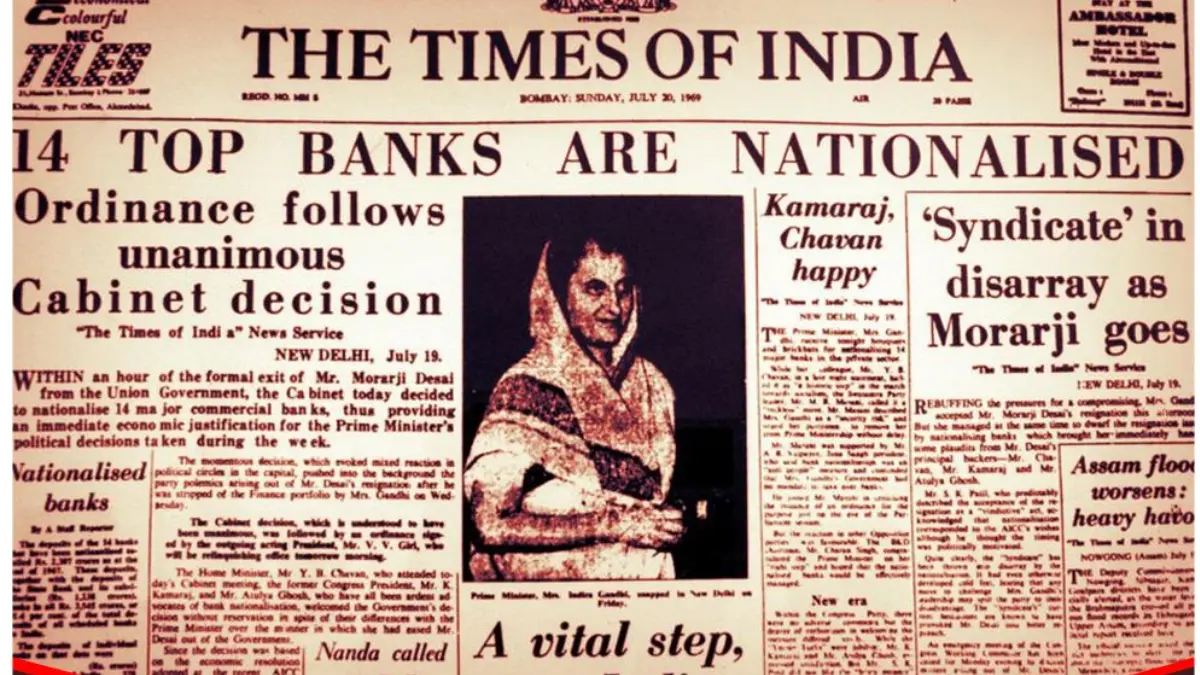
B. N. Adarkar (1970)
B N Adarkar served briefly as an acting Governor. Like other short-term appointments, his role was mainly to maintain smooth functioning until a full-time Governor took charge.
S. Jagannathan (1970 to 1975)
S Jagannathan oversaw the early years after the nationalisation of 14 major commercial banks in 1969. His responsibility was to integrate these banks into a unified public banking system. He also managed monetary policy during a period of expanding government involvement in banking.
N. C. Sen Gupta (1975)
N C Sen Gupta served for a short period of around three months as acting Governor. Such tenures are often tested in exams to check attention to detail.
K. R. Puri (1975 to 1977)
K R Puri led the RBI during the Emergency period when India faced political and administrative uncertainty. Despite the sensitive environment, he ensured that banks continued to function normally and that public confidence in the financial system remained intact.
M. Narasimham (1977)
M Narasimham served as RBI Governor for a short period, but his impact came later. He is best known for chairing the Narasimham Committees in the 1990s, which laid the foundation for modern banking reforms in India. These reports are frequently mentioned in UPSC and banking exams.
I. G. Patel (1977 to 1982)
I G Patel brought strong academic and international experience to RBI, having worked with the International Monetary Fund. His focus was on strengthening India’s foreign exchange reserves and improving the country’s global financial standing. His tenure helped India become more confident in international economic dealings.
Manmohan Singh (1982 to 1985)
Manmohan Singh later became India’s Prime Minister, but his time as RBI Governor shaped his economic thinking deeply. He handled a difficult balance of payments situation and gained first-hand experience of India’s structural economic weaknesses. This experience later influenced the major economic reforms of the 1990s.
A. Ghosh (1985)
A Ghosh served as acting Governor during a short transition phase. Such brief tenures are important from an exam perspective, as questions often test attention to detail.
R. N. Malhotra (1985 to 1990)
R N Malhotra led the RBI at a time when India was slowly preparing for economic change. He modernised banking practices, introduced new financial instruments, and opened discussions on reforms. His tenure helped RBI transition smoothly into the liberalisation era of the 1990s.
The Liberalisation Period (1990 to 2008)
This was one of the most important phases in India’s economic history. RBI Governors during this period played a central role in moving India from a controlled economy to a more open and market-driven system.
S. Venkitaramanan (1990 to 1992)
S Venkitaramanan took charge during India’s worst economic crisis in 1991. Foreign exchange reserves had fallen to dangerously low levels, barely enough to cover two weeks of imports. He worked closely with the government to manage the crisis and stabilise the economy in the short term.
C. Rangarajan (1992 to 1997)
C Rangarajan implemented landmark economic and monetary reforms after 1991. He restructured monetary policy, increased transparency, and opened up the banking sector. His five-year tenure is widely regarded as one of the most transformative periods in RBI history.
Bimal Jalan (1997 to 2003)
Bimal Jalan served during relatively stable years but faced the challenge of the Asian Financial Crisis. He focused on preserving financial stability and protecting the gains of earlier reforms. India emerged from this global disturbance with limited damage.
Y. V. Reddy (2003 to 2008)
Y V Reddy followed a cautious and disciplined approach. While many global banks took excessive risks, he kept Indian banks conservative. This approach protected India from the worst effects of the 2008 global financial crisis, making his tenure highly respected.
The Modern Era of RBI Governors (2008 to Present)
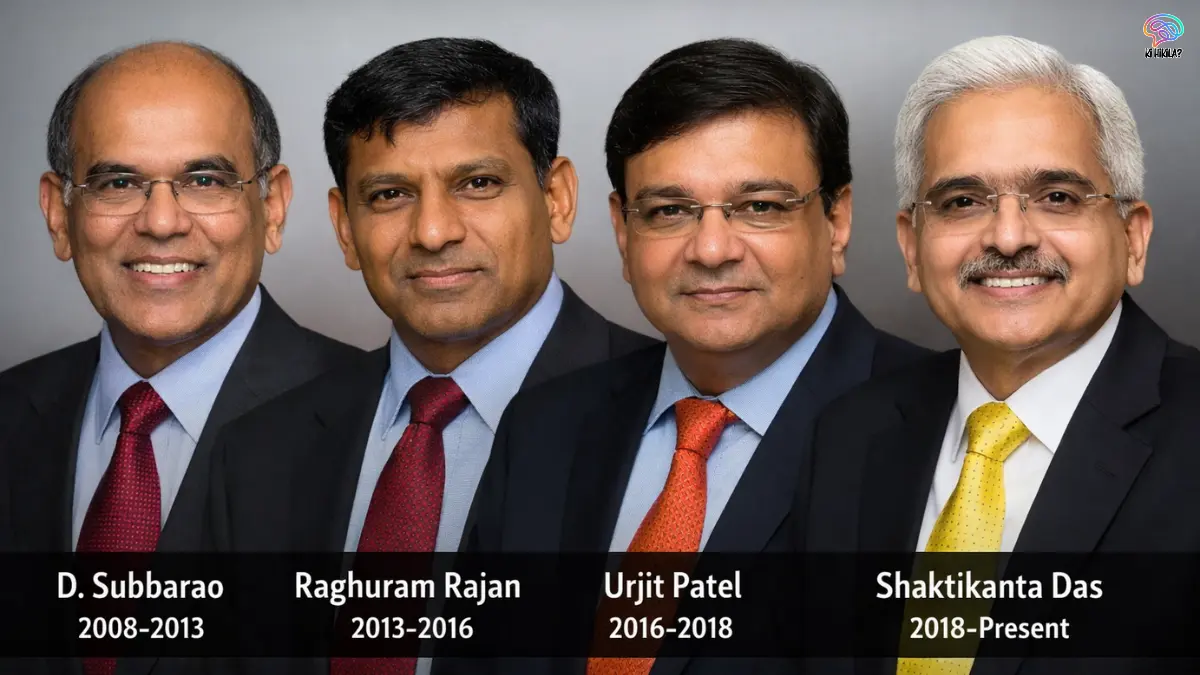
This period has tested RBI leadership through global crises, domestic challenges, and rapid economic change.
D. Subbarao (2008 to 2013)
D Subbarao assumed office just as the global financial crisis intensified. He used both traditional and innovative policy tools to protect India’s financial system. His calm and steady crisis management earned national and international recognition.
Raghuram Rajan (2013 to 2016)
Raghuram Rajan brought global credibility to the RBI. He strengthened monetary policy frameworks, addressed bad loans by cleaning up bank balance sheets, and promoted financial inclusion. His clear communication style helped ordinary citizens understand RBI decisions better.
Urjit Patel (2016 to 2018)
Urjit Patel made inflation the central objective of monetary policy. He managed the banking sector cleanup and handled the challenges following demonetization. His tenure gave the RBI stronger institutional independence through formal policy frameworks.
Shaktikanta Das (2018 to Present)
Shaktikanta Das is the current RBI Governor as of 2026. He has managed multiple challenges, including the IL and FS crisis, the economic impact of the COVID-19 pandemic, and global financial uncertainty. His pragmatic approach balances inflation control with growth support, guiding RBI through a complex economic environment.
Important Facts Every Student Must Remember
This section focuses on the facts that examiners ask again and again. If you remember these points clearly, you can score easy marks in the General Awareness and Economy sections across exams.
Record Holders Among RBI Governors
First Governor
Sir Osborne Arkell Smith was the first Governor of the Reserve Bank of India when it began operations in 1935. This is a very common one-line question in exams.
First Indian Governor
C D Deshmukh became the first Indian to lead the RBI in 1943, ending the practice of appointing only British officials.
Longest Serving Governor
Benegal Rama Rau served for about eight years from 1949 to 1957. This remains the longest continuous tenure of any RBI Governor.
Shortest Tenure
K G Ambegaonkar served for only a few months as an acting Governor. Several acting Governors had similarly short tenures.
Governor Who Became Prime Minister
Manmohan Singh is the only RBI Governor who later became the Prime Minister of India. This fact is often used in tricky multiple-choice questions.
Important Dates You Cannot Afford to Miss
April 1, 1935, is the date when the Reserve Bank of India started functioning. Many students remember this easily because it falls on April Fool’s Day.
January 1, 1949, is the date when the RBI was nationalised and became a fully government-owned institution.
The usual tenure of an RBI Governor is five years, but several Governors served for shorter or longer periods depending on national and economic conditions.
Exam Pattern: What Questions Look Like
In multiple choice questions, you may be asked who the first Indian Governor of RBI was or during whose tenure RBI was nationalised.
Fill-in-the-blank questions often focus on crisis periods, such as asking who the RBI Governor was during the 1991 economic crisis.
Match the following questions usually pair Governors with their achievements, reforms, or years of service.
Statement-based questions test whether you can identify correct and incorrect facts about specific RBI Governors.
If you revise only this section carefully before the exam, you can answer a large number of RBI-related questions with confidence.
Understanding the Role: What Does an RBI Governor Actually Do?
Many students memorise the names of RBI Governors but do not clearly understand what these Governors actually do. That gap often leads to confusion in exams. Let us break down the role in simple terms so you can connect names with their corresponding responsibilities.
Monetary Policy Decisions
The RBI Governor heads the Monetary Policy Committee, which decides key interest rates in the economy.
When interest rates increase, loans become costlier. People spend less, demand slows down, and inflation comes under control.
When interest rates are reduced, loans become cheaper. Spending increases, businesses invest more, and economic growth gets support.
You can think of this like a volume knob on a radio. The Governor adjusts it up or down so that the economy remains balanced, neither too loud nor too quiet.
Banking Supervision
RBI Governors are responsible for supervising banks and financial institutions. Their job is to make sure banks follow rules and do not take reckless risks with public money.
If a bank breaks regulations, the RBI can impose penalties. In serious cases, RBI can step in to control or restructure a troubled bank.
The safety of your money in banks largely depends on this strict supervision carried out under the Governor’s leadership.
Currency Management
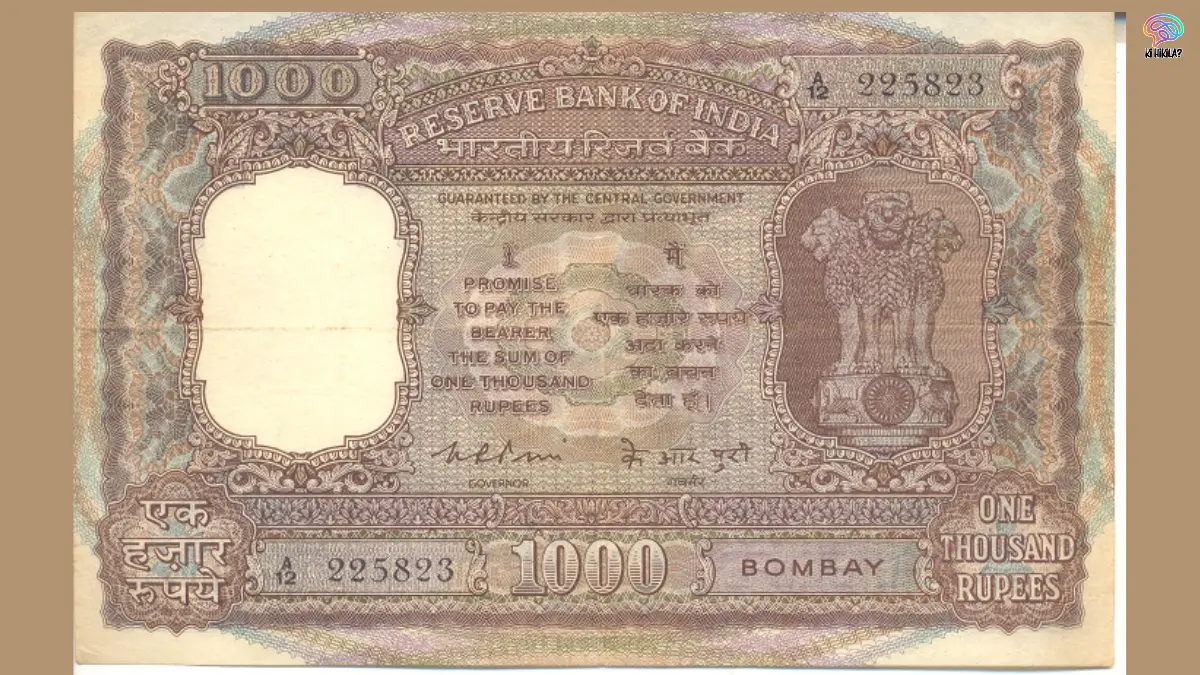
Every currency note in India carries the signature of the RBI Governor. This is not just symbolic. It represents legal authority and trust.
The Governor decides when new currency notes should be printed, when old notes should be withdrawn, and how to control fake currency circulation.
During demonetization in 2016, the entire process of withdrawing old notes and issuing new ones was overseen by Urjit Patel.
Major Economic Events and Their Governors
Linking Governors with major economic events makes this topic much easier to remember. Events act as natural memory anchors.
The 1991 Economic Crisis
In 1991, India faced a severe foreign exchange crisis. The country was close to running out of money to pay for essential imports.
S Venkitaramanan was the Governor when the crisis peaked. India even had to pledge gold abroad to secure emergency loans.
After this, C Rangarajan led the implementation of economic reforms that opened India’s economy to global markets.
The 2008 Global Financial Crisis
In 2008, banks collapsed across the world, but Indian banks remained largely stable.
This was because of cautious policies followed earlier by Y V Reddy and steady crisis management by D Subbarao.
This period clearly shows how strong central bank leadership can protect an economy during global shocks.
Demonetization in 2016
On November 8, 2016, old 500 and 1000 rupee notes were withdrawn from circulation.
Urjit Patel handled the massive logistical challenge of printing and distributing new currency while keeping banks functional and markets calm.
COVID-19 Pandemic (2020 to 2021)
During the pandemic, economic activity came to a sudden halt.
Shaktikanta Das announced multiple measures, such as reducing interest rates, providing liquidity to banks, and ensuring the smooth functioning of financial markets. These steps helped limit economic damage during an unprecedented crisis.
Memory Techniques for Exam Preparation
Remembering 26 Governors over the years may feel overwhelming, but these simple techniques make it manageable.
Chronological Grouping
Divide RBI Governors into clear eras.
British period
Early independence phase
Nationalization era
Reform period
Modern era
Study one era at a time instead of trying to memorise everything together.
Association Method
Link Governors with major events.
Manmohan Singh equals early reform thinking
Raghuram Rajan equates the monetary policy framework
Shaktikanta Das equals COVID management
Such associations create mental shortcuts that help during exams.
First Letter Method
Create short phrases using the first letters of consecutive Governors.
For example, Smith, Taylor, and Deshmukh can be remembered using a simple phrase that sticks in your mind. Silly phrases work best because the brain remembers them longer.
Timeline Visualization
Draw a basic timeline on paper.
Mark events like independence, nationalisation, the 1991 reforms, and the 2008 crisis.
Place Governors along this line.
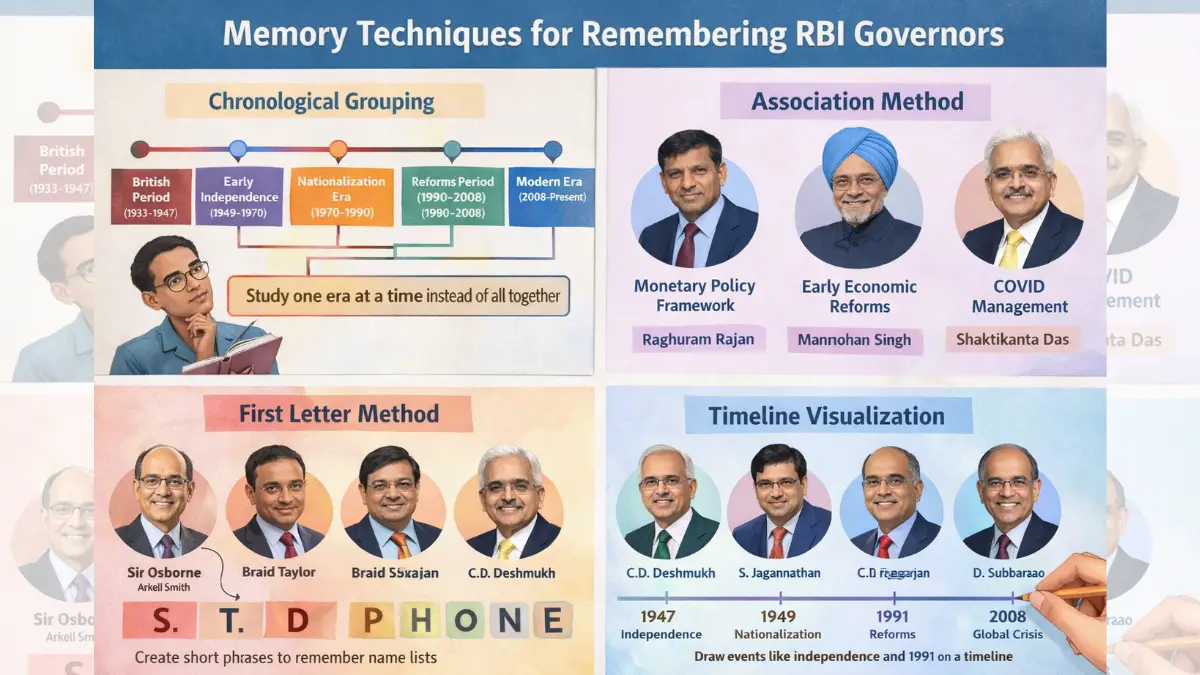
Visual memory is far more effective than reading lists repeatedly.
Common Mistakes Students Make
Avoiding these mistakes can immediately improve your accuracy in exams.
Confusing Similar Names
Do not confuse C D Deshmukh with D Subbarao. One belongs to the 1940s, the other to the post-2008 period.
Also, remember that Manmohan Singh served as RBI Governor much earlier than his tenure as Prime Minister.
Writing Wrong Tenure Periods
Students often remember the name but forget the correct years.
Always link a Governor with at least one major event.
If you remember reforms, think of the 1990s.
If you remember COVID, think of the current period.
Spelling Errors
Names like Venkitaramanan, Rangarajan, and Bhattacharya have fixed spellings.
Practice writing them correctly, especially for descriptive exams where spelling mistakes cost marks.
Incomplete Preparation
Knowing only the name is not enough.
For every RBI Governor, remember at least one key contribution or crisis handled. That single fact can help you eliminate wrong options and write stronger answers.
If you master this section, RBI Governors will become one of your strongest scoring topics in exams.
Quick Reference Table for Last Minute Revision
This section is designed for fast recall just before the exam. Read it once or twice, and you will be able to answer most factual questions related to RBI Governors confidently.
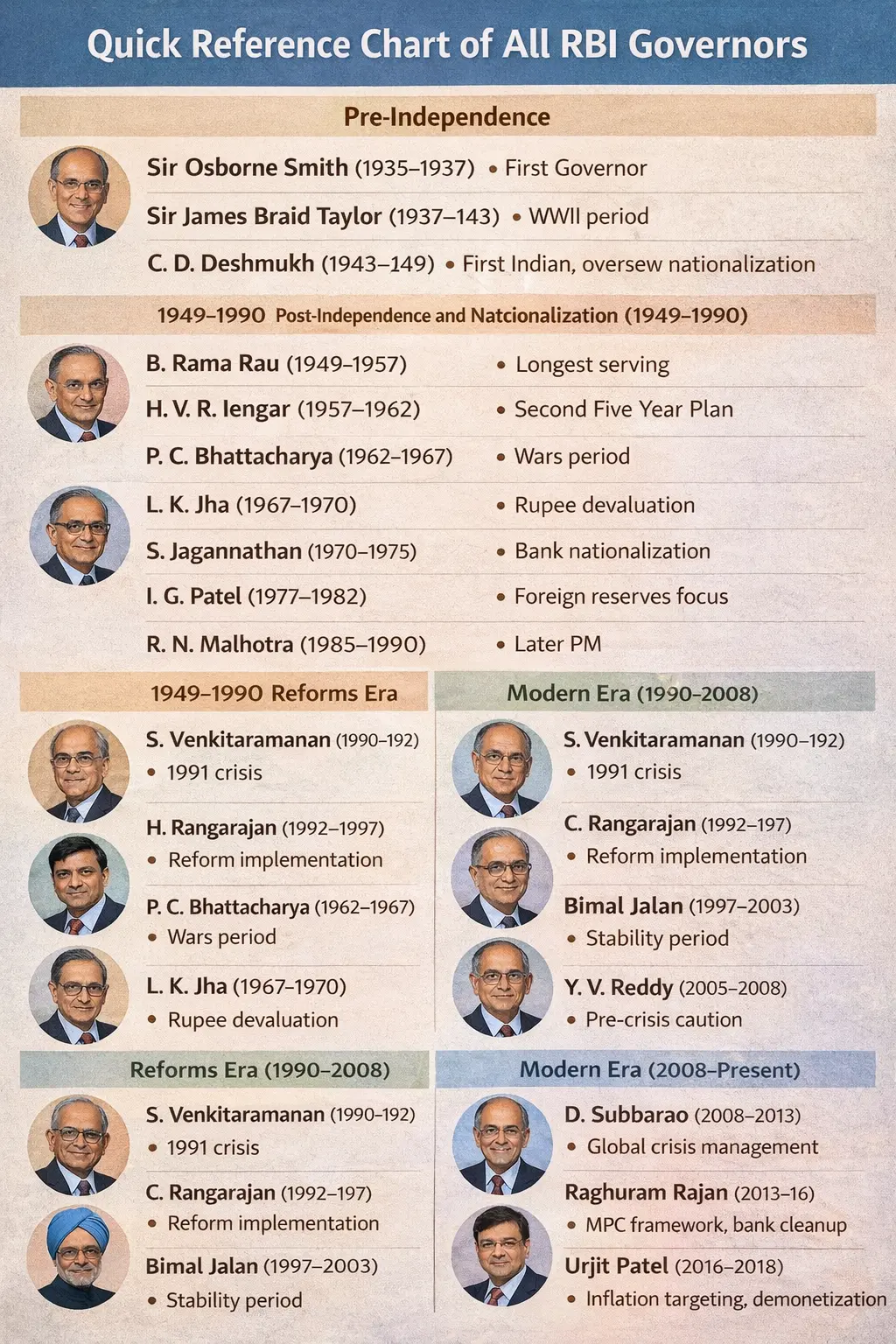
Pre-Independence Period
Sir Osborne Arkell Smith (1935 to 1937)
First Governor of the RBI when it started functioning.
Sir James Braid Taylor (1937 to 1943)
Governor during the Second World War period.
C D Deshmukh (1943 to 1949)
First Indian Governor and the one who oversaw RBI nationalisation.
Post Independence and Nationalisation Phase (1949 to 1990)
Benegal Rama Rau (1949 to 1957)
Longest serving RBI Governor.
H V R Iengar (1957 to 1962)
Governor during the Second Five-Year Plan.
P C Bhattacharya (1962 to 1967)
Governor during the wars with China and Pakistan.
L K Jha (1967 to 1970)
Associated with the devaluation of the Indian rupee.
S Jagannathan (1970 to 1975)
Governor during the early phase of bank nationalisation.
I G Patel (1977 to 1982)
Focused on strengthening foreign exchange reserves.
Manmohan Singh (1982 to 1985)
Later became the Prime Minister of India.
R N Malhotra (1985 to 1990)
Prepared the banking system for future economic reforms.
Reforms Era (1990 to 2008)
S Venkitaramanan (1990 to 1992)
Governor during the 1991 balance of payments crisis.
C Rangarajan (1992 to 1997)
Implemented major post-1991 economic reforms.
Bimal Jalan (1997 to 2003)
Maintained stability during the Asian Financial Crisis.
Y V Reddy (2003 to 2008)
Followed cautious policies before the global financial crisis.
Modern Era (2008 to Present)
D Subbarao (2008 to 2013)
Handled the global financial crisis.
Raghuram Rajan (2013 to 2016)
Introduced monetary policy reforms and bank cleanup.
Urjit Patel (2016 to 2018)
Implemented inflation targeting and managed demonetization.
Shaktikanta Das (2018 to Present)
Handled COVID-related economic challenges and continues as Governor.
Free PDF: RBI Governors Complete Revision Notes (1935–2026)
How RBI Governors Are Selected
Understanding the appointment process helps you appreciate why this position carries such authority.
Selection Criteria
The Government of India appoints the RBI Governor. The person selected usually has deep experience in economics, finance, banking, or public administration. Many Governors have come from the Indian Administrative Service, academia, or key financial institutions.
Parliament approval is not required, but expert consultation is usually involved before the appointment.
Tenure and Extension
The usual tenure of an RBI Governor is five years, but this is not fixed by law. Some Governors served shorter terms, while others served longer, depending on national needs.
The government can extend a Governor’s tenure or appoint a new one. A Governor can also resign before completing the term, as happened in 2018.
Removal from Office
Although it is rare, the government has the authority to remove an RBI Governor. In practice, RBI enjoys significant autonomy, and Governors generally function independently within the broader policy framework.
Why This Topic Matters Beyond Exams
Let me be clear with you. This topic is not only about marks.
Understanding India’s Economic History
Each RBI Governor represents a phase in India’s economic story. From a newly independent country to one of the world’s largest economies, these leaders shaped how the financial system evolved.
By studying their decisions, you understand how India reached where it is today.
Learning from Crisis Management
Several Governors handled severe economic crises. Their actions show how calm decision-making and long-term thinking can protect an entire nation.
The cautious approach of Y V Reddy before 2008 proves that careful policy making is often smarter than risky shortcuts.
Connecting Past and Present
Many current policies have roots in past decisions. Concepts like inflation targeting and monetary policy committees were introduced gradually, not overnight.
When you hear such terms in today’s news, you will know which Governors brought them into practice and why they matter.
If you understand this connection, RBI Governors stop being just names. They become chapters of India’s economic journey.
Practice Questions for Self Assessment
Before you close your book or notes, pause for a moment and test yourself. These are the kinds of direct questions that appear again and again in competitive exams.
Question 1: Who was the first Indian Governor of the Reserve Bank of India?
Question 2: Which RBI Governor later became the Prime Minister of India?
Question 3: During whose tenure was the Reserve Bank of India nationalised?
Question 4: Which Governor was in charge during the 1991 economic crisis?
Question 5: Who is the current Governor of the RBI as of 2026?
Question 6: Which RBI Governor had the longest tenure?
Question 7: Who introduced the Monetary Policy Committee framework?
Question 8: Which Governor managed the RBI during the 2008 global financial crisis?
Answers for Quick Check
- C D Deshmukh
- Manmohan Singh
- C D Deshmukh
- S Venkitaramanan
- Shaktikanta Das
- Benegal Rama Rau
- Raghuram Rajan
- D Subbarao
If you answered at least six correctly without looking back, you are already in a strong position.
Your Action Plan for Exam Success
Now comes the most important part. Knowing information is one thing. Using it effectively is what helps you score.
Immediate Steps (Next 24 Hours)
Read the complete list of RBI Governors once more, calmly. Do not rush. Focus on understanding who served when and why they mattered.
Mark the Governors you find confusing or hard to recall. These are your weak spots.
Create a simple timeline on paper and write it by hand. Writing improves memory far better than scrolling or typing.
Short Term Practice (Next One Week)
Spend just ten minutes daily revising this topic. Small, regular revision works better than long study sessions.
Use the memory techniques discussed earlier. Make flashcards for Governors whose names or tenures you keep forgetting.
Practice writing names like Venkitaramanan, Rangarajan, and Bhattacharya correctly. Spelling errors can cost marks in descriptive exams.
Final Revision Before the Exam
Use only the quick reference table for revision. Do not open new sources at the last moment.
Focus on high-priority areas such as the first Governor, the first Indian Governor, the longest serving Governor, the crisis period Governors, and the current Governor.
Keep an eye on recent RBI-related news. Sometimes exam questions link historical facts with current developments.
Most importantly, do not panic if you forget a few names. No one remembers everything perfectly. If you clearly remember the major Governors and key events, you will still score well.
At this stage, RBI Governors should feel familiar, not frightened. That confidence alone gives you an edge in the exam hall.
Conclusion: From List to Real Understanding
You now have a complete and reliable reference on RBI Governors that covers everything required for competitive exams. This guide goes beyond a simple list of names and years. It explains how India’s banking system evolved step by step through the decisions of its central bank leaders.
The 26 Governors who led the Reserve Bank of India each left a distinct mark on the economy. From Sir Osborne Arkell Smith, who helped build the institution from scratch in 1935, to Shaktikanta Das, who continues to manage modern challenges like pandemics and global uncertainty, every Governor shaped monetary policy according to the needs of their time.
For exams, remember this one thing. Questions do not test memory alone. They test understanding. Know the names and dates, but also understand why a Governor mattered. Link each person with one major event or reform, and the information will stay with you naturally.
Use this article as your final revision resource. Everything essential is already here, clearly explained and exam-focused. Save it, revisit it regularly, and you will notice that questions on RBI Governors turn into easy scoring opportunities.
All the best for your preparation. Stay calm, revise smartly, and walk into the exam with confidence. You are well prepared.
Frequently Asked Questions on RBI Governor List
Q1. Who was the first Governor of the Reserve Bank of India?
Ans: The first Governor of the RBI was Sir Osborne Smith, who served from 1935 to 1937.
Q2. Who was the first Indian Governor of RBI?
Ans: C. D. Deshmukh was the first Indian Governor of RBI, serving from 1943 to 1949.
Q3. Who is the current RBI Governor?
Ans: The current RBI Governor is Shaktikanta Das, appointed in December 2018.
Q4. Who has served the longest tenure as RBI Governor?
Ans: Sir Benegal Rama Rau served as RBI Governor for around 8 years (1949–1957), the longest tenure in history.
Q5. Which RBI Governor later became the Prime Minister of India?
Ans: Dr. Manmohan Singh, who served as RBI Governor from 1982 to 1985, later became the Prime Minister of India.
Q6. Who served the shortest tenure as RBI Governor?
Ans: Amitav Ghosh, who held the office for just 20 days in 1985.
Q7. How is the RBI Governor appointed?
Ans: The RBI Governor is appointed by the Government of India for a term usually of three years, which may be extended.
Q8. Who is considered one of the most impactful RBI Governors in recent times?
Ans: Dr. Raghuram Rajan (2013–2016) is often regarded as one of the most impactful Governors due to his reforms and policies.
Q9. How many RBI Governors have there been till now?
Ans: Since its establishment in 1935, there have been 26 Governors of the Reserve Bank of India.
Q10. What is the role of the RBI Governor in Indian economy?
Ans: The RBI Governor formulates and implements monetary policy, regulates banks, manages currency, and ensures financial stability.