India’s Demographic Dividend: Key Opportunities and Challenges

India’s Demographic Dividend is one of the most important opportunities for the country’s future growth and development. It refers to the advantage that India has because a large part of its population is young and in the working-age group. This situation can help the country grow faster economically, socially, and technologically if used properly. However, if not managed well, it can also create serious challenges like unemployment, poverty, and inequality.
Thank you for reading this post, don't forget to subscribe!What is Demographic Dividend?
The term demographic dividend refers to the economic growth potential that arises when the proportion of working-age people in a country is larger than the dependent population (children and elderly people).
According to the United Nations Population Fund (UNFPA), demographic dividend is the growth in the economy that can happen due to changes in the age structure of the population. When there are more people in the age group of 15 to 64 years, and fewer dependents, the country can grow faster if the right policies are in place.
This situation usually happens when:
- Birth rates decline
- Life expectancy increases
- More people enter the workforce
As a result, families have fewer children to support, and more people are available to work, save, and invest.
India’s Demographic Situation
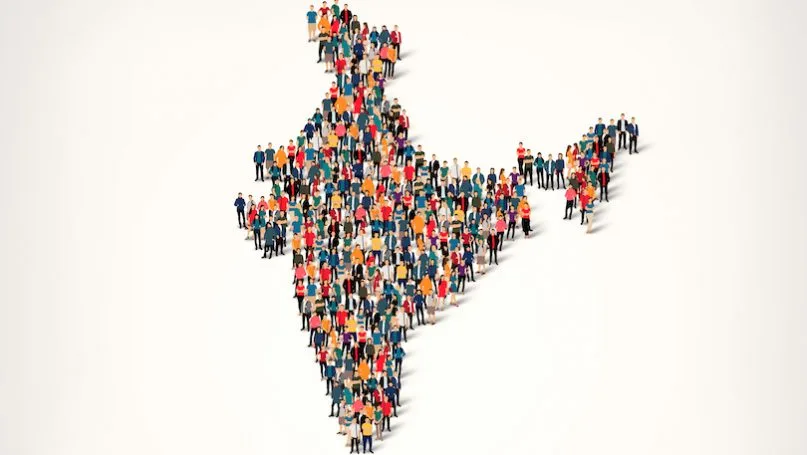
India is one of the youngest countries in the world. A large part of its population is in the working-age group, which gives it a unique advantage compared to many developed countries that are facing aging populations.
Some key facts about India’s population:
- Around 62.5% of India’s population is in the age group of 15–59 years
- This share is expected to increase and reach around 65% by 2036
- India’s demographic dividend period started around 2005-06
- It is expected to last till 2055-56, giving India nearly 50 years of opportunity
- The peak is expected around 2041
India’s median age is also lower compared to other countries:
- India: around 28 years
- China and USA: around 37 years
- Western Europe: around 45 years
- Japan: around 49 years
This shows that India has a younger workforce compared to most major economies.
Why India’s Demographic Dividend is Important
India’s demographic dividend is important because it can:
- Boost economic growth
- Increase productivity
- Improve living standards
- Reduce poverty
- Strengthen global position
If properly used, this young population can become a powerful engine of growth.
How Demographic Dividend Works
Demographic dividend works through several channels:
1. Increase in Labour Force
When more people enter the working-age group, the labour force increases. This means more people are available to work, produce goods, and provide services.
2. Higher Savings
Working-age people tend to save more money. These savings can be invested in businesses, infrastructure, and development projects.
3. More Investment in Development
With fewer children to support, families and governments can spend more on:
- Education
- Health
- Infrastructure
4. Rise in Women’s Participation
As fertility rates decline, more women join the workforce, which increases productivity and economic growth.
5. Growth of Middle Class
A larger working population leads to higher income levels, which helps in the growth of a strong middle class.
Advantages of India’s Demographic Dividend
1. Faster Economic Growth
A large workforce can produce more goods and services, leading to higher GDP growth.
2. Increased Productivity
Young people are usually more energetic, innovative, and adaptable to new technologies.
3. Rise in Savings and Investment
More working people means more savings, which can be invested in development.
4. Boost to Industrialisation
More workers and consumers increase demand for industries and services.
5. Urbanisation Growth
Young people often move to cities for jobs, leading to urban development.
6. Women Empowerment
Lower birth rates encourage more women to join the workforce.
7. Global Workforce Supply
India can become a major supplier of skilled labour to the world.
Global Examples of Demographic Dividend
Many countries have successfully used their demographic dividend:
Japan
Japan experienced rapid economic growth between 1964 and 2004 due to its favorable population structure.
South Korea
South Korea invested heavily in education and skill development, turning its young population into a productive workforce.
China
China’s economic rise was partly due to its demographic dividend, supported by industrial growth and reforms.
India can learn from these countries to use its demographic advantage effectively.
Challenges of India’s Demographic Dividend
Despite the opportunities, India faces many challenges:
1. Unemployment
One of the biggest problems is the lack of jobs. Even though many people are ready to work, there are not enough employment opportunities.
2. Skill Gap
Many young people do not have the skills required for modern jobs. This reduces their employability.
3. Poor Education System
Quality of education is still a major issue, especially in rural areas.
4. Health Issues
Poor healthcare and malnutrition reduce productivity and efficiency of workers.
5. Regional Imbalance
Different states are at different stages of demographic transition. Some states benefit earlier, while others lag behind.
6. Informal Economy
A large part of India’s workforce is in the informal sector, where jobs are unstable and low-paying.
7. Jobless Growth
Economic growth is not always creating enough jobs. This leads to frustration among youth.
8. Low Labour Force Participation
Only about half of the working-age population is actively participating in the workforce.
What Needs to Be Done
To fully benefit from India’s demographic dividend, several steps must be taken:
1. Investment in Education
Education is the most important factor. India must:
- Improve school infrastructure
- Focus on quality education
- Promote higher education
- Encourage research and innovation
Education should match industry needs so that students are job-ready.
2. Skill Development
Skill development is essential for employability. The government and private sector should:
- Provide vocational training
- Promote digital skills
- Support technical education
Programs like skill training initiatives can help youth gain practical knowledge.
3. Improve Healthcare
Healthy workers are productive workers. India must:
- Strengthen healthcare infrastructure
- Provide affordable medical services
- Focus on nutrition, especially for women and children
Better health leads to higher productivity and economic growth.
4. Job Creation
India needs to create millions of jobs every year. This can be done by:
- Promoting industries
- Supporting startups and entrepreneurship
- Encouraging small and medium enterprises (SMEs)
Sectors like manufacturing, services, and technology can create large-scale employment.
5. Promote Women Participation
Women’s participation in the workforce should be increased by:
- Providing equal opportunities
- Ensuring workplace safety
- Supporting maternity benefits
This will significantly boost economic growth.
6. Urban Planning
With more people moving to cities, proper urban planning is needed:
- Affordable housing
- Public transport
- Clean water and sanitation
- Healthcare and education facilities
7. Use of Technology
Technology can help in:
- Education (online learning)
- Healthcare (telemedicine)
- Job creation (digital economy)
8. Good Governance
Effective policies and implementation are necessary:
- Transparent systems
- Efficient administration
- Corruption-free governance
Role of Government Initiatives
Several initiatives can support demographic dividend:
- Skill development programs
- Startup promotion schemes
- Industrial development policies
- Health and nutrition programs
- Urban development missions
Proper implementation of these schemes is the key to success.
Future Outlook
India is at a very important stage in its demographic transition. The coming decades will decide whether the country can convert its population advantage into economic success.
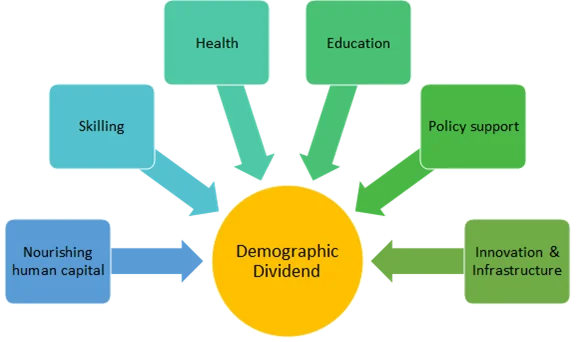
If India invests in:
- Education
- Skills
- Healthcare
- Employment
Then it can become one of the world’s leading economies.
However, if these issues are not addressed, the demographic dividend can turn into a demographic disaster.
Way Forward
India’s Demographic Dividend offers a golden opportunity for growth and development. But this opportunity is not automatic. It requires careful planning, strong policies, and effective implementation.
The focus should be on:
- Building human capital
- Creating jobs
- Improving education and healthcare
- Ensuring inclusive growth
India must also learn from successful countries like Japan and South Korea while adapting solutions to its own conditions.
Conclusion
India’s Demographic Dividend is a powerful opportunity that can transform the country’s future. With a large young population, India has the potential to become an economic superpower. However, this potential can only be realized through proper investment in people.
The youth of India are its greatest strength. If they are educated, skilled, healthy, and employed, they can drive the nation towards progress and prosperity. But if their potential is ignored, it may lead to serious social and economic problems.
Therefore, the need of the hour is to act wisely and quickly. By focusing on human development and inclusive growth, India can fully benefit from its demographic dividend and build a brighter future for all.
FAQs (Frequently Asked Questions)
1. What is India’s Demographic Dividend?
India’s Demographic Dividend refers to the economic growth opportunity that arises when a large part of the population is in the working-age group (15–64 years), and fewer people are dependent on them.
2. When did India’s demographic dividend start?
India’s demographic dividend began around 2005-06 and is expected to continue until 2055-56.
3. Why is India’s demographic dividend important?
It is important because it can lead to faster economic growth, higher productivity, increased savings, and better living standards.
4. What is the main advantage of India’s young population?
The main advantage is a large workforce that can contribute to economic development and innovation.
5. What are the major challenges of India’s demographic dividend?
The key challenges include unemployment, lack of skills, poor education quality, health issues, and low job creation.
6. How can India benefit from its demographic dividend?
India can benefit by investing in education, skill development, healthcare, and creating employment opportunities.
7. What is the role of education in demographic dividend?
Education helps in building a skilled workforce, which is necessary for economic growth and development.
8. What happens if demographic dividend is not utilized properly?
If not used properly, it can lead to unemployment, poverty, and social unrest, turning into a demographic disaster.