



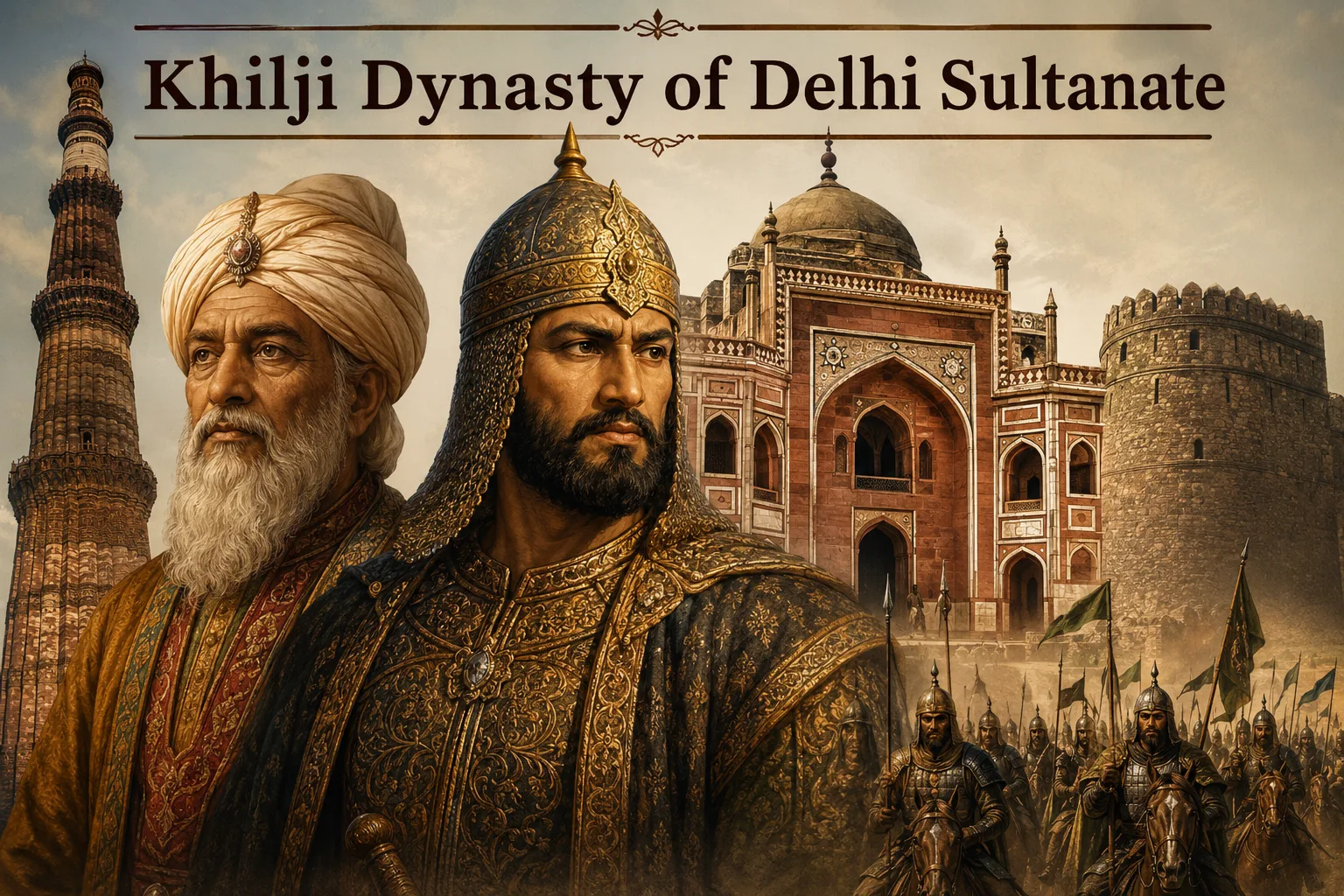
Khilji Dynasty of Delhi Sultanate(Part-ii): Rise, Reforms and Expansion

The Khilji Dynasty of Delhi Sultanate was one of the most powerful ruling dynasties in medieval Indian history. It ruled from 1290 to 1320 AD and played an important role in expanding and strengthening the Delhi Sultanate. The Khilji rulers introduced many administrative reforms, military changes, and economic policies that helped the empire become stronger. The dynasty is especially remembered for the rule of Alauddin Khilji, who expanded the empire into South India and protected India from Mongol invasions.
The Khilji Dynasty came to power after the fall of the Slave Dynasty. The rulers of this dynasty were strong military leaders and skilled administrators. They worked to increase the power of the Sultan and reduce the influence of nobles. Their rule also saw important developments in trade, markets, taxation, architecture, and administration.

Rise of the Khilji Dynasty
After the decline of the Slave Dynasty, political instability increased in the Delhi Sultanate. Many nobles fought for power, and the administration became weak. During this time, Jalaluddin Khilji emerged as a strong leader and founded the Khilji Dynasty in 1290 AD.
The Khiljis were originally of Turkish origin but had lived in Afghanistan for a long time. Because of this, some Turkish nobles in Delhi looked down upon them. However, the Khiljis proved themselves through military power and political ability.
The rise of the Khiljis ended the monopoly of old Turkish nobles in administration. This opened the doors for new groups to enter important government positions.
Jalaluddin Khilji (1290–1296 AD)
Founder of the Dynasty
Jalaluddin Khilji was the founder of the Khilji Dynasty. He became the Sultan at the age of around 70 years. Even though he ruled only for six years, he played an important role in establishing stability in the Delhi Sultanate.
Policy of Kindness and Tolerance
Unlike earlier rulers such as Balban, Jalaluddin believed in a softer and more tolerant style of governance. He tried to win the support of nobles and common people through kindness rather than fear.
Some important features of his rule were:
- He avoided harsh punishments.
- Rebels were often forgiven.
- He treated nobles with respect.
- He believed that a ruler should have the support of the people.
Jalaluddin understood that the majority population in India was Hindu. Therefore, he believed that the Delhi Sultanate could not function as a purely Islamic state. This idea was different from many earlier rulers.
Weaknesses of Jalaluddin
Although Jalaluddin was kind and generous, many people considered him weak. His forgiving nature was seen as a sign of weakness by ambitious nobles and military leaders.
One such ambitious leader was his nephew and son-in-law Alauddin Khilji.
Alauddin Khilji (1296–1316 AD)
Rise to Power
Alauddin Khilji was one of the greatest rulers of the Delhi Sultanate. Before becoming Sultan, he served under Jalaluddin Khilji and proved himself as a successful military commander.
He conducted successful campaigns in Bhilsa and Devagiri. The wealth gained from these campaigns increased his power and popularity.
In 1296 AD, Alauddin murdered Jalaluddin Khilji and declared himself Sultan of Delhi.
Alauddin Khilji’s Policies
After becoming ruler, Alauddin adopted strict policies to strengthen the Sultanate. He believed that a strong ruler should control nobles, army, and administration firmly.
Control over Nobles
Alauddin noticed that rebellions were often started by powerful nobles. To stop rebellions, he introduced strict rules.
He believed rebellions happened because:
- Nobles had too much wealth.
- Social gatherings created political alliances.
- Drinking alcohol encouraged conspiracies.
- The spy system was weak.
Measures Taken by Alauddin
To prevent rebellions, he introduced several reforms:
Confiscation of Wealth
Rich nobles and landlords had to pay heavy taxes. Free lands given earlier were taken back or taxed heavily.
Ban on Social Gatherings
Nobles were not allowed to organize parties, marriages, or meetings without the Sultan’s permission.
Prohibition of Alcohol
The use of wine and intoxicating substances was banned to reduce secret conspiracies.
Strong Spy System
Alauddin improved the intelligence system. Secret spies and officers regularly reported activities happening in the kingdom.
These strict measures helped Alauddin maintain control over the empire.
Military Reforms of Alauddin Khilji
Alauddin Khilji built a large standing army to:
- Expand the empire
- Defend India against Mongol invasions
The Mongols were repeatedly attacking northwestern India during this period. Alauddin successfully defeated them many times and protected the Delhi Sultanate.
Important Military Measures
Large Permanent Army
He maintained a huge army directly under the Sultan.
Payment in Cash
Soldiers were paid salaries in cash instead of land grants.
Branding of Horses
Horses were branded to prevent corruption in the army.
Descriptive Records of Soldiers
Detailed records of soldiers were maintained to stop fake appointments.
These reforms improved discipline and efficiency in the military.
Market Reforms of Alauddin Khilji
One of the most famous achievements of Alauddin Khilji was his market control system.
He wanted to maintain a large army, but paying high salaries would burden the treasury. Therefore, he decided to keep prices of goods low so that soldiers could live comfortably with smaller salaries.
Types of Markets
Alauddin established separate markets in Delhi for different goods:
Grain Market
Food grains like wheat, rice, and pulses were sold here.
Cloth Market
This market was called Sarai Adl and dealt in cloth, sugar, oil, and daily items.
Horse and Cattle Market
Horses, cattle, and slaves were traded in this market.
Market Administration
A special officer called Shahna-i-Mandi supervised the markets.
The Sultan also used:
- Intelligence officers
- Secret spies
- Daily reports
to monitor market activities.
Punishments for Violations
Strict punishments were given to traders who broke rules. Punishments included:
- Heavy fines
- Imprisonment
- Expulsion from Delhi
These measures helped keep prices stable.
Importance of Market Reforms
The market reforms were important because:
- Soldiers could buy goods cheaply.
- Inflation was controlled.
- Hoarding and black marketing reduced.
- Trade became organized.
These reforms show Alauddin’s administrative intelligence.
Agrarian Reforms
Alauddin also introduced important land revenue reforms.
Measurement of Land
He ordered that land tax should be based on actual measurement of cultivated land.
This reduced corruption and made taxation fairer.
Equal Taxation
Rich landlords called khuts and muqaddams had to pay taxes like ordinary farmers.
Earlier, they enjoyed many privileges and avoided taxes.
Increased Revenue
These reforms increased the income of the state and strengthened the administration.
Expansion of the Delhi Sultanate
The Khilji Dynasty greatly expanded the Delhi Sultanate. Alauddin Khilji conquered many regions in North and South India.
Conquest of Gujarat
In 1299 AD, Alauddin sent his generals Ulugh Khan and Nusrat Khan to conquer Gujarat.
Reasons for Conquest
- Gujarat was rich in trade and wealth.
- Its ports supplied Arab horses.
- Alauddin needed money for future wars.
Results
- Gujarat was successfully conquered.
- Huge wealth was captured.
- The famous Somnath temple was attacked.
- Many prisoners and slaves were taken.
One of the captured slaves was Malik Kafur, who later became Alauddin’s trusted commander.
Conquest of Rajasthan
Ranthambore
Ranthambore was ruled by the Chauhan Rajputs.
The ruler Hamirdeva gave shelter to rebel Mongol soldiers, which angered Alauddin.
After a difficult battle, Alauddin captured Ranthambore in 1301 AD.
Chittor
In 1303 AD, Alauddin attacked Chittor, one of the strongest Rajput forts.
The story of Queen Padmini is connected with this conquest, though many historians believe it is more legend than fact.
After capturing Chittor:
- A large number of people were killed.
- The fort was renamed Khizrabad after Alauddin’s son.
Effect on Rajputs
Alauddin became master of North India after defeating major Rajput states.
However, many Rajput rulers continued local administration while accepting the authority of the Sultan.
Deccan and South Indian Campaigns
After conquering North India, Alauddin focused on South India.
The South was famous for:
- Rich temples
- Precious stones
- Gold and wealth
Malik Kafur led most of these campaigns.
Conquest of Devagiri
Devagiri in the Deccan was ruled by Rai Ramachandra.
He had promised tribute to Alauddin but failed to pay regularly.
Malik Kafur attacked Devagiri, and Ramachandra surrendered.
Alauddin treated him respectfully and even formed friendly relations with him.
Warangal Campaign
Malik Kafur attacked Warangal in present-day Telangana.
The ruler Prataparudra finally agreed to pay tribute and surrender treasure to the Sultan.
Dwar Samudra and Ma’bar
Malik Kafur also attacked:
- Dwar Samudra in Karnataka
- Ma’bar in Tamil Nadu
The rulers agreed to pay tribute, and large amounts of wealth were taken.
Several temples were looted during these campaigns.
Malik Kafur
Malik Kafur became one of the most important military commanders under Alauddin Khilji.
He successfully led campaigns in South India and expanded the influence of the Delhi Sultanate.
Because of his achievements, Alauddin appointed him to high positions in administration.
Architecture During Khilji Dynasty
The Khilji rulers also contributed to architecture.
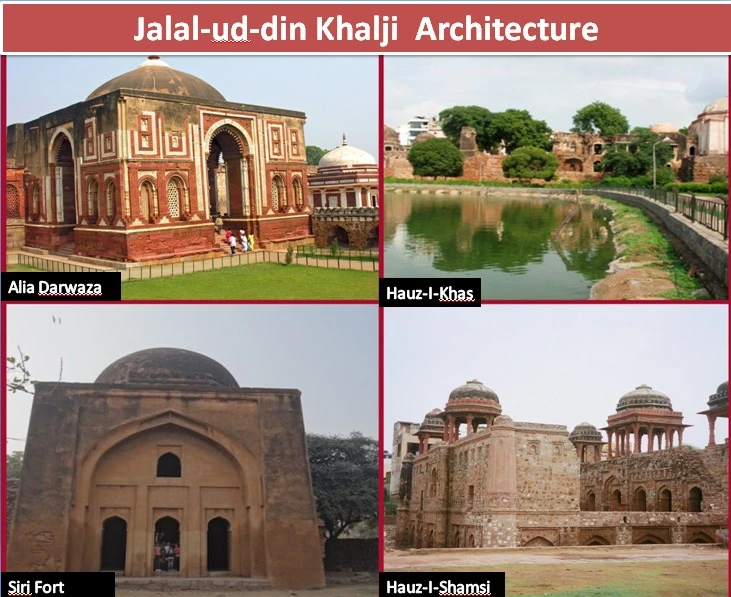
Siri Fort
Alauddin founded a new city called Siri in Delhi in 1303 AD.
Alai Darwaza
The Alai Darwaza is one of the finest examples of Indo-Islamic architecture.
Features include:
- Horseshoe-shaped arches
- Beautiful carvings
- Use of red sandstone and marble
Hauz Khas
Alauddin built the Hauz Khas reservoir to supply water to Siri city.
This reservoir became an important center later during the Tughlaq period.
Mongol Invasions and Defense
During Alauddin’s reign, Mongol invasions were a major threat.
The Mongols repeatedly attacked northwestern India.
Alauddin successfully defeated them through:
- Strong forts
- Large army
- Efficient military organization
His success protected India from massive destruction.
Administration Under the Khiljis
The Khilji rulers strengthened central administration.
Main Features
- Strong control by the Sultan
- Efficient spy system
- Strict law and order
- Better tax collection
- Military organization
The Sultan became the center of power, and nobles had less independence.
Decline of the Khilji Dynasty
After Alauddin Khilji’s death in 1316 AD, the Khilji Dynasty became weak.
Reasons for Decline
- Weak successors
- Court conspiracies
- Struggles among nobles
- Growing political instability
Malik Kafur tried to control the throne after Alauddin’s death, but confusion increased in the empire.
Finally, in 1320 AD, Ghiyasuddin Tughlaq defeated the last Khilji ruler and founded the Tughlaq Dynasty.
Importance of the Khilji Dynasty
The Khilji Dynasty holds an important place in Indian history because:
- It expanded the Delhi Sultanate greatly.
- It defended India from Mongol invasions.
- It introduced important market reforms.
- It strengthened administration and military systems.
- It connected North and South India politically.
The rule of Alauddin Khilji especially stands out because of his strong leadership and administrative ability.
Conclusion
The Khilji Dynasty of Delhi Sultanate was a powerful and influential dynasty in medieval India. From Jalaluddin Khilji’s tolerant rule to Alauddin Khilji’s strict administration and military expansion, the dynasty brought major political and economic changes.
Alauddin Khilji’s reforms in markets, army, taxation, and administration made the Delhi Sultanate stronger than before. His successful campaigns in Gujarat, Rajasthan, Deccan, and South India expanded the empire to a great extent.
Even though the dynasty lasted for only about thirty years, its impact on Indian history was significant. The Khilji rulers laid the foundation for stronger central administration and demonstrated the power of the Delhi Sultanate across India.
FAQs on Khilji Dynasty of Delhi Sultanate
1. Who founded the Khilji Dynasty?
Jalaluddin Khilji founded the Khilji Dynasty in 1290 AD after the fall of the Slave Dynasty.
2. Who was the most famous ruler of the Khilji Dynasty?
Alauddin Khilji was the most famous ruler of the Khilji Dynasty because of his military conquests and administrative reforms.
3. What were the market reforms of Alauddin Khilji?
Alauddin Khilji controlled prices of food, cloth, horses, and other goods to maintain a large army at lower salaries.
4. Why did Alauddin Khilji conquer Gujarat?
He conquered Gujarat to gain wealth, control trade routes, and secure a regular supply of horses for his army.
5. Who was Malik Kafur?
Malik Kafur was a trusted general of Alauddin Khilji who led successful campaigns in South India.
6. What was the capital city built by Alauddin Khilji?
Alauddin Khilji built the city of Siri in Delhi as his new capital.
7. How did Alauddin Khilji stop rebellions?
He used strict laws, banned social gatherings, improved the spy system, and reduced the wealth of nobles.
8. Which South Indian regions were conquered during the Khilji Dynasty?
The Khilji forces conquered Devagiri, Warangal, Dwar Samudra, and Ma’bar.
9. Why is the Alai Darwaza important?
The Alai Darwaza is an important example of Indo-Islamic architecture built during Alauddin Khilji’s rule.
10. When did the Khilji Dynasty end?
The Khilji Dynasty ended in 1320 AD when the Tughlaq Dynasty came to power.