Ministry of Finance India – Key Functions and Schemes

The Ministry of Finance of India is one of the most important ministries in the country. It manages all matters related to money, economy, and financial systems of the government. In simple words, it works like the “treasury department” of India, which means it controls how money is earned, spent, saved, and managed.
Thank you for reading this post, don't forget to subscribe!This ministry handles many important areas such as:
- Tax collection (Income tax, GST, etc.)
- Government spending
- Budget preparation
- Banking and insurance systems
- Financial laws and policies
- Economic growth and stability
Without the Ministry of Finance, it would be very difficult for the government to run the country smoothly.
Structure of the Ministry of Finance
The Ministry of Finance is divided into six main departments, each having its own role:
- Department of Economic Affairs
- Department of Expenditure
- Department of Revenue
- Department of Financial Services
- Department of Investment and Public Asset Management (DIPAM)
- Department of Public Enterprises
Each department works in a different area but together they manage the entire financial system of India.
Department of Financial Services (DFS)
The Department of Financial Services (DFS) looks after banking, insurance, and pension systems in India.
Main Functions
- Controls Public Sector Banks (PSBs)
- Manages institutions like:
- NABARD (for agriculture)
- SIDBI (for small industries)
- EXIM Bank (for foreign trade)
- Handles rural credit system
- Appoints key officials in banks and financial institutions
Financial Inclusion Schemes (Important)
DFS runs many schemes to make banking available to all citizens.
1. Pradhan Mantri Jan Dhan Yojana (PMJDY) – Launched in 2014
Why launched:
Before 2014, many poor people did not have bank accounts. This scheme was started to provide basic banking services to everyone.
Features:
- Zero balance bank account
- Free RuPay debit card
- Accident insurance
2. Pradhan Mantri Jeevan Jyoti Bima Yojana (PMJJBY) – Launched in 2015
Why launched:
To provide low-cost life insurance to poor and middle-class families.
3. Pradhan Mantri Suraksha Bima Yojana (PMSBY) – Launched in 2015
Why launched:
To provide accident insurance at a very low cost.
4. Atal Pension Yojana (APY) – Launched in 2015
Why launched:
To give pension benefits to workers in the unorganized sector like labourers and small workers.
5. Pradhan Mantri Mudra Yojana (PMMY) – Launched in 2015
Why launched:
To support small businesses and startups by giving loans without collateral.
Loan categories:
- Shishu – up to ₹50,000
- Kishore – ₹50,000 to ₹5 lakh
- Tarun – ₹5 lakh to ₹10 lakh
6. Stand-Up India Scheme – Launched in 2016
Why launched:
To support SC/ST and women entrepreneurs.
Loan range: ₹10 lakh to ₹1 crore
Department of Economic Affairs
This department plays a major role in managing the overall economy of India.
Key Functions
- Prepares the Union Budget
- Manages inflation, fiscal policy, and public debt
- Handles foreign investments (FDI)
- Maintains international financial relations (G20, BRICS, etc.)
- Produces currency, stamps, and postal stationery
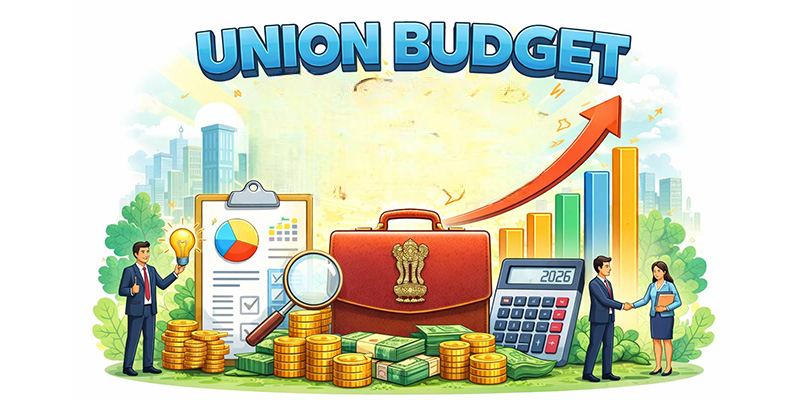
Union Budget of India
The Union Budget is presented every year in February by the Finance Minister.
What is Budget?
The budget shows:
- Government income (tax and non-tax)
- Government expenses
It is prepared under Article 112 of the Constitution.
Types of Funds in Budget
1. Consolidated Fund of India
- Main government account
- All revenues and loans are deposited here
- Money can be used only after Parliament approval
2. Contingency Fund
- Used in emergencies
- Later approval from Parliament is needed
3. Public Account
- Includes small savings, provident funds
- No prior approval needed
Budget Parts
- Revenue Budget (daily expenses)
- Capital Budget (investment and development)
Important Budget Terms
Demands for Grants
Each ministry asks for funds from Parliament.
Finance Bill
- Introduced with budget
- Contains tax changes
- It is a Money Bill
Appropriation Bill
Allows government to withdraw money from the Consolidated Fund.
Sources of Government Revenue
Tax Revenue
- Income Tax
- Corporate Tax
- GST
- Customs Duty
- Excise Duty
Non-Tax Revenue
- Interest
- Dividends
- Fines
- Service fees
Resource Transfer to States
- 2023–24: ₹11.29 lakh crore given to states
- 2024–25: ₹22.75 lakh crore estimated
This helps states in development.
Social Welfare Budgeting
SC/ST Welfare
Started in 2005–06
- SC allocation (2024–25): ₹1.66 lakh crore
- ST allocation: ₹1.21 lakh crore
Why: To improve living standards of disadvantaged communities.
Gender Budget
Started in 2005–06
- 2024–25 allocation: ₹3.3 lakh crore
Why: To support women development and empowerment.
Child Budget
Started in 2009–10
- Allocation: ₹1,09,921 crore
Why: To improve education, nutrition, and welfare of children.
Economic Performance
- Real GDP: ₹44.10 lakh crore
- Nominal GDP growth: 8%
- Inflation reduced to 5.4% (2023–24)
Public Debt and FRBM Act
Public Debt
Two types:
- Internal debt (within India)
- External debt (from foreign sources)
FRBM Act, 2003
Why launched:
To control government borrowing and maintain economic stability.
Main goals:
- Reduce fiscal deficit
- Maintain transparency
- Ensure sustainable growth
Banking Sector in India
India’s banking system is strong and growing.
Key Data (2024)
- Credit growth: 20.2%
- Total credit: ₹164.3 lakh crore
- Agricultural credit: ₹20.7 lakh crore
Banking Reforms
Insolvency and Bankruptcy Code (IBC)
Why: To solve loan default problems.
EASE Reforms (Started 2018)
Why: To improve public sector banks.
Focus areas:
- Digital banking
- Customer service
- Risk management
Digital Banking
UPI (Unified Payments Interface)
Why launched (2016):
To make digital payments easy and fast.
Growth:
- 92 crore transactions (2017-18)
- 13,116 crore transactions (2023-24)
DBT (Direct Benefit Transfer)
Why:
To send money directly to beneficiaries and reduce corruption.
Financial Stability and Reforms
CSIRT-Fin (2020)
Why:
To protect financial sector from cyber attacks.
FSDC (2010)
Why:
To maintain financial stability and coordination among regulators.
Infrastructure Development
National Infrastructure Pipeline (NIP)
- Investment: ₹111 lakh crore
- Projects: 8,900+
Why launched:
To boost economic growth and create jobs.
National Monetisation Pipeline (NMP)
- Target: ₹6 lakh crore
Why:
To generate funds by using existing government assets.
PPP(Public-Private Partnerships) Models
Examples:
- BOT
- HAM
- TOT
Why:
To involve private sector in development.
Climate Finance and Green Initiatives
Sovereign Green Bonds (2022)
Why:
To fund eco-friendly projects and reduce pollution.
Climate Goal
India needs USD 2.5 trillion (2015–2030) for climate action.
Foreign Exchange Reserves
- October 2024: USD 701 billion
India became the 4th country to cross this level.
International Financial Relations
India is connected with many international organizations to manage global economic and financial issues. These groups help countries work together, improve trade, and support development.

G20 (Group of Twenty) – Formed in 1999
The G20 is one of the most important global groups for economic and financial cooperation.
Why it was formed:
It was created in 1999 to bring together the world’s major economies to discuss financial stability and global economic issues. After the 2008 global financial crisis, it became even more important and was upgraded to a leaders’ summit level, where heads of countries meet.
How it works:
G20 operates through two main tracks:
- Finance Track – focuses on financial matters like banking, taxation, and global economy
- Sherpa Track – deals with development, climate change, and other global issues
India’s Role:
India held the G20 Presidency from 2022 to 2023, which was a major achievement. After India:
- Brazil hosted in 2024
- South Africa will host in 2025
BRICS
The BRICS is a group of major emerging economies:
- Brazil
- Russia
- India
- China
- South Africa
Why it was formed:
To promote cooperation among developing countries and reduce dependence on Western economies.
Major Achievement:
BRICS created the New Development Bank in 2014.
Purpose of NDB:
- To fund infrastructure projects
- To support sustainable development
Recent Expansion (2023):
BRICS expanded and added new countries like:
- Argentina
- Egypt
- Ethiopia
- Iran
- Saudi Arabia
- UAE
This expansion made BRICS more powerful in global economics.
SAARC (South Asian Association for Regional Cooperation) – Established in 1985
The SAARC is a regional organization that promotes cooperation among South Asian countries.
Why it was formed:
To improve economic growth, cultural ties, and regional cooperation in South Asia.
Headquarters:
Located in Kathmandu, Nepal
SAARC Development Fund (SDF) – Established in 2008
The SAARC Development Fund was created to support development projects in SAARC countries.
Purpose:
Infrastructure development
Improve livelihoods of people
Support regional integration
Fund projects in three areas:
Social sector
Economic sector
Multilateral Organizations
India works with:
- IMF (for financial stability)
- World Bank (development projects)
- AIIB (infrastructure funding)
- UNDP (poverty reduction)
- IFAD (agriculture development)
Department of Expenditure
Functions
- Manages government spending
- Implements Pay Commission
- Monitors public accounts
Key Digital Initiatives
PFMS
Why launched:
To track government funds digitally.
e-Bill (2022)
Why:
To make payments paperless and faster.
Bharatkosh Portal
Why:
To collect non-tax revenue online.
Department of Revenue
Handles all tax-related matters.
Two Boards:
- CBDT → Direct Taxes
- CBIC → Indirect Taxes
Important Acts
Indian Stamp Act, 1899
Purpose:
Tax on legal documents.
Enforcement Agencies
Directorate of Enforcement (ED) – 1956
Handles money laundering and fraud.
FIU-IND (2004)
Tracks suspicious financial transactions.
GST (Goods and Services Tax) – 2017
Why launched:
To simplify indirect tax system.
It replaced:
- VAT
- Excise
- Service Tax
Rural Banking
Regional Rural Banks (RRBs) – 1976
Why:
To support farmers and rural areas.
NABARD – 1982
Supports agriculture and rural development.
Kisan Credit Card (1998-99)
Why:
To provide easy loans to farmers.
Agriculture and Rural Schemes
Under the Atma Nirbhar Bharat Abhiyan, the government launched several important schemes to strengthen agriculture, rural economy, and related sectors.
Agriculture Infrastructure Fund (AIF) – Launched in 2020
The Agriculture Infrastructure Fund (AIF) was introduced in 2020 as part of the Atma Nirbhar Bharat package.
Why launched:
Farmers in India often face problems like lack of storage, poor supply chains, and post-harvest losses. To solve these issues, the government launched AIF.
Key features:
- Target lending of ₹1 lakh crore (2020–21 to 2023–24)
- Provides long-term loans for building warehouses, cold storage, and farming infrastructure
- Supports community farming and agri-logistics
This scheme helps farmers get better prices and reduce wastage.
Animal Husbandry Infrastructure Development Fund (AHIDF)
The AHIDF scheme was launched to improve the dairy and meat processing industry.
Why launched:
India needed better infrastructure in animal husbandry to increase farmers’ income and boost exports.
Key features:
- Target lending of ₹15,000 crore (2020–21 to 2022–23)
- Encourages investment by private companies, entrepreneurs, and Farmer Producer Organizations (FPOs)
- Focuses on dairy processing, meat processing, and animal feed plants
Insurance Sector Reforms
The insurance sector in India is regulated by the Insurance Regulatory and Development Authority of India (IRDAI), based in Hyderabad.
Why reforms were needed:
To improve insurance coverage, attract investment, and protect policyholders.
Major reforms:
- FDI limit increased from 49% to 74% in 2021
- 100% FDI allowed for insurance intermediaries
- LIC IPO in 2022, after amendment of LIC Act
- Privatization supported through the General Insurance Business Amendment Act, 2021
- Insurance Ombudsman Rules updated in 2017, 2018, and 2021
- Appeals process improved under Insurance Appeal Rules, 2016
- Insurance Act, 1938 extended to IFSC insurers
These reforms aim to make insurance more transparent, competitive, and accessible for people.vices.
Pension Schemes & DIPAM (Investment and Disinvestment)
Pension & Social Security Schemes
- National Pension System (NPS) – 2004
Started to provide retirement income to government and private employees. It is regulated by the Pension Fund Regulatory and Development Authority (PFRDA), established in 2013 to ensure safe and transparent pension management. - Atal Pension Yojana (APY) – 2015
Launched for unorganized workers to provide guaranteed pension after 60 years. - Pradhan Mantri Vaya Vandana Yojana (PMVVY)
Provides 10-year assured pension to senior citizens (60+) for financial security. - PMJJBY & PMSBY – 2015
- PMJJBY: Life insurance
- PMSBY: Accident insurance
- PMJDY – 2014
Ensures bank account for every citizen with insurance benefits. - PMMY – 2015
Provides loans up to ₹10 lakh for small businesses (Shishu, Kishore, Tarun). - Stand-Up India – 2016
Supports SC/ST and women entrepreneurs with loans up to ₹1 crore.
Digital Finance
- DIGIDHAN Mission – 2017
Promotes digital payments across India. - UPI – 2016
Enables instant money transfer; transactions crossed 13,000 crore by 2023-24.
DIPAM & Disinvestment
Bharat Bond ETF – 2019
Safe investment option in government bonds, raised ₹32,400 crore.overnment bonds.
DIPAM
Started in 1999, renamed in 2016; manages government investments and disinvestment.
Disinvestment Policy (2015 onwards)
Strategic sale (with control transfer)
Minority stake sale
New PSE Policy – 2021
Classifies sectors into strategic and non-strategic.
Conclusion
The Ministry of Finance plays a key role in shaping India’s economy. From managing taxes and budgets to running welfare schemes and supporting growth, it affects the life of every citizen.
It ensures:
- Economic stability
- Development
- Financial inclusion
- Transparency
Understanding this ministry helps us understand how the country grows and functions.
FAQs
1. What is the main function of the Ministry of Finance?
It manages government money, taxation, and economic policies.
2. When was GST introduced?
GST was introduced in 2017.
3. What is PMJDY?
It is a scheme launched in 2014 to provide bank accounts to all citizens.
4. What is FRBM Act?
A law to control government borrowing and ensure financial stability.
5. What is UPI?
A digital payment system that allows instant money transfer.