

Public Distribution System in India: Food Security and Welfare Support

The Public Distribution System (PDS) is one of India’s largest welfare programs aimed at providing food security to millions of people. It helps poor and vulnerable families access essential food items at subsidized prices through a network of ration shops across the country.
The system is managed by the Government of India under the Ministry of Consumer Affairs, Food and Public Distribution. Over the years, the Public Distribution System has become an important tool for reducing hunger, ensuring food availability, and supporting low-income households.

The main objective of the Public Distribution System is to make food grains available at affordable prices, especially to economically weaker sections of society. Through this system, food items such as rice, wheat, sugar, and other essential commodities are distributed to eligible families.
What is the Public Distribution System?
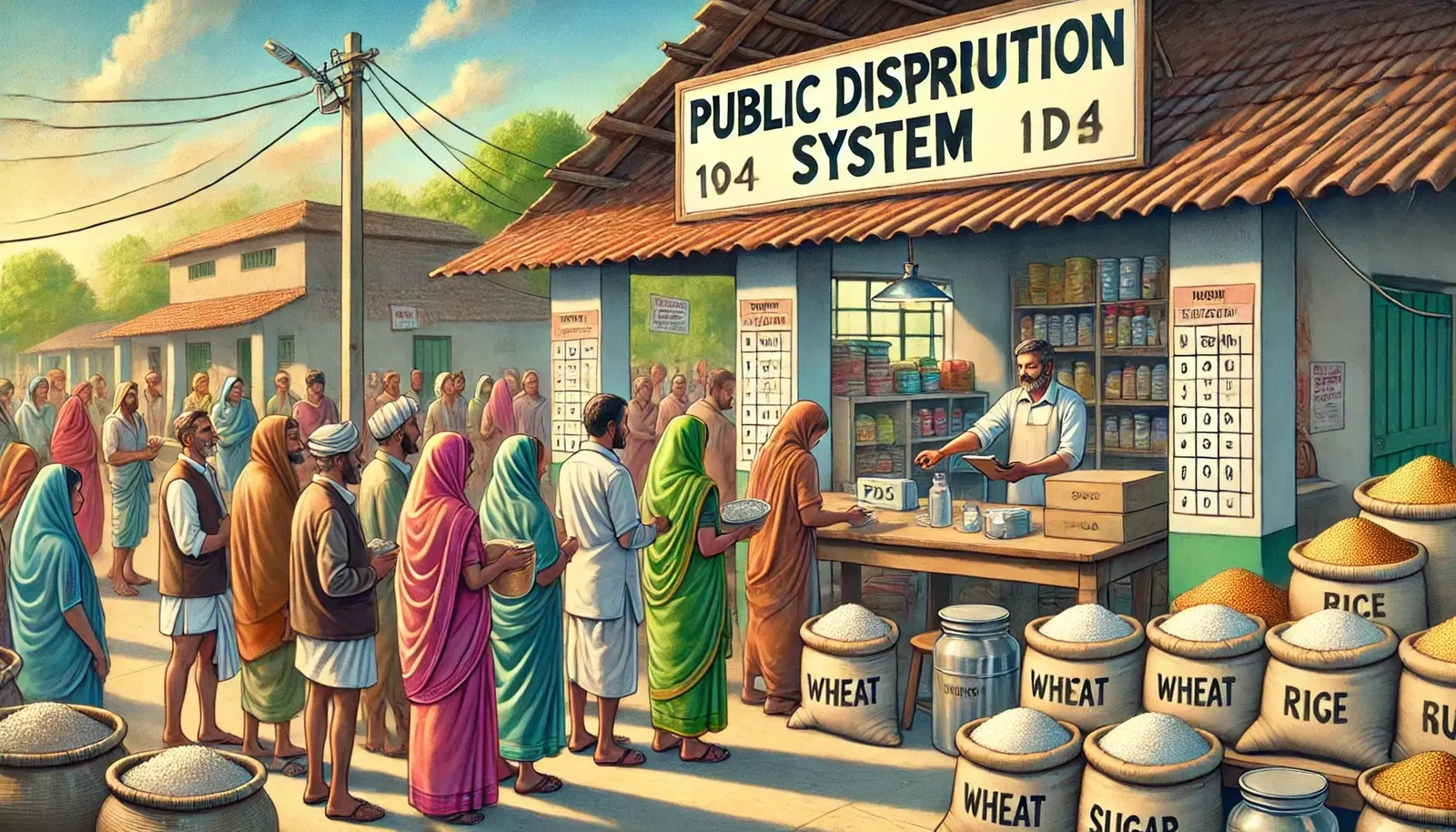
The Public Distribution System is a government-run food distribution network that supplies subsidized food grains to eligible households through Fair Price Shops (FPS), commonly known as ration shops.
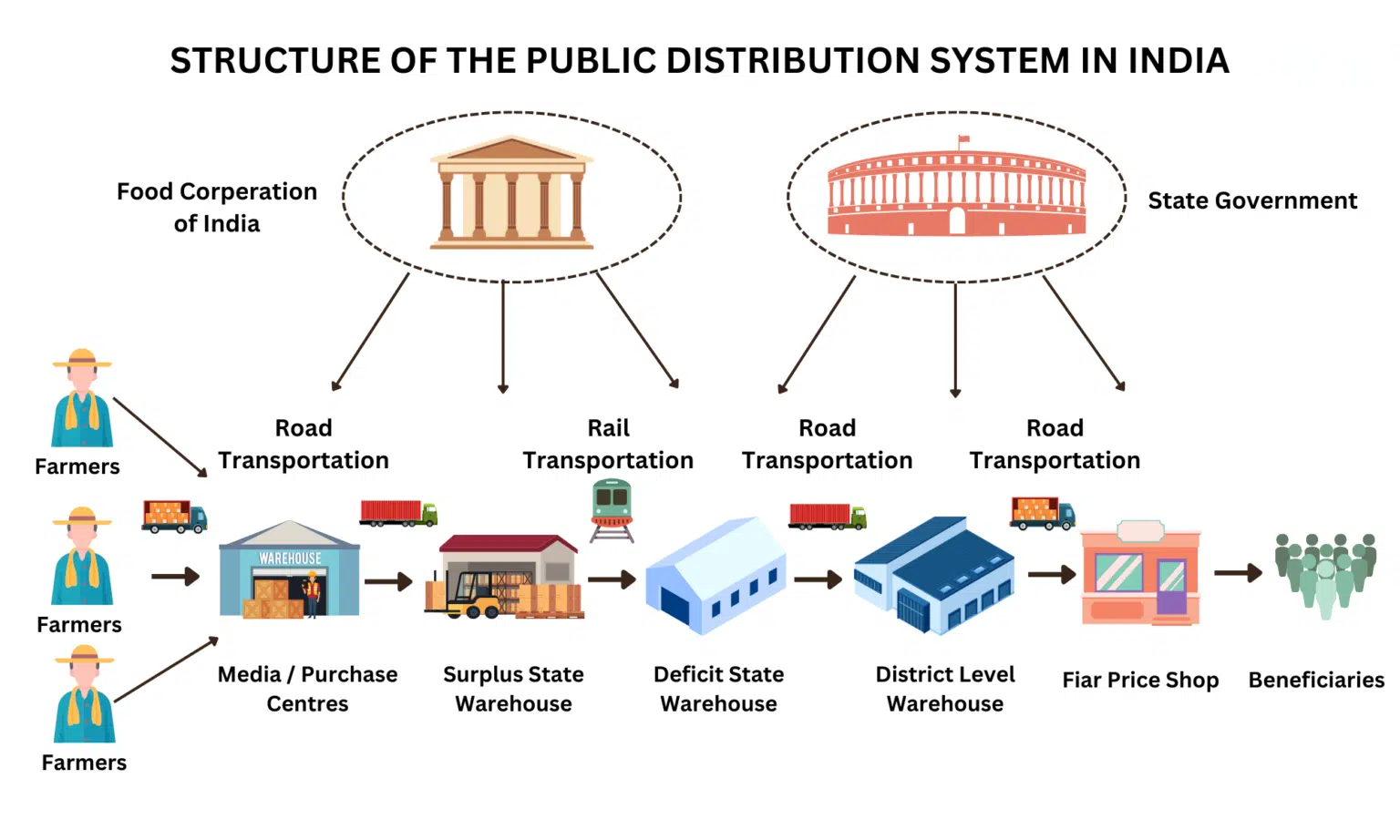
The Central Government procures food grains from farmers, stores them, and supplies them to states. State Governments then distribute these food grains to beneficiaries through local ration shops.
Today, the Public Distribution System serves as the backbone of India’s food security framework and supports millions of families every month.
Objectives of the Public Distribution System
The major objectives of the Public Distribution System are:
- Ensure food security for all citizens.
- Provide affordable food grains to poor households.
- Protect vulnerable families from hunger.
- Stabilize food prices in the market.
- Maintain buffer stocks of food grains.
- Support farmers through government procurement.
- Reduce regional food shortages.
Evolution of Public Distribution System in India
During World War II
The Public Distribution System was first introduced during World War II as a rationing measure to manage food shortages. At that time, India depended heavily on imported food grains.
Expansion During the 1960s
India faced serious food shortages during the 1960s. To address this challenge, the government expanded the Public Distribution System and established institutions such as:
| Institution | Purpose |
|---|---|
| Agriculture Prices Commission | Recommend support prices for farmers |
| Food Corporation of India (FCI) | Procurement, storage, and distribution of food grains |
These reforms helped strengthen domestic food production and food grain management.
Universal Distribution in the 1970s
By the 1970s, the Public Distribution System became a universal scheme. Every citizen could access subsidized food grains regardless of income level.
Revamped Public Distribution System (RPDS), 1992
In 1992, the government launched the Revamped Public Distribution System to improve services in remote, tribal, hilly, and inaccessible areas.
The main goal was to ensure that poor communities living in difficult regions also received food assistance.
Targeted Public Distribution System (TPDS), 1997
In June 1997, the government introduced the Targeted Public Distribution System (TPDS).
Under TPDS, beneficiaries were divided into:
| Category | Description |
| BPL | Below Poverty Line families |
| APL | Above Poverty Line families |
The scheme focused more on poor households and directed subsidies towards those who needed them most.
Antyodaya Anna Yojana (AAY), 2000
The Antyodaya Anna Yojana was launched in December 2000.
This scheme targeted the poorest families in India who often struggled to get two meals a day. Under AAY, beneficiaries receive food grains at highly subsidized rates.
National Food Security Act, 2013
A major milestone came in September 2013 when Parliament passed the National Food Security Act (NFSA).
This law made access to food a legal right for eligible citizens. It expanded food security coverage and strengthened the role of TPDS in delivering food grains to poor households.
How the Public Distribution System Works
The Public Distribution System operates through cooperation between the Central Government and State Governments.
Role of the Central Government
The Central Government:
- Procures food grains from farmers.
- Pays Minimum Support Price (MSP).
- Stores food grains through the Food Corporation of India.
- Maintains buffer stocks.
- Allocates food grains to states.
- Arranges transportation to state warehouses.
Role of State Governments
State Governments:
- Identify eligible beneficiaries.
- Issue ration cards.
- Transport food grains from warehouses to ration shops.
- Monitor Fair Price Shops.
- Handle grievance redressal.
Distribution Process
- Farmers sell food grains to the government at MSP.
- Food grains are stored in FCI warehouses.
- States receive allocated food grains.
- Food grains are transported to Fair Price Shops.
- Beneficiaries purchase food grains at subsidized prices.
Importance of the Public Distribution System
1. Ensures Food Security
The Public Distribution System helps ensure that poor families have access to essential food items throughout the year.
2. Controls Food Prices
Subsidized distribution helps stabilize food prices and protects consumers from sudden market fluctuations.
3. Maintains Buffer Stocks
The government stores large quantities of food grains to handle emergencies such as droughts, floods, or crop failures.
4. Supports Farmers
Through MSP and procurement operations, farmers receive assured prices for their produce.
5. Reduces Regional Imbalances
Food grains are moved from surplus-producing states to deficit regions, ensuring availability across the country.
6. Helps Fight Hunger
The Public Distribution System plays a vital role in reducing hunger and malnutrition among vulnerable populations.
Major Challenges Faced by the Public Distribution System
Despite its achievements, the Public Distribution System faces several challenges.
Errors in Beneficiary Identification
One of the biggest problems is the incorrect identification of beneficiaries.
Some deserving families are excluded from the system, while some ineligible households receive benefits.
This leads to:
- Exclusion errors
- Inclusion errors
- Misclassification of beneficiaries
Leakage of Food Grains
Food grains often leak from the supply chain before reaching beneficiaries.
Common reasons include:
- Theft during transportation
- Black marketing
- Diversion to open markets
- Corruption at ration shops
These leakages reduce the effectiveness of the system.
Procurement Issues
The government often continues purchasing food grains even when buffer stocks are already full.
This can create shortages in open markets and increase storage burdens.
Storage Problems
India still faces shortages of modern storage facilities.
As procurement increases, food grains sometimes suffer damage due to:
- Poor storage conditions
- Rainwater exposure
- Pest attacks
- Lack of covered warehouses
Food grain wastage remains a serious concern.
Limited Crop Diversification
The MSP system strongly favors rice and wheat production.
As a result:
- Farmers focus heavily on these crops.
- Production of coarse grains declines.
- Agricultural diversification is discouraged.
Environmental Concerns
Excessive cultivation of rice and wheat has created environmental challenges.
States such as Punjab and Haryana face:
- Groundwater depletion
- Soil degradation
- Excessive fertilizer usage
- Water scarcity
These issues threaten long-term agricultural sustainability.
Reforms in the Public Distribution System
To improve efficiency and transparency, various reforms have been introduced.
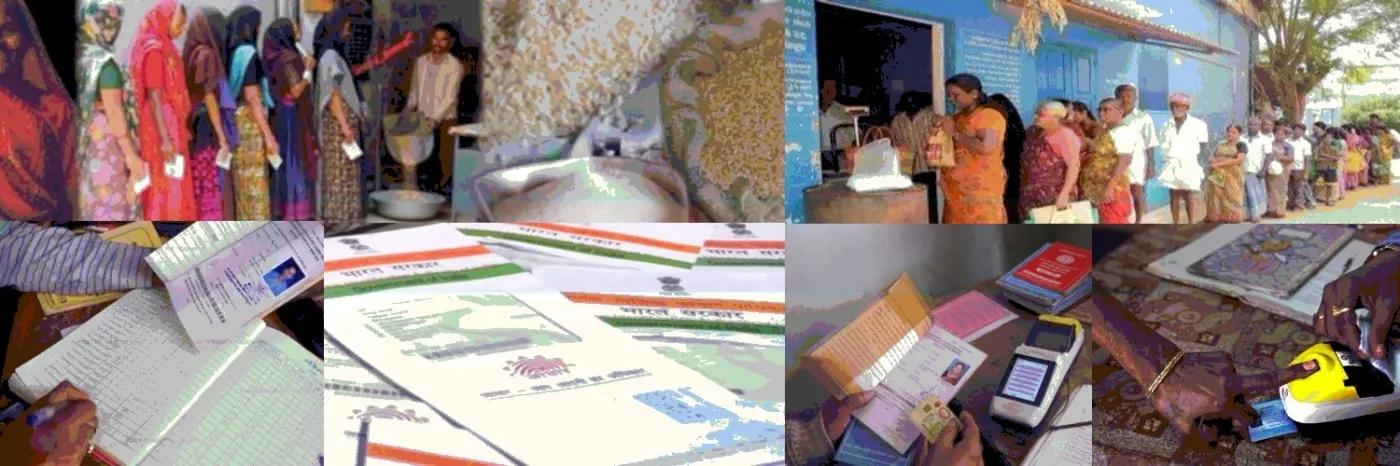
Aadhaar Integration
Linking Aadhaar with ration cards helps:
- Remove duplicate beneficiaries.
- Eliminate fake ration cards.
- Improve beneficiary identification.
- Reduce fraud.
Digitization of Ration Cards
Many states have digitized ration card records.
Benefits include:
- Faster verification.
- Better record management.
- Improved transparency.
- Reduced corruption.
Computerized Allocation Systems
Computerized systems help monitor:
- Food grain allocation.
- Stock positions.
- Distribution records.
- Supply chain activities.
This improves accountability.
Smart Cards
Some states have introduced smart cards containing:
- Beneficiary details
- Biometric information
- Family records
- Monthly entitlements
Smart cards reduce counterfeiting and fraud.
GPS Tracking
GPS technology tracks trucks transporting food grains.
Benefits include:
- Reduced diversion of food grains.
- Better monitoring.
- Improved delivery efficiency.
SMS-Based Monitoring
Citizens can receive SMS alerts regarding:
- Dispatch of food grains
- Arrival at ration shops
- Availability of stock
This increases public participation and transparency.
Citizen Portals
Online grievance portals allow people to:
- Register complaints
- Track grievances
- Access information
- Report irregularities
Public Distribution System and Direct Benefit Transfer (DBT)
The National Food Security Act also allows reforms through Direct Benefit Transfer (DBT).
Under DBT, beneficiaries receive money directly into their bank accounts instead of receiving food grains.
Benefits of DBT
- Reduces transportation costs.
- Minimizes leakage.
- Encourages financial inclusion.
- Gives beneficiaries greater freedom of choice.
- Improves targeting.
Challenges of DBT
- Cash may be spent on non-food items.
- Poor banking access in remote areas.
- Exposure to inflation and rising food prices.
- Digital literacy issues.
Because of these concerns, experts suggest a cautious approach while expanding DBT.
Role of Technology in Strengthening PDS
Technology has significantly improved the Public Distribution System.
Key technological interventions include:
| Reform | Benefit |
| Aadhaar Linking | Eliminates duplicate beneficiaries |
| Digitized Ration Cards | Improves transparency |
| GPS Tracking | Reduces diversion |
| Smart Cards | Prevents fraud |
| SMS Alerts | Increases citizen monitoring |
| Online Portals | Improves grievance redressal |
States such as Chhattisgarh, Tamil Nadu, Madhya Pradesh, Karnataka, Gujarat, Andhra Pradesh, Haryana, Odisha, and Delhi have successfully implemented several of these reforms.
Future of the Public Distribution System
The Public Distribution System remains essential for India’s food security goals.
To make it more effective, the government should focus on:
- Modern storage infrastructure.
- Better beneficiary identification.
- Strong monitoring systems.
- Greater transparency.
- Reduced leakages.
- Public participation through social audits.
- Improved training of officials.
- Use of advanced technology.
There is also a growing need to distribute nutritious and bio-fortified food grains through the Public Distribution System to address malnutrition and improve public health.
With continuous reforms and technological improvements, the Public Distribution System can become more transparent, efficient, and beneficial for millions of people across India.
FAQs
1. What is the Public Distribution System (PDS)?
The Public Distribution System is a government scheme that provides subsidized food grains and essential commodities to eligible households through ration shops.
2. Who manages the Public Distribution System?
The system is jointly managed by the Central Government and State Governments.
3. What are Fair Price Shops?
Fair Price Shops are ration shops where beneficiaries purchase subsidized food grains under the Public Distribution System.
4. What is TPDS?
Targeted Public Distribution System (TPDS) is a scheme launched in 1997 that focuses on providing food subsidies to poor households.
5. What is Antyodaya Anna Yojana?
Antyodaya Anna Yojana is a food security scheme that provides highly subsidized food grains to the poorest families in India.
6. What is the role of Aadhaar in PDS?
Aadhaar helps eliminate duplicate beneficiaries, reduce fraud, and improve transparency in food distribution.
7. What are the major problems in the Public Distribution System?
Major issues include beneficiary identification errors, food grain leakages, storage shortages, corruption, and environmental concerns.
8. What is Direct Benefit Transfer (DBT)?
DBT is a system where food subsidy benefits are transferred directly to beneficiaries’ bank accounts instead of providing physical food grains.