Rashtrakuta Empire: History, Administration, Art and Architecture

Rashtrakuta Empire was one of the most powerful dynasties in medieval Indian history. The Rashtrakutas ruled large parts of India for nearly two hundred years, especially in the Deccan region. Their empire became famous for strong administration, military power, cultural development, religious tolerance, literature, and magnificent art and architecture. The Rashtrakutas acted as a bridge between North India and South India by connecting trade, culture, and political ideas.
Thank you for reading this post, don't forget to subscribe!The dynasty played an important role in shaping Indian history between the 8th and 10th centuries. During their rule, India witnessed growth in education, religion, trade, and temple architecture. Their rulers were not only brave warriors but also supporters of literature, scholars, and religion. The famous Kailasanatha Temple at Ellora remains one of the greatest achievements of Indian architecture.
Who Were the Rashtrakutas?
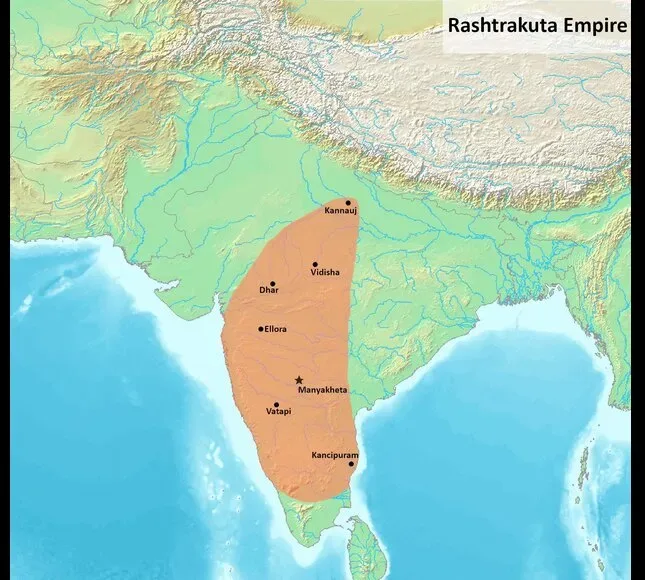
The Rashtrakutas were a powerful ruling dynasty that dominated the Deccan region of India from the 8th century to the 10th century CE. Their capital was Manyakheta, also known as Malkhed, located in present-day Karnataka.
The Rashtrakutas expanded their influence over large territories in North and South India. They controlled important trade routes and maintained strong political relations with neighboring kingdoms. Since there was no strong northern power during their rise, the Rashtrakutas got an opportunity to build a vast empire.
The dynasty is remembered for:
- Military strength
- Efficient administration
- Promotion of art and architecture
- Religious tolerance
- Development of literature
- Expansion of trade and economy
The Rashtrakutas also promoted cultural exchange between northern and southern India. They adopted and spread many traditions, administrative systems, and cultural practices across different regions.
Origin of the Rashtrakutas
Several branches of the Rashtrakuta family ruled in different regions of India during the early medieval period. Historians believe that the earliest Rashtrakuta ruling family was founded by Mananka at Malkhed.
Their royal symbol included:
- Palidhvaja (royal flag)
- Garuda-lanchhana (bird symbol)
Another branch of the Rashtrakutas ruled parts of present-day Madhya Pradesh and Gujarat. Inscriptions found in different regions provide information about their family line and political control.
The Rashtrakutas slowly became powerful by defeating neighboring kingdoms and expanding their territories.
Important Rulers of the Rashtrakuta Empire
Dantidurga
Dantidurga was the founder of the Rashtrakuta Empire. He established his capital at Manyakheta near modern Karnataka. He is considered one of the most important rulers because he laid the foundation of the empire.
Dantidurga defeated the Chalukya ruler Kirtivarman II in 753 CE and ended the rule of the Badami Chalukyas. After this victory, he assumed grand royal titles such as:
- Prithivivallabha
- Maharajadhiraja
- Parameshvara
- Paramabhattaraka
He also attacked Kanchi, the capital of the Pallavas, and formed alliances with other rulers.
Under Dantidurga, the Rashtrakuta kingdom expanded rapidly. His rule marked the beginning of Rashtrakuta power in Indian history.
Krishna I
After Dantidurga’s death, his uncle Krishna I became king in 756 CE. He was a capable ruler and greatly expanded the empire.
Krishna I defeated the remaining Chalukya forces and extended his rule over:
- Maharashtra
- Karnataka
- Parts of Andhra Pradesh
- Madhya Pradesh
- Southern Konkan region
He also established authority over the Ganga kingdom in South India.
Krishna I is most famous for constructing the magnificent Kailasanatha Temple at Ellora. This temple is considered one of the greatest rock-cut temples in the world.
Govinda II
Govinda II ruled from 774 CE to 780 CE. His reign was affected by civil war with his younger brother Dhruva. Because of internal conflicts, his rule was not very successful.
Some later Rashtrakuta records even ignored his name because of political disputes.
Dhruva Dharavarsha
Dhruva became king after defeating Govinda II. He was a strong and ambitious ruler who expanded the Rashtrakuta Empire in both northern and southern India.
His important titles included:
- Nirupama
- Kali-vallabha
- Dharavarsha
- Shrivallabha
Dhruva punished rulers who had supported Govinda II during the civil war. He also selected his talented son Govinda III as successor during his own lifetime.
Govinda III
Govinda III was one of the greatest rulers of the Rashtrakuta dynasty. He ruled from 793 CE to 814 CE.
His military achievements made the Rashtrakuta Empire famous throughout India. He defeated many powerful rulers and expanded the empire from the Himalayas in the north to Cape Comorin in the south.
His titles included:
- Jagattunga
- Kirti-Narayana
- Janavallabha
- Tribhuvanadhavala
- Prabhutavarsha
Govinda III successfully controlled rebellions and conquered regions such as:
- Malwa
- Kosala
- Kalinga
- Vengi
- Dahala
- Odraka
His diplomatic and military skills made the Rashtrakutas one of the strongest empires in India.
Amoghavarsha I
Amoghavarsha I ruled from 814 CE to 878 CE and became one of the most respected Rashtrakuta rulers.
Unlike many warrior kings, he was deeply interested in religion, literature, and philosophy. He spent much of his time with Jain monks and scholars.
His titles included:
- Nripatunga
- Atisayadhavala
- Maharaja-shanda
- Vira-Narayana
Amoghavarsha I strongly supported Jainism, but he also respected Brahmanical traditions. He performed religious rituals for the welfare of his people.
He was not only a patron of literature but also an author himself. Scholars and poets received royal support during his reign.
The famous Jain scholar Jinasena, author of Adipurana, lived during his rule.
Krishna II
Krishna II ruled from 878 CE to 914 CE. His reign faced many rebellions and military challenges.
Although he attempted wars against the Cholas and Vengi rulers, he was not very successful. However, he managed to end the Lata viceroyalty and maintain parts of the empire.
Indra III
Indra III became ruler in 915 CE and restored Rashtrakuta power.
He defeated the ruler Mahipala and attacked Kanauj, one of the most important cities in North India. His victories made him one of the strongest rulers of his time.
His titles included:
- Nityavarsha
- Kirti-Narayana
- Rajamarathanda
Indra III’s military campaigns helped re-establish the strength of the Rashtrakuta Empire.
Krishna III
Krishna III was the last great Rashtrakuta ruler. He defeated the Chola king Parantaka I and captured northern parts of the Chola kingdom.
He even reached Rameshwaram and built a temple there to celebrate his victory.
After his death around 966 CE, the Rashtrakuta Empire weakened rapidly. Their enemies united against them, and the capital Manyakheta was attacked and destroyed by the Paramaras in 972 CE.
This marked the decline of Rashtrakuta power.
Administration of the Rashtrakuta Empire
Nature of Administration
The Rashtrakutas created a vast empire consisting of nearly seven and a half lakh villages. They developed an organized system of administration to manage such a large territory.
The administration was influenced by:
- Gupta Empire
- Harsha’s kingdom
- Chalukya administration
The king was the supreme authority and controlled:
- Administration
- Military
- Law and order
- Revenue collection
Monarchy and Feudal System
The Rashtrakuta government was based on monarchy. The king was supported by feudatories and vassal chiefs.
Over time, the empire became more feudal in nature. Local chiefs gained more power and hereditary positions became common.
The king expected complete loyalty from:
- Ministers
- Feudatories
- Officials
- Military commanders
System of Succession
The throne usually passed from father to son, but succession rules were not fixed.
Many times, brothers fought each other for power. For example:
- Dhruva defeated his elder brother Govinda II
- Govinda IV also removed his elder brother
This shows that military strength often decided succession.
Ministers and Officials
The king was assisted by important ministers and officials. These included:
- Chief Minister
- Foreign Minister
- Revenue Minister
- Treasurer
- Chief Justice
- Army Commander
- Purohita (priest)
These officials helped manage the empire effectively.
Administrative Divisions
The empire was divided into different administrative units:
- Rashtra – Province
- Vishaya – District
- Bhukti – Smaller division
The Vishaya was managed by an officer called Visayapati.
Village administration formed the base of governance.
Village Administration
Villages were the smallest administrative units. Village administration was handled by:
- Village headman
- Village accountant
- Village elders
Their positions were usually hereditary.
Village committees managed:
- Schools
- Roads
- Temples
- Water tanks
These committees worked closely with local officials.
Town Administration
Towns also had committees that included heads of trade guilds.
Law and order in cities were maintained by officers known as:
- Koshta-pala
- Kotwal
These officers protected cities and nearby areas.
Revenue System
Land revenue was the main source of income for the Rashtrakutas.
Officials were often paid through grants of rent-free land instead of salaries.
The administration mainly focused on:
- Tax collection
- Maintaining law and order
- Managing agriculture
Military System of the Rashtrakutas
The Rashtrakutas maintained a powerful military to protect and expand their empire.
Their army included:
- Infantry
- Cavalry
- War elephants
The Rashtrakutas were famous for importing high-quality horses from:
- Arabia
- West Asia
- Central Asia
They also built many forts protected by special troops.
The army included both:
- Regular soldiers
- Troops supplied by feudatories
War chariots were no longer used during this period.
The strength of their military helped the Rashtrakutas dominate Indian politics for nearly two centuries.
Art and Architecture Under the Rashtrakutas
The Rashtrakutas made remarkable contributions to Indian art and architecture. Their temples and cave monuments are considered masterpieces of Indian culture.
Most of their architectural achievements can still be seen in Maharashtra and Karnataka.
Ellora Caves
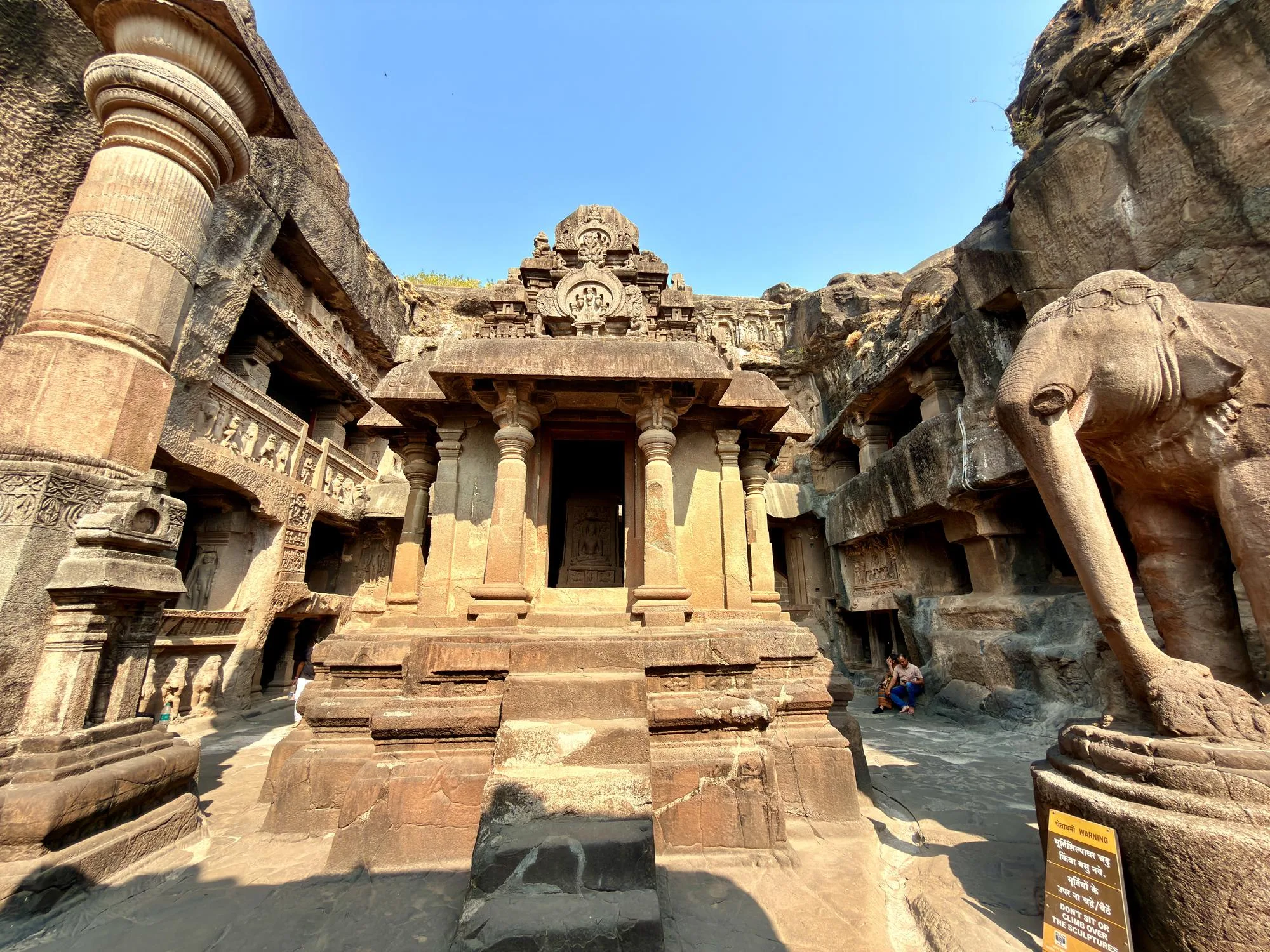
The Ellora Caves are among the greatest examples of Indian rock-cut architecture.
The caves include:
- Buddhist caves
- Hindu temples
- Jain caves
The Rashtrakutas renovated older caves and also built new temples.
Jain monks lived at Ellora during the reign of Amoghavarsha I.
Kailasanatha Temple
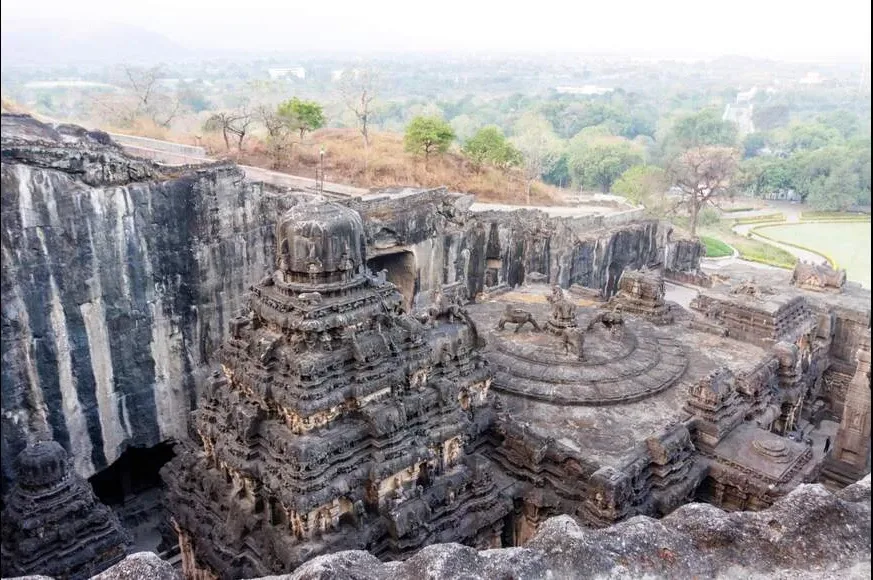
The Kailasanatha Temple at Ellora is the most famous creation of the Rashtrakutas.
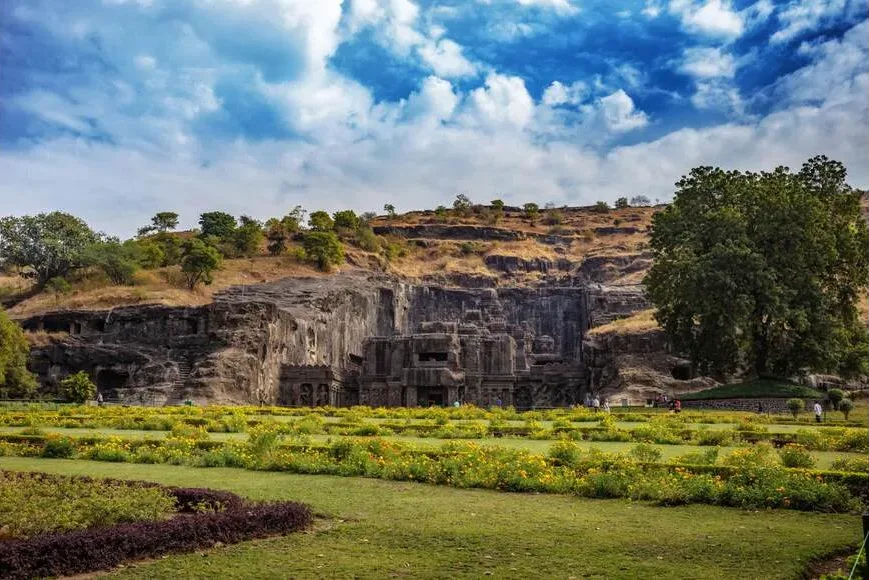
It was built by Krishna I and is one of the largest rock-cut Hindu temples in the world.
The temple follows the Karnata Dravida style of architecture.
Main features of the temple include:
- Monolithic rock-cut structure
- Large gateway
- Nandi pavilion
- Massive courtyard
- Beautiful sculptures
The temple walls contain scenes from:
- Ramayana
- Hindu mythology
- Stories of Shiva and Parvati
One famous sculpture shows Ravana trying to lift Mount Kailasa, the home of Lord Shiva.
Another sculpture shows Goddess Durga killing the buffalo demon Mahishasura.
The temple remains one of India’s greatest architectural wonders.
Elephanta Caves
The Elephanta Caves are located on an island near Mumbai. Earlier, the island was called Sripuri or Gharapuri.
The caves are famous for huge sculptures dedicated to Lord Shiva.
Important sculptures include:
- Nataraja
- Gangadhara
- Ardhanarishvara
- Somaskanda
- Trimurti
The entrance contains giant guardian figures called Dwarapalakas.
The style of the Elephanta Caves shows similarities with Ellora, proving the continuity of artistic traditions.
Navalinga Temple
The Navalinga Temple complex was built during the Rashtrakuta period by Amoghavarsha I or Krishna II.
It is located at Kukkanur in Karnataka.
The temple complex contains nine temples built in Dravidian style architecture.
The name “Navalinga” comes from the presence of Shiva Lingas inside the temples.
Religion Under the Rashtrakutas
The Rashtrakutas followed a policy of religious tolerance.
They supported:
- Hinduism
- Jainism
- Buddhism
Many rulers personally followed Jainism, especially Amoghavarsha I. However, they respected all religions and donated to temples and religious institutions.
Their religious policy helped maintain peace and cultural growth in the empire.
Literature and Education
The Rashtrakuta period saw major progress in literature and education.
Languages promoted during their rule included:
- Sanskrit
- Kannada
Many scholars received royal support.
Amoghavarsha I himself wrote literary works and encouraged poets and philosophers.
Famous scholars of the period included:
- Jinasena
- Gunabhadra
- Mahaviracharya
Educational institutions and religious centers flourished during their rule.
Economy and Trade
The Rashtrakuta Empire had a strong economy based mainly on:
- Agriculture
- Trade
- Taxation
Trade with foreign countries increased during their rule. Arab travelers described the Rashtrakutas as one of the most powerful kingdoms in the world.
The empire traded goods such as:
- Textiles
- Spices
- Precious stones
- Horses
Their strategic location helped connect North India and South India through trade routes.
Decline of the Rashtrakuta Empire
After the death of Krishna III, the Rashtrakuta Empire began to weaken.
Reasons for decline included:
- Internal conflicts
- Weak successors
- Attacks by rival kingdoms
- Rise of regional powers
The Paramaras attacked and destroyed the capital Manyakheta in 972 CE.
Finally, the Western Chalukyas replaced the Rashtrakutas and established their own rule in the Deccan.
Importance of the Rashtrakuta Empire
The Rashtrakutas hold a very important place in Indian history because of their achievements in politics, culture, and architecture.
Their importance can be understood through:
- Political unification of large territories
- Cultural connection between North and South India
- Promotion of religious tolerance
- Development of Kannada literature
- Magnificent temple architecture
- Strong military organization
- Economic growth and foreign trade
Their monuments like the Kailasanatha Temple continue to attract visitors and historians from around the world.
Conclusion
The Rashtrakuta Empire was one of the greatest dynasties of medieval India. The Rashtrakutas ruled for nearly two centuries and established a powerful empire across the Deccan and other regions of India. Their rulers were brave warriors, skilled administrators, and great supporters of religion, literature, and art.
The dynasty is especially remembered for its magnificent architectural achievements such as the Kailasanatha Temple at Ellora and the Elephanta Caves. Their contributions to administration, military organization, trade, and culture left a lasting impact on Indian civilization.
Even today, the legacy of the Rashtrakutas can be seen in India’s historical monuments, literature, and cultural traditions.
FAQs About Rashtrakuta Empire
1. Who founded the Rashtrakuta Empire?
The Rashtrakuta Empire was founded by Dantidurga in the 8th century CE after defeating the Chalukyas.
2. What was the capital of the Rashtrakuta Empire?
Manyakheta, also known as Malkhed, was the capital of the Rashtrakuta Empire.
3. Which Rashtrakuta ruler built the Kailasanatha Temple?
King Krishna I built the famous Kailasanatha Temple at Ellora.
4. Why was Amoghavarsha I famous?
Amoghavarsha I was famous for supporting Jainism, literature, education, and cultural development.
5. What were the main achievements of the Rashtrakutas?
Their main achievements included strong administration, military power, temple architecture, literature, and trade growth.
6. Which religions were supported by the Rashtrakutas?
The Rashtrakutas supported Hinduism, Jainism, and Buddhism.
7. What is the most famous architectural work of the Rashtrakutas?
The Kailasanatha Temple at Ellora is the most famous architectural achievement of the Rashtrakutas.
8. How did the Rashtrakuta Empire decline?
The empire declined because of internal conflicts, weak rulers, and attacks by rival kingdoms like the Paramaras.