


Renewable Energy India: Schemes, Policies and Achievements

Renewable Energy in India has become one of the country’s biggest priorities as the demand for electricity continues to increase. With rapid economic growth, urbanization, industrial development, and a growing population, India needs more energy than ever before. At the same time, the country is also working to reduce pollution and fight climate change.
Thank you for reading this post, don't forget to subscribe!The Ministry of New and Renewable Energy (MNRE) is the government body responsible for promoting clean energy sources such as solar, wind, biomass, small hydropower, and other renewable technologies. Through various schemes and policies, the ministry aims to reduce dependence on fossil fuels, improve energy security, protect the environment, and create new employment opportunities.
What is the Ministry of New and Renewable Energy?
The Ministry of New and Renewable Energy is responsible for planning, promoting, and developing renewable energy sources across India.
Its major objectives include:
- Increasing renewable energy generation.
- Reducing greenhouse gas emissions.
- Promoting clean and sustainable energy.
- Improving energy access in rural and urban areas.
- Encouraging private investment in renewable projects.
- Supporting India’s climate commitments.
The ministry plays a major role in helping India transition towards a cleaner and greener energy future.
India’s Climate Commitments under the Paris Agreement
India is one of the countries committed to reducing the impact of climate change.
Under its Nationally Determined Contributions (NDCs) submitted as part of the Paris Agreement, India initially pledged to:
- Generate 40% of installed electricity capacity from non-fossil fuel sources by 2030.
- Reduce the emission intensity of GDP by 33-35% compared to 2005 levels.
Since then, India has updated its climate goals.
Updated Targets
India has strengthened its commitments by aiming to:
- Achieve about 50% of installed electric power capacity from non-fossil fuel sources by 2030.
- Reduce the emission intensity of GDP by 45% from 2005 levels.
- Achieve Net Zero emissions by 2070.
These updated goals reflect India’s growing focus on sustainable development and clean energy.
India’s Renewable Energy Targets
In 2015, India announced an ambitious target of installing 175 GW of renewable energy capacity by 2022, including:
- 100 GW Solar Power
- 60 GW Wind Power
- 10 GW Biomass Power
- 5 GW Small Hydropower
Although the 2022 target was not fully achieved, India continued expanding renewable energy rapidly. By 2025, installed renewable energy capacity crossed 220 GW, making India one of the world’s leading renewable energy producers.
The government has now set an even bigger goal of reaching 500 GW of non-fossil fuel capacity by 2030.
PM-KUSUM Scheme
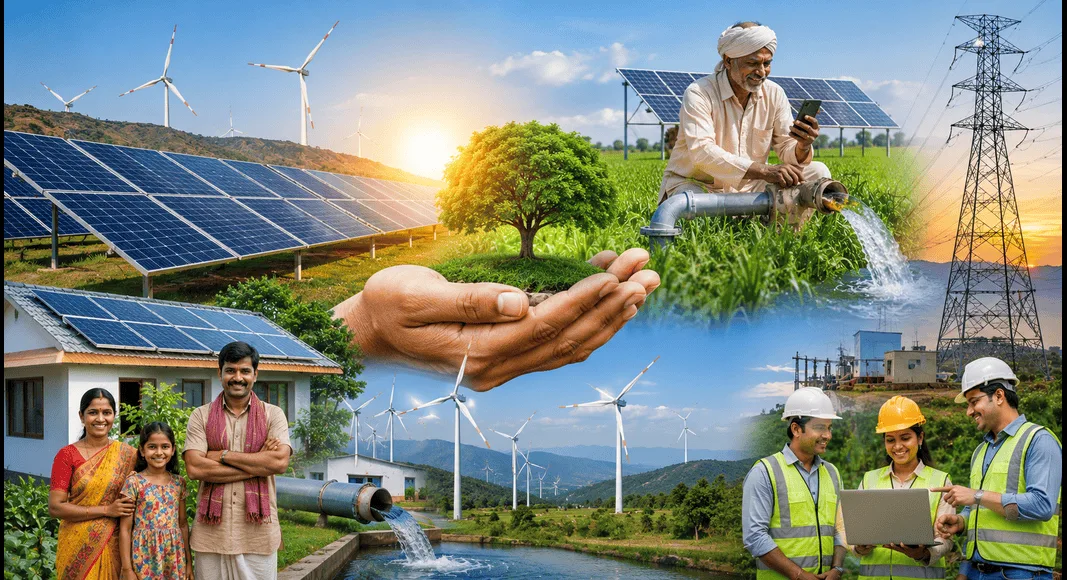
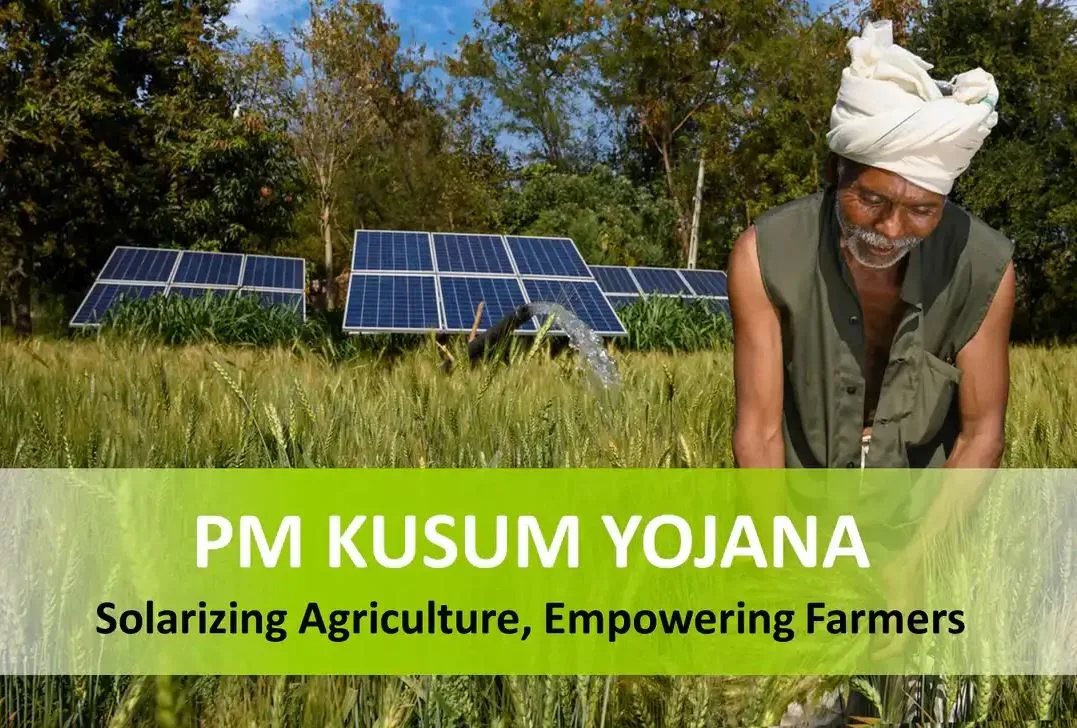
The Pradhan Mantri Kisan Urja Suraksha evam Utthaan Mahabhiyan (PM-KUSUM) is one of India’s most important renewable energy schemes for farmers.
It helps farmers generate solar energy while reducing electricity costs.
Main Components
1. Solar Power Plants
Farmers can install decentralized solar power plants on barren or unused land near substations.
This provides:
- Additional income from selling electricity.
- Productive use of unused land.
- Clean electricity generation.
2. Solar Water Pumps
Farmers receive support to install standalone solar irrigation pumps.
These pumps:
- Reduce dependence on diesel.
- Lower irrigation costs.
- Work in remote villages without electricity.
3. Solarization of Existing Pumps
Existing electric pumps can be converted into solar-powered pumps.
Farmers can use electricity for irrigation and sell surplus power back to electricity distribution companies, creating an additional source of income.
Ultra Mega Renewable Energy Power Parks
The government launched the Ultra Mega Renewable Energy Power Parks (UMREPPs) scheme to develop large renewable energy parks across the country.
These parks provide:
- Ready land for developers.
- Transmission infrastructure.
- Solar and wind energy projects.
- Hybrid renewable systems.
- Energy storage facilities.
This reduces project costs and speeds up renewable energy development.
Grid Connected Rooftop Solar Programme
The Rooftop Solar Programme encourages households, schools, offices, hospitals, industries, and commercial buildings to install solar panels on rooftops.
The generated electricity is connected directly to the power grid.
Benefits
- Lower electricity bills.
- Reduced dependence on fossil fuels.
- Clean energy generation.
- Increased private investment.
- Better use of unused rooftop space.
The government continues to provide financial assistance for residential rooftop solar systems under updated schemes introduced after 2022.
National Wind-Solar Hybrid Policy
Solar power is available during the daytime, while wind energy often increases during evenings and different seasons.
The Wind-Solar Hybrid Policy combines both sources to improve electricity generation.
Its objectives include:
- Better use of land.
- Better use of transmission infrastructure.
- More stable electricity supply.
- Reduced fluctuations in renewable energy generation.
- Promotion of innovative hybrid technologies.
Hybrid projects are becoming increasingly popular across several Indian states.
National Offshore Wind Energy Policy
India has a coastline of nearly 7,600 kilometres, offering huge potential for offshore wind power.
The National Offshore Wind Energy Policy aims to develop wind farms in the sea, especially along the coasts of Gujarat and Tamil Nadu.
The estimated offshore wind potential exceeds 70 GW.
Offshore wind projects produce clean electricity without occupying valuable agricultural land.
Understanding India’s Exclusive Economic Zone (EEZ)
India enjoys special rights over resources within its Exclusive Economic Zone (EEZ), which extends up to 200 nautical miles from its coastline.
Within this zone, India has the right to:
- Explore natural resources.
- Produce energy from offshore wind.
- Utilize ocean resources.
- Develop renewable energy projects.
However, international ships and aircraft continue to enjoy freedom of navigation through these waters.
Atal Jyoti Yojana (AJAY)
The Atal Jyoti Yojana was launched to improve public lighting using solar energy.
Under this scheme, solar-powered street lights are installed in:
- Villages
- Small towns
- Bus stops
- Market areas
- Public places
- Roads and intersections
The scheme especially benefits areas where regular electricity supply is limited.
Solar street lighting improves safety while reducing electricity costs.
International Solar Alliance (ISA)
India has taken global leadership in promoting solar energy through the International Solar Alliance (ISA).
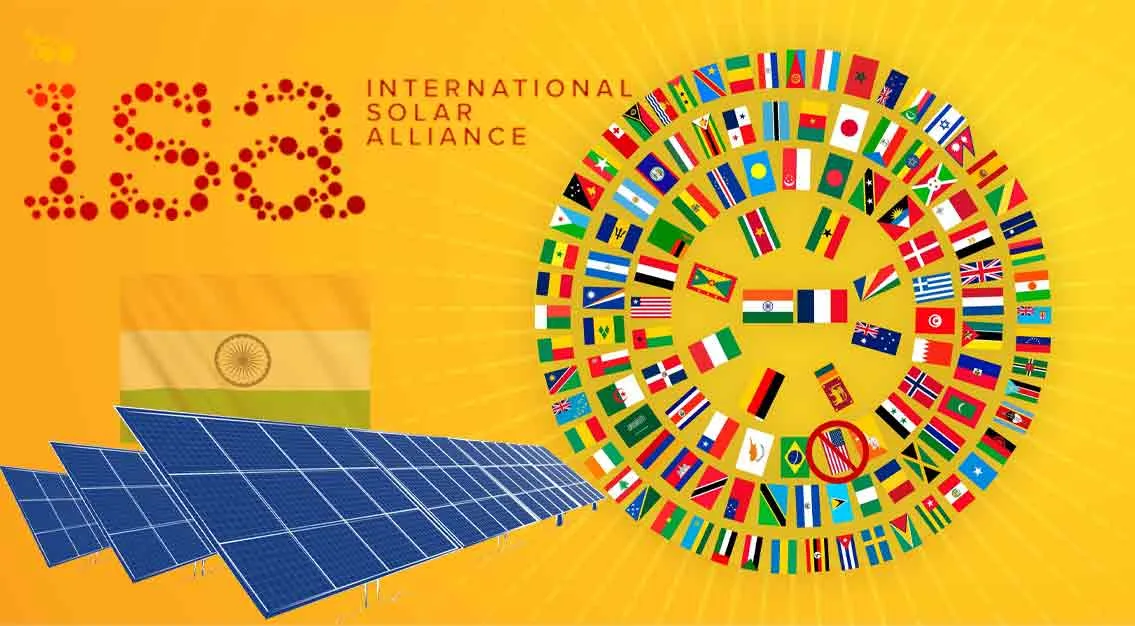
The ISA was launched jointly by India and France during the 2015 Climate Conference in Paris.
It brings together more than 120 sunshine-rich countries located between the Tropic of Cancer and the Tropic of Capricorn.
Objectives of ISA
The alliance aims to:
- Increase global use of solar energy.
- Reduce solar technology costs.
- Promote investment.
- Share knowledge and technology.
- Support clean energy development.
India hosted the Second Assembly of the ISA in New Delhi during 2019, strengthening international cooperation in renewable energy.
Major Developments After 2019 (2020-2025)
The renewable energy sector has witnessed significant progress after 2019.
Some major developments include:
PM Surya Ghar: Muft Bijli Yojana
Launched in 2024, this scheme encourages households to install rooftop solar panels with government financial support. It aims to reduce electricity bills and increase clean energy generation across India.
Green Hydrogen Mission
The National Green Hydrogen Mission was launched in 2023 to promote hydrogen produced using renewable energy.
Its objectives include:
- Reducing fossil fuel imports.
- Promoting clean industries.
- Supporting exports.
- Creating green jobs.
Rapid Solar Capacity Growth
India has become one of the largest solar power producers in the world.
Large solar parks have been developed in Rajasthan, Gujarat, Karnataka, Madhya Pradesh, and several other states.
Growth in Wind Energy
India continues to expand both onshore and offshore wind projects, particularly in Gujarat and Tamil Nadu.
Battery Energy Storage
Large battery storage systems are now being developed to store renewable electricity generated during sunny and windy periods.
These systems improve grid stability and ensure continuous electricity supply.
Domestic Manufacturing
The government introduced Production Linked Incentive (PLI) schemes to encourage domestic manufacturing of:
- Solar modules
- Solar cells
- Advanced batteries
These initiatives reduce import dependence and strengthen India’s renewable energy industry.
Challenges Ahead
Despite impressive growth, several challenges remain.
These include:
- High initial installation costs.
- Land acquisition issues.
- Energy storage limitations.
- Grid integration challenges.
- Need for better transmission infrastructure.
- Weather-dependent electricity generation.
Continuous investment and technological innovation will help overcome these challenges.
Importance of Renewable Energy
Renewable energy offers several long-term benefits.
It helps:
- Reduce pollution.
- Lower carbon emissions.
- Improve public health.
- Increase energy security.
- Reduce fuel imports.
- Create employment.
- Support sustainable development.
- Protect the environment for future generations.
As renewable technologies become cheaper, they are becoming a preferred source of electricity worldwide.
Conclusion
The Ministry of New and Renewable Energy has played a major role in transforming India’s energy sector. Through schemes like PM-KUSUM, Rooftop Solar Programme, Atal Jyoti Yojana, Ultra Mega Renewable Energy Parks, and international initiatives such as the International Solar Alliance, India has made significant progress toward clean and sustainable energy.
Between 2020 and 2025, new initiatives like the PM Surya Ghar Scheme, National Green Hydrogen Mission, battery storage projects, and domestic solar manufacturing have further strengthened India’s renewable energy sector.
As India moves toward its target of 500 GW of non-fossil fuel capacity by 2030 and Net Zero emissions by 2070, renewable energy will remain one of the country’s strongest pillars for economic growth, environmental protection, and energy security.
FAQs
1. What is renewable energy?
Renewable energy is energy generated from natural sources like sunlight, wind, water, and biomass that can be replenished naturally.
2. What is the Ministry of New and Renewable Energy (MNRE)?
The Ministry of New and Renewable Energy (MNRE) is responsible for promoting and developing renewable energy sources such as solar, wind, biomass, and small hydropower in India.
3. What is the PM-KUSUM Scheme?
PM-KUSUM is a government scheme that helps farmers install solar pumps and solar power plants, reducing electricity costs while providing an additional source of income.
4. What is the Grid Connected Rooftop Solar Programme?
It is a government initiative that encourages homes, offices, schools, and industries to install rooftop solar panels and generate clean electricity.
5. What is the National Wind-Solar Hybrid Policy?
The policy promotes combined wind and solar power projects to improve renewable energy generation and maintain better grid stability.
6. What is the International Solar Alliance (ISA)?
The International Solar Alliance is a global organization launched by India and France to promote solar energy adoption and cooperation among sunshine-rich countries.
7. What is the National Green Hydrogen Mission?
Launched in 2023, the National Green Hydrogen Mission aims to produce clean hydrogen using renewable energy, reducing carbon emissions and fossil fuel imports.
8. What is PM Surya Ghar: Muft Bijli Yojana?
PM Surya Ghar is a government scheme launched in 2024 that provides financial support to households for installing rooftop solar panels and reducing electricity bills.
9. What are Ultra Mega Renewable Energy Power Parks?
These are large renewable energy parks developed with ready land and transmission infrastructure for solar, wind, hybrid, and energy storage projects.
10. What are India’s renewable energy targets?
India aims to achieve 500 GW of non-fossil fuel power capacity by 2030 and reach Net Zero carbon emissions by 2070.