Pacific Ring of Fire – Earth’s Most Active Zone of Volcanoes and Earthquakes

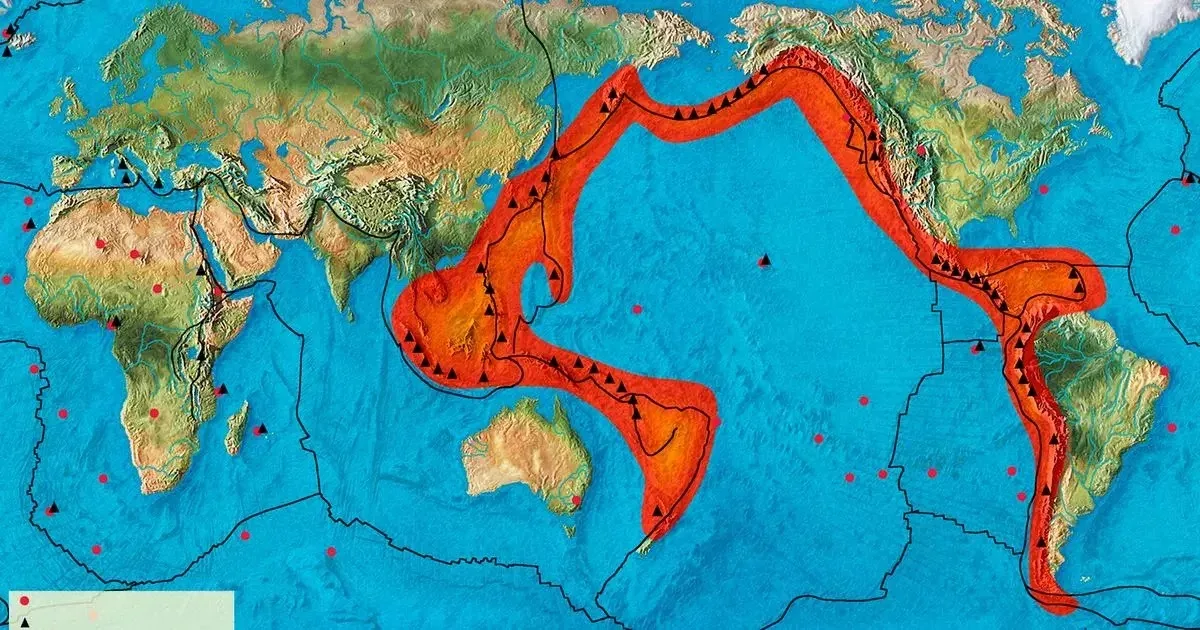
The Pacific Ring of Fire is one of the most important and fascinating geographical features on Earth. It is a vast region surrounding the Pacific Ocean where the majority of the world’s earthquakes and volcanic eruptions occur. This zone forms a horseshoe-shaped belt stretching nearly 40,000 kilometers and is known for its intense tectonic activity. Understanding the Pacific Ring of Fire is essential for students of geography, geology, and environmental science because it explains how Earth’s internal forces shape the surface we live on.
Thank you for reading this post, don't forget to subscribe!What is the Pacific Ring of Fire?
The Pacific Ring of Fire, also called the Circum-Pacific Belt, is a region that experiences frequent earthquakes and volcanic eruptions. This happens because of the movement of tectonic plates beneath the Earth’s surface.
The Earth’s crust is divided into large pieces called tectonic plates. These plates are constantly moving, although very slowly. The Pacific Plate, which is the largest tectonic plate, interacts with several other plates such as the North American Plate, South American Plate, Eurasian Plate, Indo-Australian Plate, and others. These interactions create intense geological activity.
As a result, about 75% of the world’s volcanoes and around 90% of earthquakes occur within this region. This makes the Pacific Ring of Fire the most geologically active area on Earth.
Geographical Extent of the Pacific Ring of Fire
The Pacific Ring of Fire forms a large arc around the Pacific Ocean. It begins from the western coasts of North and South America, moves up through Alaska, crosses the Aleutian Islands, and then extends down along the eastern coasts of Asia and Oceania.
Countries located along this belt include:
- Chile, Peru, and Ecuador in South America
- Mexico, the United States, and Canada in North America
- Russia and Japan in East Asia
- Philippines and Indonesia in Southeast Asia
- Papua New Guinea and New Zealand in Oceania
This wide geographical spread explains why so many countries in this region frequently experience earthquakes and volcanic eruptions.
Major Features of the Pacific Ring of Fire
1. Active Volcanoes
The Pacific Ring of Fire contains more than 450 active and dormant volcanoes, making it the largest volcanic belt in the world. These volcanoes are mainly found along the edges of tectonic plates.
Some important volcanoes include:
- Mount Tambora (Indonesia) – Its eruption in 1815 was the most powerful in recorded history and caused global climate changes.
- Mount Pinatubo (Philippines) – Its 1991 eruption released massive ash clouds and affected global temperatures.
- Mount Fuji (Japan) – A famous and active volcano located at a triple plate junction.
- Mount St. Helens (USA) – Known for its destructive eruption in 1980.
- Krakatoa (Indonesia) – Its 1883 eruption destroyed the island and created massive tsunamis.
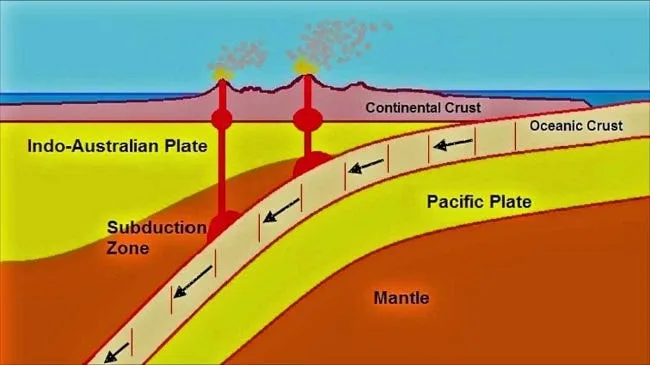
Volcanoes in this region are mostly formed due to a process called subduction, where one tectonic plate is forced beneath another.
2. Frequent Earthquakes
The Pacific Ring of Fire is responsible for about 90% of the world’s earthquakes. Many of the strongest earthquakes in history have occurred in this region.
Some major earthquakes include:
- Chile Earthquake (1960) – The strongest ever recorded, with a magnitude of 9.5
- Alaska Earthquake (1964) – Magnitude 9.2
- Indian Ocean Earthquake (2004) – Magnitude 9.1, caused a devastating tsunami
- Japan Earthquake (2011) – Magnitude 9.0, led to a tsunami and nuclear disaster
These earthquakes occur due to stress built up along fault lines where tectonic plates interact.
3. Island Arcs
Island arcs are curved chains of volcanic islands formed due to tectonic activity. They are usually found near subduction zones.
Characteristics of island arcs:
- Located near deep-sea trenches
- Formed by volcanic activity
- Often associated with earthquakes
Examples include:
- Aleutian Islands (Alaska)
- Kuril Islands (Russia-Japan region)
These arcs play an important role in understanding how continents and ocean basins evolve.
4. Ocean Trenches
Ocean trenches are deep depressions in the ocean floor formed where one tectonic plate is pushed beneath another.
Important trenches in the Pacific Ring of Fire include:
- Mariana Trench – The deepest part of the Earth’s oceans
- Peru-Chile Trench
- Philippine Trench
- Tonga Trench
These trenches indicate areas of intense tectonic activity and are often associated with earthquakes and volcanic eruptions.
Causes of Geological Activity in the Pacific Ring of Fire
The main reason behind the intense activity in this region is plate tectonics. The movement of tectonic plates leads to different types of boundaries:
1. Convergent Boundaries
At these boundaries, two plates collide. One plate is forced beneath the other in a process called subduction. This leads to:
- Formation of volcanoes
- Creation of ocean trenches
- Occurrence of earthquakes
2. Divergent Boundaries
At divergent boundaries, plates move away from each other. This allows magma to rise and create new crust.
3. Transform Boundaries
At transform boundaries, plates slide past each other. This movement causes stress buildup, which is released as earthquakes.
An example is the boundary between the Pacific Plate and North American Plate.
Understanding Subduction
Subduction is the most important process in the Pacific Ring of Fire. It occurs when a denser oceanic plate sinks beneath a lighter continental plate.
Steps in subduction:
- Two plates move towards each other
- The heavier plate bends and sinks into the mantle
- Heat and pressure cause the plate to melt
- Magma rises to the surface
- Volcanoes are formed
This process explains why so many volcanoes are located along the Ring of Fire.
Geothermal Energy Resources
The Pacific Ring of Fire is not only known for disasters but also for its valuable resources. One of the most important is geothermal energy.

Key facts:
- Around 40% of the world’s geothermal energy is found here
- Heat stored beneath the Earth’s surface can be used to generate electricity
- Countries like the United States, Indonesia, and the Philippines use geothermal energy
Geothermal energy is a clean and renewable source of power, making it highly valuable for future energy needs.
Impact on Human Life
The Pacific Ring of Fire has both positive and negative effects on human life.
Negative Impacts
- Earthquakes cause destruction of buildings and infrastructure
- Volcanic eruptions release ash, lava, and gases
- Tsunamis triggered by underwater earthquakes can cause massive loss of life
Positive Impacts
- Fertile soil due to volcanic ash
- Availability of minerals and natural resources
- Development of geothermal energy
People living in this region must be well-prepared for natural disasters.
Recent Scientific Research
Recent studies show that the Pacific Plate is gradually cooling and shrinking. Scientists have found that younger parts of the plate cool faster than older parts.
Important findings:
- Younger regions (around 2 million years old) are cooling rapidly
- Older regions (around 100 million years old) are more stable
- This cooling process may influence future tectonic activity
Understanding these changes helps scientists predict earthquakes and volcanic eruptions more accurately.
Comparison with Other Seismic Belts
The Pacific Ring of Fire is the most active seismic belt, but there are others as well.
Alpide Belt
- Extends from the Mediterranean region through Turkey and Iran to the Himalayas
- Accounts for about 5–6% of global earthquakes
Although important, it is much less active compared to the Pacific Ring of Fire.
Why the Pacific Ring of Fire is Important
The Pacific Ring of Fire is important for several reasons:
- Helps us understand Earth’s internal processes
- Explains the distribution of earthquakes and volcanoes
- Provides valuable natural resources
- Helps in disaster management and planning
Studying this region allows scientists and governments to prepare better for natural hazards.
Conclusion
The Pacific Ring of Fire is a powerful reminder of the dynamic nature of our planet. It is a region where Earth’s internal forces are constantly shaping the surface through earthquakes, volcanic eruptions, and tectonic movements. While it poses significant risks to human life, it also offers valuable resources like fertile soil and geothermal energy.
Understanding the Pacific Ring of Fire is essential not only for academic purposes but also for real-world applications such as disaster preparedness and sustainable resource use. As research continues, scientists hope to better predict natural events and reduce their impact on human society.
FAQs – Pacific Ring of Fire
1. What is the Pacific Ring of Fire?
The Pacific Ring of Fire is a large horseshoe-shaped region around the Pacific Ocean where most of the world’s earthquakes and volcanoes are found due to tectonic plate movements.
2. Why is the Pacific Ring of Fire so active?
It is highly active because several tectonic plates meet, collide, and slide past each other in this region, causing frequent earthquakes and volcanic eruptions.
3. How many volcanoes are in the Pacific Ring of Fire?
There are more than 450 active and dormant volcanoes, which is about 75% of all volcanoes on Earth.
4. Which countries are part of the Pacific Ring of Fire?
Countries include Japan, Indonesia, Philippines, New Zealand, USA, Canada, Mexico, Chile, Peru, and others along the Pacific Ocean.
5. What causes earthquakes in the Pacific Ring of Fire?
Earthquakes occur due to the sudden release of energy when tectonic plates move, collide, or slide along fault lines.
6. What is subduction in the Pacific Ring of Fire?
Subduction is the process where one tectonic plate is forced beneath another, leading to magma formation and volcanic eruptions.
7. Which is the most powerful earthquake recorded in this region?
The Chile earthquake of 1960, with a magnitude of 9.5, is the strongest recorded earthquake in the Pacific Ring of Fire.
8. What is the deepest trench in the Ring of Fire?
The Mariana Trench is the deepest ocean trench in the world, located within this region.