



RBI Q-SAFE Committee to Strengthen Financial Security

RBI Q-SAFE Committee has been established by the Reserve Bank of India to study the impact of quantum technology on the country’s financial sector. The central bank announced the formation of the expert panel on 25 May 2026, highlighting the growing importance of preparing India’s banking and payment systems for future technological changes.
Named the Expert Committee for a Quantum Secure and Adaptive Financial Ecosystem (Q-SAFE), the panel will examine how quantum technology could affect financial institutions, digital payments, cybersecurity systems and data protection mechanisms. The committee will also explore opportunities that quantum technology may bring while identifying risks that could challenge existing security systems.

RBI Q-SAFE Committee Focuses on Future Financial Security
Quantum technology is considered one of the most advanced areas of modern science. It uses the principles of quantum mechanics to process information in ways that are much faster and more powerful than traditional computers.
In the financial world, quantum computing has the potential to improve portfolio management, risk analysis, fraud detection and economic forecasting. At the same time, experts warn that future quantum computers could break many of the encryption systems currently used to protect banking networks and digital transactions.
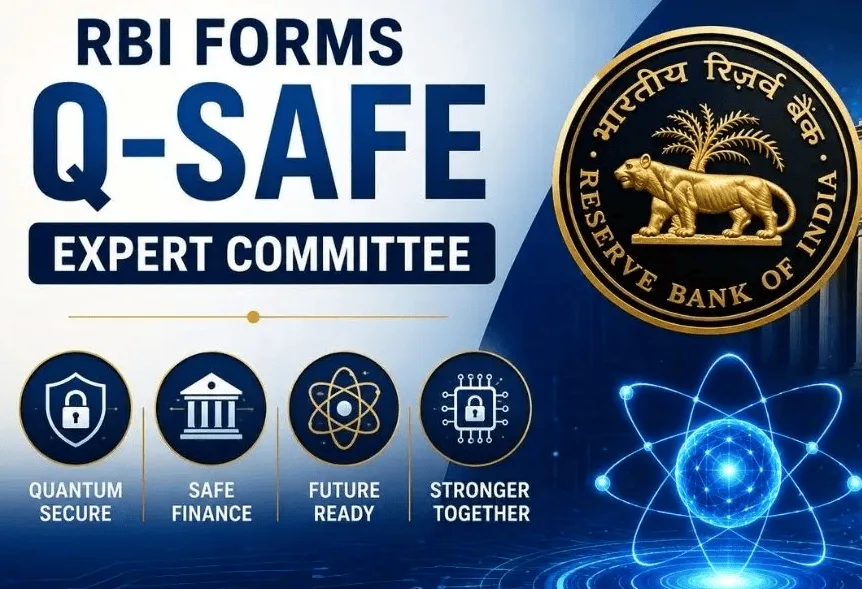
Recognizing these challenges, the RBI Q-SAFE Committee has been created to help India prepare for a future where quantum technology becomes widely available.
RBI Q-SAFE Committee Includes Leading Experts
The committee consists of eight members from various fields, including banking, technology, cybersecurity and scientific research.
The panel is led by Anil Prabhakar, Professor in the Department of Electrical Engineering at Indian Institute of Technology Madras, who serves as the convener.
Suvendu Pati, Chief General Manager of the RBI’s FinTech Department, has been appointed as the Member-Secretary.
Other members include experts from government agencies, financial institutions and technology organizations:
- Department of Science and Technology
- State Bank of India
- National Payments Corporation of India
- Ministry of Electronics and Information Technology
- Data Security Council of India
- Former quantum technology industry leaders and specialists
The diverse composition of the committee is expected to provide a balanced understanding of both technical and financial challenges.
RBI Q-SAFE Committee Will Assess Quantum Risks
One of the committee’s main responsibilities is to identify areas where India’s financial infrastructure may be vulnerable to future quantum-based cyber threats.
Modern banking systems depend heavily on cryptography, which protects customer information, payment systems and digital communications. If powerful quantum computers become capable of breaking current encryption methods, financial institutions may need to adopt entirely new security standards.
To address this issue, the RBI Q-SAFE Committee will study the financial sector’s Cryptography Bill of Materials (CBOM). This is a structured inventory that records the cryptographic tools and security systems currently in use.
By understanding where these technologies are deployed, the committee can help identify systems that may require upgrades in the future.
RBI Q-SAFE Committee to Promote Crypto Agility
Another important area of study is crypto agility. This refers to the ability of an organization to replace old cryptographic algorithms with newer and more secure alternatives without major disruptions.
Financial institutions process millions of transactions every day. Any future transition to quantum-safe security standards must be smooth and efficient. The committee will examine how prepared banks and payment providers are for such a transition.
It will also review whether existing systems can quickly adapt to changing cybersecurity requirements.
RBI Q-SAFE Committee to Review Available Technologies
The panel will evaluate tools and solutions being developed around the world for quantum-safe security. It will examine whether these technologies are mature enough for large-scale adoption and whether they can be integrated into India’s financial ecosystem.

The committee will also study the scalability of available solutions. Since India’s banking and digital payment systems serve hundreds of millions of users, any future security framework must be capable of operating at a very large scale.
RBI Q-SAFE Committee and India’s Digital Payment Growth
India has become one of the world’s leading digital payment markets. Platforms managed by National Payments Corporation of India, including UPI and RuPay, process billions of transactions every month.
As digital transactions continue to grow, protecting financial infrastructure becomes increasingly important. The RBI’s decision to establish the Q-SAFE Committee reflects a proactive approach toward safeguarding the country’s digital economy against future technological risks.
The committee is expected to submit its recommendations within six months of its first meeting. Its findings may play an important role in shaping India’s long-term strategy for quantum security in banking, payments and financial services.