



Anti Defection Law: Meaning, History, Objectives, Features and Challenges

The Anti Defection Law is an important law in India that helps keep the country’s democratic system stable. It prevents elected representatives such as Members of Parliament (MPs) and Members of Legislative Assemblies (MLAs) from changing political parties after winning elections for personal benefits. This law was introduced to stop political instability and reduce corruption in politics.
Thank you for reading this post, don't forget to subscribe!What is Anti Defection Law?
The Anti Defection Law was introduced through the 52nd Constitutional Amendment Act, 1985 during the government of Prime Minister Rajiv Gandhi.
The law was added to the Tenth Schedule of the Constitution of India.
Defection means leaving one political party and joining another after getting elected. This often happens for personal gains such as ministerial posts or other benefits.
The law gives the Speaker of the Lok Sabha or the Chairman of the Rajya Sabha the power to decide whether a member should be disqualified because of defection.

The law applies to:
| Feature | Details |
|---|---|
| Introduced Through | 52nd Constitutional Amendment Act, 1985 |
| Constitutional Provision | Tenth Schedule |
| Applies To | Parliament and State Legislatures |
| Main Purpose | Prevent political defections |
| Decision Authority | Speaker or Chairman |
History of Anti Defection Law
Before 1985, political leaders frequently changed parties after elections. This created instability in governments across many states.
A famous incident took place in 1967 when Haryana MLA Gaya Lal changed his political party three times in one day. After this incident, the phrase “Aaya Ram Gaya Ram” became popular in Indian politics.
Because of frequent defections:
- Many state governments collapsed.
- Political corruption increased.
- Public trust in democracy weakened.
To study the issue, the government formed the Chavan Committee under Home Minister Yashwantrao Chavan. The committee recommended strict action against legislators who switched parties for personal benefits.
Based on these recommendations, the Anti Defection Law was introduced in 1985.
Later, the 91st Constitutional Amendment Act, 2003 made the law stronger by removing the protection earlier given to party splits.
Objectives of Anti Defection Law
The Anti Defection Law was created to achieve several important goals.
Main objectives include:
- Prevent political defections for personal gain.
- Maintain stability in governments.
- Reduce corruption in politics.
- Promote party discipline.
- Protect the mandate given by voters.
- Strengthen democracy.
- Prevent frequent collapse of elected governments.
Grounds for Disqualification under Anti Defection Law
A legislator can be disqualified under the following situations.
1. Voluntarily Giving Up Party Membership
A member does not need to officially resign from the party to be disqualified.
Even if the member publicly supports another political party or acts against the interests of their own party, it may be treated as voluntarily giving up party membership.
The Supreme Court has clarified that a person’s actions are enough to prove defection.
2. Voting Against the Party Whip
Political parties issue instructions called a whip.
If a legislator:
- votes against the party’s direction, or
- remains absent during voting without permission,
the member can be disqualified.
3. Independent Member Joining a Political Party
If an independent candidate wins an election and later joins any political party, the member becomes disqualified.
4. Nominated Member Joining a Political Party
A nominated member may join a political party within six months after becoming a legislator.
If the member joins any political party after six months, disqualification can take place.
Role of the Speaker
The Speaker of the Legislative Assembly or the Chairman of Parliament decides whether a legislator has violated the Anti Defection Law.
Earlier, this decision was considered final.
However, in 1992, the Supreme Court ruled that the Speaker’s decision can be reviewed by the courts after the final order is passed.
Therefore:
- High Courts
- Supreme Court
can examine whether the Speaker followed the law correctly.
Important Amendments
52nd Constitutional Amendment Act, 1985
| Provision | Description |
|---|---|
| Added Tenth Schedule | Yes |
| Introduced Anti Defection Law | Yes |
| Covered MPs and MLAs | Yes |
91st Constitutional Amendment Act, 2003
This amendment strengthened the law by:
- Removing protection for party splits.
- Allowing only mergers supported by two-thirds of legislators.
- Preventing disqualified members from becoming ministers.
Exceptions under Anti Defection Law
The law also provides certain exceptions.
Merger of Political Parties
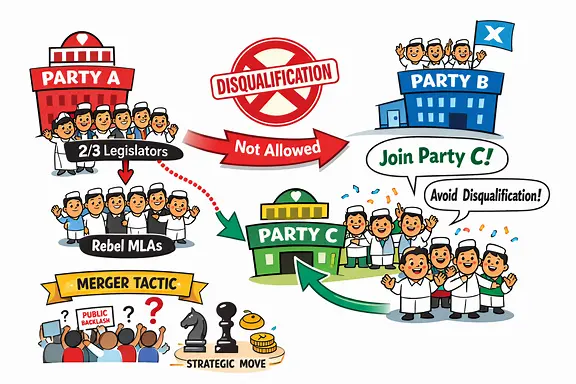
If at least two-thirds of the legislators of a political party agree to merge with another political party, they will not face disqualification.
Both:
- members who join the new party, and
- members who stay with the old party
remain protected.
Speaker and Deputy Speaker
Under certain conditions mentioned in the Tenth Schedule, the Speaker, Chairman, and Deputy Chairman receive limited protection from disqualification while holding their constitutional offices.
Important Supreme Court Judgments
Kihoto Hollohan vs Zachillhu (1992)
This is the most important judgment related to the Anti Defection Law.
The Supreme Court held that:
- the Tenth Schedule is constitutional.
- the Speaker’s decision can be reviewed by courts after the decision is given.
This judgment strengthened judicial oversight while respecting the role of the Speaker.
Keisham Meghachandra Case (2020)
In this case, the Supreme Court observed that Speakers should decide disqualification cases within a reasonable time.
Justice Rohinton Nariman suggested creating an independent tribunal headed by a retired judge to decide defection cases quickly and fairly.
Advantages of Anti Defection Law
The law has several benefits.
- Prevents political corruption.
- Stops horse trading among political parties.
- Maintains stable governments.
- Encourages party discipline.
- Protects the public mandate.
- Reduces unnecessary political instability.
- Strengthens parliamentary democracy.
Criticism of Anti Defection Law
Although the law has many benefits, experts have also pointed out several weaknesses.
Limits Freedom of Legislators
MPs and MLAs often cannot vote according to their personal opinion because they must follow the party whip.
Too Much Power to the Speaker
Since the Speaker usually belongs to the ruling party, questions are sometimes raised about neutrality.
Delay in Decisions
Many disqualification petitions remain pending for months or even years, creating political uncertainty.
Weakens Debate
Legislators may hesitate to express independent views due to fear of disqualification.
Reduces Accountability
Instead of being directly accountable to voters, legislators often become more accountable to party leadership.
Suggestions to Improve Anti Defection Law
Experts have suggested several reforms.
Restrict the Law to Important Votes
The law should mainly apply to votes that decide the survival of the government, such as:

- No Confidence Motion
- Confidence Motion
- Annual Budget
- Money Bills
Create an Independent Authority
Instead of the Speaker deciding defection cases, an independent tribunal or the Election Commission could be given this responsibility.
Promote Internal Party Democracy
Political parties should encourage open discussion before issuing party whips so that members can express their opinions.
Fix a Time Limit
The Constitution should prescribe a fixed time limit for deciding disqualification petitions to avoid unnecessary delays.
Regular Judicial Review
The Supreme Court should continue reviewing important cases to ensure that the Anti Defection Law is applied fairly.
Recent Developments
In recent years, several political crises, including those in Maharashtra and Manipur, have once again highlighted the importance of the Anti Defection Law.
The Supreme Court has repeatedly emphasized that:
- disqualification cases should not remain pending for long,
- Speakers must act within a reasonable time,
- reforms are needed to ensure fairness and speed.
These developments have renewed discussions about creating an independent body to decide defection disputes.
Why is Anti Defection Law Important?
The Anti Defection Law plays a major role in protecting India’s democratic system. It discourages elected representatives from changing political parties for personal benefits and helps governments complete their term with greater stability.
At the same time, experts believe that the law should be improved to balance party discipline with the freedom of elected representatives. Timely decisions, independent authorities, and stronger internal democracy within political parties can make the law more effective in the future.
FAQs
What is the Anti Defection Law?
The Anti Defection Law prevents MPs and MLAs from changing political parties after being elected. It was introduced through the 52nd Constitutional Amendment Act, 1985.
Which Schedule of the Constitution contains the Anti Defection Law?
The Anti Defection Law is included in the Tenth Schedule of the Constitution of India.
Who decides disqualification under the Anti Defection Law?
The Speaker of the Legislative Assembly or the Chairman of Parliament decides disqualification cases, and their decision can be reviewed by the courts.
What is meant by party whip?
A party whip is an official instruction issued by a political party directing its members how to vote in the legislature.
Which amendment strengthened the Anti Defection Law?
The 91st Constitutional Amendment Act, 2003 strengthened the law by removing protection for party splits and restricting ministerial positions for disqualified members.
What is the famous “Aaya Ram Gaya Ram” incident?
It refers to Haryana MLA Gaya Lal changing political parties three times in one day in 1967, leading to widespread concern about political defections.
Can courts review the Speaker’s decision?
Yes. The Supreme Court ruled in Kihoto Hollohan vs Zachillhu (1992) that the Speaker’s final decision is subject to judicial review.