Rocks: Types of Rocks, Formation of Rocks and Rock Cycle

Rocks are one of the most important parts of the Earth. The entire crust of the Earth is made up of rocks. Mountains, hills, plateaus, valleys, and even the soil around us are connected to rocks in some way. Rocks are natural solid materials made up of one or more minerals. They may be hard or soft, rough or smooth, and they come in many different colors and shapes.
Thank you for reading this post, don't forget to subscribe!Rocks play a major role in shaping the Earth’s surface. They are also very important for humans because we use rocks for building houses, roads, bridges, statues, and many other things. Some rocks also contain valuable minerals and fuels such as coal and petroleum.
The study of rocks helps us understand the history of the Earth. Scientists can learn about volcanic eruptions, ancient oceans, mountain formation, and even climate change by studying rocks.
Rocks are mainly divided into three major groups:
- Igneous Rocks
- Sedimentary Rocks
- Metamorphic Rocks
These rocks continuously change from one form to another through a natural process called the rock cycle.
What is a Rock?
A rock is a naturally occurring solid mass made up of minerals. Some rocks contain only one mineral, while others contain many minerals together.
For example:
- Granite is a hard rock.
- Soapstone is a soft rock.
- Gabbro is black in color.
- Quartzite may appear white or milky.
Rocks do not have a fixed chemical composition. Different rocks contain different types and amounts of minerals. However, quartz and feldspar are among the most common minerals found in rocks.
Rocks are found everywhere on Earth. Some rocks are very old and may be millions of years old. They are formed through different natural processes inside and outside the Earth.
Types of Rocks
Rocks are classified into three major groups according to the way they are formed.
1. Igneous Rocks
2. Sedimentary Rocks
3. Metamorphic Rocks
Each type of rock has unique characteristics and forms under different conditions.
Igneous Rocks
Meaning of Igneous Rocks
The word “igneous” comes from the Latin word ignis, which means fire. Igneous rocks are formed from molten material called magma or lava.
These rocks are also known as primary rocks because they are the first rocks formed on Earth.

Formation of Igneous Rocks
Deep inside the Earth, rocks melt due to extremely high temperature and become molten material called magma.
When magma cools and solidifies, it forms igneous rocks.
Sometimes magma cools below the Earth’s surface, while at other times it reaches the surface through volcanoes as lava and then cools.
The cooling process may happen:
- Inside the Earth’s crust
- On the Earth’s surface
Types of Igneous Rocks
Igneous rocks are mainly divided into two types:
Intrusive Igneous Rocks
These rocks form when magma cools slowly beneath the Earth’s surface.
Because cooling is slow, large mineral crystals are formed.
Examples:
- Granite
- Gabbro
Extrusive Igneous Rocks
These rocks form when lava cools quickly on the Earth’s surface.
Fast cooling produces very small crystals.
Examples:
- Basalt
- Volcanic tuff
Texture of Igneous Rocks
The texture of igneous rocks depends on:
- Speed of cooling
- Size of mineral grains
- Arrangement of crystals
Slow Cooling
Slow cooling creates large crystals.
Example:
- Granite
Rapid Cooling
Rapid cooling creates very small crystals.
Example:
- Basalt
Intermediate Cooling
Intermediate cooling creates medium-sized crystals.
Characteristics of Igneous Rocks
- Very hard and compact
- Usually not layered
- Do not contain fossils
- Resistant to weathering
- Rich in minerals
Examples of Igneous Rocks
Some common igneous rocks are:
- Granite
- Basalt
- Gabbro
- Pegmatite
- Volcanic breccia
- Tuff
Importance of Igneous Rocks
Igneous rocks are very useful for humans.
Construction Material
Granite and basalt are widely used in construction work.
Source of Minerals
Many valuable minerals are found in igneous rocks.
Formation of Soil
Weathering of igneous rocks helps in soil formation.
Sedimentary Rocks
Meaning of Sedimentary Rocks
The word “sedimentary” comes from the Latin word sedimentum, meaning settling.
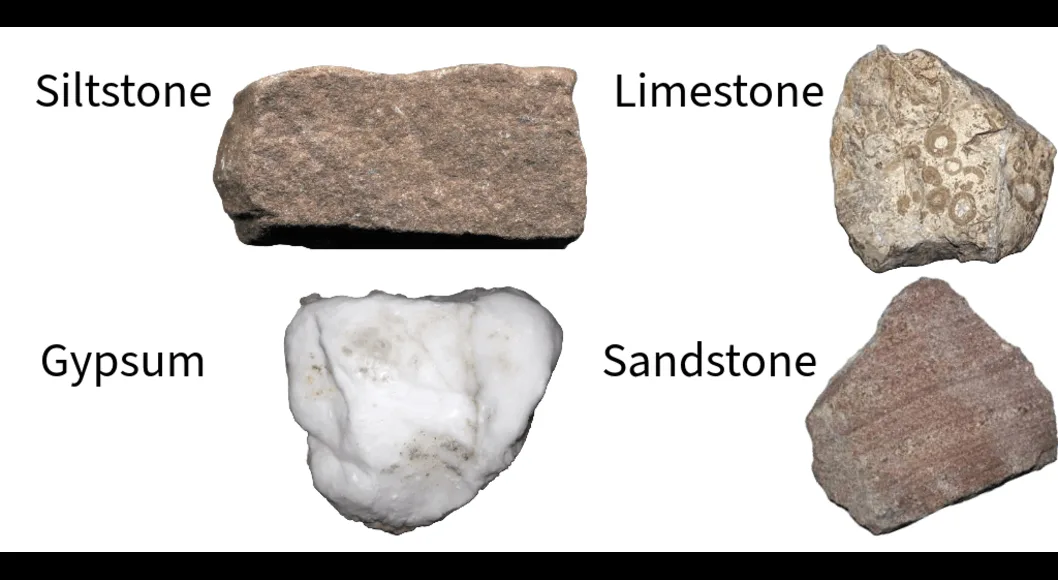
Sedimentary rocks are formed from sediments or fragments of older rocks that settle down in layers.
These rocks are also called secondary rocks.
Formation of Sedimentary Rocks
The Earth’s surface is constantly affected by natural forces such as:
- Wind
- Water
- Ice
- Temperature changes
These forces break rocks into smaller particles called sediments.
The sediments are carried by rivers, wind, glaciers, or oceans and deposited in low-lying areas.
Over time, the sediments become compact and hard due to pressure. This process is called lithification.
Layers in Sedimentary Rocks
Sedimentary rocks usually form in layers called strata.
Each layer represents a different period of deposition.
This layered structure helps scientists study Earth’s history.
Types of Sedimentary Rocks
Sedimentary rocks are divided into three main groups.
Mechanically Formed Sedimentary Rocks
These rocks are formed from rock fragments.
Examples:
- Sandstone
- Conglomerate
- Shale
- Loess
Organically Formed Sedimentary Rocks
These rocks form from remains of plants and animals.
Examples:
- Coal
- Chalk
- Limestone
Coal forms from dead plant material buried under pressure for millions of years.
Chemically Formed Sedimentary Rocks
These rocks form when minerals dissolved in water are deposited.
Examples:
- Chert
- Halite
- Potash
- Limestone
Characteristics of Sedimentary Rocks
- Usually arranged in layers
- Softer than igneous rocks
- Often contain fossils
- Formed by deposition and compaction
Fossils in Sedimentary Rocks
Sedimentary rocks are very important because they contain fossils.
Fossils are preserved remains of ancient plants and animals.
Scientists study fossils to learn about:
- Ancient life
- Climate
- Evolution
- Earth’s history
Examples of Sedimentary Rocks
Some common sedimentary rocks are:
- Sandstone
- Limestone
- Shale
- Coal
- Conglomerate
Importance of Sedimentary Rocks
Sedimentary rocks are very useful in daily life.
Source of Fuel
Coal and petroleum are connected with sedimentary rocks.
Building Material
Sandstone and limestone are used in construction.
Fertile Soil
Weathering of sedimentary rocks forms fertile soil.
Metamorphic Rocks
Meaning of Metamorphic Rocks
The word “metamorphic” means “change of form.”
Metamorphic rocks are formed when existing rocks change due to heat, pressure, or chemical action.
These rocks are also called tertiary rocks.
Formation of Metamorphic Rocks
Igneous or sedimentary rocks may undergo major changes inside the Earth.
These changes happen because of:
- High temperature
- High pressure
- Chemical reactions
As a result, the original rocks change their form and structure and become metamorphic rocks.
This process is called metamorphism.
Causes of Metamorphism
Metamorphism occurs due to several reasons.
Heat
Hot magma inside the Earth heats nearby rocks.
Pressure
Heavy layers of rocks create pressure on lower rocks.
Tectonic Movements
Movement of Earth’s plates causes crushing and deformation of rocks.
Types of Metamorphism
There are two major types of metamorphism.
Contact Metamorphism
In contact metamorphism, rocks come into contact with hot magma or lava.
The intense heat changes the mineral structure of rocks.
Examples:
- Limestone changing into marble
- Sandstone changing into quartzite
Regional Metamorphism
Regional metamorphism occurs over large areas.
It is caused by:
- High pressure
- High temperature
- Tectonic movements
This type of metamorphism usually occurs during mountain formation.
Foliation and Banding
Many metamorphic rocks show special arrangements of minerals.
Foliation
When minerals arrange themselves in layers or lines, it is called foliation.
Banding
Sometimes light and dark minerals form alternate bands.
This structure is called banding.
Rocks showing banding are known as banded rocks.
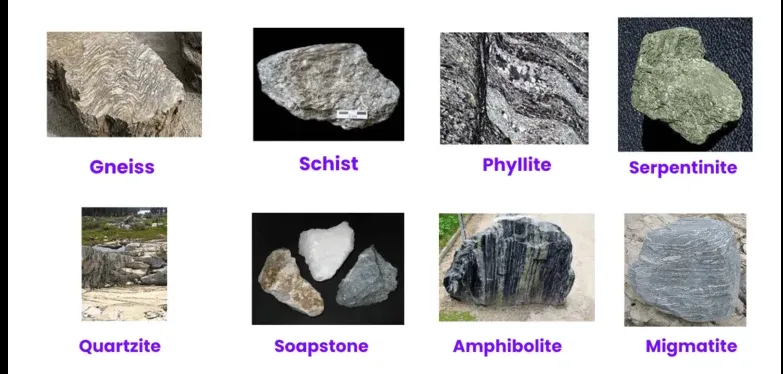
Types of Metamorphic Rocks
Metamorphic rocks are divided into two groups.
Foliated Rocks
These rocks show layered structure.
Examples:
- Slate
- Schist
- Gneiss
Non-Foliated Rocks
These rocks do not show layers.
Examples:
- Marble
- Quartzite
Examples of Metamorphic Rocks
Some common metamorphic rocks are:
- Marble
- Slate
- Schist
- Gneiss
- Quartzite
- Syenite
Characteristics of Metamorphic Rocks
- Very hard and strong
- Formed under heat and pressure
- May show foliation or banding
- Often shiny due to recrystallization
Importance of Metamorphic Rocks
Construction Work
Marble is widely used in buildings and monuments.
Decorative Purposes
Metamorphic rocks are used for flooring and sculptures.
Industrial Use
Some metamorphic rocks are used in industries.
Rock Cycle
Meaning of Rock Cycle
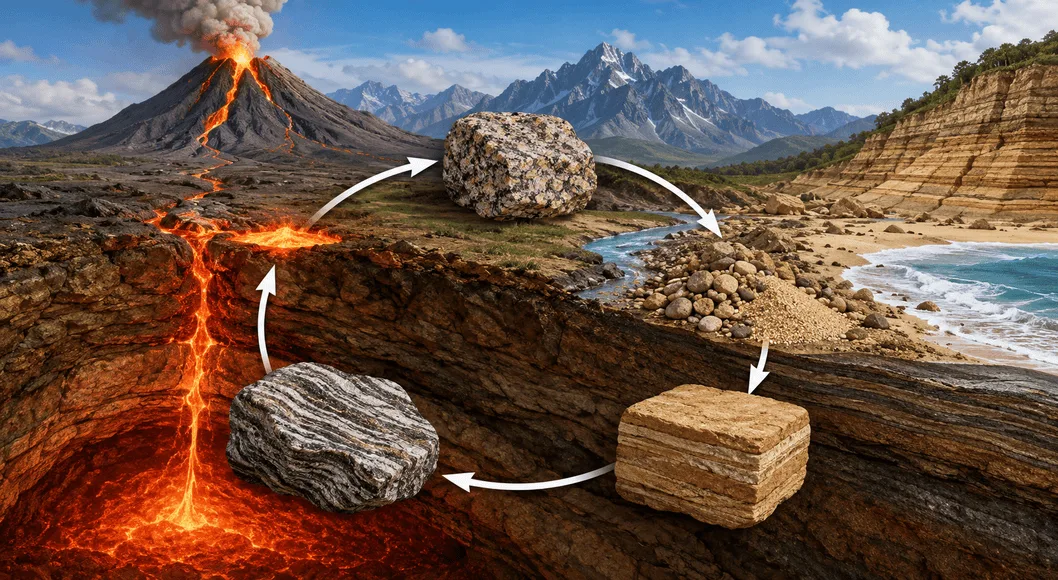
The rock cycle is a continuous natural process through which rocks change from one form to another.
Rocks do not remain the same forever. Over millions of years, they transform due to different geological processes.
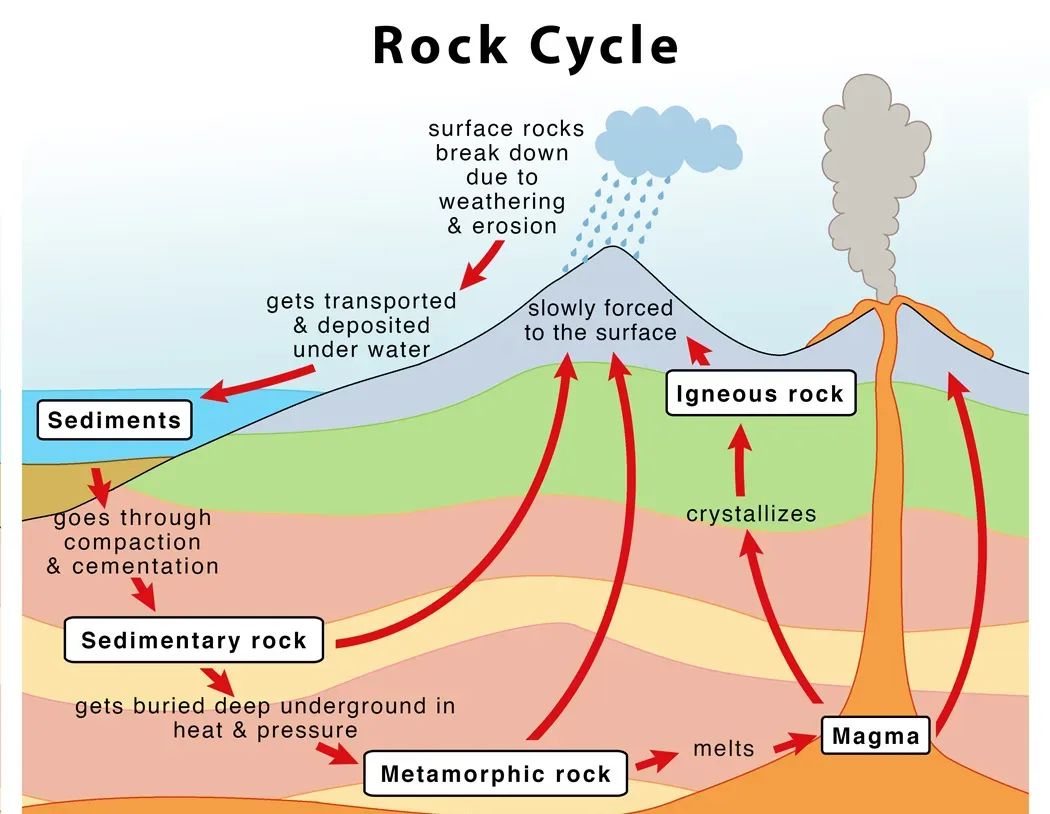
Process of the Rock Cycle
The rock cycle connects all three types of rocks.
Step 1: Formation of Igneous Rocks
Molten magma cools and solidifies to form igneous rocks.
Step 2: Formation of Sedimentary Rocks
Igneous rocks break down into sediments due to weathering and erosion.
The sediments are deposited, compacted, and hardened into sedimentary rocks.
Step 3: Formation of Metamorphic Rocks
Sedimentary and igneous rocks undergo heat and pressure and become metamorphic rocks.
Step 4: Melting into Magma
Metamorphic rocks may melt deep inside the Earth and turn back into magma.
The cycle then starts again.
Importance of the Rock Cycle
The rock cycle is important because:
- It explains how rocks change over time.
- It helps in soil formation.
- It supports the movement of minerals.
- It maintains balance in Earth’s crust.
- It helps scientists understand Earth’s history.
Difference Between Igneous, Sedimentary and Metamorphic Rocks
| Feature | Igneous Rocks | Sedimentary Rocks | Metamorphic Rocks |
|---|---|---|---|
| Formation | Cooling of magma | Deposition of sediments | Heat and pressure |
| Structure | Hard and compact | Layered | Foliated or banded |
| Fossils | Absent | Common | Rare |
| Examples | Granite, Basalt | Sandstone, Shale | Marble, Slate |
Uses of Rocks in Daily Life
Rocks are extremely useful for human life.
Construction
Rocks are used for:
- Buildings
- Roads
- Bridges
- Dams
Source of Minerals
Many metals and minerals are obtained from rocks.
Fuel Resources
Coal and petroleum are associated with sedimentary rocks.
Decorative Purposes
Marble and granite are used in homes and monuments.
Agriculture
Weathered rocks help form soil for farming.
Conclusion
Rocks are an essential part of the Earth’s crust and play a major role in shaping our planet. They are formed through natural geological processes and are divided into three main types: igneous, sedimentary, and metamorphic rocks. Each type has its own method of formation, characteristics, and uses.
Igneous rocks form from cooling magma, sedimentary rocks form from deposited sediments, and metamorphic rocks form under heat and pressure. These rocks continuously change from one type to another through the rock cycle.
The study of rocks helps us understand Earth’s history, natural resources, and geological changes. Rocks are also very important in construction, industry, agriculture, and daily human life. Understanding rocks and the rock cycle gives us a better understanding of how our planet works and changes over time.
FAQs About Rocks
1. What are rocks?
Rocks are naturally occurring solid materials made up of one or more minerals and form the Earth’s crust.
2. What are the three main types of rocks?
The three main types of rocks are igneous rocks, sedimentary rocks, and metamorphic rocks.
3. How are igneous rocks formed?
Igneous rocks are formed when magma or lava cools and solidifies.
4. Why are sedimentary rocks important?
Sedimentary rocks are important because they often contain fossils, coal, petroleum, and natural gas.
5. What causes metamorphic rocks to form?
Metamorphic rocks form due to high heat, pressure, and chemical changes inside the Earth.
6. What is the rock cycle?
The rock cycle is the continuous process through which rocks change from one type to another over time.
7. Which rock is used in construction work?
Granite, basalt, sandstone, and marble are commonly used in construction.