


Important Constitutional Articles of India Explained Part-1

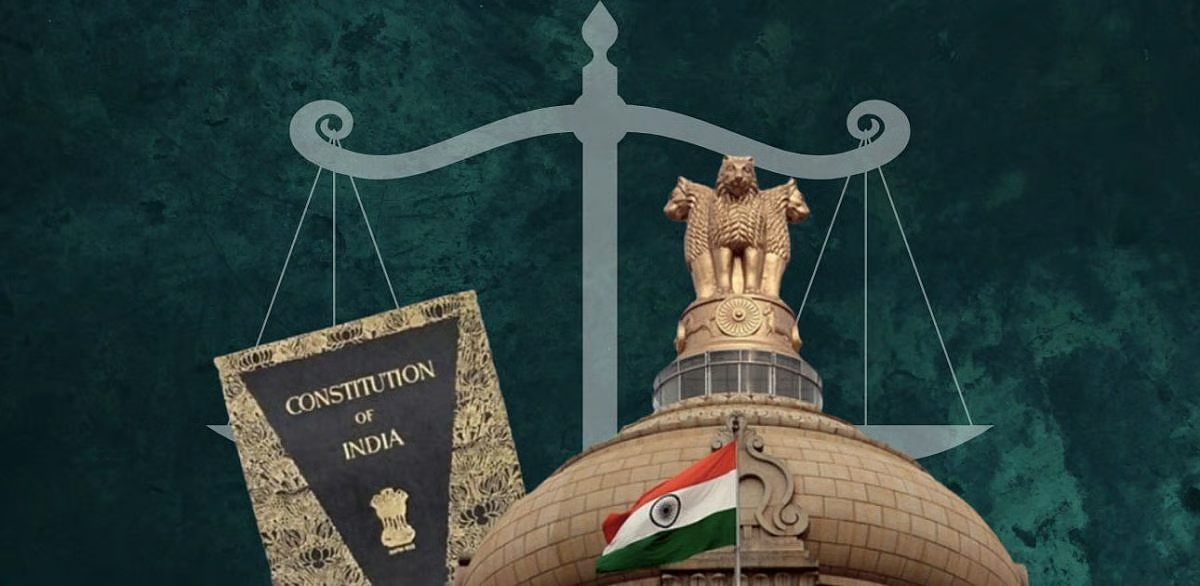
The Indian Constitution is the supreme law of India. It explains how the country should be governed, protects the rights of citizens, and defines the powers of different government institutions. It came into effect on 26 January 1950 and is one of the longest written constitutions in the world.
Thank you for reading this post, don't forget to subscribe!Originally, the Constitution had 395 Articles, 22 Parts, and 8 Schedules. Today, after many amendments, it has more than 470 Articles (numbered including inserted Articles), 25 Parts, and 12 Schedules. Over the years, the Constitution has been amended several times to meet the changing needs of the country.
Many constitutional articles often become important because of new laws, Supreme Court judgments, constitutional amendments, and national events.
Part I: The Union and Its Territory
Part I explains the territory of India and how new states can be formed or existing states can be changed.
Article 3 – Formation of New States
Article 3 gives Parliament the power to:
- Create a new state.
- Divide an existing state.
- Merge two or more states.
- Change the boundaries of a state.
- Change the name of a state.
This article gives flexibility to reorganize states whenever required.
Recent Importance
The Jammu and Kashmir Reorganisation Act, 2019 was passed under the powers provided by Article 3. As a result:
- Jammu and Kashmir became a Union Territory with a legislature.
- Ladakh became a separate Union Territory without a legislature.
This is one of the biggest constitutional changes in recent Indian history.
Part II: Citizenship
Part II contains Articles 5 to 11 and explains who is considered an Indian citizen.
Article 8
Article 8 provides citizenship rights to persons of Indian origin living outside India if they fulfill certain legal conditions.
Article 10
Article 10 states that a person’s citizenship will continue unless Parliament makes a law changing it.
Article 11
Article 11 gives Parliament the authority to make laws related to citizenship.
Why These Articles Became Important
The Citizenship (Amendment) Act, 2019 (CAA) brought major discussions on citizenship. It amended the Citizenship Act, 1955 and provided a faster path to Indian citizenship for certain religious minorities from Afghanistan, Bangladesh, and Pakistan.
The National Register of Citizens (NRC) also became an important topic. Currently, Assam is the only state where NRC has been prepared.
Part III: Fundamental Rights
Part III is called the heart of the Constitution because it guarantees fundamental rights to every citizen.
Article 14 – Equality Before Law
Article 14 says that every person is equal before the law.
No person can receive special treatment unless the Constitution itself provides reasonable classification.
Importance
The Supreme Court declared Triple Talaq unconstitutional because it violated the principle of equality under Article 14.
Article 15 – Prohibition of Discrimination
Article 15 prohibits discrimination based on:
- Religion
- Race
- Caste
- Sex
- Place of birth
However, it allows the government to provide special provisions for socially and educationally backward classes, women, children, and economically weaker sections.
Article 16 – Equality in Public Employment
Article 16 ensures equal opportunity in government jobs.
No citizen can be discriminated against while applying for public employment.
Importance
The 103rd Constitutional Amendment Act, 2019 introduced 10% reservation for Economically Weaker Sections (EWS) by inserting Articles 15(6) and 16(6).
In 2022, the Supreme Court upheld the constitutional validity of the EWS reservation.
Article 19 – Right to Freedom
Article 19 guarantees six important freedoms:
- Freedom of speech and expression
- Freedom to assemble peacefully
- Freedom to form associations
- Freedom to move freely
- Freedom to reside anywhere in India
- Freedom to practice any profession
Importance
The Supreme Court ruled that access to the internet is closely connected with the freedom of speech and business under Article 19, making internet restrictions subject to constitutional review.
Article 20 – Protection in Criminal Cases
Article 20 protects people accused of crimes.
It provides protection against:
- Ex post facto laws
- Double jeopardy
- Self-incrimination
No person can be forced to give evidence against themselves.
Article 32 – Right to Constitutional Remedies
Dr. B. R. Ambedkar called Article 32 the “Heart and Soul of the Constitution.”
This article allows any citizen to directly approach the Supreme Court if their Fundamental Rights are violated.
The Supreme Court can issue writs such as:
- Habeas Corpus
- Mandamus
- Prohibition
- Certiorari
- Quo Warranto
Article 32 makes Fundamental Rights meaningful because it provides a remedy when rights are violated.
Part IV: Directive Principles of State Policy (DPSP)
Directive Principles are guidelines for governments while making laws. Although they cannot be enforced in courts, they help build a welfare state.
Article 39
Article 39 asks the State to ensure:
- Equal justice
- Equal pay for equal work
- Protection of workers
- Proper distribution of wealth
- Protection of children
Article 39A
Article 39A promotes free legal aid and equal access to justice.
It has become very important in prison reforms and legal assistance for poor people.
Article 41
Article 41 encourages the government to provide:
- Right to work
- Right to education
- Public assistance during unemployment, old age, sickness, and disability
Many welfare schemes are based on this Directive Principle.
Article 43
Article 43 directs the government to provide:
- Living wages
- Decent working conditions
- Better quality of life for workers
The Code on Wages, 2019 reflects this constitutional principle by ensuring minimum wages for workers.
Article 44 – Uniform Civil Code
Article 44 says that the State should work towards implementing a Uniform Civil Code (UCC) for all citizens.
A Uniform Civil Code would provide common civil laws relating to marriage, divorce, inheritance, and adoption regardless of religion.
Recent Developments
The topic has remained important after several Supreme Court observations. In recent years, some states have started taking steps towards implementing a Uniform Civil Code, making Article 44 a major constitutional discussion.
Part V: Union Executive and Parliament
Part V explains the functioning of the President, Prime Minister, Parliament, and Union Government.
Article 72 – Power of President to Grant Pardons
The President can:

- Grant pardon
- Suspend punishment
- Reduce punishment
- Remit sentences
- Commute death sentences
This power acts as a constitutional safeguard in exceptional cases.
Article 80 – Composition of Rajya Sabha
Article 80 explains the composition of the Council of States (Rajya Sabha).
Members are:
- Elected by elected members of State Legislative Assemblies.
- Some distinguished persons are nominated by the President.
The Supreme Court clarified that the NOTA option is not applicable in Rajya Sabha elections because these elections follow a different voting system.
Article 82 – Delimitation
Article 82 allows Parliament to readjust parliamentary constituencies after every Census.
Delimitation ensures fair political representation according to population changes.
Following the reorganization of Jammu and Kashmir, delimitation became an important constitutional issue.
Article 102 – Disqualification of MPs
Article 102 lists conditions under which a Member of Parliament can be disqualified.
These include:
- Holding an office of profit
- Unsound mind
- Insolvency
- Foreign citizenship
- Disqualification under any law made by Parliament
The debate over the definition of office of profit continues to remain relevant.
Article 123 – Ordinance Making Power
When Parliament is not in session, the President can issue an Ordinance on the advice of the Union Cabinet.
An Ordinance has the same force as a law but must be approved by Parliament within the prescribed time after it reassembles.
Recent Examples
Several important Ordinances have been issued in recent years, including those related to:
- Taxation
- Health workers’ protection
- Economic reforms
- Agricultural reforms (later repealed)
- Criminal law changes in specific situations
Important Supreme Court Developments
The Supreme Court has expanded the scope of constitutional rights through many judgments.
Some major developments include:
- Internet access linked with freedom under Article 19.
- Validation of the EWS reservation under Articles 15(6) and 16(6).
- Continued strengthening of Article 32 for protecting Fundamental Rights.
- Expansion of constitutional protections in areas such as privacy, dignity, and equality through various judgments.
These decisions show that the Constitution is a living document that evolves with society.
Conclusion
The Indian Constitution is not just a legal document but the foundation of Indian democracy. Every important article plays a unique role in protecting citizens’ rights, maintaining the balance of power, and ensuring good governance. From equality before law to the President’s power to grant pardons, these constitutional provisions continue to influence India’s political, social, and legal systems.
Understanding these important constitutional articles helps students, citizens, and competitive exam aspirants appreciate how democracy functions in India. As new laws, constitutional amendments, and Supreme Court judgments continue to shape the country, these articles remain highly relevant. A strong understanding of the Constitution also encourages responsible citizenship and strengthens faith in democratic values.
FAQs
1. What are the important constitutional articles in India?
Some of the most important articles are Articles 3, 14, 15, 16, 19, 21, 32, 39, 44, 72, 80, 82, 102, and 123.
2. Which article is called the Heart and Soul of the Constitution?
Article 32 is called the “Heart and Soul of the Constitution” by Dr. B. R. Ambedkar because it protects Fundamental Rights.
3. What does Article 14 of the Constitution provide?
Article 14 guarantees equality before the law and equal protection of laws to every person.
4. What is the purpose of Article 19?
Article 19 provides important freedoms such as freedom of speech, expression, movement, residence, profession, assembly, and association.
5. What is Article 44 of the Indian Constitution?
Article 44 directs the State to work towards implementing a Uniform Civil Code (UCC) for all citizens.
6. What does Article 72 deal with?
Article 72 gives the President of India the power to grant pardons, reprieves, remissions, and commute certain sentences.
7. What is the importance of Article 123?
Article 123 allows the President to issue Ordinances when Parliament is not in session.
8. What is Article 3 related to?
Article 3 gives Parliament the power to create new states or change the boundaries and names of existing states.
9. Why are constitutional articles important for competitive exams?
Questions on constitutional articles are frequently asked in UPSC, State PSC, SSC, Banking, Railway, CDS, and other government exams.
10. How many Articles are there in the Indian Constitution today?
After several constitutional amendments, the Constitution now contains more than 470 Articles (including inserted Articles), organized into 25 Parts.