



Big Data: Meaning, Uses, Challenges and Importance in India

Big Data is one of the most important technologies in today’s digital world. Every day, people use smartphones, social media, online banking, shopping apps, and digital services. All these activities create a huge amount of data. Managing and understanding this massive data is called Big Data.
Thank you for reading this post, don't forget to subscribe!Big Data refers to a very large amount of data that can be structured, semi-structured, or unstructured. This data is so large and complex that traditional databases and software cannot process it efficiently. Big Data is not only about collecting huge amounts of information, but also about storing, organizing, analyzing, and using that data to make better decisions.
In simple words, Big Data helps governments, businesses, hospitals, and many other sectors understand patterns and improve services.
What is Big Data?
Data can come from many sources such as:
- Mobile phones
- Websites
- Social media platforms
- Online shopping
- CCTV cameras
- Sensors and satellites
- Banking transactions
- Medical records
This data grows every second. According to reports, billions of gigabytes of data are created daily around the world. Because of this huge volume, advanced systems are needed to manage and analyze it.
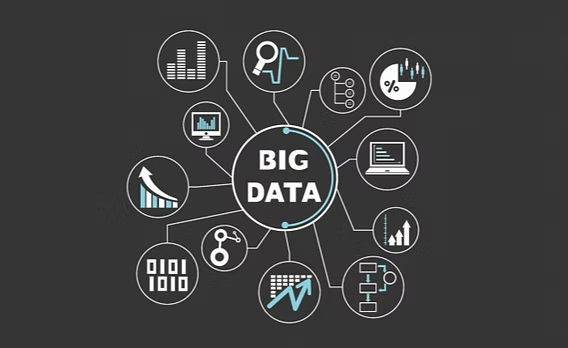
Big Data is often explained using the 6 Vs:
| 6 Vs of Big Data | Meaning |
|---|---|
| Volume | Huge amount of data |
| Velocity | Speed at which data is generated |
| Variety | Different types of data |
| Veracity | Accuracy and reliability of data |
| Value | Useful insights from data |
| Variability | Changing nature of data |
These six factors make Big Data different from traditional data systems.
Evolution of Big Data
In the modern world, data is often called the new oil. Just like crude oil becomes useful only after processing, raw data becomes valuable only after analysis.
Earlier, organizations stored limited data in simple databases. But with the growth of the internet, smartphones, and the Internet of Things (IoT), data generation increased rapidly.
IoT means devices connected to the internet, such as:
- Smart watches
- Smart TVs
- Security cameras
- Home appliances
- GPS devices
These devices continuously collect and send data.
As technology improved, businesses realized that analyzing large datasets could help them predict customer behavior, reduce costs, and improve performance. This led to the rise of Big Data technologies.
Importance of Big Data in India
India has a population of more than 1.4 billion people. A large number of people use digital services like:
Because of this, India generates an enormous amount of digital data.
Big Data is becoming highly important in India because it helps in:
- Better governance
- Faster services
- Economic growth
- Improved healthcare
- Better planning for development
India’s analytics industry is growing quickly and is expected to become one of the largest in the world.
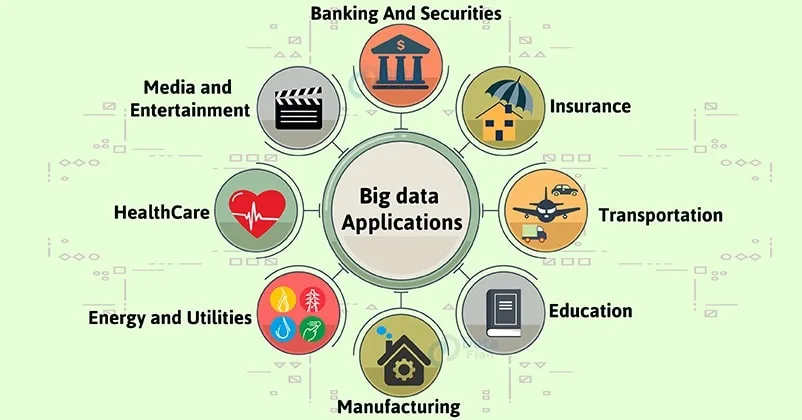
Applications of Big Data
Big Data is used in many important sectors.
1. Governance
Governments use Big Data to improve public services and policymaking.
Important uses include:
- Monitoring electricity distribution
- Reducing power loss
- Improving welfare delivery
- Tracking public services
- Better planning for cities and villages
For example, data analysis helps identify areas where electricity theft or transmission loss is high.
Government agencies also use data to study citizen needs and improve schemes.
2. Security and Cyber Safety
Security agencies and police use Big Data to improve law enforcement.
Uses include:
- Detecting cyber attacks
- Preventing online fraud
- Identifying suspicious activities
- Tracking criminal records
- Predicting crime patterns
For example, systems like Crime and Criminal Tracking Networks and Systems (CCTNS) help police access criminal records quickly.
Big Data also helps banks detect unusual card transactions to prevent fraud.
3. Disaster Management
Big Data plays an important role in disaster preparedness.
It helps in:
- Weather forecasting
- Flood prediction
- Earthquake monitoring
- Cyclone tracking
- Risk assessment
By analyzing satellite images and sensor data, authorities can issue early warnings and save lives.
This is especially important in disaster-prone areas.
4. Economy and Finance
Big Data supports economic planning and financial management.
It helps in sectors like:
Banking
Banks use Big Data for:
- Fraud detection
- Risk analysis
- Customer service improvement
- Loan approval decisions
Insurance
Insurance companies use data to:
- Process claims faster
- Detect false claims
- Improve customer support
Government Revenue
Big Data helps tax authorities identify:
- Tax evasion
- Money laundering
- Fake financial activities
Projects like Project Insight help track suspicious transactions.
It also helps in identifying shell companies involved in illegal financial activities.
5. Healthcare
Healthcare is one of the most important areas where Big Data is useful.
Hospitals and researchers use Big Data for:
- Disease prediction
- Better diagnosis
- Treatment planning
- Medicine recommendation
- Medical research
Doctors can study patient records and identify health patterns.
Benefits include:
| Healthcare Use | Benefit |
| Disease prediction | Early treatment |
| Clinical data analysis | Better diagnosis |
| Research | New medicines |
| Patient monitoring | Improved care |
Big Data also helps during disease outbreaks by tracking spread patterns.
6. Agriculture and Food Sector
India is an agricultural country, so Big Data is very useful in farming.
Farmers and agricultural departments use it for:
- Weather forecasting
- Soil analysis
- Crop disease detection
- Irrigation planning
- Seed selection
Satellite mapping helps track agricultural land and crop growth.
This improves productivity and reduces losses.
Big Data also supports food processing and supply chain management.
7. Digital Space and Technology
The digital sector uses Big Data heavily.
Applications include:
Telecom
Telecom companies use data to:
- Improve network quality
- Expand internet access
- Connect remote villages
Social Media
Social media platforms analyze user data to:
- Show personalized content
- Recommend videos
- Display targeted ads
Artificial Intelligence
AI systems use Big Data to learn and improve.
Examples include:
- Voice assistants
- Smart home devices
- Recommendation systems
- Self-learning machines
Wearable devices like smartwatches also collect health data and help users track fitness.
Government Initiatives in India
The Indian government has launched several initiatives that use Big Data.
National Data & Analytics Platform (NDAP)
NITI Aayog is developing the National Data & Analytics Platform.
This platform aims to provide a single source of sector-wise data for:
- Citizens
- Policymakers
- Researchers
This improves data accessibility and decision-making.
Big Data Management Policy
The Comptroller and Auditor General (CAG) introduced policies for auditing large public sector data.
This helps ensure better transparency and accountability.
National Data Warehouse
The Ministry of Statistics and Programme Implementation has proposed a data warehouse for official statistics.
Its purpose is to improve economic data quality using analytical tools.
Aadhaar and Direct Benefit Transfer
Unique Identification Authority of India and Direct Benefit Transfer systems help ensure benefits reach real beneficiaries.
Benefits include:
- Removal of fake beneficiaries
- Reduced corruption
- Faster payment delivery
Agriculture and Satellite Mapping
Indian Space Research Organisation works with the agriculture ministry to map agricultural assets using satellites.
Digital India and Smart Cities
Programs like Digital India, Smart City Mission, and the BHIM app rely on Big Data to improve governance and digital payments.
Challenges of Big Data
Although Big Data offers many benefits, it also creates serious challenges.
1. Privacy Issues
One major concern is privacy.
When large amounts of personal data are collected, there is a risk of misuse.
Examples include:
- Tracking user behavior
- Selling personal information
- Unauthorized access
People worry about how companies and governments use their data.
2. Data Security
Big Data systems store sensitive information such as:
- Bank details
- Aadhaar data
- Medical records
- Personal identity
If hackers access this data, it can cause major damage.
Cybersecurity is therefore extremely important.
3. Technical Challenges
Managing Big Data is not easy.
Major technical problems include:
| Challenge | Problem |
| Storage | Requires huge servers |
| Processing | Needs powerful computers |
| Scalability | System must grow with data |
| Streaming | Real-time analysis is difficult |
Organizations need strong infrastructure to handle such large data volumes.
4. Governance Challenges
Data-based policymaking requires constant monitoring.
Governments must:
- Analyze feedback regularly
- Update policies quickly
- Ensure fair implementation
Without proper planning, even useful data may not improve governance.
Way Forward
To fully use the power of Big Data, India must address current challenges.
Important steps include:
Strong Data Protection Laws
India needs modern laws to protect user privacy and prevent misuse of personal data.
Better Cybersecurity
Stronger security systems are needed to protect digital infrastructure from cyber threats.
Improved Infrastructure
Advanced data centers and computing systems are essential for storing and analyzing large datasets.
Skilled Workforce
India needs more trained professionals in:
- Data science
- Artificial Intelligence
- Analytics
- Cybersecurity
New Technologies
Combining Big Data with technologies like blockchain and AI can create safer and smarter systems.

Final Thoughts
Big Data is changing how the world works. It helps governments improve governance, businesses serve customers better, doctors provide better treatment, and farmers increase production.
At the same time, Big Data can become dangerous if privacy and security are ignored.
Big Data is often called a double-edged sword. If used wisely, it can become a powerful tool for India’s growth and development in the digital age.
FAQs
Q1. What is Big Data in simple words?
Big Data refers to extremely large amounts of data that cannot be managed using traditional software and databases. It includes collecting, storing, and analyzing data for useful insights.
Q2. Why is Big Data important?
Big Data is important because it helps organizations make better decisions, improve services, reduce risks, and increase efficiency.
Q3. What are the 6 Vs of Big Data?
The 6 Vs of Big Data are:
- Volume
- Velocity
- Variety
- Veracity
- Value
- Variability
Q4. How is Big Data used in healthcare?
Big Data helps in disease prediction, diagnosis, treatment planning, patient monitoring, and medical research.
Q5. How does Big Data help agriculture?
It helps farmers through weather forecasting, crop disease detection, irrigation planning, soil analysis, and better seed selection.
Q6. What are the main challenges of Big Data?
Major challenges include:
- Data privacy issues
- Cybersecurity risks
- Storage problems
- High infrastructure costs
Q7. How does the Indian government use Big Data?
The government uses Big Data in Digital India, Smart Cities, Aadhaar-based services, agriculture mapping, and welfare schemes.
Q8. Is Big Data useful for businesses?
Yes, businesses use Big Data for customer analysis, fraud detection, market research, and improving products and services.