


Linkages of Organised Crime with Terrorism in India

Linkages of Organised Crime with Terrorism is a major security concern for India. These two dangerous activities often support each other and create serious threats to peace, law, and national security. Organised crime mainly focuses on earning illegal money through criminal activities, while terrorism aims to spread fear and achieve political or ideological goals. When both work together, they become even more dangerous.
Thank you for reading this post, don't forget to subscribe!India has faced many security challenges for decades, including separatist movements, cross-border terrorism, insurgency, and internal violence. In many cases, terrorist groups use criminal networks to collect money, buy weapons, and expand their influence. This connection creates instability not only in India but also in neighboring regions.
What is Organised Crime?
Organised crime refers to illegal activities carried out by a group of people in a planned and structured way to earn money or gain power. These groups usually operate secretly and often use violence, threats, and corruption.
Common examples of organised crime include:
- Drug trafficking
- Money laundering
- Human trafficking
- Arms smuggling
- Extortion
- Illegal gambling
- Counterfeit currency
- Cyber fraud
- Prostitution networks
Unlike ordinary crimes, organised crime involves networks that operate for long periods and often across state or national borders.
How Organised Crime Works in India
India faces several conditions that make organised crime easier to grow. These include poverty, unemployment, corruption, weak law enforcement in some areas, and long-standing conflicts.
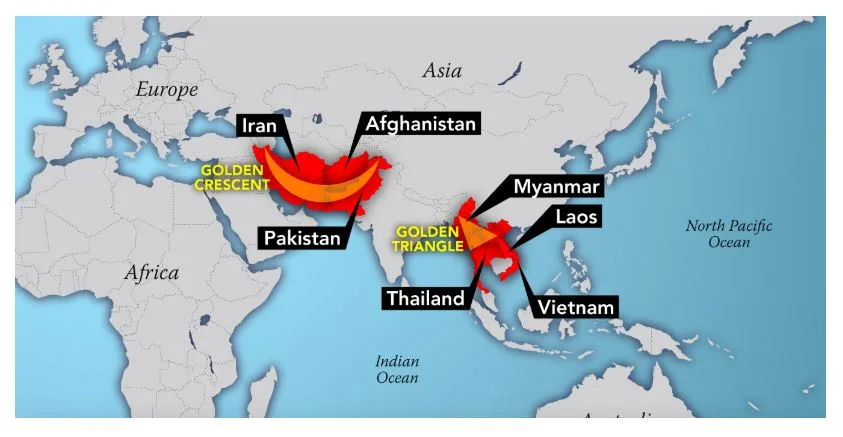
India’s geographical location also increases risk. The country is close to major illegal drug-producing regions such as the Golden Crescent (Afghanistan, Iran, Pakistan) and the Golden Triangle (Myanmar, Laos, Thailand). These regions are known for drug production and trafficking.
Criminal groups use land borders, forests, rivers, and sea routes to transport illegal goods. Modern technology, encrypted messaging apps, and digital payments have made their operations more advanced.
Some criminal groups also invest illegal money into legal businesses to hide their profits.
Conflict Zones in India
Certain regions in India are more vulnerable to the crime-terror nexus.
Jammu and Kashmir
Jammu and Kashmir has faced militancy and terrorism for decades. Cross-border infiltration and illegal funding have increased security challenges.
Northeastern States
States like Assam, Nagaland, and Manipur have seen insurgent activities for many years.
Naxal-Affected Areas
Regions in Chhattisgarh, Telangana, and Andhra Pradesh continue to face Maoist violence.
These areas often become hotspots where crime and terrorism connect.
Difference Between Organised Crime and Terrorism
Although organised crime and terrorism are different, they sometimes overlap.
| Aspect | Organised Crime | Terrorism |
|---|---|---|
| Main Goal | Earn money and profit | Spread fear and achieve political goals |
| Activities | Smuggling, fraud, extortion | Bombings, attacks, hostage-taking |
| Structure | Usually group-based | Can be individual or group |
| Motivation | Financial gain | Ideological or political |
| Violence | Used when needed for control | Used as a primary tool |
Similarities
Both organised crime and terrorism:
- Operate secretly
- Use violence and fear
- Build illegal networks
- Exploit weak governance
- Use corruption to avoid arrest
Because of these similarities, cooperation between them becomes easier.
How Organised Crime Supports Terrorism
Terrorist groups need money, weapons, safe houses, and transportation. Organised crime helps provide these resources.
Major support systems include:
Illegal Funding
Terror groups earn money through:
- Drug trade
- Extortion
- Kidnapping
- Illegal taxation
- Smuggling
Weapon Supply
Criminal groups supply:
- Guns
- Explosives
- Ammunition
- Communication tools
Money Laundering
Illegal money is cleaned through fake businesses or shell companies.
Hawala Network
Hawala is an informal money transfer system. It allows money to move without direct bank transactions, making tracking difficult.
This system is commonly used by both criminals and terrorists.
Examples of Linkages of Organised Crime with Terrorism in India
Jammu and Kashmir
Jammu and Kashmir remains one of the strongest examples of the crime-terror link.
Terror groups such as:
- Lashkar-e-Taiba
- Jaish-e-Mohammad
- Harkat-ul-Jihad al-Islami
have been involved in militant activities.
These groups often receive funds through:
- Foreign donors
- Hawala channels
- Fake charities
- Drug money
- Counterfeit currency
This money is used to train militants, buy weapons, and conduct attacks.
Northeastern India
The Northeast has witnessed insurgencies for decades.
Groups such as United Liberation Front of Assam have operated in the region.
Poor governance and difficult terrain create opportunities for illegal networks.
Criminal and insurgent groups engage in:
- Drug trafficking
- Arms smuggling
- Human trafficking
- Illegal tax collection
- Money laundering
Some groups even establish parallel control over remote areas.
Because many international borders pass through this region, cross-border crime becomes difficult to control.
Naxalite Movement
The Naxalite movement began in Naxalbari, West Bengal.
It expanded to many states where poverty and lack of development created anger among local communities.
Naxalite groups collect funds through:
- Extortion from contractors
- Illegal taxes
- Mining-related payments
- Smuggling
- Arms trade
These funds help them maintain operations in remote forest areas.
Legal Position of Organised Crime in India
India has many laws to fight crime and terrorism, but there is no single national law focused only on organised crime.
Important laws include:
National Security Act, 1980
The National Security Act allows preventive detention in security-related cases.
Narcotic Drugs and Psychotropic Substances Act, 1985
The Narcotic Drugs and Psychotropic Substances Act controls drug production, transport, and trade.
Some states have their own laws:
- Gujarat Control of Organised Crime Act
- Karnataka Control of Organised Crime Act
- Uttar Pradesh Control of Organised Crime Act
India also works with global institutions such as:
- United Nations Office on Drugs and Crime (UNODC)
- United Nations Convention against Transnational Organized Crime (UNTOC)
- United Nations Convention against Corruption (UNCAC)
These agreements improve international cooperation.
Challenges Related to Organised Crime
1. Social Damage
Organised crime harms society in many ways.
Examples include:
- Drug addiction
- Violence
- Fear among citizens
- Family breakdown
- Rising crime rates
Young people are especially vulnerable.
2. Political Influence
Criminal groups sometimes influence:
- Political leaders
- Elections
- Local administrations
- Government systems
This weakens democracy and public trust.
3. Corruption
Corruption is one of the biggest challenges.
When criminals bribe officials, law enforcement becomes weaker. Corruption can affect:
- Police
- Border security
- Customs officers
- Local administration
This allows criminal networks to survive.
4. Weak Legal Framework
India lacks a centralized law specifically targeting organised crime networks.
Many existing laws punish individuals but do not fully target the entire criminal network.
This creates loopholes.
5. Economic Loss
Organised crime causes huge economic damage.
Criminal groups:
- Invest black money into businesses
- Distort market competition
- Increase illegal trade
- Reduce tax collection
Money earned from crime can reach billions.
6. Cross-Border Nature
Modern organised crime is global.
Criminal networks operate across countries through:
- Internet
- Digital banking
- Dark web
- International smuggling routes
Different legal systems make international action difficult.
Way Forward
India needs stronger and smarter strategies to break the connection between organised crime and terrorism.
Intelligence Fusion Centers
Special centers should be created where intelligence agencies share information quickly.
This improves coordination.
Strong Financial Tracking
Authorities must monitor suspicious money flow.
Using advanced tools can help track:
- Hawala payments
- Money laundering
- Terror funding
Financial intelligence is very important.
Risk Monitoring
Government agencies should identify sectors at high risk, such as:
- Banking
- Real estate
- Border trade
- Transport
Regular audits can detect suspicious activities early.
Better Laws
India needs stronger national laws specifically against organised crime.
New laws should focus on:
- Criminal groups
- Financial networks
- Cross-border operations
International Cooperation
Since organised crime crosses borders, global cooperation is necessary.
Countries must improve:
- Intelligence sharing
- Joint investigations
- Extradition agreements
This helps track criminals hiding abroad.
Community Participation
Local communities can help security agencies.
Community policing builds trust and improves intelligence gathering.
Local leaders can help identify suspicious activities early.
Use of Technology
Advanced technology can strengthen security.

Useful tools include:
- Artificial Intelligence
- Big data analytics
- Blockchain tracking
- Cyber surveillance
Technology can detect hidden patterns faster than traditional methods.
The Linkages of Organised Crime with Terrorism remain one of the biggest internal security threats to India. Criminal groups provide money, weapons, and support systems to terrorist organizations, making them stronger and more dangerous. Breaking this connection requires strong laws, advanced technology, international cooperation, and active public participation.
FAQs
1. What is organised crime?
Organised crime is illegal activity carried out by groups to earn money through planned criminal operations like smuggling and trafficking.
2. What is the link between organised crime and terrorism?
Organised crime provides funds, weapons, and support systems to terrorist groups.
3. What is Hawala?
Hawala is an informal money transfer system used to move funds without traditional banking channels.
4. Which Indian regions are most affected?
Jammu and Kashmir, Northeastern states, and Naxal-affected regions are heavily affected.
5. Why is organised crime dangerous?
It increases violence, corruption, terrorism, and economic losses while weakening governance.