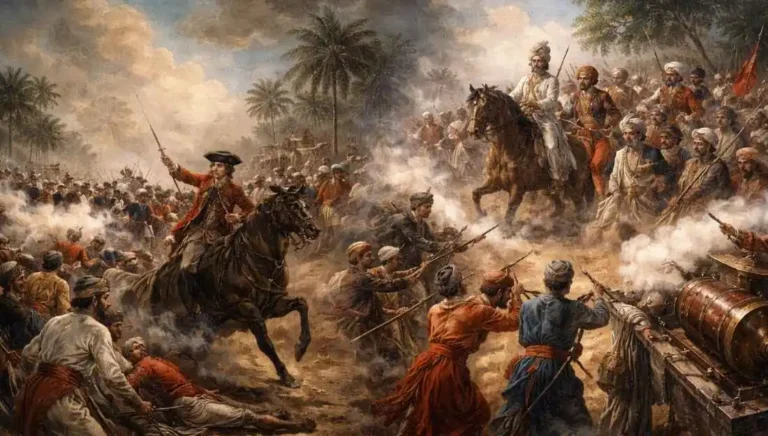
British Conquest for Bengal: Battles of Plassey and Buxar

The British Conquest for Bengal: Battles of Plassey and Buxar marks one of the most important turning points in Indian history. These two battles not only changed the political structure of Bengal but also laid the strong foundation of British rule in India. Through strategy, diplomacy, and military power, the British East India Company transformed from a trading organization into a ruling power.
Thank you for reading this post, don't forget to subscribe!Bengal in the 17th–18th Century
During the Mughal period, Bengal was the most fertile and richest province of the Mughal Empire. It included present-day Bangladesh along with the regions of Bihar and Odisha. Due to its fertile land, favorable climate, and strong river system, Bengal became one of the most productive agricultural regions in India. The province was widely known for its prosperity, dense population, and flourishing trade activities.
Economic Importance of Bengal
Bengal held great economic importance both within India and in international trade. It was especially famous for its high-quality goods such as fine cotton textiles, silk, and saltpetre, which was an important ingredient in gunpowder. In addition to these, Bengal exported rice, indigo, pepper, sugar, handicrafts, and various other products to European markets.
European countries, especially Britain, depended heavily on Bengal for these goods. In fact, nearly 60% of British imports from Asia consisted of products from Bengal. This made Bengal a highly valuable region for foreign traders.
Administration and Power
The administrative authority of Bengal was in the hands of the Nawab of Bengal. Although the Nawab was officially under the Mughal Emperor, in reality, he enjoyed a large degree of independence and controlled the internal affairs of the province.
Importance of Bengal for the British
Bengal became the first major region in India to be occupied by the British. The British East India Company carried on highly profitable trade with this province. The enormous wealth and resources of Bengal later helped the British finance their expansion in other parts of India.
The Company established its commercial base in Bengal in the 1690s and laid the foundation of Calcutta (now Kolkata) as an important trading center. The Mughal Emperor allowed the Company to trade freely in Bengal in return for a small annual payment of around Rs 3,000 (approximately £350).
However, the Company’s earnings from Bengal were extremely high. Its exports from Bengal were worth more than £50,000 per year, which created a huge imbalance between what they paid and what they earned.
Conflicts Between Nawabs and the British
The special privileges enjoyed by the British East India Company were strongly opposed by the Nawabs of Bengal. These privileges caused heavy losses to the provincial treasury, as the British often avoided paying taxes and duties.
This situation created growing tension between the Nawabs and the British. The misuse of trade privileges, along with the Company’s increasing interference in political matters, became the main cause of conflict.
Main Causes of Conflict
- Misuse of trade privileges by the British
- Loss of revenue for the Nawab
- British fortification of Calcutta without permission
- Increasing political ambitions of the British
Due to these conflicts, the British realized the need to place a “puppet Nawab” on the throne of Bengal. Such a ruler would support their interests, grant them trade concessions, and allow them to exercise indirect control over the province. This strategy eventually led to major confrontations and paved the way for the Battles of Plassey and Buxar.
Battle of Plassey (1757)
The Battle of Plassey was fought in 1757 in the Plassey (Palashi) region of Bengal, on the eastern side of the Bhagirathi River in present-day West Bengal. It was a decisive turning point that marked the beginning of British political control in India.
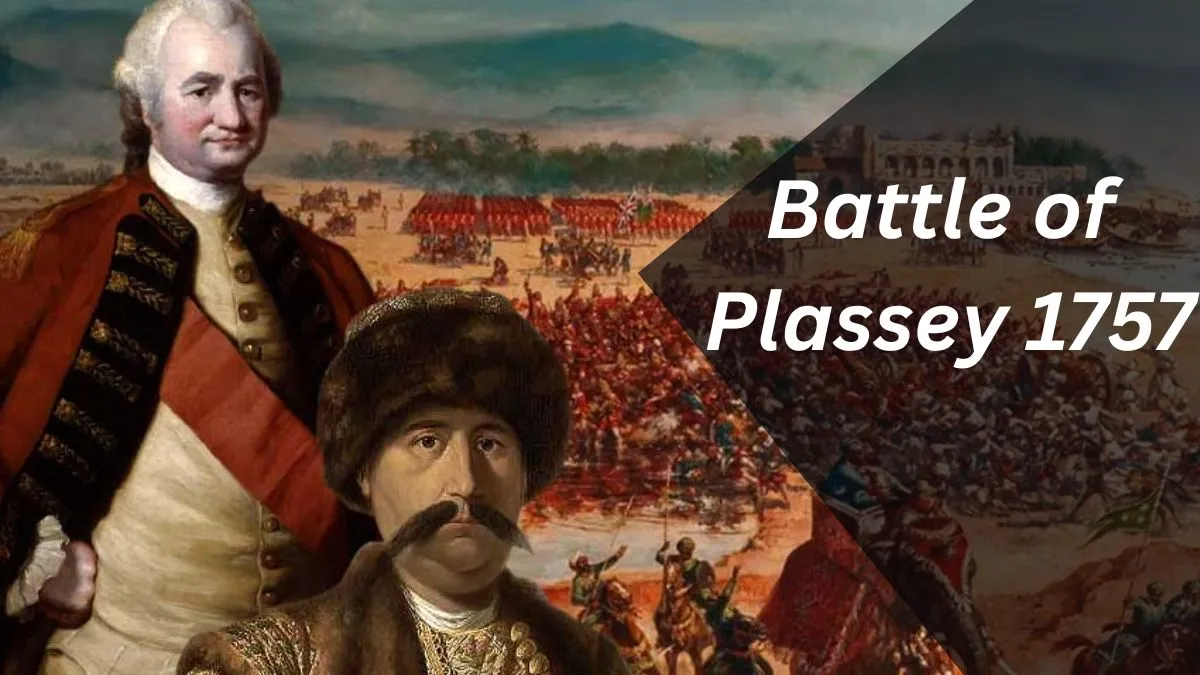
The battle was fought between the forces of the British East India Company, led by Robert Clive, and the army of Siraj-ud-Daulah, the last independent Nawab of Bengal, who was supported by his French allies.
Background of the Battle
Siraj-ud-Daulah
Siraj-ud-Daulah became the Nawab of Bengal after the death of his grandfather, Alivardi Khan. Alivardi Khan himself had become the ruler after defeating Sarfaraz Khan. Siraj-ud-Daulah inherited a powerful but politically unstable kingdom.
He was surrounded by many rivals and enemies within his own court. These internal conflicts later played a major role in the British victory.
Growing Tensions with the British
Several reasons increased tension between the Nawab and the British:
- The British misused their trade privileges and avoided paying taxes
- This caused heavy financial loss to the Nawab
- The British fortified Calcutta without the Nawab’s permission
- This act was seen as a direct challenge to his authority
At the same time, the British had already become powerful after their success in the Carnatic region, which made Siraj-ud-Daulah suspicious of their intentions.
Capture of Calcutta (1756)
In anger, Siraj-ud-Daulah marched towards Calcutta and captured Fort William in June 1756. This was a major blow to the British.
Black Hole of Calcutta Incident
After capturing the fort, Siraj-ud-Daulah imprisoned 146 British soldiers in a small room. Due to lack of space and air, 123 prisoners died of suffocation.
This tragic event is known as the “Black Hole of Calcutta.” It greatly increased hostility between the British and the Nawab and pushed the British towards revenge.
Course of the Battle
After their defeat in Calcutta, the British sent a strong army from Madras under the leadership of Robert Clive to regain control and overthrow the Nawab.
Secret Conspiracy
The British did not rely only on military strength. They used political strategy:
- They made secret agreements with dissatisfied nobles
- Mir Jafar, a close relative and commander of Siraj-ud-Daulah, was bribed
- He was promised the throne of Bengal if he supported the British
Battle Situation
The battle took place at Plassey:
- Nawab’s army: Around 50,000 soldiers
- British army: Around 3,000 soldiers
Even though the Nawab had a much larger army, the British had a strong advantage due to internal betrayal.
What Happened in the Battle
- Mir Jafar and his troops (about one-third of the Nawab’s army) did not fight
- Many other commanders also stayed inactive
- This weakened the Nawab’s position
As a result, the British easily defeated the Nawab’s forces.
Siraj-ud-Daulah tried to escape after the defeat, but he was captured and later killed by Miran, the son of Mir Jafar.
Results of the Battle of Plassey
The British victory had major consequences:
- Mir Jafar was declared the new Nawab of Bengal
- He was placed on the throne at Murshidabad by Robert Clive
- The British received huge amounts of wealth and land
- The Company gained strong political influence in Bengal
This battle marked the beginning of British rule in India. It was not just a military victory but mainly a result of conspiracy, betrayal, and diplomacy.
After Plassey: Rise of British Power
After becoming Nawab, Mir Jafar tried to satisfy the British:
- He granted the zamindari of the 24 Parganas to the Company
- He gave large sums of money as per agreements
However, he failed to meet all British demands. As a result:
- He was removed from power
- His son-in-law Mir Qasim was made the new Nawab
Mir Qasim later proved to be a strong and independent ruler, which led to further conflict with the British and eventually to the Battle of Buxar.
Battle of Buxar (1764)
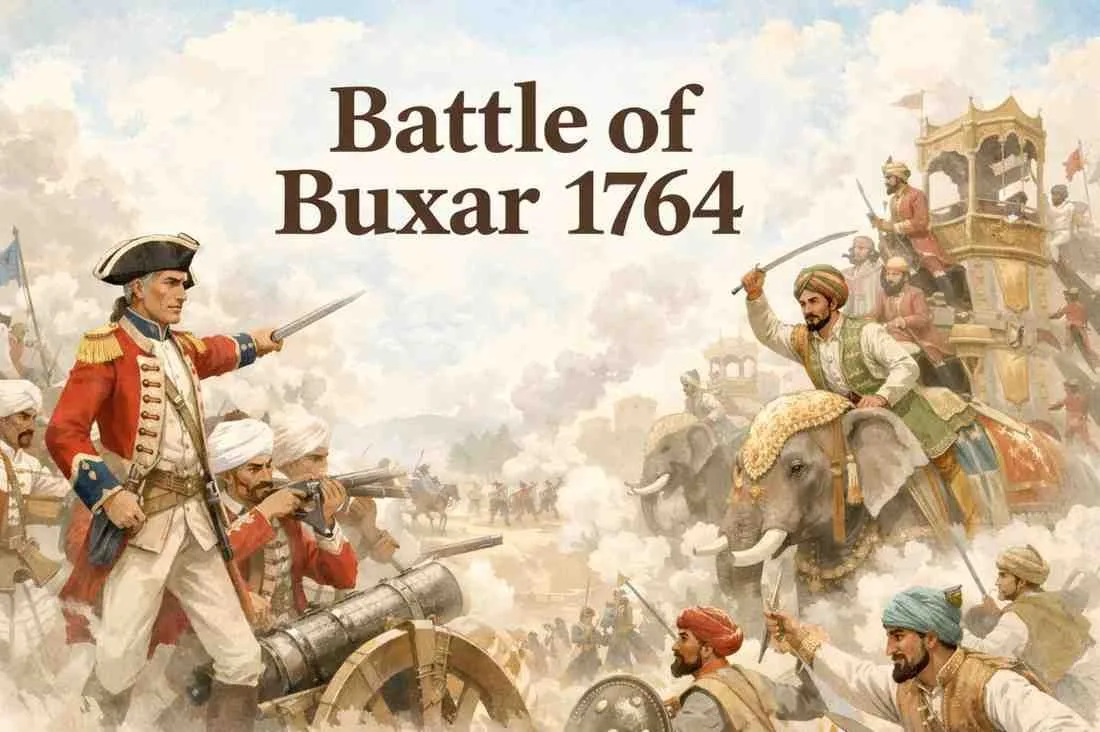
The Battle of Buxar was fought in 1764 and was more significant than the Battle of Plassey in terms of its long-term impact. It was a decisive and full-scale war that firmly established British power in India.
Participants in the Battle
The battle was fought between:
- British East India Company (led by Hector Munro)
- Mir Qasim (former Nawab of Bengal)
- Shuja-ud-Daulah (Nawab of Awadh)
- Shah Alam II (Mughal Emperor)
Background of the Battle
Mir Qasim and His Policies
Mir Qasim was considered the most capable ruler among the successors of Alivardi Khan. He was an efficient and strong administrator who wanted to make Bengal independent from British control.
To strengthen his position, he:
- Improved the administration
- Built a strong and modern army
- Shifted his capital from Murshidabad to Munger in 1762
- Focused on increasing the treasury
Mir Qasim believed he was an independent ruler. However, this was a problem for the British because they wanted a weak and dependent Nawab.
Conflict with the British
The main issue between Mir Qasim and the British was trade privileges.
- The British misused the Farman of 1717 to avoid paying internal customs duties
- Indian traders had to pay taxes, which created inequality
To solve this problem, Mir Qasim abolished all internal trade duties so that Indian traders could compete equally with the British.
However, the British strongly opposed this move and demanded special treatment.
War Between Mir Qasim and the British
Due to increasing conflicts, war broke out in 1763.
The British defeated Mir Qasim in several battles, including:
- Katwa
- Murshidabad
- Giria
- Sooty
- Munger
After these defeats, Mir Qasim fled to Awadh. There, he formed a strong alliance with:
- Shuja-ud-Daulah (Nawab of Awadh)
- Shah Alam II (Mughal Emperor)
Their aim was to defeat the British and regain control over Bengal.
Course of the Battle of Buxar
In October 1764, the combined armies of Mir Qasim, Shuja-ud-Daulah, and Shah Alam II fought against the British at Buxar.
Despite their large numbers, the combined forces were decisively defeated by the British army led by Hector Munro.
Outcome of the Battle
- The British achieved a clear and decisive victory
- It proved the military strength and discipline of the British army
- Unlike Plassey, this was a proper and direct war, not based on conspiracy
Results of the Battle of Buxar
The Battle of Buxar had major and long-lasting consequences:
- It confirmed British control over Bengal
- It ended attempts to rule Bengal through puppet Nawabs
- It showed that even powerful Indian rulers and the Mughal Emperor could not defeat the British
The battle led to the Treaty of Allahabad (1765), where the Mughal Emperor accepted British authority over Bengal.
Robert Clive later became the first Governor of Bengal.
Significance of the Battle
- It was a full-scale war that showed British military power
- Both the Nawab of Bengal and the Mughal Emperor were defeated
- The British became the strongest power in North India
- It made them contenders to rule the entire country
Post-War Developments
After the battle:
- Mir Jafar was reinstated as the Nawab of Bengal in 1763
- He handed over important districts like Midnapore, Burdwan, and Chittagong to the British
- The British got duty-free trade in Bengal (except 2% duty on salt)
After Mir Jafar’s death in 1765:
- His son Najm-ud-Daulah became Nawab
- He became only a nominal ruler (pensioner of the British)
Gradually:
- The British reduced the powers of Nawabs
- In 1772, they took complete control of Bengal administration
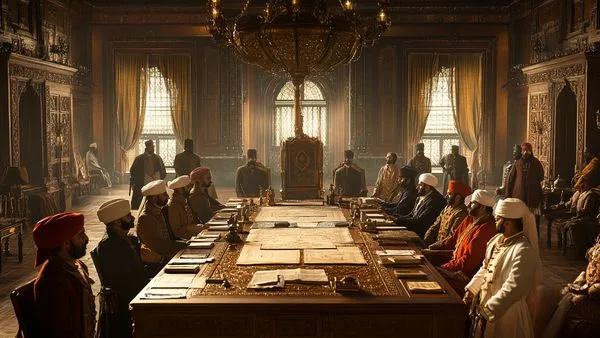
Treaty of Allahabad (1765)
After the victory, the British signed treaties with Indian rulers.
Key Terms
- The Mughal Emperor granted Diwani rights (revenue collection) to the British
- The British gained control over Bengal, Bihar, and Orissa
- The Nawab of Awadh paid a large indemnity
This treaty made the British the real rulers of Bengal.
After Buxar: Expansion of British Power
After the battle:
- Mir Jafar was briefly reinstated
- Later, his successors became dependent on the British
- The Nawabs lost real power
By 1772, the British took direct control of Bengal.
Comparison: Plassey vs Buxar
Battle of Plassey (1757)
- Won through conspiracy and betrayal
- Beginning of British political rule
- Installed puppet Nawab
Battle of Buxar (1764)
- A full-scale military battle
- Established British supremacy in North India
- Defeated Mughal Emperor and regional powers
Importance of These Battles
The British Conquest for Bengal: Battles of Plassey and Buxar changed Indian history in many ways:
Political Impact
- End of independent rule in Bengal
- Beginning of British Empire in India
Economic Impact
- British gained control over rich resources
- Wealth of Bengal was used for further expansion
Military Impact
- British proved their military strength
- Indian rulers realized the need for unity
Conclusion
The British Conquest for Bengal: Battles of Plassey and Buxar was not just about two battles; it was about the transformation of power in India. The Battle of Plassey opened the door for British control, while the Battle of Buxar secured their dominance.
These events marked the decline of the Mughal Empire and the rise of British colonial rule. Understanding these battles helps us understand how India came under British control and how history shaped the modern nation.
FAQs
1. What was the main cause of the Battle of Plassey?
The main cause was the conflict between the Nawab of Bengal and the British over misuse of trade privileges and political control.
2. When was the Battle of Plassey fought?
The Battle of Plassey was fought in 1757.
3. Who led the British in the Battle of Plassey?
Robert Clive led the British East India Company forces.
4. Why did Siraj-ud-Daulah lose the Battle of Plassey?
He lost mainly due to betrayal by Mir Jafar and lack of support from his own army.
5. What was the result of the Battle of Plassey?
It led to British political control in Bengal and the appointment of Mir Jafar as Nawab.
6. When was the Battle of Buxar fought?
The Battle of Buxar was fought in 1764.
7. Who fought against the British in the Battle of Buxar?
Mir Qasim, Shuja-ud-Daulah, and Mughal Emperor Shah Alam II fought against the British.
8. Why is the Battle of Buxar more important than Plassey?
Because it was a decisive military victory that established British supremacy in North India.
9. What was the Treaty of Allahabad (1765)?
It was an agreement that gave the British the right to collect revenue (Diwani) in Bengal, Bihar, and Orissa.
10. How did these battles help the British?
They helped the British gain political power, economic control, and expand their empire in India.