


Citizenship of India

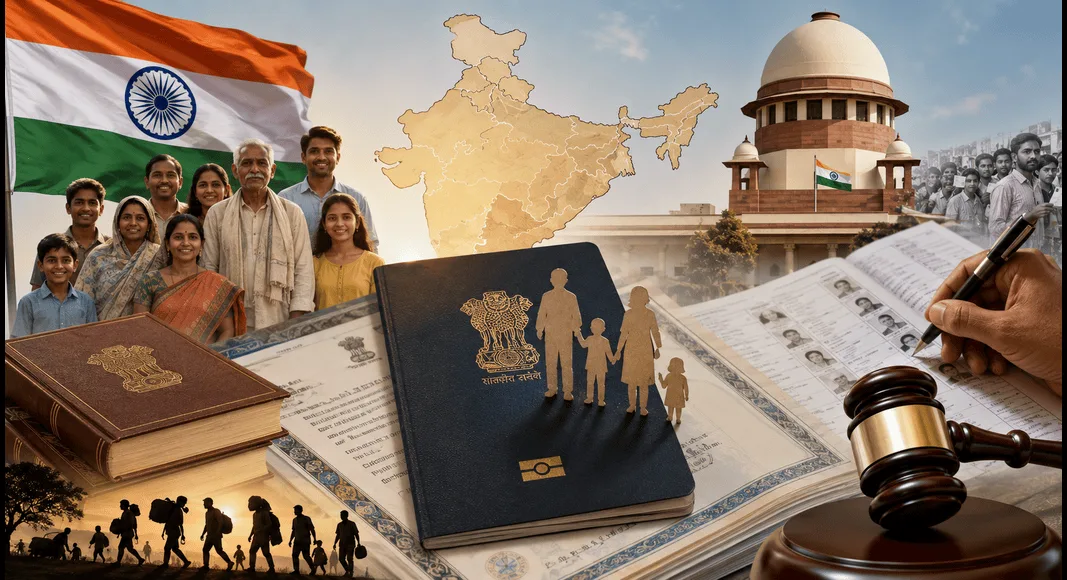
Citizenship of India is one of the most important concepts in the Indian Constitution. Citizenship determines who belongs to the Indian nation and who enjoys the rights and responsibilities granted by the Constitution. It defines the legal relationship between an individual and the State. Citizens enjoy various civil, political, and constitutional rights, while non-citizens do not enjoy all these privileges.
Thank you for reading this post, don't forget to subscribe!The topic of citizenship gained significant attention during discussions on the National Register of Citizens (NRC) in Assam, the Citizenship Act, and various amendments related to citizenship laws. Understanding citizenship is important because it affects identity, voting rights, government benefits, and participation in the democratic process.
What is Citizenship?
Citizenship refers to the legal status of a person as a member of a country. A citizen owes loyalty to the nation and, in return, receives protection and rights from the State.
Every modern country has citizens and non-citizens. Citizens have full political and legal rights, such as:
- Right to vote
- Right to contest elections
- Right to hold certain public offices
- Protection under the Constitution
- Access to various government services and benefits
Non-citizens, also known as foreigners or aliens, may live in the country legally but do not enjoy all the rights available to citizens.
Principles of Citizenship
Countries generally follow two main principles for granting citizenship:
Jus Soli (Right of the Soil)
Under this principle, citizenship is granted based on the place of birth. A person born within a country’s territory becomes a citizen of that country.
Jus Sanguinis (Right of Blood)
Under this principle, citizenship is granted based on the citizenship of parents rather than the place of birth.
When India became independent, its leaders largely supported the principle of Jus Soli because it reflected equality and inclusiveness. However, over time, citizenship laws became more restrictive and gradually moved toward a combination of both principles.
Constitutional Provisions Related to Citizenship
Citizenship is included in the Union List, which means only Parliament has the authority to make laws regarding citizenship.
The Constitution discusses citizenship in Part II (Articles 5 to 11).
Article 5 – Citizenship at the Commencement of the Constitution
According to Article 5, a person became an Indian citizen if:
- They were domiciled in India.
- They were born in India.
- Either parent was born in India.
- They had lived in India for at least five years before the Constitution came into force.
Article 6 – Migrants from Pakistan
Article 6 deals with people who migrated from Pakistan to India during Partition.
Those who migrated before July 19, 1949, were generally granted citizenship if they or their ancestors were born in India.
Those who migrated after that date had to register themselves.
Article 7 – Migrants to Pakistan
This article dealt with people who migrated to Pakistan after March 1, 1947, but later returned to India with proper permits.
Such people could also become Indian citizens.
Article 8 – Indians Living Abroad
People of Indian origin living outside India could register themselves as Indian citizens through Indian diplomatic missions if they or their parents or grandparents were born in India.
Article 9 – Citizenship of Another Country
A person who voluntarily acquires citizenship of another country loses Indian citizenship.
India does not allow dual citizenship.
Article 10 – Continuation of Citizenship
This article ensures that persons recognized as citizens continue to remain citizens unless Parliament makes laws affecting their status.
Article 11 – Powers of Parliament
This article gives Parliament complete authority to regulate citizenship matters through legislation.
Citizenship Act, 1955
To provide detailed rules regarding citizenship, Parliament passed the Citizenship Act, 1955.
The Act explains how citizenship can be acquired and terminated.
Ways of Acquiring Indian Citizenship
There are four main ways:
- By Birth
- By Descent
- By Registration
- By Naturalisation
Citizenship by Birth
Citizenship by birth depends on the date of birth and the citizenship status of parents.
Born Between January 26, 1950 and July 1, 1987
Anyone born in India during this period automatically became an Indian citizen regardless of the nationality of parents.
Born Between July 1, 1987 and December 2, 2004
A person born in India during this period became a citizen if at least one parent was an Indian citizen.
Born On or After December 3, 2004
A person born in India becomes a citizen only if:
- Both parents are Indian citizens, or
- One parent is an Indian citizen and the other is not an illegal migrant.
These changes show how citizenship laws gradually became stricter.
Citizenship by Descent
Citizenship by descent applies to people born outside India.
A child born abroad can become an Indian citizen if one or both parents are Indian citizens, subject to certain conditions.
For children born after December 3, 2004, parents must register the birth at an Indian consulate within one year and ensure the child does not hold another country’s passport.
Citizenship by Registration
Certain categories of people can obtain Indian citizenship through registration.
These include:
- Persons of Indian origin living in India for seven years.
- Persons of Indian origin living abroad.
- Foreign spouses of Indian citizens who meet residence requirements.
- Minor children of Indian citizens.
Registration provides a legal pathway for people with Indian roots to obtain citizenship.
Citizenship by Naturalisation
A foreign national can become an Indian citizen through naturalisation.
Generally, the person must:
- Reside in India for at least 12 years.
- Meet all legal requirements specified under the Citizenship Act.
Naturalisation allows foreigners who have lived in India for a long time to become Indian citizens.
Amendments to Citizenship Laws
The Citizenship Act has been amended several times to address changing circumstances.
1986 Amendment
Originally, citizenship by birth was very broad.
The 1986 amendment introduced a condition that at least one parent must be an Indian citizen for those born after July 1, 1987.
This reduced the scope of automatic citizenship.
2003 Amendment
The 2003 amendment made citizenship laws even stricter.
For children born after December 3, 2004:
- Both parents must be citizens, or
- One parent must be a citizen and the other must not be an illegal migrant.
The amendment also introduced provisions related to the National Register of Citizens (NRC).
2005 and 2015 Amendments
These amendments mainly focused on overseas Indians and procedures relating to citizenship.
National Register of Citizens (NRC)
The National Register of Citizens (NRC) is an official record of Indian citizens.
Origin of NRC
The NRC was first prepared in 1951 after the Census.
It contained details of individuals living in different villages and towns across India.
The NRC was published only once.
Legacy Data
The following records are considered legacy documents:
- NRC of 1951
- Electoral Rolls up to March 24, 1971
People whose names or ancestors’ names appear in these records can use them as proof of Indian citizenship.
Why NRC Became Important in Assam
Assam has a unique history of migration.
For decades, the state witnessed migration from:
- East Pakistan (before 1971)
- Bangladesh (after 1971)
Many people in Assam feared that illegal migration would affect local culture, language, and political representation.
These concerns led to widespread protests and movements demanding identification of illegal migrants.
Assam Movement
Between 1979 and 1985, Assam witnessed a major public movement against illegal immigration.
The movement was led primarily by the All Assam Students’ Union (AASU).
The main demands included:
- Identification of illegal migrants.
- Removal of foreigners from electoral rolls.
- Protection of Assamese identity and culture.
Assam Accord of 1985
The Assam Movement ended with the signing of the Assam Accord in 1985 between movement leaders and the Government of India.
Main Feature
The Accord fixed March 25, 1971 as the cut-off date.
People entering Assam after this date would be considered illegal migrants.
This date differs from citizenship rules applicable in most other parts of India.
Section 6A of the Citizenship Act
To implement the Assam Accord, Parliament inserted Section 6A into the Citizenship Act.
Key Provisions
Before January 1, 1966
People of Indian origin who entered Assam before this date were considered citizens.
Between January 1, 1966 and March 25, 1971
Such persons could obtain citizenship after being identified and completing the required waiting period.
During the waiting period, they could not vote but could obtain passports.
After March 25, 1971
People entering after this date could be treated as illegal migrants.
Section 6A applies only to Assam.
Illegal Migrants (Determination by Tribunal) Act
The IMDT Act, 1983 was introduced specifically for Assam to identify illegal migrants.
However, critics argued that the law made detection and deportation difficult.
In 2005, the Supreme Court struck down the IMDT Act, declaring it unconstitutional.
Later replacement mechanisms were also challenged in courts.
Citizenship Amendment Bill, 2019
The Citizenship Amendment Bill proposed special provisions for certain religious minorities from neighboring countries.
The Bill aimed to provide a faster path to citizenship for:
- Hindus
- Sikhs
- Buddhists
- Jains
- Parsis
- Christians
who came from:
- Pakistan
- Bangladesh
- Afghanistan
before December 31, 2014.
The residency requirement was proposed to be reduced from 11 years to 5 years.
The proposal generated significant debate, especially in Assam, where many organizations feared it could affect the provisions of the Assam Accord.
Major Challenges Related to Citizenship
Illegal Migration
Managing illegal migration while protecting genuine citizens remains a major challenge.
Documentation Issues
Many poor and rural citizens lack proper documents, making it difficult to prove citizenship.
Legal Complexities
Citizenship laws involve constitutional provisions, court judgments, and special regional arrangements.
Social and Political Tensions
Citizenship debates often create anxiety and tension among communities.
Balancing Security and Human Rights
Governments must ensure national security while also protecting human rights and dignity.
Importance of Citizenship
Citizenship is important because it:
- Provides legal identity.
- Protects constitutional rights.
- Enables participation in democracy.
- Grants voting rights.
- Allows access to government welfare schemes.
- Creates a sense of belonging to the nation.
Without citizenship, people may face difficulties in accessing many essential rights and services.
Way Forward
India must maintain a balanced approach to citizenship issues. National security, constitutional values, human rights, and social harmony must all be considered together.
The government should ensure transparent citizenship procedures, simplify documentation processes, and provide clear information to citizens. Special attention should be given to vulnerable groups who may struggle to prove their citizenship due to lack of records.
Political parties should avoid turning citizenship into a source of division and instead focus on practical and humane solutions. Dialogue, fairness, and constitutional principles should guide all decisions related to citizenship.
Conclusion
Citizenship of India is the foundation of an individual’s relationship with the Indian State. The Constitution and the Citizenship Act provide detailed rules regarding who can become a citizen and how citizenship can be acquired or lost. Over the years, citizenship laws have evolved due to changing social, political, and security concerns.
Issues such as the NRC, Assam Accord, Section 6A, and citizenship amendments have made the topic highly important in public discussions. While citizenship laws must protect national interests, they should also uphold justice, equality, and human dignity. A fair, transparent, and balanced citizenship framework is essential for strengthening democracy and ensuring social harmony in India.
FAQs About Citizenship of India
1. What is Citizenship of India?
Citizenship of India is the legal status that makes a person a member of the Indian nation, giving them constitutional rights and responsibilities.
2. Which law governs citizenship in India?
Citizenship in India is governed by the Citizenship Act, 1955, along with relevant constitutional provisions.
3. What are the four ways to acquire Indian citizenship?
Indian citizenship can be acquired through:
- Birth
- Descent
- Registration
- Naturalisation
4. Can a person born in India automatically become a citizen?
It depends on the date of birth and the citizenship status of the parents, as defined under the Citizenship Act.
5. Does India allow dual citizenship?
No, India does not allow dual citizenship. A person who voluntarily acquires citizenship of another country loses Indian citizenship.
6. What is the National Register of Citizens (NRC)?
The NRC is an official register containing the names of genuine Indian citizens. It was first prepared in 1951.
7. What is the significance of the Assam Accord in citizenship matters?
The Assam Accord of 1985 fixed March 25, 1971 as the cut-off date for identifying illegal migrants in Assam.
8. What is Section 6A of the Citizenship Act?
Section 6A provides special citizenship provisions for Assam and implements the terms of the Assam Accord.
9. How can a foreign citizen become an Indian citizen?
A foreign citizen can apply for Indian citizenship through naturalisation after fulfilling the required residency and legal conditions.
10. Why is citizenship important?
Citizenship provides legal identity, voting rights, constitutional protections, and access to various government benefits and services.