



Climate Finance: Understanding Global Funding for Climate Change and Sustainable Development

Climate Finance is one of the most important tools in the global fight against climate change. As the effects of climate change become more visible through rising temperatures, floods, droughts, cyclones, and extreme weather events, countries need large amounts of money to reduce greenhouse gas emissions and adapt to changing environmental conditions.
Climate finance refers to financial support provided by governments, international organizations, private companies, and financial institutions to help countries tackle climate change. It plays a crucial role in supporting clean energy projects, climate-resilient infrastructure, sustainable agriculture, forest conservation, and disaster preparedness.

Developing countries like India need significant financial assistance to achieve climate goals while continuing economic growth and poverty reduction.
What is Climate Finance?
Climate finance refers to local, national, and international funding obtained from public, private, and alternative sources to support activities that address climate change.
These activities generally fall into two categories:
| Type | Purpose |
|---|---|
| Mitigation | Reducing greenhouse gas emissions and preventing climate change |
| Adaptation | Adjusting to climate impacts and reducing vulnerabilities |
Examples include:
- Solar and wind energy projects
- Electric vehicle infrastructure
- Climate-resilient agriculture
- Flood protection systems
- Water conservation programs
- Forest restoration projects
The concept is supported by major international agreements such as:
- United Nations Framework Convention on Climate Change (UNFCCC)
- Kyoto Protocol
- Paris Agreement
Under these agreements, developed countries are expected to support developing nations financially.
Principle of Common but Differentiated Responsibilities (CBDR)
One of the most important principles behind climate finance is Common but Differentiated Responsibilities and Respective Capabilities (CBDR-RC).
This principle recognizes that:
- Climate change is a shared global problem.
- Developed countries have historically contributed more greenhouse gas emissions.
- Developing countries have fewer financial and technological resources.
Therefore, developed nations are expected to provide financial assistance to poorer countries for climate action.
Climate Finance and COP26
At the climate conference COP26, countries discussed ways to increase climate financing.
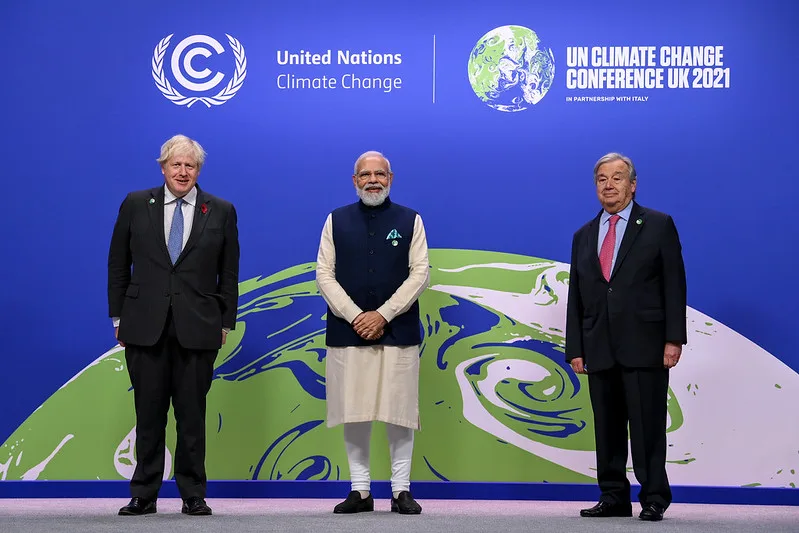
Important outcomes included:
- Greater financial support for developing countries.
- Increased adaptation funding.
- New international carbon trading mechanisms.
- Renewed commitment to climate goals under the Paris Agreement.
Developed countries also agreed to work toward increasing adaptation finance by 2025.
The USD 100 Billion Climate Finance Goal
Background
During the Climate Conference held in Copenhagen in 2009 (COP15), developed countries promised to mobilize USD 100 billion annually to help developing nations address climate change.
This target was later formally recognized at COP16 in Cancun.
At the Paris Climate Conference (COP21), the commitment was extended until 2025.
Why is the Target Important?
The USD 100 billion goal is important because many developing countries:
- Face severe climate risks.
- Need financial support for renewable energy projects.
- Require resources for adaptation and disaster management.
- Have limited domestic funding capacity.
The target also helps build trust between developed and developing nations.
Why is Climate Finance Needed?
1. Supporting Climate Mitigation
Reducing greenhouse gas emissions requires massive investments.
Examples include:
- Solar parks
- Wind farms
- Green hydrogen projects
- Energy-efficient industries
- Electric transportation
Such projects require substantial capital investment.
2. Supporting Climate Adaptation
Many climate impacts are already unavoidable.
Countries need funding for:
- Flood control systems
- Drought-resistant crops
- Water management
- Coastal protection
- Climate-resilient infrastructure
3. Building Climate Resilience
Climate finance helps vulnerable communities prepare for future climate shocks.
This reduces economic losses and protects livelihoods.
4. Encouraging Private Investment
Government resources alone are insufficient.
Climate finance helps attract private sector investments into sustainable development projects.
Global Investment Requirements
According to global estimates, trillions of dollars are needed every year to tackle climate change effectively.
The world must invest heavily in:
| Sector | Investment Need |
| Renewable Energy | Very High |
| Green Infrastructure | Very High |
| Climate Adaptation | High |
| Sustainable Transport | High |
| Water Security | High |
Without adequate financing, achieving global climate goals will become extremely difficult.
Climate Finance Requirements in India
India is one of the fastest-growing economies and faces significant climate challenges.
Under the Paris Agreement, India committed to reducing emissions intensity and increasing renewable energy capacity.
To achieve these goals, India requires large-scale climate financing.
Major Challenges
| Challenge | Impact |
| Limited long-term funding | Slows green projects |
| Growing energy demand | Increases investment needs |
| Poverty and development concerns | Compete for financial resources |
| Climate disasters | Increase adaptation costs |
India must balance economic development with environmental sustainability.
Global Climate Finance Mechanisms
Several international funds support climate-related projects.

Green Climate Fund (GCF)
The Green Climate Fund is one of the world’s largest climate financing mechanisms.
Its objectives include:
- Reducing greenhouse gas emissions.
- Supporting climate adaptation.
- Assisting vulnerable developing countries.
Adaptation Fund (AF)
The Adaptation Fund finances projects that help countries adapt to climate change impacts.
It supports:
- Water management
- Agriculture
- Disaster risk reduction
- Coastal protection
Global Environment Facility (GEF)
The GEF serves as an important financial mechanism supporting environmental and climate projects worldwide.
It helps fund:
- Biodiversity conservation
- Climate change mitigation
- Sustainable land management
Special Climate Change Fund (SCCF)
This fund supports climate adaptation activities in developing countries.
Least Developed Countries Fund (LDCF)
The LDCF specifically assists the world’s poorest countries in adapting to climate change.
Climate Finance Initiatives in India
National Clean Energy Fund (NCEF)
The National Clean Energy Fund was established to promote clean energy development.
Its funding initially came from a carbon tax on coal usage.
Key objectives include:
- Clean energy research
- Renewable energy innovation
- Green technology development
National Adaptation Fund for Climate Change (NAFCC)
Established in 2015, this fund supports states and union territories vulnerable to climate change.
It finances:
- Adaptation projects
- Water conservation initiatives
- Agricultural resilience programs
Clean Development Mechanism (CDM)
The CDM allows emission reduction projects in developing countries to earn carbon credits.
These credits can be traded internationally.
Benefits include:
- Additional income
- Technology transfer
- Sustainable development support
Internal Climate Funding Programs
India also supports climate action through:
- CAMPA Fund
- Disaster Management Fund
- Renewable Energy Programs
- Climate Change Finance Unit
Principles of Climate Finance
Polluter Pays Principle
This principle states that those responsible for pollution should bear the costs of managing and reducing environmental damage.
It encourages accountability and sustainable practices.
Common but Differentiated Responsibilities (CBDR)
Countries have different historical responsibilities and capacities.
Developed countries should contribute more resources.
Additionality
Climate finance should be additional to existing development aid.
Funds meant for poverty reduction and development should not be diverted to climate activities.
Adequacy
Funding levels should be sufficient to address climate challenges effectively.
Insufficient funding limits progress.
Predictability
Countries need predictable and long-term funding commitments.
Stable financial support helps governments plan climate projects effectively.
Importance of Climate Finance
Climate finance offers several benefits:
Environmental Benefits
- Reduced greenhouse gas emissions
- Improved air quality
- Increased renewable energy use
- Forest conservation
Economic Benefits
- Green job creation
- Sustainable industrial growth
- Increased investment opportunities
Social Benefits
- Better public health
- Improved disaster preparedness
- Enhanced food and water security
Global Benefits
- International cooperation
- Faster achievement of climate goals
- Reduced climate-related conflicts
Challenges of Climate Finance
Global Challenges
Funding Gap
Available funding remains much lower than actual requirements.
Unequal Distribution
Least developed countries often receive less funding than needed.
Slow Approval Processes
Many climate projects face delays due to lengthy approval procedures.
Political Uncertainty
Changes in political priorities can affect climate finance commitments.
Challenges in India
Limited Financial Products
Climate-friendly financial instruments remain limited.
Long Project Timelines
Many climate projects require years before generating returns.
Budget Constraints
Government budgets often face competing priorities.
Private Sector Participation
Private investments remain below required levels.
Way Forward
To strengthen climate finance, several measures are necessary.
Increase Global Commitments
Developed countries should fulfill and expand climate finance promises.
Promote Public-Private Partnerships
Collaboration between governments and businesses can mobilize larger investments.
Improve Access to Funds
Funding approval processes should become faster and simpler.
Strengthen Green Financial Markets
Green bonds and sustainable investment products should be expanded.
Focus on People-Centered Development
Climate projects should improve livelihoods and create sustainable employment opportunities.
Support Technology Transfer
Developed nations should help developing countries access advanced clean technologies.
Enhance Transparency
Clear reporting systems can improve trust and accountability in climate finance.
Frequently Asked Questions (FAQs)
1. What is climate finance?
Climate finance refers to funding provided for activities that reduce climate change impacts and help societies adapt to changing environmental conditions.
2. Why is climate finance important?
It supports renewable energy, climate adaptation, disaster resilience, and sustainable development projects worldwide.
3. What is the USD 100 billion climate finance target?
It is a commitment by developed countries to mobilize USD 100 billion annually for developing nations to address climate change.
4. What are mitigation and adaptation?
Mitigation focuses on reducing emissions, while adaptation focuses on adjusting to climate impacts.
5. What is the Green Climate Fund?
The Green Climate Fund is an international fund that supports climate-related projects in developing countries.
6. How does climate finance help India?
It supports renewable energy projects, climate adaptation programs, disaster management, and sustainable infrastructure development.
7. What is the Polluter Pays Principle?
It states that those responsible for pollution should bear the costs of preventing and managing environmental damage.
8. What are green bonds?
Green bonds are financial instruments used to raise money for environmentally sustainable projects.