


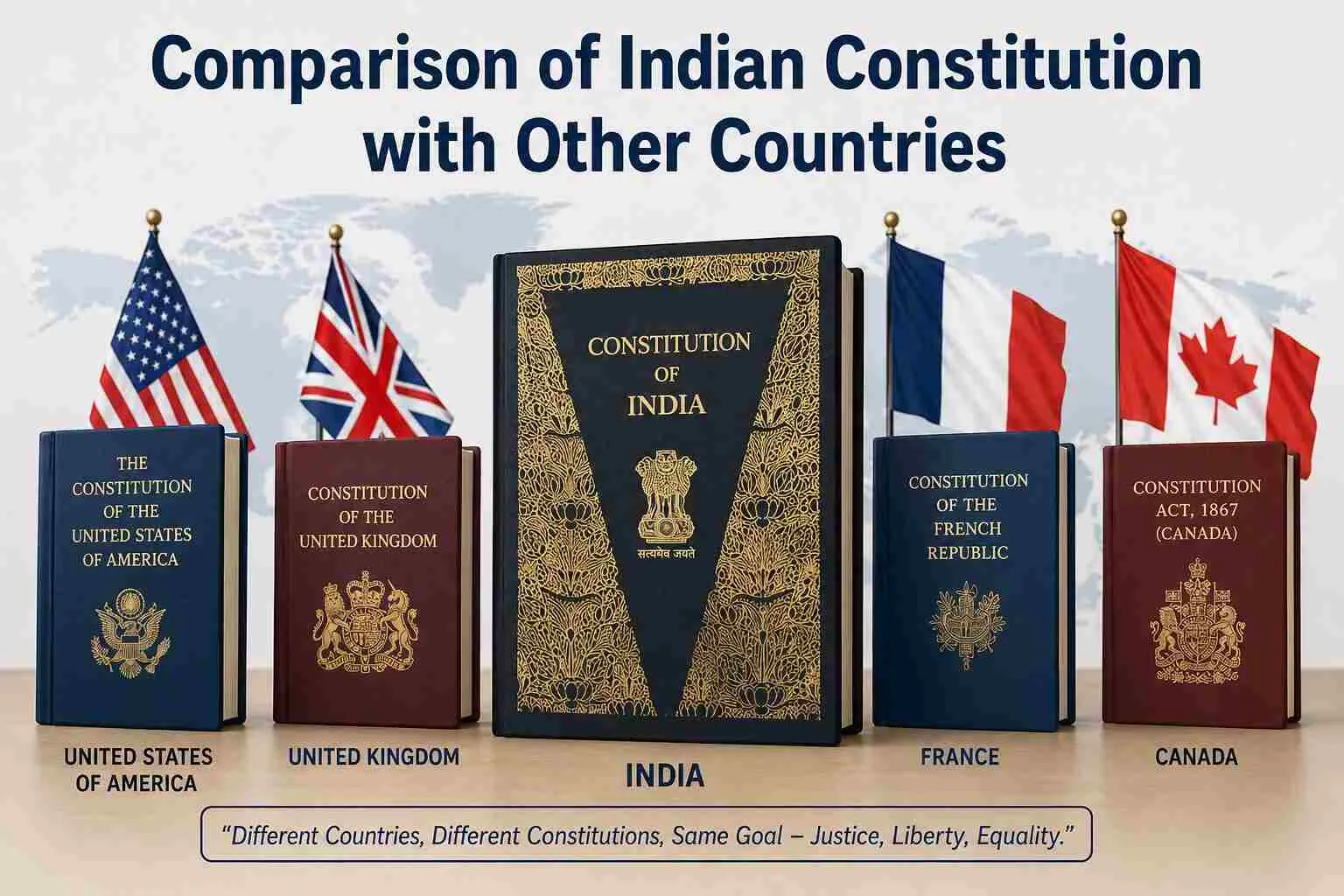
Comparison of Indian Constitution with Other Countries

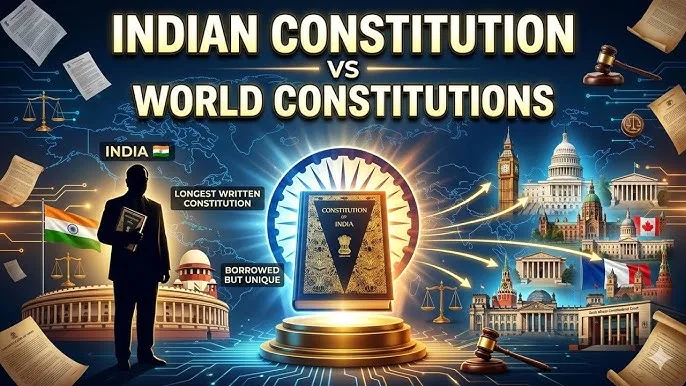
The Comparison of Indian Constitution with Other Countries helps us understand how the Constitution of India is unique while also learning from the constitutional systems of other nations. When the Constitution of India was prepared, the makers studied the constitutions of many democratic countries. They selected the best ideas and modified them according to India’s needs.
Thank you for reading this post, don't forget to subscribe!The Indian Constitution came into force on 26 January 1950. It is the longest written Constitution in the world and provides a strong legal framework for democracy, justice, equality, liberty, and national unity. Although it borrows many features from countries such as the United Kingdom, the United States, Canada, Ireland, Australia, France, South Africa, Japan, and Germany, it has its own identity.
What Is the Indian Constitution?
The Constitution is the highest law of India. It defines the structure of the government, the powers of different institutions, the rights of citizens, and the duties of the government. Every law made in India must follow the Constitution.
The Constitution also protects the rights of citizens and ensures that the government works according to democratic principles.
Borrowed Features of the Indian Constitution
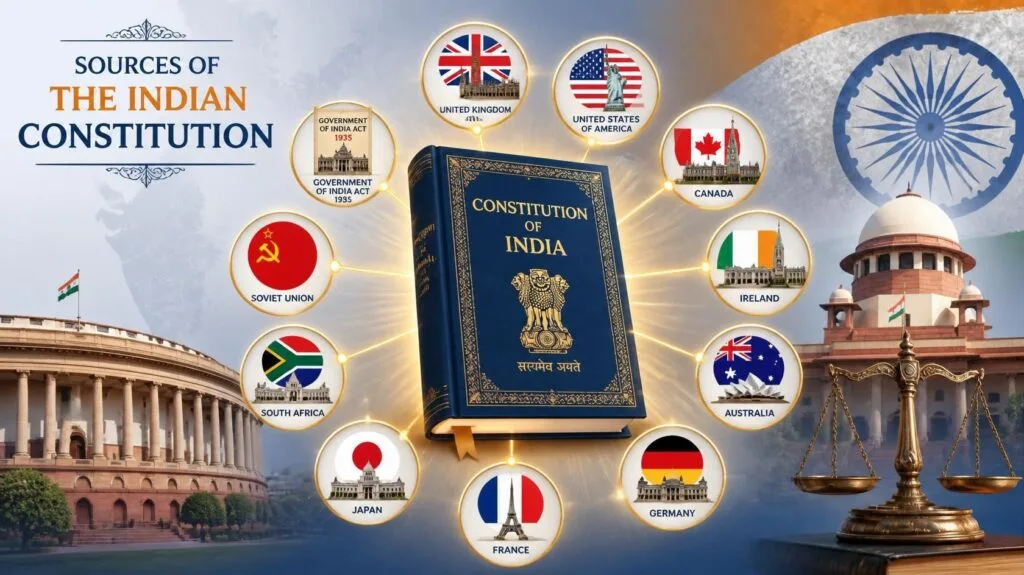
The Constitution of India includes many ideas from other countries. However, these ideas were carefully adapted to suit Indian conditions.
| Country | Features Borrowed |
|---|---|
| United Kingdom | Parliamentary system, Rule of Law, Cabinet system, Single Citizenship, Bicameral Legislature |
| United States | Fundamental Rights, Judicial Review, Independent Judiciary, Vice President, Removal of Judges |
| Ireland | Directive Principles of State Policy, Election of President, Rajya Sabha nominations |
| Canada | Federal system with a strong Centre, Governor appointment, Residuary powers |
| Australia | Concurrent List, Freedom of Trade and Commerce, Joint Sitting |
| France | Republic, Liberty, Equality and Fraternity |
| Germany | Emergency provisions |
| Russia (USSR) | Fundamental Duties, Social and Economic Justice |
| South Africa | Constitutional Amendment Procedure, Election of Rajya Sabha members |
| Japan | Procedure Established by Law |
These borrowed features make the Indian Constitution strong and balanced.
Comparison of Indian Constitution with the United States
India and the United States are both democratic countries, but their constitutional systems are different in many ways.
Similarities
- Both have written constitutions.
- Both follow a federal system.
- Both protect the rights of citizens.
- Both have an independent judiciary.
- Both allow judicial review.
- Both have a bicameral legislature.
- Both are democratic republics.
Differences
| India | United States |
| Parliamentary system | Presidential system |
| Single citizenship | Dual citizenship |
| Strong Central Government | States enjoy greater powers |
| Longest written Constitution | Shortest written Constitution |
| Prime Minister is the real executive | President is the real executive |
| Parliament has residuary powers | States have residuary powers |
The Indian Constitution provides more flexibility because it combines federal and unitary features.
Comparison of Indian Constitution with the United Kingdom
India adopted many constitutional principles from Britain because India was under British rule for many years.
Similarities
- Parliamentary form of government.
- Cabinet system.
- Bicameral legislature.
- Rule of Law.
- Prime Minister as the real executive.
- Collective responsibility of the Council of Ministers.
Differences
| India | United Kingdom |
| Written Constitution | Unwritten Constitution |
| Republic | Constitutional Monarchy |
| Judicial Review is available | Limited Judicial Review |
| Constitution is supreme | Parliament is supreme |
| Single citizenship | Dual citizenship allowed |
| Fundamental Rights are written | No separate list of Fundamental Rights |
Although India borrowed many ideas from Britain, it created a written Constitution suitable for a democratic republic.
Comparison of Indian Constitution with France
France also influenced the Indian Constitution, especially through the ideas of the French Revolution.
Similarities
- Written Constitution.
- Democratic government.
- Republic.
- President as Head of State.
- Constitutional amendment procedure.
Differences
| India | France |
| Parliamentary democracy | Semi-presidential system |
| Federal structure | Unitary system |
| President has limited powers | President has strong executive powers |
| Single citizenship | Dual citizenship is allowed |
India follows secularism by respecting all religions equally, while France follows a stricter form of secularism where the government stays separate from religion.
Special Features of the Indian Constitution
The Indian Constitution is unique because it combines the best ideas from different countries while protecting India’s diversity.
Some important features include:
- Longest written Constitution in the world.
- Parliamentary democracy.
- Federal system with a strong Centre.
- Independent judiciary.
- Fundamental Rights.
- Directive Principles of State Policy.
- Fundamental Duties.
- Universal Adult Franchise.
- Single Citizenship.
- Secular State.
- Emergency provisions.
- Local self-government through Panchayats and Municipalities.
These features help maintain democracy, justice, and national unity.
Why Did India Borrow Features from Other Countries?
The members of the Constituent Assembly wanted to create a Constitution that would work effectively in a large and diverse country like India. Instead of copying one Constitution, they selected the best ideas from many countries.
The borrowed features were modified to match India’s culture, history, social conditions, and administrative needs. This helped create a Constitution that is both practical and flexible.
Importance of Comparing Constitutions
Studying the constitutions of different countries helps us understand how governments function around the world.
Some benefits include:
- Better understanding of democracy.
- Learning different methods of governance.
- Improving constitutional laws.
- Protecting citizens’ rights.
- Strengthening democratic institutions.
- Encouraging constitutional reforms when needed.
Comparison also shows why India’s Constitution is considered one of the most comprehensive constitutions in the world.
Why the Indian Constitution Is Unique
Although many provisions were borrowed from other countries, the Indian Constitution is not a copy of any single Constitution. It combines the best constitutional practices with India’s own traditions and democratic values.
It provides equal rights to all citizens, ensures social justice, protects minorities, maintains national unity, and creates a balance between the powers of the Centre and the States. This combination makes the Constitution suitable for one of the world’s largest and most diverse democracies.
Frequently Asked Questions
What is the Comparison of Indian Constitution with Other Countries?
It is the study of similarities and differences between the Indian Constitution and the constitutions of countries like the USA, UK, France, Canada, Ireland, Australia, and others.
Which country influenced the Indian Constitution the most?
The United Kingdom had the greatest influence, especially in the parliamentary system, cabinet government, and rule of law.
Which country inspired India’s Fundamental Rights?
India borrowed the concept of Fundamental Rights from the Constitution of the United States.
Why is the Indian Constitution called unique?
It combines the best features of many constitutions while meeting India’s social, political, and cultural needs.
Which is the longest written Constitution in the world?
The Constitution of India is the longest written Constitution in the world.
What is the biggest difference between India and the US Constitution?
India follows a parliamentary system, while the United States follows a presidential system.