Meghalayan Age: The Latest Age in Earth’s History

The Meghalayan Age is the most recent age in the history of Earth. Scientists and geologists officially declared this age to describe the last 4,200 years of Earth’s geological timeline. This age is very important because it began after a major climate change event that affected many ancient civilizations around the world.
Thank you for reading this post, don't forget to subscribe!The name “Meghalayan Age” comes from the state of Meghalaya in India. Evidence of this age was discovered in the famous Mawmluh Cave of Meghalaya. The chemical changes found inside the cave helped scientists understand an important climatic event that happened thousands of years ago.
The Meghalayan Age is a part of the Holocene Epoch, which is the current geological epoch in which humans live today. This classification was accepted by geologists and added to the Geological Time Scale.
What is Meghalayan Age?
The Meghalayan Age began around 4,200 years ago after a severe global drought and cooling period. This climate event lasted for nearly 200 years and caused major environmental and social changes across the world.
Scientists found that rainfall decreased greatly during this time. Many agricultural societies suffered because crops failed and water sources dried up. As a result, several powerful ancient civilizations weakened or collapsed.
The Meghalayan Age is special because it is the only geological age that started due to a global climatic event that directly affected human civilizations.
Why is the Meghalayan Age Important?
The Meghalayan Age is important for several reasons:
- It is the newest division of Earth’s geological history.
- It shows how climate change can affect human life and civilizations.
- It connects geological events with human history.
- Evidence of this age was found in India, giving global importance to Meghalaya.
- It helps scientists study past climate patterns to understand future climate changes.
The Global Climate Event of 4,200 Years Ago
Around 2200 BCE, Earth experienced a major climatic disaster. Scientists believe there was a long period of drought and cooling across many regions.
This event caused:
- Reduction in rainfall
- Dry rivers and lakes
- Failure of agriculture
- Food shortages
- Migration of people
- Collapse of cities and kingdoms
Evidence of this climate event has been discovered on all seven continents.
Civilizations Affected by the Meghalayan Age
The climate change during the Meghalayan Age affected many ancient civilizations. Some of the major civilizations that suffered were:
1. Indus Valley Civilization
The Indus Valley Civilization in present-day India and Pakistan depended heavily on rivers and farming. Reduced rainfall weakened agriculture and forced people to leave cities.
2. Egyptian Civilization
Ancient Egypt depended on the flooding of the Nile River. Weak floods caused food shortages and political instability.
3. Mesopotamian Civilization
Mesopotamia, located between the Tigris and Euphrates rivers, also faced severe drought conditions that damaged farming activities.
4. Civilizations in Greece and Syria
Many settlements in Greece and Syria suffered from famine and social disorder because of changing climate conditions.
5. Yangtze River Valley Civilization
Ancient communities in China near the Yangtze River also experienced environmental stress due to climate change.
The Three Ages of the Holocene Epoch
The Holocene Epoch is divided into three ages:
| Age | Time Period | Main Feature |
|---|---|---|
| Greenlandian Age | 11,700 – 8,326 years ago | End of the last Ice Age |
| Northgrippian Age | 8,326 – 4,200 years ago | Sudden global cooling |
| Meghalayan Age | 4,200 years ago – Present | Global drought and civilization changes |
These three ages together form the Holocene Epoch.
What is the Holocene Epoch?
The Holocene Epoch is the current geological epoch of Earth. It started about 11,700 years ago after the last Ice Age ended.
During this period:
- Ice sheets melted
- Temperatures became warmer
- Human civilizations developed
- Agriculture expanded
- Modern societies formed
The Holocene belongs to the Cenozoic Era, which is known as the age of mammals.
Scientists study sediments, ice, rocks, caves, and fossils from the Holocene Epoch to understand Earth’s climate history.
How Scientists Identified the Meghalayan Age
Scientists used special geological methods to identify the Meghalayan Age. They studied:
- Ice cores
- Cave formations
- Sediments
- Oxygen isotopes
For older Holocene ages, scientists used ice cores from Greenland. These ice layers preserved yearly climate records.
However, for the Meghalayan Age, scientists needed another method because younger layers were harder to study through ice alone.
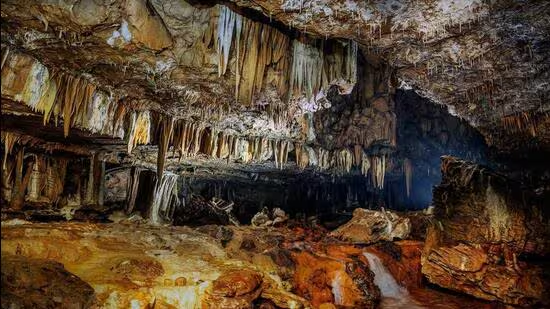
They found important evidence inside the stalagmites of Mawmluh Cave in Meghalaya.
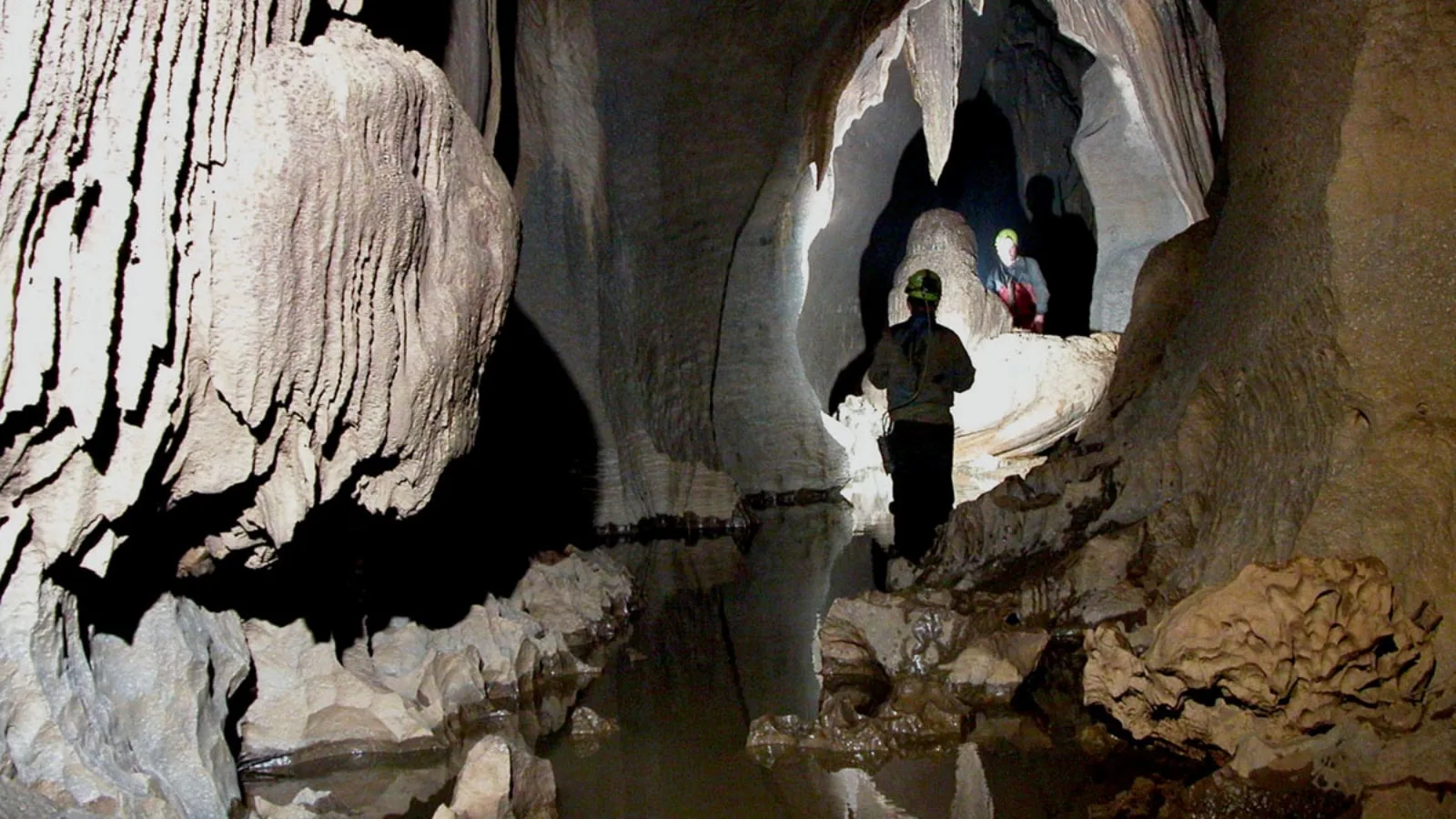
Mawmluh Cave in Meghalaya
Location and Importance
Mawmluh Cave is located in Meghalaya at a height of about 1,290 meters above sea level. It is one of the longest and deepest caves in India.
The cave became internationally famous because scientists found evidence of the Meghalayan Age there.
What are Stalagmites?
Stalagmites are rock formations that rise upward from the floor of caves. They form slowly due to dripping mineral-rich water.
These formations preserve chemical records of ancient climate conditions. Scientists can study them like natural climate archives.
Oxygen Isotopes and Climate Study
Scientists examined oxygen isotopes inside the stalagmites of Mawmluh Cave.
An isotope is a form of an element with a different number of neutrons. Changes in oxygen isotopes help scientists understand past rainfall and temperature conditions.
The cave showed a sudden shift in oxygen isotope levels around 4,200 years ago. This proved that a major climate change event had occurred globally.
Geological Age Dating Method
Scientists used geological age dating methods to determine the age of the stalagmites and climatic changes.
These methods help scientists calculate:
- Age of rocks
- Age of fossils
- Time of climate events
- Geological changes
This scientific study confirmed the beginning of the Meghalayan Age.
International Geostandards
The stalagmite from Mawmluh Cave became an official geological marker.
It was recognized as a:
Global Boundary Stratotype Section and Point (GSSP)
A GSSP is an internationally accepted reference point used to define geological time boundaries.
This was the first officially recognized geological time marker in India.
What is Geological Time Scale?
The Geological Time Scale is a system used by geologists to divide Earth’s 4.6-billion-year history into different periods.
Scientists divide Earth’s history into:
| Geological Unit | Description |
|---|---|
| Eon | Largest time division |
| Era | Subdivision of eon |
| Period | Subdivision of era |
| Epoch | Subdivision of period |
| Age | Smallest major division |
Each division represents important changes in climate, geography, plants, animals, or human development.
Importance of Geological Time Scale
The Geological Time Scale helps scientists:
- Understand Earth’s history
- Study evolution of life
- Analyze climate changes
- Identify mass extinctions
- Compare geological events
Without this system, studying Earth’s long history would be very difficult.
International Commission on Stratigraphy (ICS)
The International Commission on Stratigraphy (ICS) is the organization responsible for maintaining the Geological Time Scale.
Main Functions of ICS
- Defines geological ages and epochs
- Updates geological classifications
- Studies rock layers and fossils
- Maintains international geological standards
The ICS officially approved the Meghalayan Age.
The organization works under the International Union of Geological Sciences (IUGS).
Why Meghalaya Was Chosen
Meghalaya was chosen because the evidence found in Mawmluh Cave clearly showed the climatic event of 4,200 years ago.
The cave conditions were ideal because:
- The cave remained protected from erosion
- Chemical records were preserved properly
- The stalagmites showed clear oxygen changes
This made Meghalaya globally important in geological studies.
Connection Between Climate and Civilization
The Meghalayan Age teaches an important lesson about climate change and human societies.
Ancient civilizations depended heavily on:
- Farming
- Rivers
- Rainfall
- Natural resources
When climate conditions changed suddenly, food production decreased and societies became unstable.
This shows how environmental changes can directly affect human life.
Meghalayan Age and Modern Climate Change
Scientists also compare the Meghalayan climatic event with modern climate challenges.
Today, the world faces:
- Global warming
- Droughts
- Floods
- Heat waves
- Melting glaciers
By studying past climate events like the Meghalayan Age, scientists can better understand how climate affects civilizations and ecosystems.
Key Features of Meghalayan Age
| Feature | Details |
|---|---|
| Beginning | Around 4,200 years ago |
| Main Event | Global drought and cooling |
| Duration of Climate Event | About 200 years |
| Evidence Found In | Mawmluh Cave, Meghalaya |
| Geological Period | Holocene Epoch |
| Importance | Latest geological age |
| Recognized By | International Commission on Stratigraphy |
Interesting Facts About Meghalayan Age
- It is the youngest age in Earth’s geological timeline.
- It is named after an Indian state.
- Evidence of this age was found in cave rocks.
- Ancient civilizations collapsed during this period.
- It is connected with global climate change.
- Mawmluh Cave became globally important after this discovery.
Conclusion
The Meghalayan Age is an important chapter in Earth’s history. It began around 4,200 years ago after a major global drought and cooling event. This climatic change affected many ancient civilizations and changed human societies across different regions of the world.
Scientists discovered evidence of this age in the stalagmites of Mawmluh Cave in Meghalaya, India. Because of this discovery, Meghalaya gained international recognition in geological studies.
The Meghalayan Age also reminds us that climate change can greatly influence human life. Studying past climate events helps scientists understand the present and prepare for future environmental challenges.
FAQs on Meghalayan Age
1. What is the Meghalayan Age?
The Meghalayan Age is the latest age in Earth’s geological history that began around 4,200 years ago after a major global drought.
2. Why is it called the Meghalayan Age?
It is named after Meghalaya because important evidence of this age was found in Mawmluh Cave in Meghalaya, India.
3. Which cave is connected with the Meghalayan Age?
Mawmluh Cave in Meghalaya is connected with the Meghalayan Age.
4. What caused the Meghalayan Age?
A major global drought and cooling event caused the beginning of the Meghalayan Age.
5. Which civilizations were affected during this age?
The Indus Valley, Egyptian, Mesopotamian, Greek, Syrian, and Yangtze River Valley civilizations were affected.
6. What is the Holocene Epoch?
The Holocene Epoch is the current geological epoch that started about 11,700 years ago after the Ice Age ended.
7. What does ICS stand for?
ICS stands for International Commission on Stratigraphy.
8. What is a stalagmite?
A stalagmite is a rock formation that grows upward from the floor of caves due to dripping mineral-rich water.
9. What is GSSP?
GSSP stands for Global Boundary Stratotype Section and Point, an official geological marker.
10. Why is the Meghalayan Age important today?
It helps scientists understand past climate changes and their effects on human civilizations.