


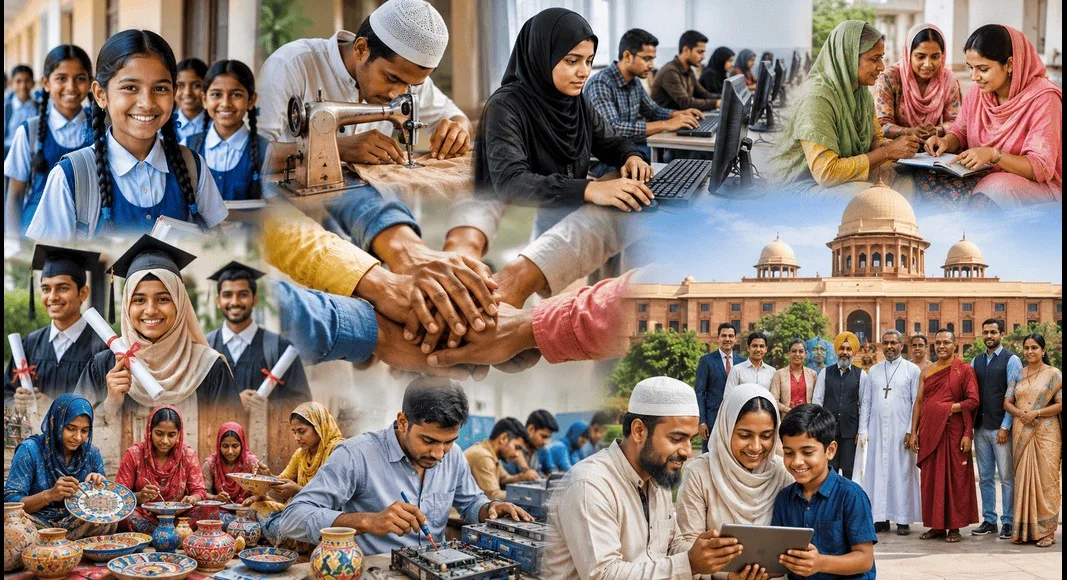
Minority Welfare: Government Schemes and Rights in India

India is a country where people from different religions, languages, and cultures live together. Protecting the rights of minority communities and ensuring their equal development is an important responsibility of the government. The Ministry of Minority Affairs works to improve the social, educational, and economic conditions of minority communities through various welfare schemes, scholarships, skill development programs, and infrastructure projects.
Thank you for reading this post, don't forget to subscribe!The Ministry focuses on creating equal opportunities in education, employment, entrepreneurship, women’s empowerment, and preservation of traditional arts and culture. Over the years, many new initiatives have been introduced to help minority communities become financially independent while preserving their cultural identity.
What is the Ministry of Minority Affairs?
The Ministry of Minority Affairs is responsible for planning and implementing welfare programs for India’s notified minority communities.
Currently, the Government of India recognizes six religious minority communities:
- Muslims
- Christians
- Sikhs
- Buddhists
- Parsis (Zoroastrians)
- Jains
The ministry works in partnership with state governments, educational institutions, NGOs, and other organizations to improve education, employment, skill development, healthcare, and infrastructure for these communities.
Its main objective is to ensure that minorities receive equal opportunities for growth and become active participants in India’s development.
Pradhan Mantri Jan Vikas Karyakram (PMJVK)
One of the biggest development programmes for minority communities is the Pradhan Mantri Jan Vikas Karyakram (PMJVK).
The scheme focuses on improving basic infrastructure in areas where minority populations are concentrated.
Under this programme, the government supports the construction of:
- Schools
- Colleges
- Polytechnic institutes
- Industrial Training Institutes (ITIs)
- Girls’ hostels
- Skill development centres
- Health centres
- Community facilities
- Drinking water and sanitation projects
To improve public services, Common Service Centres (CSCs) have also been established under the programme. These centres provide information about government schemes and help people apply for different welfare benefits through a single-window system.
Progress after 2019
Since 2019, PMJVK has continued to improve infrastructure in minority-concentrated areas. More projects related to education, healthcare, sanitation, digital services, and skill development have been approved across several states.
The scheme now places greater emphasis on improving the quality of life rather than only creating physical infrastructure.
Begum Hazrat Mahal National Scholarship
The Begum Hazrat Mahal National Scholarship was introduced to encourage girls from economically weaker minority families to continue their education.
The scholarship supported students studying in schools by reducing financial difficulties faced by their families.
The scheme mainly focused on:
- Preventing school dropouts
- Encouraging girls’ education
- Supporting poor minority families
Recent developments
In recent years, several scholarship schemes have been reorganized and merged with other scholarship programmes under government policy reforms. However, financial assistance for deserving minority students continues through different educational support initiatives.
Gharib Nawaz Employment Scheme
The Gharib Nawaz Employment Scheme was designed to provide short-term skill training to unemployed minority youth.
The scheme offered practical training in industries where jobs were available.
Training covered areas such as:
- Retail
- Hospitality
- Electrical work
- Plumbing
- Computer skills
- Tailoring
- Mobile repairing
- Healthcare support
The objective was to help young people find employment quickly after completing training.
Seekho Aur Kamao Scheme
Seekho Aur Kamao is one of the most important skill development schemes for minority youth.
The programme provides industry-oriented training that matches current market demands.
Its main objectives include:
- Improving employability
- Creating self-employment opportunities
- Upgrading traditional skills
- Training school dropouts
- Supporting unemployed youth between 14 and 35 years
Many trainees receive placement assistance after completing the course.
Importance
Skill development reduces unemployment and helps young people become financially independent without depending entirely on government jobs.
Nai Manzil Scheme
Many young people leave school before completing their education because of poverty or family responsibilities.
The Nai Manzil Scheme helps such school dropouts complete formal education while also receiving vocational skill training.
The scheme combines:
- Basic education
- Skill development
- Employment opportunities
This approach improves both educational qualifications and job readiness.
USTTAD Scheme
India has a rich tradition of handicrafts and artisan work. Many minority communities possess unique traditional skills that are slowly disappearing.
The USTTAD Scheme (Upgrading the Skills and Training in Traditional Arts/Crafts for Development) was launched to preserve these valuable traditions.
Its objectives include:
- Protecting traditional crafts
- Training young artisans
- Improving product quality
- Standardizing traditional skills
- Creating national and international markets
The scheme helps artisans earn better incomes while preserving India’s cultural heritage.
Nai Roshni Scheme
Women play an important role in family and community development.
The Nai Roshni Scheme focuses on leadership development for women belonging to minority communities.
Training programmes include:
- Leadership skills
- Legal awareness
- Health education
- Financial literacy
- Digital literacy
- Government schemes awareness
The goal is to empower women to participate actively in society and decision-making.
Hunar Haat
One of the most popular initiatives of the Ministry is Hunar Haat.
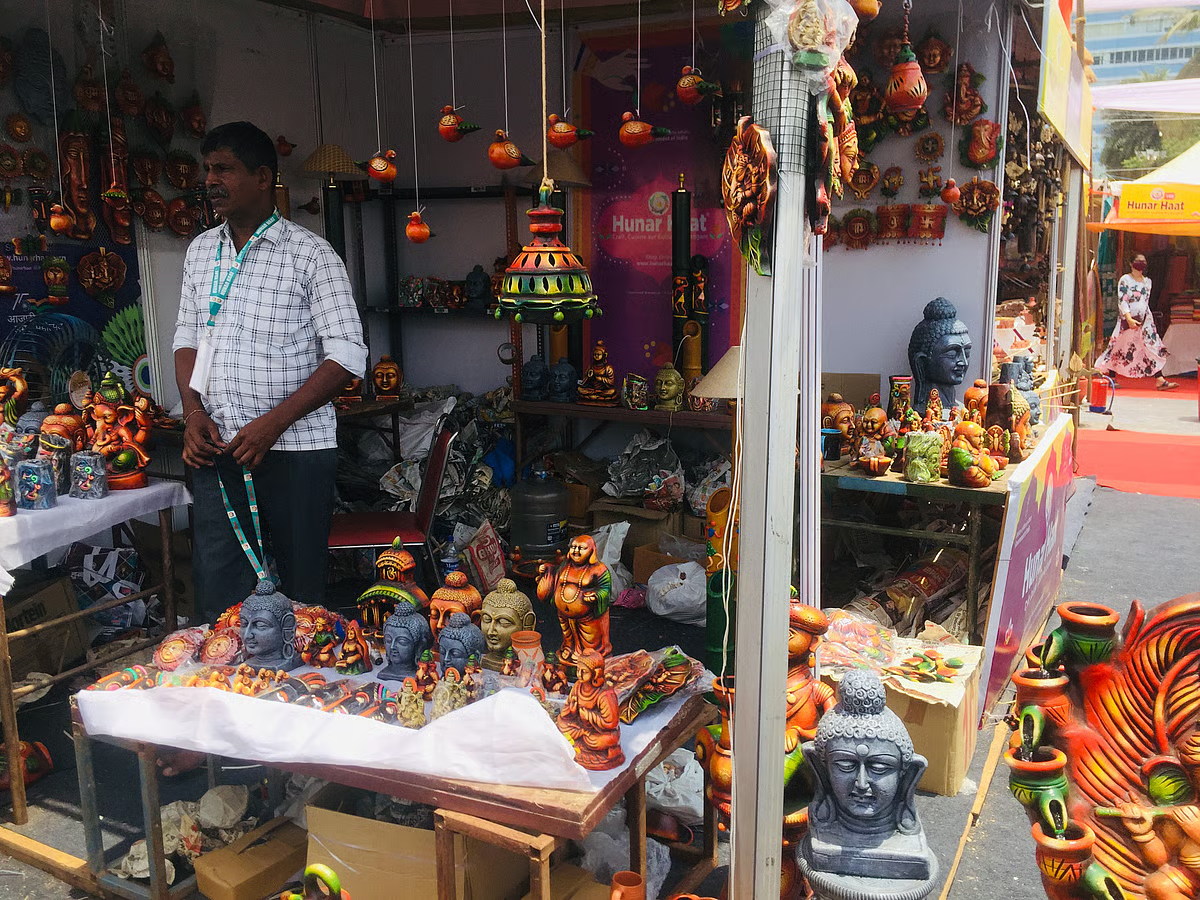
It provides a national platform for minority artisans, craftsmen, and traditional food experts to sell their products directly to customers.
Products displayed include:
- Handicrafts
- Handloom items
- Carpets
- Wooden crafts
- Metal crafts
- Traditional paintings
- Regional foods
Benefits
Hunar Haat:
- Creates employment
- Promotes traditional crafts
- Increases artisans’ income
- Encourages entrepreneurship
- Preserves India’s cultural diversity
After 2019
Several editions of Hunar Haat were organized across India until the programme was later discontinued. However, support for artisans continues through other government initiatives and digital marketing platforms.
Constitutional Rights of Minorities
Although the Constitution does not specifically define the word “minority,” it provides several important safeguards.
Article 29
Article 29 protects the language, script, and culture of any group of citizens.
It allows communities to preserve their unique identity.
Article 30
Article 30 gives minorities the right to establish and manage educational institutions of their choice.
This helps minority communities preserve their educational and cultural traditions.
Article 350B
Article 350B provides for the appointment of a Special Officer for Linguistic Minorities.
The officer investigates whether linguistic minorities are receiving the constitutional protections guaranteed to them.
National Commission for Minorities (NCM)
The National Commission for Minorities (NCM) was established under the National Commission for Minorities Act, 1992.
Its major functions include:
- Monitoring constitutional safeguards
- Examining complaints
- Advising the government
- Protecting minority rights
- Promoting equality
Every year, 18 December is observed as Minorities Rights Day to spread awareness about minority rights and equality.
Digital Haj Services and E-MASIHA
India became one of the first countries to make the Haj application process almost completely digital.
Facilities introduced include:
- Online application
- E-Visa
- Mobile application
- Digital accommodation details
- Digital baggage management
One of the biggest innovations is E-MASIHA (E Medical Assistance System for Indian Pilgrims Abroad).
This system maintains the complete medical records of Indian pilgrims during Haj and allows doctors to provide better healthcare during emergencies.
The digital platform improves medical care and reduces paperwork.
Waqf Property Digitization
A Waqf is a property permanently dedicated for religious or charitable purposes under Islamic law.
Examples include:
- Mosques
- Graveyards
- Schools
- Colleges
- Shelter homes
- Charitable institutions
The Ministry started large-scale digitization and geo-tagging of Waqf properties across India.
Benefits
Digitization helps:
- Prevent illegal occupation
- Improve transparency
- Maintain proper records
- Better utilize properties for public welfare
Central Waqf Council
The Central Waqf Council is a statutory body under the Ministry of Minority Affairs.
Its responsibilities include:
- Advising Central Government
- Guiding State Waqf Boards
- Improving Waqf administration
- Promoting better management of Waqf properties
The Council received greater powers after the Waqf (Amendment) Act, 2013.
Major Developments from 2020 to 2025
The Ministry introduced several changes and policy reforms after 2019.
Some major developments include:
Greater Digital Governance
Applications for scholarships, skill development, and welfare programmes became more digital, making services easier to access.
Better Infrastructure
PMJVK projects expanded educational institutions, healthcare facilities, hostels, sanitation, and skill centres in minority-concentrated districts.
Women’s Empowerment
Greater focus was given to financial inclusion, digital literacy, entrepreneurship, and self-employment among minority women.
Support for Artisans
Traditional artisans increasingly received support through exhibitions, digital marketplaces, and entrepreneurship programmes.
Education
Government efforts continued to improve educational opportunities, skill development, and vocational training for minority students and youth, while scholarship schemes underwent restructuring to improve efficiency.
Waqf Reforms
Digitization of Waqf properties continued, and discussions on improving Waqf administration gained attention, including legislative reforms aimed at enhancing transparency and governance.
Challenges Ahead
Despite many achievements, several challenges remain.
These include:
- School dropout rates
- Unemployment among youth
- Limited awareness of government schemes
- Poor access to quality education
- Digital divide in rural areas
- Need for stronger women’s participation
- Better implementation of welfare programmes
Addressing these issues requires cooperation between the Central Government, State Governments, local authorities, educational institutions, and civil society organizations.
Conclusion
The Ministry of Minority Affairs plays an important role in ensuring inclusive development in India. Through programmes such as Pradhan Mantri Jan Vikas Karyakram, Seekho Aur Kamao, Nai Manzil, Nai Roshni, USTTAD, and Hunar Haat, the government has worked to improve education, employment, infrastructure, women’s empowerment, and preservation of traditional crafts.
The use of digital technology, better infrastructure, skill development initiatives, and transparent governance has made many welfare programmes more effective. Constitutional protections under Articles 29, 30, and 350B continue to safeguard the cultural and educational rights of minority communities.
Although challenges remain, continued focus on education, employment, digital inclusion, and equal opportunities can help minority communities contribute even more to India’s social and economic progress. Inclusive development is essential for building a stronger, more united, and prosperous nation where every citizen has the opportunity to grow with dignity.
FAQs
1. What is Minority Welfare in India?
Minority Welfare refers to government programs that improve the education, employment, healthcare, and social development of minority communities in India.
2. Which ministry is responsible for minority welfare?
The Ministry of Minority Affairs is responsible for planning and implementing welfare schemes for notified minority communities.
3. Which communities are recognized as minorities in India?
India recognizes six religious minority communities: Muslims, Christians, Sikhs, Buddhists, Jains, and Parsis.
4. What is the Pradhan Mantri Jan Vikas Karyakram (PMJVK)?
PMJVK is a government scheme that develops schools, colleges, hospitals, skill centres, hostels, and other infrastructure in minority-concentrated areas.
5. What is the Seekho Aur Kamao Scheme?
Seekho Aur Kamao is a skill development program that provides industry-based training and employment opportunities to minority youth.
6. What is the Nai Manzil Scheme?
Nai Manzil helps school dropouts from minority communities complete their education while receiving vocational skill training.
7. What is the purpose of the USTTAD Scheme?
The USTTAD Scheme preserves traditional arts and crafts of minority communities by providing training, skill development, and market support.
8. What is Hunar Haat?
Hunar Haat is an exhibition that promotes handicrafts, handloom products, and traditional foods made by minority artisans and craftsmen.
9. Which constitutional articles protect minority rights?
Articles 29 and 30 protect the cultural and educational rights of minorities, while Article 350B provides safeguards for linguistic minorities.
10. What is E-MASIHA?
E-MASIHA (Electronic Medical Assistance System for Indian Pilgrims Abroad) is a digital healthcare platform that manages medical records and treatment for Indian Haj pilgrims.