Poverty Estimation in India: Meaning, Methods and Challenges

Poverty Estimation in India is an important process used to measure how many people in the country are living below the poverty line. It helps the government understand who needs support and how welfare schemes can be planned. In India, poverty remains a major challenge, especially in rural areas. Recent reports show that about 25.7% of the rural population lives below the poverty line, while in urban areas around 13.7% of people are below the poverty line.
Thank you for reading this post, don't forget to subscribe!What is Poverty?
According to the World Bank, poverty means severe lack of well-being. It includes low income and inability to afford basic needs such as food, clothing, shelter, healthcare, and education.
A poor person often struggles to live with dignity because basic facilities are not easily available.
What is Poverty Line?
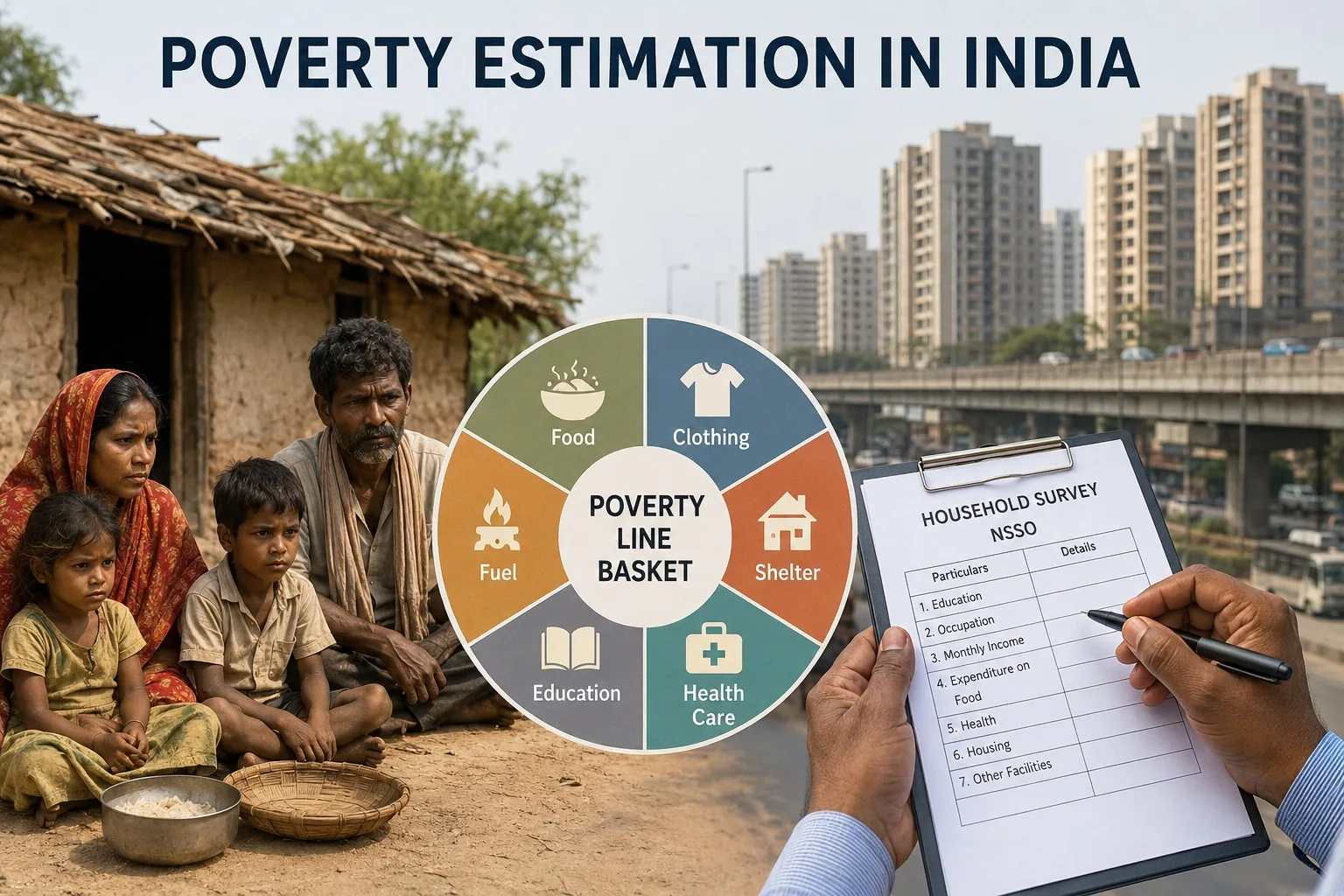
The poverty line is the minimum amount of money needed to buy basic goods and services required for survival. If a person or family spends less than this amount, they are considered poor.
The goods and services included in this calculation are called the Poverty Line Basket (PLB).
Examples of items in PLB:
- Food grains
- Vegetables
- Clothing
- Shelter
- Education
- Healthcare
- Fuel
How Poverty is Estimated in India
In India, poverty estimation is mainly based on consumption expenditure rather than income. This means the government studies how much households spend on daily needs instead of only checking their income.
Currently, NITI Aayog handles poverty-related policy analysis. Earlier, this work was done by the Planning Commission.
Data is collected by the National Sample Survey Office (NSSO) under the Ministry of Statistics and Programme Implementation.
Why Consumption is Preferred Over Income
There are several reasons:
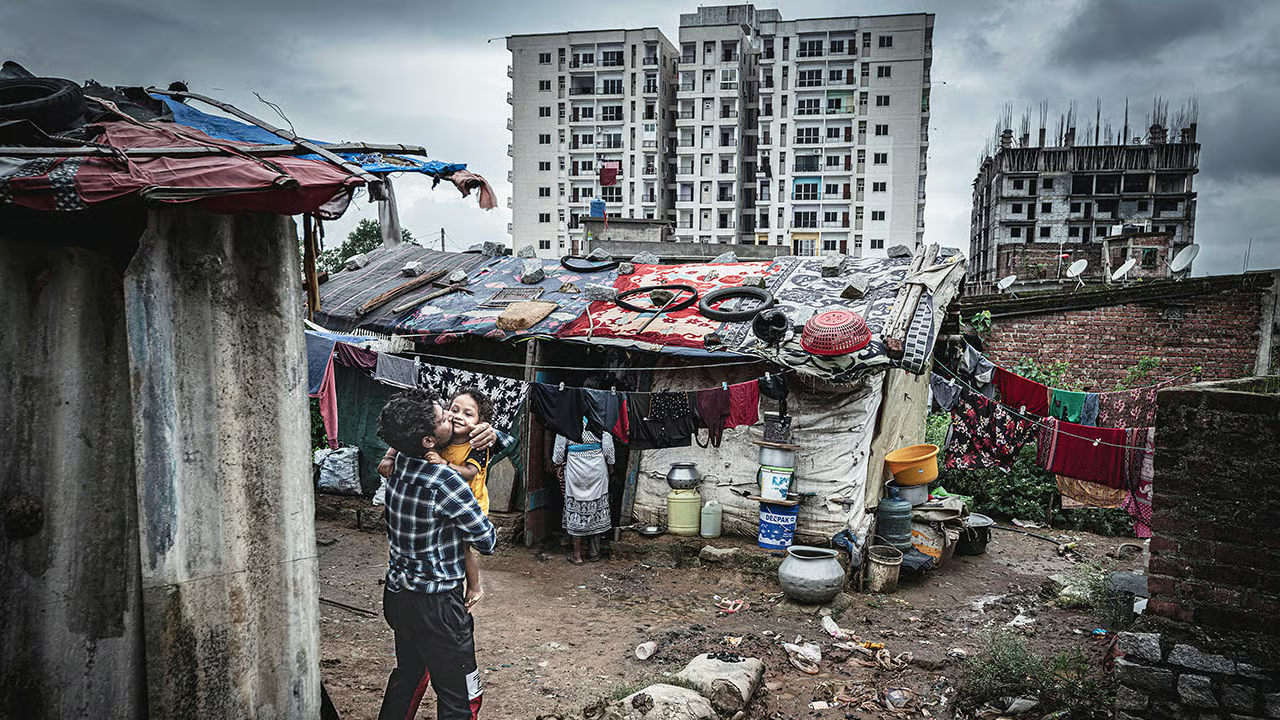
1. Income is unstable
Daily wage workers, farmers, and self-employed people often do not earn the same amount every month.
2. Hidden income
Many people have side income that is difficult to measure.
3. Easier data collection
Families can usually remember what they spent in the last 30 days more easily than calculating total income.
Because of these reasons, consumption-based surveys are considered more reliable.
Why Poverty Estimation is Important
Poverty estimation is necessary for many reasons.
Welfare Scheme Planning
Government schemes for food, housing, health, and employment are designed using poverty data.
Identifying Poor Families
The BPL (Below Poverty Line) Census helps identify households needing support.
Policy Making
Accurate poverty data helps the government create poverty reduction plans.
Social Equality
Reducing poverty supports the goal of a fair and equal society.
Types of Poverty Measurement
There are mainly two methods to measure poverty.
1. Absolute Poverty
Absolute poverty means a person cannot meet basic needs such as:
- Food
- Safe drinking water
- Shelter
- Healthcare
- Education
In this method, a fixed poverty line is set. Anyone below that level is considered poor.
Problems with Absolute Poverty
- Does not reflect rising living costs in different regions
- May ignore quality of life differences between states or countries
2. Relative Poverty
Relative poverty compares a person’s income with the average income of society.
For example, even if a person can meet basic needs, they may still be poor compared to most people in society.
This method is more common in developed countries.
Problems with Relative Poverty
- Focuses only on comparison
- May ignore actual survival needs
Survey Methods Used in India
India has used different survey methods over time.
Uniform Reference Period (URP)
Under URP, families were asked about their spending during the previous 30 days.
This method was used until 1993-94.
Mixed Reference Period (MRP)
From 1999-2000, India shifted to MRP.
Under this method:
- Clothing, footwear, education, durable goods, and hospital expenses were measured over 365 days
- Other items were measured over 30 days
This improved accuracy.
Modified Mixed Reference Period (MMRP)
A more advanced version added:
- 365-day recall for low-frequency items
- 7-day recall for fast-consuming food items
- 30-day recall for remaining goods
Poverty Estimation Before Independence
India’s poverty estimation history started before independence.
Dadabhai Naoroji
Dadabhai Naoroji made one of the earliest poverty estimates in his book Poverty and Un-British Rule in India.
He estimated the poverty line at ₹16–₹35 per person per year.
His estimate was based on the cost of a minimum diet.
National Planning Committee (1938)
This committee suggested a poverty line of ₹15–₹20 per person per month.
It was formed under Subhas Chandra Bose with Jawaharlal Nehru as chairman.
Bombay Plan (1944)
Business leaders proposed a poverty line of ₹75 per person per year.
Poverty Estimation After Independence
After 1947, several committees worked on better methods.
Major Committees on Poverty Estimation
| Committee | Year | Main Recommendation |
|---|---|---|
| Planning Commission Expert Group | 1962 | Separate rural and urban poverty lines |
| Dandekar & Rath | 1971 | 2250 calorie-based poverty estimation |
| Alagh Committee | 1979 | Nutrition-based poverty line |
| Lakdawala Committee | 1993 | State-specific poverty lines |
| Tendulkar Committee | 2009 | Consumption-based broader basket |
| Rangarajan Committee | 2014 | Updated food and non-food expenditure |
Dandekar and Rath (1971)
V. M. Dandekar and N. Rath conducted the first systematic poverty study using NSS data.
They said poverty should be based on the spending needed to get 2250 calories per day.
This started major discussions on calorie-based poverty estimation.
Alagh Committee (1979)
The committee led by Y. K. Alagh created separate poverty lines for rural and urban India.
The poverty line was based on:
- Nutrition requirements
- Consumption expenditure
- Inflation-adjusted prices
Lakdawala Committee (1993)
Led by D. T. Lakdawala, this committee recommended:
- Continue calorie-based estimation
- Create state-specific poverty lines
- Update prices using inflation indexes
This method was widely used for years.
Tendulkar Committee (2009)
The committee led by Suresh Tendulkar changed poverty estimation significantly.
Why New Method Was Needed
Older methods had problems:
- Old consumption patterns
- Poor inflation adjustment
- Health and education costs ignored
Key Recommendations
1. Move beyond calorie counting
The committee included broader daily expenses.
These included:
- Food
- Clothing
- Education
- Medical care
- Fuel
- Personal needs
2. Uniform Poverty Basket
Same basket used for both rural and urban calculations.
3. Include private spending
Health and education expenses were included.
Poverty Line Under Tendulkar Committee (2004–05)
| Area | Monthly Per Capita Spending |
| Rural | ₹446.68 |
| Urban | ₹578.80 |
This was roughly equal to ₹33 per day in purchasing power terms.
What is Purchasing Power Parity (PPP)?
PPP compares the value of money across countries.
It measures how much money is needed in one country to buy the same goods available in another country.
This helps compare poverty internationally.
Rangarajan Committee
The committee led by C. Rangarajan was formed after criticism of the earlier poverty line.
Many people felt ₹22 per day for rural India was unrealistically low.
Main Recommendations
Poverty should include both:
- Nutrition needs
- Non-food spending
Nutritional Requirements
| Requirement | Rural | Urban |
| Calories | 2155 kcal | 2090 kcal |
| Protein | 48 gm | 50 gm |
| Fat | 26 gm | 28 gm |
Poverty Threshold
| Area | Daily Spending |
| Rural | ₹32 |
| Urban | ₹47 |
Using this method, the number of poor people increased compared to Tendulkar estimates.
Criticism
The committee still focused mainly on expenditure and did not fully include multidimensional poverty.
International Poverty Line
The World Bank defines extreme poverty as living on less than $1.90 per day.
Asian Development Bank uses a poverty line of about $1.51 per person per day.
These global standards help compare poverty across countries.
Challenges in Poverty Estimation in India
India faces many difficulties while measuring poverty.
1. Price Differences
Prices vary from state to state.
Food in one state may cost much more than in another.
2. Changing Consumption
People’s spending habits change over time.
Modern needs now include:
- Internet
- Mobile connectivity
- Better healthcare
- Transport
3. Lack of Consensus
Different states support different poverty estimation methods.
Some support the Tendulkar method, while others prefer Rangarajan.
4. Poverty Line Too Low
Many experts believe current poverty lines are too low to reflect real living costs.
Way Forward
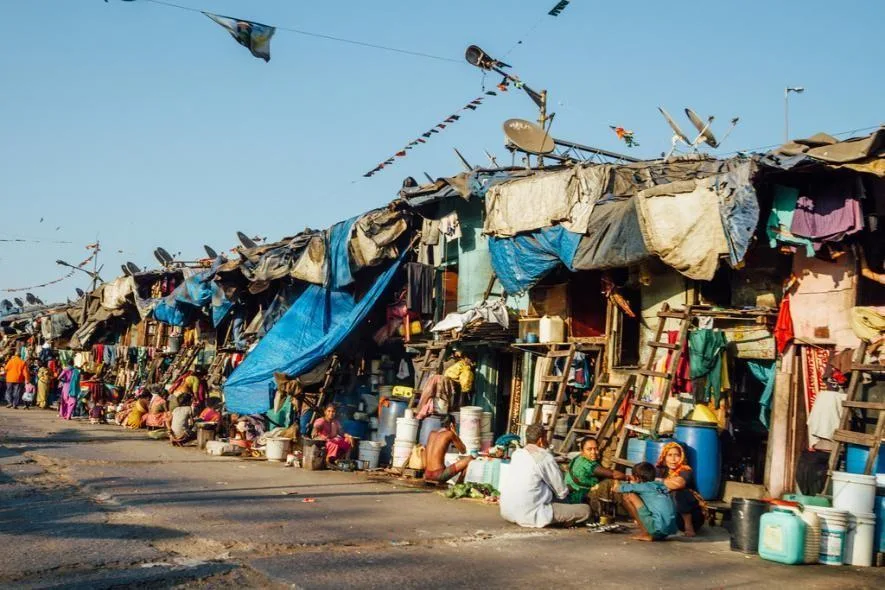
India needs better poverty estimation methods to match today’s economy.
Redefine Poverty Line
The poverty line should be updated regularly based on:
- Income growth
- Inflation
- New living costs
Use Better Standards
Experts suggest a higher poverty line that allows:
- Two proper meals daily
- Basic healthcare
- Education
- Safe housing
Hybrid Approach
India can combine:
- Absolute poverty measurement
- Relative poverty measurement
This would provide a more realistic picture.
Focus on Public Services
Government spending should improve:
- Schools
- Hospitals
- Drinking water
- Sanitation
- Transport
Better public services reduce poverty more effectively than subsidies alone.
Poverty Estimation in India remains essential for building a fair society. Accurate poverty measurement helps identify the needy, improve welfare schemes, and ensure that economic growth benefits everyone.
FAQs
Q1. What is poverty estimation in India?
Poverty estimation in India is the process of measuring how many people live below the poverty line based on their consumption or income levels.
Q2. Who calculates poverty in India?
NITI Aayog handles poverty-related policy analysis using survey data collected by the National Sample Survey Office (NSSO).
Q3. What is the poverty line?
The poverty line is the minimum amount of money needed to buy essential goods and services such as food, clothing, shelter, healthcare, and education.
Q4. Why is poverty estimation important?
It helps the government identify poor households and plan welfare schemes related to food, housing, health, and employment.
Q5. What are the main methods of poverty measurement?
The two main methods are:
- Absolute Poverty
- Relative Poverty
Q6. What is the Tendulkar Committee?
The Tendulkar Committee, led by Suresh Tendulkar, recommended a broader consumption-based method for poverty estimation in India in 2009.
Q7. What is the Rangarajan Committee?
The Rangarajan Committee, led by C. Rangarajan, suggested updated poverty lines by including both food and non-food expenses.
Q8. What are the major challenges in poverty estimation?
Major challenges include price differences across states, changing living costs, and lack of agreement on poverty measurement methods.