


Public Interest Litigation: Meaning, Importance and Evolution in India

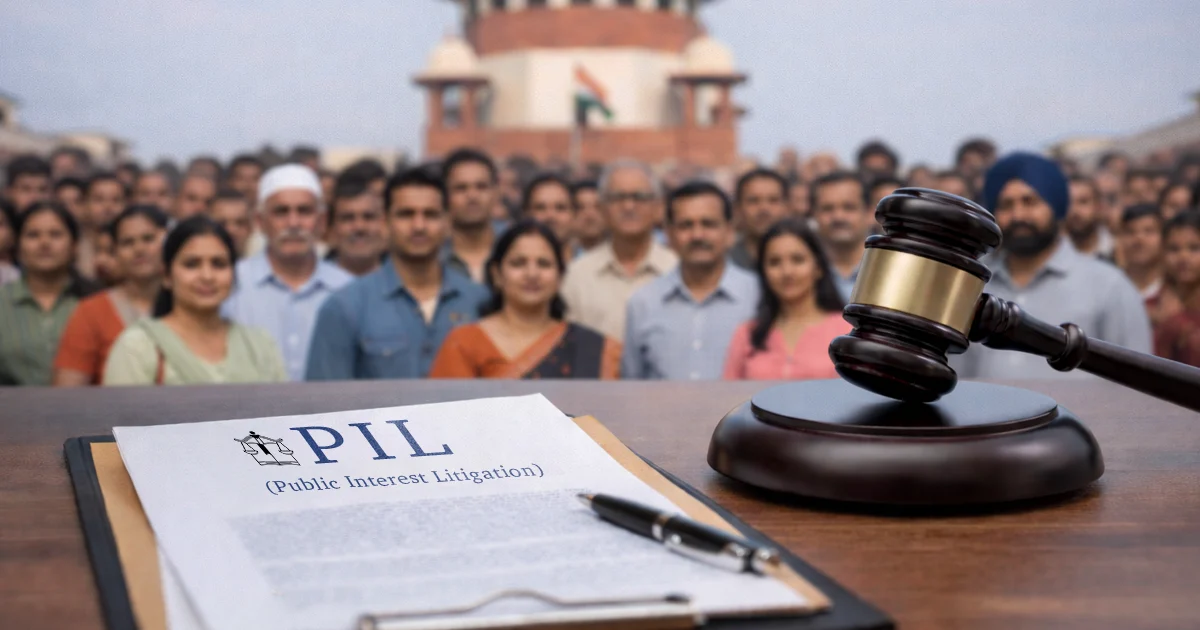
Public Interest Litigation (PIL) is one of the most important legal tools available in India for protecting the rights of people and ensuring justice for society. It allows any concerned citizen or organization to approach the court for issues that affect the public at large. Through PIL, courts can take action on matters related to human rights, environmental protection, corruption, labor exploitation, women’s safety, child welfare, and many other public concerns.
Thank you for reading this post, don't forget to subscribe!Public Interest Litigation has played a major role in strengthening democracy and making justice accessible to poor and marginalized people. It has helped courts become more responsive to social problems and has increased the accountability of governments and public authorities.
The term “Public Interest Litigation” originated in the United States. It was developed to provide legal representation to people and groups who could not easily approach courts. These included poor people, racial minorities, consumers, environmental activists, and other disadvantaged sections of society.
In India, Public Interest Litigation refers to a legal action filed in a court for the protection of public interest. Unlike ordinary cases, where only affected individuals can file a case, PIL allows any public-spirited citizen to seek justice on behalf of people whose rights have been violated.
A PIL can be filed in matters involving:
- Environmental pollution
- Child labor
- Bonded labor
- Women’s rights
- Prison reforms
- Road safety
- Food adulteration
- Protection of heritage sites
- Human rights violations
- Corruption and misuse of public funds
The main purpose of PIL is to ensure that justice reaches those who cannot fight for themselves.
Meaning of Public Interest Litigation
Public Interest Litigation is not specifically defined in any law or statute. It has been developed through judicial interpretation and judicial activism.
The courts consider a case as a PIL when:
- It concerns public welfare.
- It affects a large section of society.
- The affected people are unable to approach the court themselves.
- The petitioner is acting honestly and not for personal gain.
The Supreme Court and High Courts have the authority to entertain PILs and provide relief in the interest of justice.
Evolution of Public Interest Litigation in India
The development of PIL in India happened gradually through several important judgments.
Mumbai Kamgar Sabha vs Abdul Thai (1976)
Justice V.R. Krishna Iyer laid the foundation of PIL in India through this case. He supported a broader approach to justice and encouraged courts to help weaker sections of society.
Hussainara Khatoon vs State of Bihar (1979)
This was the first major PIL case in India. It highlighted the poor conditions of undertrial prisoners who had been kept in jail for years without trial.
The Supreme Court ordered the release of more than 40,000 undertrial prisoners and declared that the right to a speedy trial is a fundamental right under Article 21 of the Constitution.
This case marked the beginning of a new era in judicial activism.
S.P. Gupta vs Union of India (1981)
This case greatly expanded the scope of PIL.
Justice P.N. Bhagwati held that any public-spirited individual or social organization could approach the court on behalf of people who could not do so because of poverty, disability, or social disadvantages.
This judgment relaxed the traditional rule of “locus standi” and made justice more accessible.
M.C. Mehta vs Union of India
Environmental lawyer M.C. Mehta filed several PILs related to environmental protection.
One famous case concerned the pollution of the River Ganga. The Supreme Court recognized that even if a person is not directly affected, they can file a PIL if public welfare is involved.
This case strengthened environmental jurisprudence in India.
Vishaka vs State of Rajasthan (1997)
This landmark PIL addressed sexual harassment of women at workplaces.
The Supreme Court issued the Vishaka Guidelines to prevent workplace harassment. These guidelines later became the basis for the Sexual Harassment of Women at Workplace (Prevention, Prohibition and Redressal) Act, 2013.
Factors Responsible for the Growth of PIL in India
Several factors contributed to the growth of PIL in India.
Progressive Constitution
The Indian Constitution guarantees Fundamental Rights and provides Directive Principles of State Policy.
These constitutional provisions encourage courts to protect social justice and public welfare.
Social Welfare Laws
India has many laws related to labor rights, environmental protection, education, and social justice.
When governments fail to implement these laws properly, PIL becomes a useful tool for enforcement.
Liberal Interpretation of Locus Standi
Earlier, only directly affected individuals could approach courts.
The judiciary relaxed this rule and allowed public-spirited individuals to file cases on behalf of affected groups.
Judicial Activism
Indian judges played an important role in promoting PIL.
They adopted flexible procedures and even treated letters and newspaper reports as petitions in some cases.
Expansion of Fundamental Rights
The courts expanded the meaning of Article 21 (Right to Life).
The right to life now includes:
- Right to education
- Right to health
- Right to dignity
- Right to legal aid
- Right to a clean environment
- Right to speedy justice
This expansion encouraged more PILs.
Who Can File a PIL?
Any Indian citizen can file a Public Interest Litigation.
The petitioner does not need to be personally affected by the issue.
The following people can file PILs:
- Social activists
- Non-governmental organizations (NGOs)
- Journalists
- Lawyers
- Public-spirited citizens
- Social action groups
However, the petitioner must act in good faith and not for personal or political motives.
Where Can a PIL Be Filed?
A PIL can be filed:
In the Supreme Court
Under Article 32 of the Constitution for enforcement of Fundamental Rights.
In the High Courts
Under Article 226 of the Constitution for violation of legal or constitutional rights.
Before Magistrates
Under Section 133 of the Criminal Procedure Code in certain public nuisance cases.
Against Whom Can a PIL Be Filed?
A PIL can generally be filed against:
- Central Government
- State Governments
- Municipal Authorities
- Public Sector Undertakings
- Government Agencies
- Local Bodies
A PIL cannot normally be filed against a private individual unless the issue involves public interest and government responsibility.
Importance of Public Interest Litigation
Access to Justice
PIL allows poor and disadvantaged people to access justice even when they cannot afford legal proceedings.
Protection of Human Rights
It helps protect the rights of vulnerable groups such as women, children, laborers, prisoners, and minorities.
Government Accountability
PIL compels public authorities to perform their duties responsibly and transparently.
Environmental Protection
Many environmental issues have been addressed through PILs.
Cases involving pollution, deforestation, waste management, and conservation have been brought before courts through PILs.
Judicial Review
PIL strengthens the power of judicial review by allowing courts to examine administrative actions and government policies.
Strengthening Democracy
It encourages citizen participation in governance and promotes transparency.
Major Areas Covered Under PIL
Over the years, PIL has been used in various areas.
Labor Rights
Cases involving bonded labor, child labor, and exploitation of workers.
Women’s Rights
Cases involving sexual harassment, domestic violence, trafficking, and gender discrimination.
Environmental Issues
Cases related to river pollution, air pollution, forest conservation, and wildlife protection.
Prison Reforms
Cases addressing overcrowding, torture, and poor conditions in prisons.
Consumer Protection
Cases involving food adulteration and public health concerns.
Heritage Conservation
Cases protecting historical monuments and cultural heritage.
Benefits of Public Interest Litigation
Justice for the Poor
PIL helps people who lack financial resources to seek legal remedies.
Social Change
Many social reforms have been achieved through PILs.
Better Governance
Government departments become more accountable and efficient.
Protection of Constitutional Values
PIL ensures that constitutional rights are protected and respected.
Faster Attention to Public Issues
Courts can intervene quickly in urgent matters affecting society.
Weaknesses of Public Interest Litigation
Despite its benefits, PIL also faces several challenges.
Frivolous PILs
Some people misuse PILs for publicity, political motives, or personal interests.
These cases waste judicial time and resources.
Judicial Overreach
Sometimes courts may enter areas that are traditionally handled by the executive or legislature.
This may disturb the balance among different organs of government.
Delay in Disposal
Many important PIL cases remain pending for years.
Delayed judgments reduce their effectiveness.
Competing Interests
A PIL decision may benefit one group while negatively affecting another.
For example, closing a polluting factory may improve environmental conditions but cause unemployment for workers.
Burden on Courts
The increasing number of PILs adds to the already heavy workload of courts.
PIL and Judicial Activism
Public Interest Litigation is closely linked to judicial activism.
Judicial activism refers to the active role played by courts in protecting rights and addressing social issues.
Through PIL, courts have:
- Protected environmental rights
- Improved prison conditions
- Expanded human rights
- Ensured government accountability
- Promoted gender justice
However, judicial activism must remain within constitutional limits to maintain the balance of power.

Challenges Before PIL Today
To preserve the effectiveness of PIL, certain challenges need to be addressed.
Screening of Genuine Cases
Courts should identify genuine PILs and reject frivolous petitions.
Speedy Disposal
Important public interest matters should be heard and decided quickly.
Preventing Misuse
Strict penalties may be imposed for filing PILs with malicious intentions.
Balancing Powers
Courts should respect the roles of the legislature and executive while protecting constitutional rights.
Conclusion
Public Interest Litigation has transformed the Indian legal system by making justice more accessible to ordinary citizens. It has helped protect human rights, improve governance, safeguard the environment, and strengthen democracy. Through PIL, courts have become a powerful instrument for social justice and public welfare.
Over the years, PIL has given a voice to prisoners, laborers, women, children, environmental activists, and many other marginalized groups. It has ensured that governments remain accountable and that constitutional values are upheld.
However, the misuse of PIL and the possibility of judicial overreach remain concerns. Therefore, courts must carefully examine every PIL and ensure that it truly serves the public interest. When used responsibly, Public Interest Litigation remains one of the strongest tools for achieving justice, transparency, and social change in India.
FAQs on Public Interest Litigation
1. What is Public Interest Litigation (PIL)?
Public Interest Litigation (PIL) is a legal action filed in court to protect the interests and rights of the public or a large section of society.
2. Who can file a PIL in India?
Any public-spirited citizen, NGO, social activist, or organization can file a PIL on behalf of affected people.
3. In which courts can a PIL be filed?
A PIL can be filed in the Supreme Court under Article 32 and in High Courts under Article 226 of the Constitution.
4. What is the main objective of PIL?
The main objective of PIL is to provide justice to people who cannot approach courts due to poverty, lack of awareness, or social disadvantages.
5. What types of issues can be raised through a PIL?
Issues related to environmental protection, human rights, corruption, labor rights, women’s safety, child welfare, and public health can be raised through a PIL.
6. What is the significance of PIL in India?
PIL promotes social justice, government accountability, transparency, and protection of constitutional rights.
7. Can a PIL be filed against a private person?
Generally, a PIL is filed against government bodies or public authorities. It is usually not filed against private individuals unless public interest is involved.
8. Which case is considered the first major PIL in India?
The Hussainara Khatoon vs State of Bihar (1979) case is considered the first major PIL in India.
9. What are the benefits of Public Interest Litigation?
PIL helps protect human rights, ensures access to justice, improves governance, and supports environmental conservation.
10. What are the drawbacks of PIL?
Misuse of PIL for personal interests, judicial overreach, delay in decisions, and increased burden on courts are some major drawbacks.