



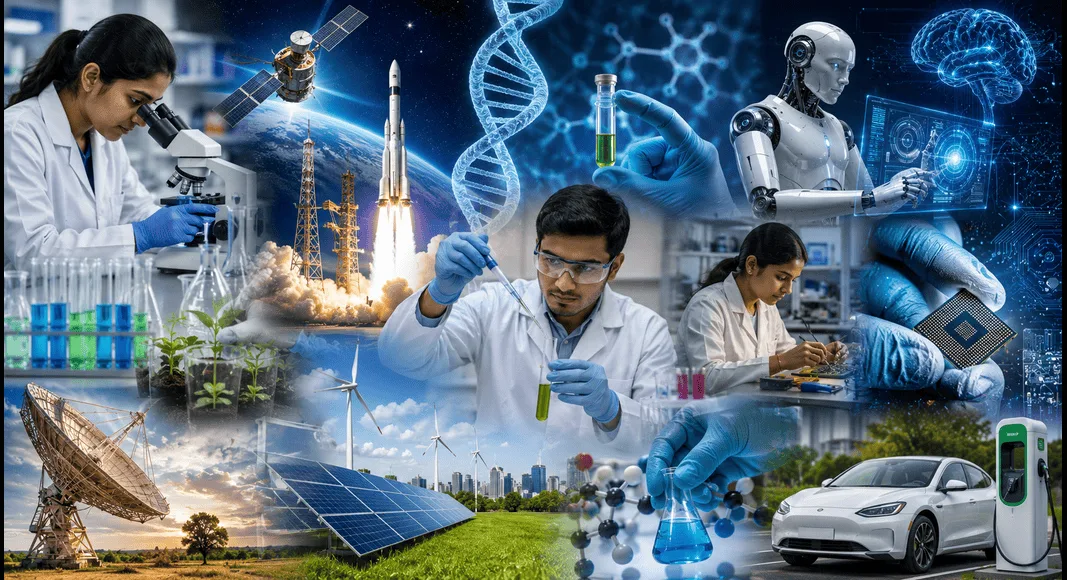
Science and Technology in India: Growth and Innovations

Science and Technology in India have played a major role in the country’s development. From healthcare and agriculture to space research and clean energy, scientific innovations have improved the quality of life and strengthened India’s economy. The Ministry of Science and Technology works to promote research, innovation, biotechnology, and advanced technologies that help solve national and global challenges.
Thank you for reading this post, don't forget to subscribe!The Year End Review 2019 highlighted several important achievements and initiatives in science and technology. These included biotechnology missions, genome research, nanotechnology, healthcare innovations, and international collaborations. Since then, India has made remarkable progress in artificial intelligence, quantum technology, semiconductor manufacturing, biotechnology, space exploration, green energy, and digital innovation.
Importance of Science and Technology
Science and technology are essential for the growth of every nation. They improve healthcare, agriculture, education, transportation, communication, defence, and industry.
Science and technology help India to:
- Improve healthcare services
- Increase agricultural production
- Develop new medicines
- Strengthen national security
- Create employment opportunities
- Promote innovation and startups
- Support sustainable development
- Improve digital governance
- Boost economic growth
The Government of India continues to invest in scientific research to make India a global innovation leader.
Atal Jai Anusandhan Biotech Mission (UNaTI)
The Atal Jai Anusandhan Biotech Mission, also known as UNaTI (Undertaking Nationally Relevant Technology Innovation), aims to promote biotechnology-based solutions for national development.
Objectives
- Improve healthcare.
- Strengthen agriculture.
- Promote clean energy.
- Support biotechnology research.
- Encourage innovation.
Major Components
1. GARBH-ini Mission
The mission focuses on improving maternal and child health.
Its objectives include:
- Predicting premature births.
- Improving maternal healthcare.
- Reducing infant mortality.
2. IndCEPI Mission
This mission supports the development of affordable vaccines for diseases affecting India.
Its goals include:
- Faster vaccine development.
- Better disease prevention.
- Affordable healthcare.
3. Biofortified Wheat Programme
The programme develops wheat varieties with:
- Higher protein content.
- Better nutrition.
- Improved food security.
It also supports POSHAN Abhiyaan by helping reduce malnutrition.
4. Mission on Antimicrobial Resistance
The mission focuses on:
- Affordable diagnostics.
- Better treatment methods.
- Monitoring antibiotic resistance.
- Promoting responsible use of antibiotics.
5. Clean Energy Mission
The mission develops innovative technologies for:
- Clean energy production.
- Waste management.
- Swachh Bharat Mission.
- Environmental sustainability.
UMMID Initiative
The Government launched the UMMID (Unique Methods of Management and Treatment of Inherited Disorders) initiative.
Objectives
- Detect inherited genetic diseases.
- Improve diagnosis.
- Provide better treatment.
- Support genetic counselling.
- Train healthcare professionals.
NIDAN Kendras
The National Inherited Diseases Administration (NIDAN) Kendras provide specialized healthcare services for people suffering from inherited disorders.
They help in:
- Early diagnosis.
- Treatment planning.
- Genetic testing.
- Patient counselling.
Global Innovation and Technology Alliance (GITA)
GITA is a Public-Private Partnership between:
- Department of Science and Technology (DST)
- Confederation of Indian Industry (CII)
Objectives
- Promote industrial innovation.
- Support technology transfer.
- Encourage international partnerships.
- Help startups commercialize research.
Redefinition of SI Units
In 2019, scientists worldwide adopted new definitions for four important SI units:
- Kilogram
- Kelvin
- Mole
- Ampere
The new definitions are based on universal scientific constants, making measurements more accurate and reliable.
India adopted these standards through CSIR-National Physical Laboratory (CSIR-NPL).
IndiGen Genome Project
The IndiGen Genome Project is one of India’s biggest genome sequencing programmes.
Scientists sequenced the genomes of more than 1,000 Indians from different populations.
Objectives
- Understand genetic diversity.
- Improve precision medicine.
- Develop personalized healthcare.
- Support disease research.
The project forms an important foundation for future medical research in India.
DNA Technology Regulation
The DNA Technology (Use and Application) Regulation Bill aims to regulate the use of DNA technology.
Objectives
- Identify missing persons.
- Help criminal investigations.
- Identify disaster victims.
- Improve forensic science.
The Bill also proposes safeguards for privacy and proper use of DNA data.
Nanopharmaceutical Guidelines
India introduced guidelines for evaluating nanopharmaceuticals.
What are Nanopharmaceuticals?
These are medicines developed using nanotechnology.
Their benefits include:
- Better drug delivery.
- Improved effectiveness.
- Fewer side effects.
- Faster treatment.
Nanotechnology is becoming increasingly important in modern healthcare.
One Health Initiative
India launched the One Health Initiative to recognize the close relationship between:
- Human health
- Animal health
- Environmental health
This approach helps manage diseases that spread between animals and humans.
It became especially important after the COVID-19 pandemic.
Global Antimicrobial Resistance Hub
India joined the Global Antimicrobial Resistance Research and Development Hub.
Objectives
- Improve global research.
- Develop new antibiotics.
- Promote international collaboration.
- Reduce antimicrobial resistance.
This partnership strengthens India’s role in global health research.
Global Bio-India
The Global Bio-India Summit is one of India’s largest biotechnology events.
It brings together:
- Scientists
- Researchers
- Startups
- Investors
- Industry experts
- Government agencies
The summit promotes biotechnology innovation and investment.
Prime Minister’s Science, Technology and Innovation Advisory Council (PM-STIAC)
PM-STIAC advises the Prime Minister on important scientific matters.
Its responsibilities include:
- Preparing technology roadmaps.
- Identifying priority research areas.
- Promoting innovation.
- Supporting scientific policy.
It plays a major role in India’s long-term scientific planning.
Department of Biotechnology (DBT)
The Department of Biotechnology (DBT) promotes biotechnology research across India.
Its major focus areas include:
- Healthcare
- Agriculture
- Vaccines
- Biofuels
- Industrial biotechnology
- Genetic engineering
DBT also supports research institutions and startup companies.
BRITE Awards
The Biotechnology Research Innovation and Technology Excellence (BRITE) Awards recognize outstanding achievements in biotechnology research and innovation.
These awards encourage scientists to develop technologies that benefit society.
Shanti Swarup Bhatnagar Prize
The Shanti Swarup Bhatnagar Prize is India’s highest science award for researchers.
It recognizes exceptional contributions in fields such as:
- Biology
- Chemistry
- Engineering
- Mathematics
- Medicine
- Physics
- Earth Sciences
The award encourages scientific excellence and innovation.
Indigenous Fuel Cell System
India developed its first indigenous fuel cell system under the New Millennium Indian Technology Leadership Initiative (NMITLI).
Benefits
- Clean energy generation.
- Reduced pollution.
- Lower dependence on fossil fuels.
- Better energy efficiency.
Fuel cells are expected to play an important role in India’s green energy transition.
Bharatiya Nideshak Dravya (BND)
CSIR-NPL and HPCL developed Bharatiya Nideshak Dravya (Indian Reference Materials).
These materials help:
- Test petroleum products.
- Support BS-VI fuel standards.
- Improve laboratory accuracy.
- Reduce dependence on imported reference materials.
National Quantum Mission
India launched the National Quantum Mission in 2023.
Objectives
- Develop quantum computers.
- Build secure communication systems.
- Advance quantum sensors.
- Promote scientific research.
The mission aims to make India one of the leading countries in quantum technology.
IndiaAI Mission
The IndiaAI Mission was approved to strengthen artificial intelligence research and innovation.
The mission focuses on:
- AI computing infrastructure.
- AI datasets.
- AI startups.
- Skill development.
- Responsible AI.
Artificial Intelligence is expected to transform healthcare, education, agriculture, governance, and industry.
India Semiconductor Mission
India has launched the India Semiconductor Mission to develop domestic chip manufacturing.
Objectives
- Build semiconductor manufacturing units.
- Reduce import dependence.
- Strengthen electronics manufacturing.
- Create high-skilled employment.
The mission supports India’s goal of becoming a global electronics manufacturing hub.
National Green Hydrogen Mission
Science and technology play a major role in the National Green Hydrogen Mission.
Researchers are developing:
- Efficient electrolysers.
- Hydrogen storage technologies.
- Clean industrial processes.
- Renewable energy solutions.
This mission supports India’s clean energy future.
Space Technology Achievements
India’s space programme has achieved remarkable success in recent years.
Major achievements include:
- Chandrayaan-3 successful Moon landing.
- Aditya-L1 Solar Mission.
- Gaganyaan Human Spaceflight Mission preparations.
- Expansion of private space startups.
These missions have strengthened India’s position in global space research.
Biotechnology After COVID-19
The COVID-19 pandemic accelerated biotechnology research in India.
Major achievements include:
- Indigenous vaccine development.
- Genome surveillance.
- Digital health technologies.
- Advanced diagnostics.
- Vaccine manufacturing leadership.
India is now among the world’s leading biotechnology and pharmaceutical producers.
Importance of Science and Technology for India
Science and technology contribute to:
- Better healthcare.
- Stronger national security.
- Higher agricultural productivity.
- Cleaner energy.
- Digital transformation.
- Economic growth.
- Better disaster management.
- Innovation-based industries.
- Employment generation.
- Global competitiveness.
These sectors will continue to drive India’s development in the coming decades.
Conclusion
Science and Technology in India have become the foundation of the country’s progress. Programmes such as the Atal Jai Anusandhan Biotech Mission, UMMID Initiative, IndiGen Genome Project, National Quantum Mission, IndiaAI Mission, and the India Semiconductor Mission demonstrate India’s strong commitment to research and innovation.
India has also made remarkable achievements in biotechnology, healthcare, renewable energy, artificial intelligence, space technology, and semiconductor manufacturing. Scientific research is helping improve public health, strengthen the economy, protect the environment, and enhance national security.
As of 2026, India continues to invest heavily in scientific innovation, digital technologies, clean energy, and advanced research. With strong government support, skilled scientists, and growing global collaborations, science and technology will remain one of the key pillars of India’s journey towards becoming a developed and innovation-driven nation.
FAQs About Science and Technology in India
1. What is Science and Technology in India?
Science and Technology in India refers to research, innovation, and technological development that support growth in healthcare, agriculture, industry, space, and education.
2. What is the Atal Jai Anusandhan Biotech Mission?
It is a biotechnology mission launched to promote innovations in health, agriculture, clean energy, and disease prevention through scientific research.
3. What is the UMMID Initiative?
UMMID (Unique Methods of Management and Treatment of Inherited Disorders) is a government programme that helps diagnose and manage genetic diseases in India.
4. What is the IndiGen Genome Project?
The IndiGen Genome Project involves sequencing the genomes of Indians to support precision medicine and improve healthcare research.
5. What is the purpose of the DNA Technology Regulation Bill?
The bill aims to regulate the use of DNA technology for criminal investigations, identifying missing persons, and forensic applications.
6. What are nanopharmaceuticals?
Nanopharmaceuticals are medicines developed using nanotechnology to improve drug delivery, effectiveness, and treatment outcomes.
7. What is the National Quantum Mission?
The National Quantum Mission aims to develop quantum computing, secure communication systems, quantum sensors, and advanced scientific research.
8. What is the IndiaAI Mission?
The IndiaAI Mission promotes artificial intelligence research, computing infrastructure, AI startups, skill development, and responsible AI applications.
9. What is the India Semiconductor Mission?
The India Semiconductor Mission supports domestic semiconductor manufacturing to strengthen India’s electronics industry and reduce import dependence.
10. How does science and technology help India’s development?
Science and technology improve healthcare, education, agriculture, energy, transportation, communication, employment, and national security.