




Corporate Governance: Meaning, Principles, Importance, Challenges and Reforms in India

Corporate Governance is one of the most important parts of modern business management. It refers to the system of rules, practices, and processes through which a company is controlled and managed. Good corporate governance helps companies work honestly, fairly, and responsibly.
Thank you for reading this post, don't forget to subscribe!In today’s business world, companies handle large amounts of money, employ thousands of people, and affect society in many ways. Because of this, there must be proper systems to ensure that companies do not misuse power or resources. Corporate governance helps maintain discipline, transparency, and trust.
Corporate governance is closely connected with ethics. Ethics means doing what is morally right. A company with strong ethics usually treats its employees, customers, investors, and society fairly. When ethics and governance work together, businesses become more trustworthy and sustainable.
What is Corporate Governance?
Corporate governance is the framework that guides how a company operates and makes decisions. It ensures that the company works in the best interests of shareholders and other stakeholders.
Its main purpose is to prevent corruption, fraud, and misuse of power. It creates accountability among directors and managers and ensures that decisions are made responsibly.
Good corporate governance protects the interests of:
- Shareholders
- Employees
- Customers
- Suppliers
- Government
- Society
It ensures that companies follow laws, disclose important information, and maintain fair business practices.
Why Corporate Governance is Important
Corporate governance is important because it builds trust between a company and the people connected to it.
A company with good governance:
- Attracts more investors
- Builds a strong reputation
- Reduces chances of fraud
- Improves decision-making
- Ensures long-term growth
Poor governance can lead to scandals, financial loss, and damage to public trust. Famous fraud cases like Satyam Computer Services showed what can happen when governance fails.

Principles of Corporate Governance
Good corporate governance is based on five major principles.
1. Fairness
A company should treat all stakeholders fairly. This includes shareholders, employees, suppliers, and customers. No group should get unfair advantages.
2. Transparency
The company must provide clear and accurate information about financial performance, risks, and important decisions. Transparency builds trust.
3. Accountability
Company leaders should be answerable for their actions. If something goes wrong, responsible individuals must explain their decisions.
4. Responsibility
The board of directors must ensure that the company runs efficiently and ethically. They are responsible for major strategic decisions.
5. Risk Management
Every business faces risks such as financial loss, cyber threats, legal issues, and market competition. Corporate governance ensures these risks are identified and managed properly.
Four Ps of Corporate Governance
Corporate governance is often explained using the Four Ps.
People
People include board members, executives, and employees. Their honesty, skill, and decision-making matter greatly.
Purpose
Purpose means the long-term goals and mission of the company. Governance ensures business goals align with ethical values.
Processes
Processes are systems used to make decisions, control risks, and monitor performance.
Practices
Practices refer to the actual behavior of the company in daily operations. Good practices reflect good governance.
Key Components of Corporate Governance
Board of Directors
The board of directors plays the most important role in governance. They supervise management and protect shareholder interests.
In India:
- Public companies need at least 3 directors
- Private companies need at least 2 directors
- One-person companies need 1 director
- Maximum directors allowed without special approval: 15
Indian law also requires:
- At least one resident director
- At least one woman director in certain companies
- Listed companies must have independent directors
Independent directors help make unbiased decisions.
Board Committees
Large companies often form committees for specialized work.
Common committees include:
| Committee | Role |
|---|---|
| Audit Committee | Reviews financial reporting |
| Compensation Committee | Decides executive salaries |
| Nomination Committee | Selects board members |
These committees improve oversight.
Shareholders and Stakeholders
Shareholders own shares of a company. Stakeholders include anyone affected by company operations.
Rights of Shareholders
Shareholders have the right to:

- Vote in important decisions
- Elect directors
- Receive dividends
- Review company records
Minority Shareholders
Minority shareholders own less than 50% shares. Even though they lack control, their rights must be protected.
Strong governance ensures minority shareholders are not exploited by major shareholders or promoters.
Disclosure and Transparency
Disclosure means sharing important information with stakeholders.
Financial Reporting
Companies must disclose financial statements such as:
- Balance Sheet
- Income Statement
- Cash Flow Statement
These reports show the financial health of the company.
Financial reporting follows standards like:
- GAAP
- IFRS
These standards ensure consistency and reliability.
Non-Financial Disclosure
Companies also disclose non-financial information like:
- Environmental impact
- Employee welfare
- Social responsibility
- Governance practices
This helps investors understand overall business quality.
ESG Goals in Corporate Governance
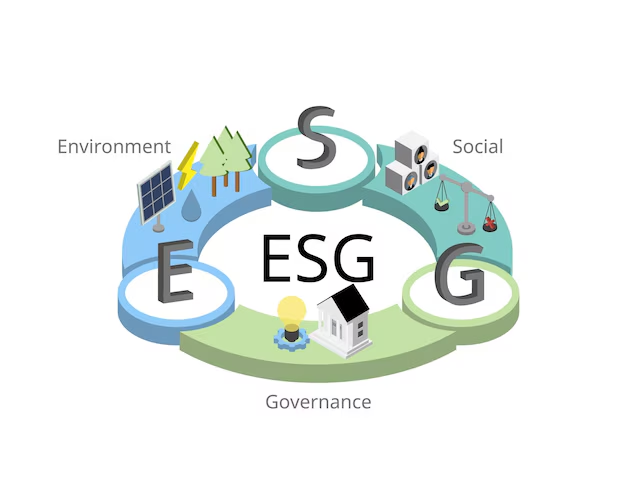
ESG stands for:
- Environmental
- Social
- Governance
ESG has become very important in modern business.
Environmental
This measures how environmentally responsible a company is.
Examples:
- Pollution control
- Waste management
- Renewable energy use
Social
This focuses on relationships with:
- Employees
- Suppliers
- Customers
- Communities
It includes labor rights and workplace safety.
Governance
This evaluates leadership quality, audits, internal controls, and shareholder rights.
Since the launch of the United Nations Principles for Responsible Investing (UNPRI) in 2006, ESG has become a major investment factor. United Nations
Today, many investors care not only about profits but also about sustainability and ethics.
Corporate Governance in India
India has developed a strong regulatory system for corporate governance.
Major regulators include:
- Ministry of Corporate Affairs (MCA)
- Securities and Exchange Board of India (SEBI)
These institutions ensure companies follow laws and governance standards.
Evolution of Corporate Governance Regulation
In the 1990s, India started strengthening governance laws through:
- Securities Contracts Regulation Act, 1956
- SEBI Act, 1992
- Depositories Act, 1996
A major milestone came in 2000, when SEBI introduced the first formal governance framework based on recommendations of the Kumar Mangalam Birla Committee.
Later, the Naresh Chandra Committee suggested further reforms in auditing and governance.
Institutions such as:
- Confederation of Indian Industry
- Institute of Chartered Accountants of India
also contributed to improving standards.
Companies Act, 2013 and Corporate Governance
The Companies Act, 2013 significantly improved governance rules in India.
Important provisions include:
- Appointment of Key Managerial Personnel (KMP)
- Stronger audit committees
- Independent audits
- Regulation of related-party transactions
- Better disclosures
Companies must now provide detailed information in:
- Board reports
- Financial statements
- Regulatory filings
This improves transparency.
Important Amendments
Key changes include:
- Creation of National Company Law Tribunal (NCLT)
- Creation of National Company Law Appellate Tribunal (NCLAT)
- Introduction of Insolvency and Bankruptcy Code, 2016
These reforms improved dispute resolution and insolvency management.
National Financial Reporting Authority (NFRA)
National Financial Reporting Authority was established in 2018 under the Companies Act, 2013.
Its responsibilities include:
- Monitoring accounting standards
- Regulating audits
- Investigating professional misconduct
NFRA improves financial accountability.
Ethical Challenges in Corporate Governance
Despite regulations, many governance challenges remain.
1. Weak Board Selection
Sometimes board appointments are influenced by promoters rather than merit.
The Tata-Mistry dispute (2016) highlighted governance issues involving board decisions. Tata Sons
2. Poor Director Evaluation
Many companies do not properly assess director performance.
Transparent evaluation helps improve governance.
3. Lack of Independent Directors
Independent directors are expected to act without bias. But sometimes they are too close to promoters.
The ICICI Bank controversy raised such concerns.
4. Removal of Independent Directors
Some directors are removed for raising concerns. This discourages honest governance.
5. Conflict of Interest
Managers may make decisions for personal benefit instead of company welfare.
Related-party transactions often create conflicts.
6. Excessive Promoter Control
Founders and promoters can dominate governance.
While leadership helps growth, too much control reduces transparency.
7. Weak Data Protection
Companies handle sensitive customer data.
Poor security can lead to data misuse and privacy risks.
8. Internal Conflicts
Power struggles between management members affect governance.
Example: InterGlobe Aviation leadership disputes raised concerns.
9. Weak Board Diversity
Boards with similar backgrounds may make poor decisions.
Diverse boards improve decision quality.
10. Insider Trading
Insider trading happens when company insiders use secret information for personal profit.
This harms fairness in financial markets.
Major Corporate Governance Scandals in India
Satyam Fraud (2009)
Founder B. Ramalinga Raju admitted to inflating financial statements.

This became one of India’s biggest corporate frauds.
It exposed weaknesses in auditing and board oversight.
SEBI vs Sahara (2012)
Sahara India Pariwar faced legal action over fundraising practices.
The case emphasized investor protection and regulatory compliance.
IL&FS Crisis (2019)
Infrastructure Leasing & Financial Services suffered major financial collapse due to mismanagement.
This affected many stakeholders.
Reforms Needed in Corporate Governance
India still needs stronger governance reforms.
Strengthen Board Independence
Companies should appoint more qualified independent directors.
Boards should have diversity in:
- Gender
- Experience
- Skills
- Background
Improve Transparency
Financial and non-financial disclosures should become stronger.
Stakeholders need timely and honest reporting.
Empower Shareholders
Shareholders should actively participate in governance.
Proxy advisory services can help them make informed decisions.
Better Risk Management
Companies should regularly identify and manage risks.
Dedicated risk committees can improve preparedness.
Strong Ethical Culture
Companies should create a clear code of ethics.
Employees should understand acceptable behavior.
Whistleblower Protection
Employees must feel safe reporting fraud or misconduct.
Whistleblower systems should protect them from retaliation.
Fair Executive Compensation
Executive salaries should match performance.
Compensation structures must be transparent.
Strong CSR Integration
Corporate Social Responsibility (CSR) should be part of governance.
Companies should contribute to social welfare and sustainability.
Continuous Board Training
Directors must stay updated on:
- Laws
- Technology
- Governance trends
- Industry changes
Regular training improves decision-making.
Stakeholder Engagement
Companies should maintain open communication with:
- Investors
- Employees
- Customers
- Communities
Listening to stakeholders builds trust.

Important Committee Reports
Kotak Committee Report (2017)
Led by Uday Kotak, this committee recommended:
- Separation of Chairman and CEO roles
- Minimum 6 directors on board
- 50% independent directors
- At least one woman independent director
- Better whistleblower protection
- Penalizing auditors for negligence
These recommendations improved governance standards.
T.K. Viswanathan Committee (2018)
This committee focused on insider trading reforms.
Recommendations included:
- Better monitoring of insider information
- Stronger digital record systems
- More powers for SEBI investigations
Kumar Mangalam Birla Committee (2000)
Major recommendations:
- Separate Chairman and CEO roles
- Independent directors
- Audit committees
- Better disclosures
- Code of conduct for senior management
This committee laid the foundation of modern corporate governance in India.
Final Thoughts
Corporate governance is essential for building responsible and trustworthy companies. It ensures fairness, accountability, transparency, and ethical business practices.
In India, corporate governance has improved significantly due to stronger laws, better regulations, and increased awareness. However, challenges like insider trading, conflicts of interest, weak board independence, and poor transparency still exist.
For India to achieve sustainable economic growth, companies must adopt stronger governance practices. Ethical leadership, responsible decision-making, and strict compliance will help build investor confidence and create a healthier corporate environment.
FAQs:
1. What is corporate governance?
Corporate governance is the system of rules and processes used to manage and control a company.
2. Why is corporate governance important?
It ensures transparency, accountability, ethical behavior, and protects stakeholder interests.
3. What are the main principles of corporate governance?
Fairness, transparency, accountability, responsibility, and risk management.
4. What is ESG in corporate governance?
ESG stands for Environmental, Social, and Governance standards used to measure sustainable business practices.
5. Which body regulates corporate governance in India?
The main regulators are Securities and Exchange Board of India and Ministry of Corporate Affairs.