


Security Forces in India: Roles and Responsibilities

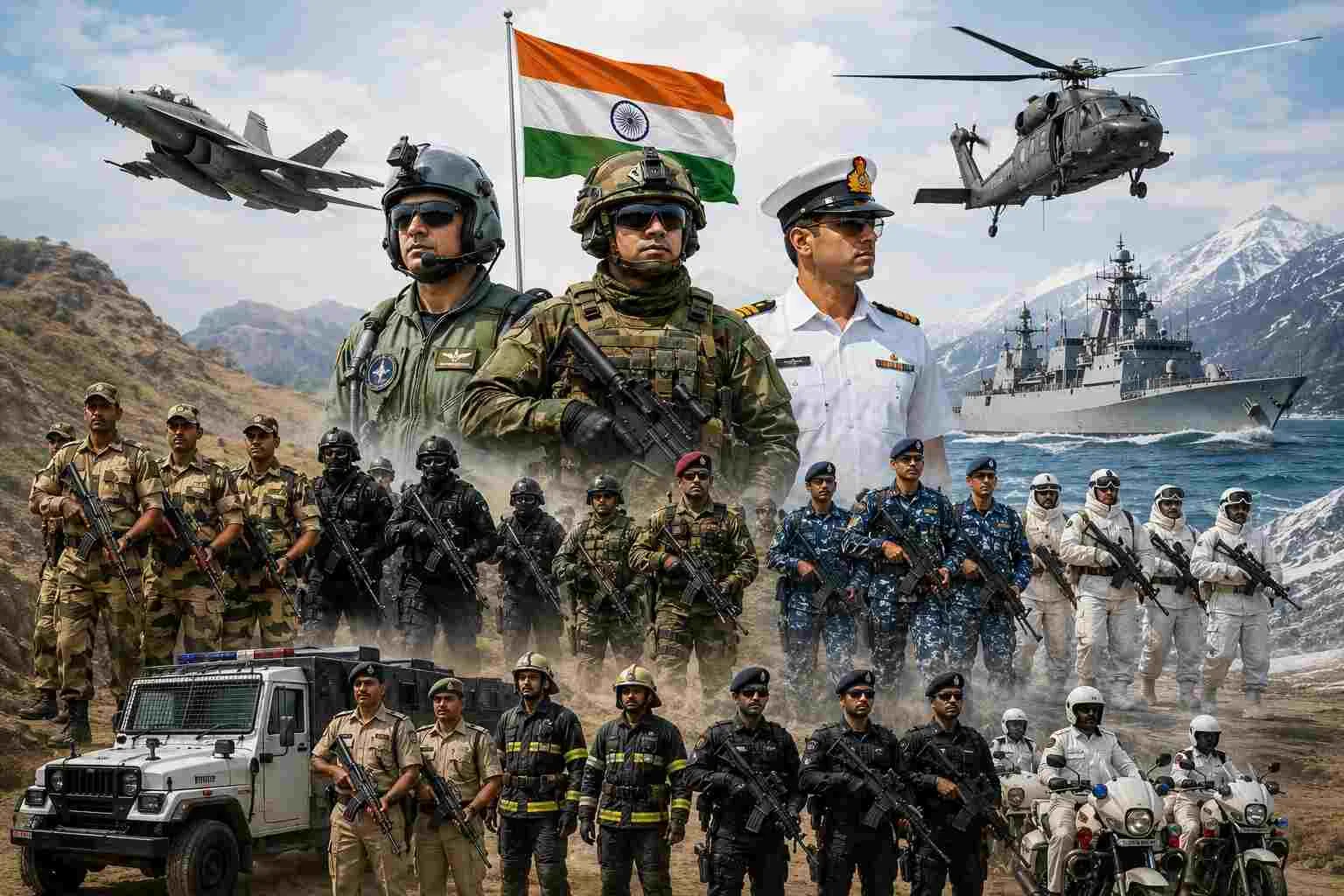
Security Forces in India play a very important role in protecting the country from external attacks and internal threats. India is a large country with long land borders, sea boundaries, and many internal security challenges such as terrorism, insurgency, smuggling, and riots. To handle these challenges, India has created different security forces, each with a specific duty.
Thank you for reading this post, don't forget to subscribe!These forces work under different ministries such as the Ministry of Defence (MoD) and the Ministry of Home Affairs (MHA). Together, they help maintain peace, safety, and national security.
Framework of Security Forces in India
India’s security system mainly includes three major parts:
- Indian Armed Forces
- Central Armed Police Forces (CAPFs)
- Special Security Forces and Agencies
External Security
External security means protecting India from threats coming from outside the country, such as enemy attacks or border violations. This responsibility mainly belongs to the Ministry of Defence.
Internal Security
Internal security means maintaining peace inside the country. It includes controlling riots, fighting terrorism, and preventing crime. This is mainly handled by the Ministry of Home Affairs.
Law and Order
Law and order is mainly a state subject. State police and local administration maintain daily peace and security. However, central forces help during emergencies.
Indian Armed Forces
The Indian Armed Forces are responsible for defending the nation from external threats. They include:
- Indian Army
- Indian Navy
- Indian Air Force
The President of India is the Supreme Commander of these forces.
Indian Army
The Indian Army protects India on land. It is one of the largest armies in the world.
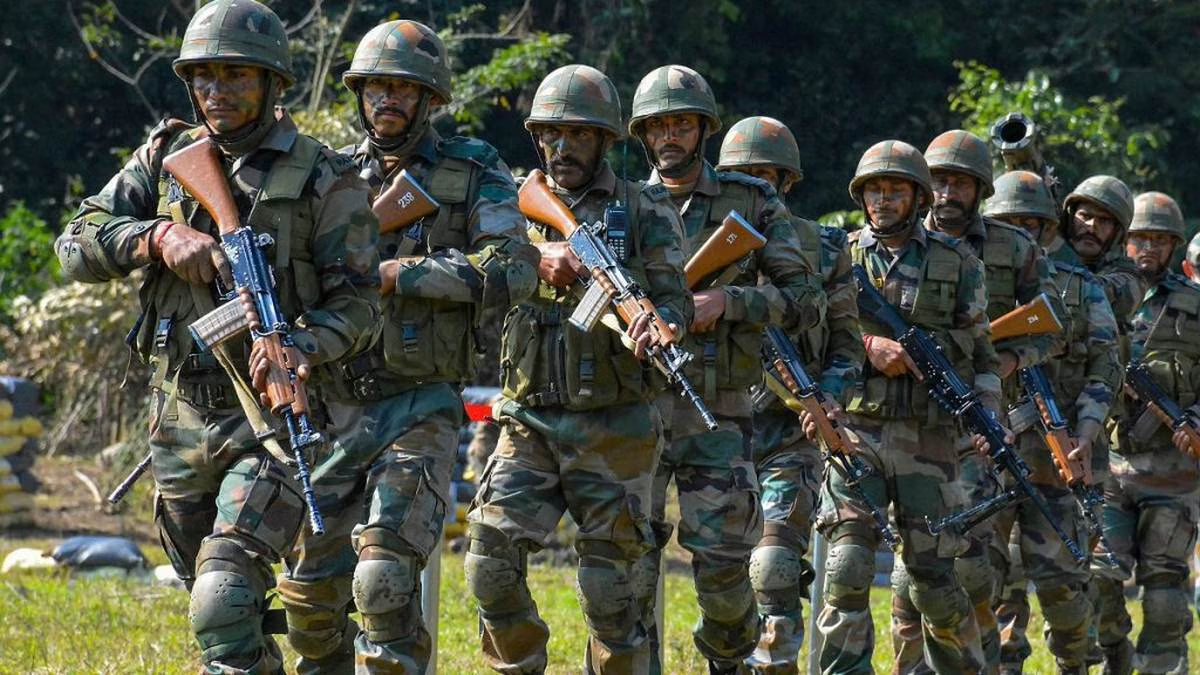
Main Duties of Indian Army
- Protect national borders
- Fight enemy forces during war
- Counter terrorism and insurgency
- Rescue citizens during disasters
The Army also helps during floods, earthquakes, and landslides.
Special Force: Para Commandos
The Para Commandos are elite soldiers of the Indian Army. They carry out:
- Anti-terror operations
- Rescue missions
- Secret operations behind enemy lines
They are highly trained for difficult missions.
Indian Navy
The Indian Navy protects India’s sea borders and maritime interests. It operates above, on, and under the sea.
Main Duties of Indian Navy
- Protect sea routes
- Stop piracy
- Secure coastal areas
- Support during war
The Navy has three main commands:
| Command | Headquarters | Role |
|---|---|---|
| Western Naval Command | Mumbai | Arabian Sea operations |
| Eastern Naval Command | Visakhapatnam | Bay of Bengal operations |
| Southern Naval Command | Kochi | Training command |
The Navy also protects island regions like Andaman & Nicobar and Lakshadweep.
Special Force: MARCOS
The Marine Commandos, called MARCOS, are the Navy’s special force.
Their duties include:
- Anti-piracy missions
- Counter-terror operations
- Hostage rescue
- Underwater attacks
They are among the best commandos in the world.
Indian Air Force
The Indian Air Force (IAF) protects India’s airspace. It was established in 1932 and is among the largest air forces globally.
Main Duties of Air Force
- Defend Indian airspace
- Conduct air attacks during war
- Transport troops and supplies
- Support disaster relief
The Air Force also participates in UN peacekeeping missions.
Special Force: Garud Commandos
The Garud Commando Force handles:
- Airbase security
- Search and rescue
- Enemy air defense suppression
- Special combat missions
Chief of Defence Staff (CDS)
The Chief of Defence Staff (CDS) improves coordination between the Army, Navy, and Air Force.
The post was officially created in 2019. General Bipin Rawat became the first CDS.
Main Duties of CDS
- Improve coordination among three services
- Advise the Defence Minister
- Help in joint military planning
- Improve defense resource management
The CDS helps India prepare better for modern warfare.
Central Armed Police Forces (CAPFs)
The Central Armed Police Forces (CAPFs) mainly handle border security and internal security.
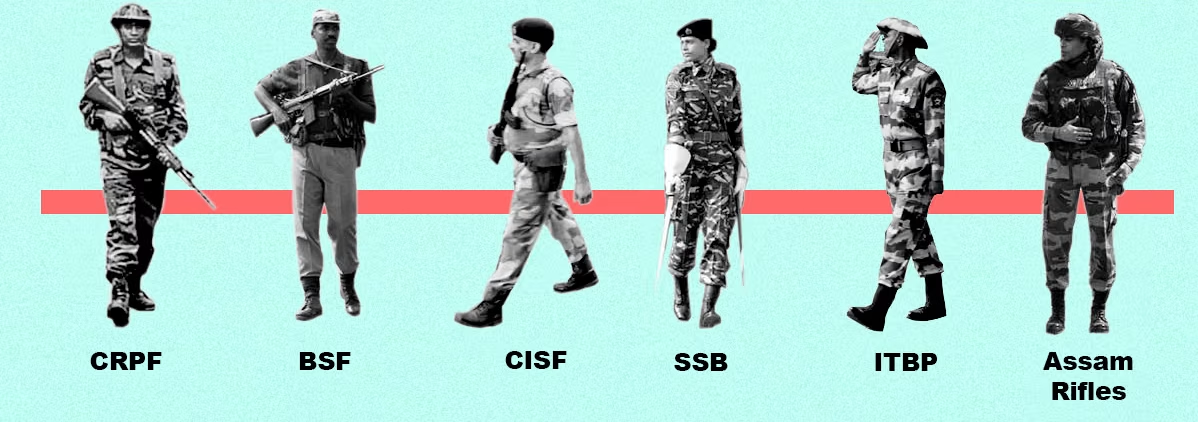
These include:
- Assam Rifles
- Border Security Force (BSF)
- Central Industrial Security Force (CISF)
- Central Reserve Police Force (CRPF)
- Indo-Tibetan Border Police (ITBP)
- National Security Guard (NSG)
- Sashastra Seema Bal (SSB)
Most CAPFs work under the Ministry of Home Affairs.
Assam Rifles
Assam Rifles is one of India’s oldest paramilitary forces. It was established in 1835.
It is called the Sentinels of the Northeast.
Main Duties
- Guard Northeast border areas
- Counter insurgency
- Support peace operations
- Assist in disaster relief
It is the only force under dual control:
- Administrative control: MHA
- Operational control: Indian Army
Assam Rifles has played a major role in maintaining peace in Northeast India.
Border Security Force (BSF)
The Border Security Force (BSF) was established in 1965.
Its main duty is protecting India’s land borders, especially with Pakistan and Bangladesh.
Main Duties of BSF
- Prevent illegal border crossing
- Stop smuggling
- Prevent infiltration
- Protect border villages
During war, BSF also supports the Army by guarding important areas.
Indo-Tibetan Border Police (ITBP)
The ITBP was created in 1962 after the India-China conflict.
It guards the India-China border in high mountain areas.
Main Duties
- Border patrol in Himalayan areas
- Prevent border violations
- Stop illegal activities
- Rescue people during mountain disasters
ITBP personnel work in extremely cold and difficult conditions.
Sashastra Seema Bal (SSB)
The SSB was established in 1963.
It guards India’s borders with Nepal and Bhutan.
Main Duties
- Stop smuggling
- Prevent illegal entry
- Improve border security
- Work with local communities
SSB is known as a People’s Force because of its close connection with border villages.
National Security Guard (NSG)
The National Security Guard (NSG) was created in 1984 to fight terrorism.
Its commandos are popularly called Black Cats.
Main Duties
- Counter-terror operations
- Hostage rescue
- Bomb disposal
- Anti-hijack missions
NSG played a major role during the 2008 Mumbai attacks.
These commandos are specially trained for dangerous missions.
Special Protection Group (SPG)
The SPG protects the Prime Minister of India and other designated high-risk individuals.
It was formed in 1985 after the assassination of Indira Gandhi.
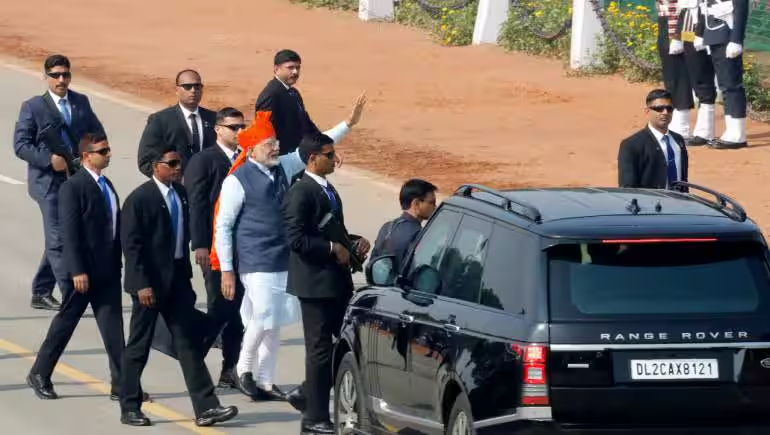
Main Duties
- Close security protection
- Threat assessment
- Secure travel routes
- Coordinate with police and intelligence agencies
SPG officers receive advanced security training.
Indian Coast Guard
The Indian Coast Guard (ICG) was established in 1978.
It protects India’s maritime zones and coastal security.
Main Duties
- Stop smuggling through sea routes
- Protect marine environment
- Conduct search and rescue operations
- Help during cyclones and floods
The Coast Guard is often called the First Responder at Sea.
It also helps prevent oil spills and maritime crimes.
Central Industrial Security Force (CISF)
The CISF was established in 1969.
It protects important infrastructure across India.
Main Duties
- Security at airports
- Protect nuclear plants
- Guard seaports
- Protect metro systems and government buildings
CISF also provides fire safety services at many important installations.
Central Reserve Police Force (CRPF)
The CRPF is one of India’s largest internal security forces.
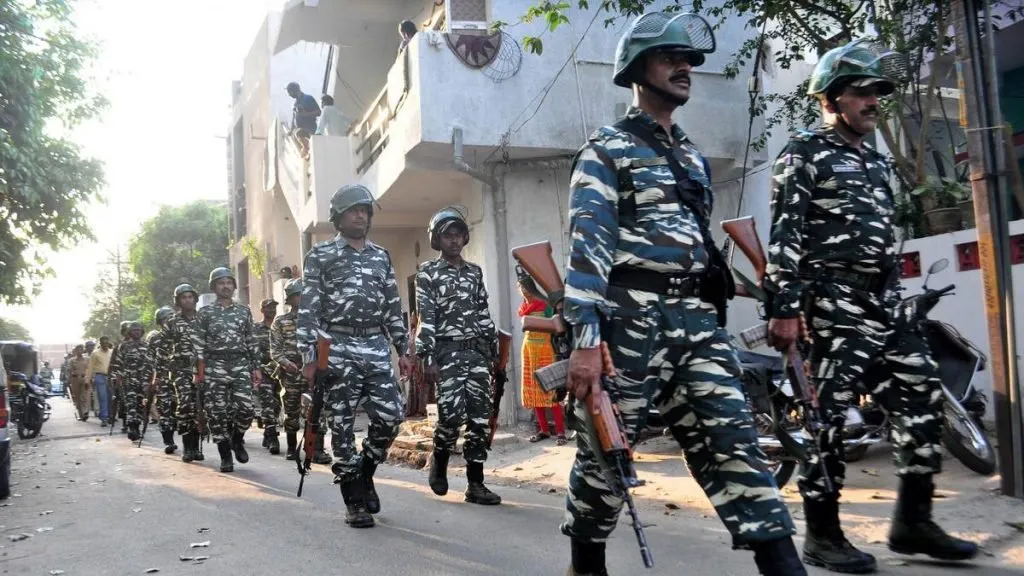
It was originally formed in 1939.
Main Duties
- Riot control
- Counter insurgency
- Anti-Naxal operations
- Election security
- Disaster rescue
CRPF plays a major role in fighting Left Wing Extremism and maintaining law and order.
It is often deployed in sensitive areas during elections and emergencies.
Importance of Security Forces in India
Security forces are essential for India’s safety and stability. They protect the country from enemies, maintain peace inside the nation, and help during disasters.
Their importance includes:
- Protecting borders
- Fighting terrorism
- Maintaining law and order
- Preventing crime and smuggling
- Helping citizens during emergencies
Because of these forces, millions of people can live safely.
India faces many modern security challenges such as cyber threats, cross-border terrorism, and organized crime. Therefore, strong coordination among all security forces remains very important.
FAQs
Q1. What are Security Forces in India?
Security Forces in India are military and police organizations that protect the country from external and internal threats.
Q2. Which are the three armed forces of India?
The three armed forces are the Indian Army, Indian Navy, and Indian Air Force.
Q3. What is the role of BSF?
BSF protects India’s land borders and prevents illegal crossings and smuggling.
Q4. What is the function of CISF?
CISF protects important infrastructure such as airports, ports, and power plants.
Q5. What is NSG known for?
NSG is known for anti-terror operations, hostage rescue, and bomb disposal.