Indian Polity: Structure, Constitution, and Government System of India

Introduction
Indian Polity explains how the government of India works according to the Constitution. India is a Union of States and is described as a Sovereign, Socialist, Secular, Democratic Republic.
Thank you for reading this post, don't forget to subscribe!- Sovereign means India is an independent country.
- Socialist means the government tries to reduce economic inequality.
- Secular means all religions are treated equally.
- Democratic means people elect their government.
- Republic means the head of the country is elected, not a king.
The Constitution of India was adopted by the Constituent Assembly on 26 November 1949 and came into force on 26 January 1950, which we celebrate as Republic Day.
India follows a parliamentary system of government where the Prime Minister and the Council of Ministers run the government.
The Constitution also creates a federal system, where powers are shared between the Central Government and State Governments. However, in some situations the central government has stronger authority, which gives the system unitary features.
At the Union level:
- The President is the constitutional head.
- The Prime Minister and Council of Ministers exercise real executive power.
Similarly, in the states:
- The Governor is the constitutional head.
- The Chief Minister and Council of Ministers have real executive power.
The Constitution also divides law-making powers between Parliament and State Legislatures. The power to amend the Constitution lies with Parliament.
Union and Its Territory
India currently consists of 28 States and 8 Union Territories.
| Category | Number |
|---|---|
| States | 28 |
| Union Territories | 8 |
Jammu and Kashmir Reorganisation
In 2019, the Jammu and Kashmir Reorganisation Act was passed.

After this law:
- The former state of Jammu and Kashmir was divided into two Union Territories:
This happened after a Presidential Order under Article 370, which removed the special status of Jammu and Kashmir and made all provisions of the Indian Constitution applicable to it.
Citizenship in India
The Constitution provides single citizenship for the whole country. This means a person is only a citizen of India, not a separate citizen of a particular state.
When the Constitution came into force on 26 January 1950, a person became an Indian citizen if:
- They were born in India, or
- One of their parents was born in India, or
- They had lived in India for at least five years.
Citizenship Act, 1955
The Citizenship Act of 1955 deals with matters related to:
- Acquiring citizenship
- Determining citizenship
- Ending citizenship
Citizenship Amendment Act (CAA), 2019
The Citizenship (Amendment) Act, 2019 allows citizenship to migrants from certain religious communities who came from neighboring countries due to religious persecution.
Eligible Communities
| Religion | Countries |
|---|---|
| Hindus | Afghanistan |
| Sikhs | Bangladesh |
| Buddhists | Pakistan |
| Jains | |
| Parsis | |
| Christians |
Conditions:
- They must have entered India before 31 December 2014.
- The period for citizenship by naturalisation was reduced from 11 years to 5 years.
Areas Where CAA Does Not Apply
The law does not apply to:
- Tribal areas of Assam, Meghalaya, Mizoram, Tripura (Sixth Schedule)
- Areas under Inner Line Permit (ILP):
Fundamental Rights
Fundamental Rights are basic rights guaranteed by the Constitution to all citizens. They are mentioned in Part III (Articles 12–35).
| Fundamental Right | Meaning |
|---|---|
| Right to Equality | Everyone is equal before the law |
| Right to Freedom | Freedom of speech, expression, movement, and profession |
| Right Against Exploitation | Prohibits forced labour, child labour, and human trafficking |
| Right to Freedom of Religion | Freedom to follow and practice any religion |
| Cultural and Educational Rights | Protects language and culture of minorities |
| Right to Constitutional Remedies | Citizens can approach courts to protect their rights |
Fundamental Duties
Fundamental Duties were added by the 42nd Constitutional Amendment in 1976 under Article 51A.
Some important duties include:
- Respect the Constitution and national symbols.
- Follow the ideals of the freedom struggle.
- Defend the country when needed.
- Promote harmony among people of different religions and regions.
Directive Principles of State Policy (DPSP)
Directive Principles are mentioned in Part IV (Articles 36–51) of the Constitution.
These principles are not enforceable by courts, but they guide the government in making laws and policies.
Important aims include:
- Promote social and economic justice
- Provide education and employment opportunities
- Ensure equal pay for equal work
- Protect weaker sections like SCs and STs
- Organize village panchayats
- Protect the environment
- Promote international peace
Union Executive
The Union Executive is responsible for running the central government.
| Position | Role |
|---|---|
| President | Head of the country |
| Vice-President | Deputy head |
| Prime Minister | Head of the government |
| Council of Ministers | Helps run the government |
President of India
The President is the constitutional head of India.

Election
The President is elected by an Electoral College, which includes:
- Elected members of Parliament
- Elected members of State Legislative Assemblies
Qualifications
A candidate must:
- Be a citizen of India
- Be at least 35 years old
- Be eligible to become a member of the Lok Sabha
Term
- Term of 5 years
- Eligible for re-election
The President is also the Supreme Commander of the Indian Armed Forces.
Vice-President of India
| Feature | Details |
|---|---|
| Election | By members of both Houses of Parliament |
| Minimum Age | 35 years |
| Term | 5 years |
| Role | Chairman of Rajya Sabha |
The Vice-President acts as President if the position becomes vacant.
Council of Ministers
The Prime Minister leads the Council of Ministers.
Structure of Council of Ministers
| Type | Role |
|---|---|
| Cabinet Ministers | Senior ministers |
| Ministers of State | Assist Cabinet Ministers |
| Deputy Ministers | Junior ministers |
The Council of Ministers is collectively responsible to the Lok Sabha.
Parliament of India
The Parliament is the highest law-making body.
Structure of Parliament
| Component | Description |
|---|---|
| President | Part of Parliament |
| Rajya Sabha | Upper House |
| Lok Sabha | Lower House |
Rajya Sabha (Council of States)
| Feature | Details |
|---|---|
| Maximum Members | 250 |
| Nominated Members | 12 |
| Election | Indirect election by MLAs |
| Nature | Permanent body |
Every two years, one-third of members retire.

Lok Sabha (House of the People)
| Feature | Details |
|---|---|
| Maximum Members | 550 |
| Current Members | 543 |
| Election | Direct election by citizens |
| Term | 5 years |
Seat allocation is based on the 1971 Census and remains frozen until after the 2026 Census.
Functions and Powers of Parliament
Main functions include:
- Making laws
- Approving the national budget
- Discussing public issues
- Controlling the executive
- Amending the Constitution
- Impeaching the President
Parliamentary Committees
Parliament creates committees to study important matters in detail.
Financial Committees
| Committee | Function |
|---|---|
| Public Accounts Committee | Checks government spending |
| Estimates Committee | Suggests efficient use of money |
| Committee on Public Undertakings | Reviews government companies |
National e-Vidhan Application (NeVA)
NeVA is part of the Digital India Mission Mode Project.
Aim
To create paperless legislatures (Digital Houses).
Features
- e-Book format for legislative documents
- Real-time updates to the public
- Greater transparency
- “One Nation, One Application” principle
Comptroller and Auditor General (CAG)
The CAG is the highest authority for auditing government accounts under Articles 148–151.
Duties
- Audit Union and State government spending
- Check contingency fund accounts
- Audit government organizations and public bodies
The first Indian CAG was V. Narhari Rao (1948–1954).
Attorney General for India
The Attorney General is the chief legal advisor of the Government of India.
Appointment
Appointed by the President of India.
Qualification
Must be qualified to become a judge of the Supreme Court.
Functions
- Advises the government on legal matters
- Represents the government in court
- Has the right to speak in all courts in India
Right to Information (RTI) Act, 2005
The RTI Act allows citizens to access information from government authorities.
Purpose
- Promote transparency
- Reduce corruption
- Empower citizens
Process
- Submit an application to the Public Information Officer.
- If not satisfied within 30 days, file an appeal.
- Second appeal can be made to the Information Commission within 90 days.
Inter-State Council
The Inter-State Council was created under Article 263 to improve cooperation between the Central and State Governments.
Members
- Prime Minister (Chairman)
- Chief Ministers
- Union Ministers
- Administrators of Union Territories
Zonal Councils of India
These councils help states cooperate on regional issues.
| Zonal Council | States Included |
|---|---|
| Northern | Haryana, Punjab, Himachal Pradesh, Rajasthan, Delhi |
| Central | Uttar Pradesh, Uttarakhand, Madhya Pradesh, Chhattisgarh |
| Eastern | Bihar, Jharkhand, West Bengal, Odisha |
| Western | Gujarat, Maharashtra, Goa |
| Southern | Andhra Pradesh, Tamil Nadu, Karnataka, Kerala, Telangana |
State Government
Every state has its own government.
| Position | Role |
|---|---|
| Governor | Head of the state |
| Chief Minister | Head of government |
| Council of Ministers | Assists the Chief Minister |
State Legislature
A state legislature may have one or two houses.
| House | Description |
|---|---|
| Legislative Assembly (Vidhan Sabha) | Lower House |
| Legislative Council (Vidhan Parishad) | Upper House |
States with two houses include:
Union Territories
Union Territories are directly administered by the President through Administrators or Lieutenant Governors.
Examples:
- Delhi – Lieutenant Governor
- Puducherry – Lieutenant Governor
- Lakshadweep – Administrator
Local Government
Local governments manage administration at village and city levels.
Municipalities (Urban Areas)
The 74th Constitutional Amendment Act, 1992 created a system for urban local bodies.
| Type | Area |
|---|---|
| Nagar Panchayat | Small towns |
| Municipal Council | Medium towns |
| Municipal Corporation | Large cities |
Panchayati Raj System
The Panchayati Raj system governs rural areas.
Key Features
- Gram Sabha at village level
- Direct elections
- Reservation for SC, ST and women
- Five-year term
At least one-third of seats are reserved for women.
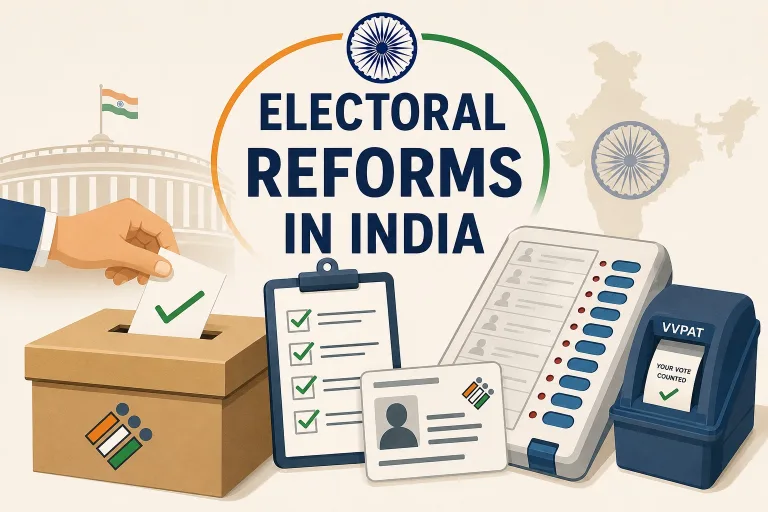
Election Commission of India (ECI)
The Election Commission of India (ECI) is an important constitutional body that conducts free and fair elections in the country. It was established in 1950 and works as a permanent and independent authority to manage the entire election process in India.
Main Powers and Responsibilities
- Supervise, direct, and control elections for:
- Parliament
- State and Union Territory legislatures
- President and Vice-President of India
Key Functions
- Decide election schedules for general and bye-elections
- Prepare, maintain, and update electoral rolls (voter lists)
- Supervise candidate nominations
- Register political parties
- Monitor election campaigns and candidate spending
- Facilitate media coverage of elections
- Conduct voter education and awareness programs
- Organize polling stations and voting booths
- Oversee counting of votes and declaration of results
Use of Technology in Elections
- Voting is conducted using Electronic Voting Machines (EVMs)
- Voter Verifiable Paper Audit Trail (VVPAT) is used for verification
- Electors’ Photo Identity Cards (EPIC) are used for voter identification
- Voter information slips are distributed before polling
Legal Framework of Elections
Elections in India are conducted according to constitutional provisions and important laws such as:
- Presidential and Vice-Presidential Elections Act, 1952
- Representation of the People Act, 1950
- Representation of the People Act, 1951
State-Level Election Administration
- Each state has a Chief Electoral Officer (CEO) who manages election work under the supervision of the Election Commission.
- The CEO is usually a senior civil servant of the state government.
- Election work at the district level is managed by officials such as:
- District Magistrates / Deputy Commissioners
- Sub-Divisional Magistrates
- Revenue Divisional Officers
- Tehsildars
IIIDEM
The India International Institute of Democracy and Election Management (IIIDEM) was launched by the Election Commission.
- Located in New Delhi
- Works as a training and research center
- Promotes knowledge about electoral democracy and election management
Conclusion
Indian Polity explains how the Indian democratic system works. The Constitution of India is the foundation of the country’s political system. It defines the powers of the government, rights of citizens, and duties of the state.
India’s governance includes Union Government, State Governments, Parliament, Judiciary, and Local Bodies. Together they ensure democracy, justice, and development in the country.
Understanding Indian Polity helps citizens know their rights, duties, and the functioning of the government.
FAQs
1. What is Indian Polity?
Indian Polity refers to the system of government and political structure defined by the Constitution of India.
2. When was the Constitution of India adopted?
The Constitution of India was adopted on 26 November 1949 and came into force on 26 January 1950.
3. How many states and union territories are there in India?
India currently has 28 states and 8 union territories.
4. What are Fundamental Rights?
Fundamental Rights are basic rights guaranteed by the Constitution to protect the freedom and equality of citizens.
5. What is the role of Parliament in India?
Parliament makes laws, approves the budget, discusses national issues, and supervises the functioning of the government.