


Ramsar Award: Honouring Extraordinary Global Champions of Wetland Wise Use

Introduction
Did you know that wetlands cover only 6 percent of the Earth’s land area, yet they support nearly 40 percent of all plant and animal species? Even more worrying is the fact that wetlands are disappearing three times faster than forests.
Thank you for reading this post, don't forget to subscribe!For students preparing for UPSC, State Civil Services, and other competitive exams, environmental topics like the Ramsar Award have become very important. Questions related to wetlands, conservation efforts, and international environmental recognition now appear regularly in both prelims and mains.
The problem is that most study materials are not helpful. Some explain the topic in just two lines, while others use technical language that is difficult to understand and remember during exams. This makes revision stressful.
After carefully studying current affairs reports, official documents, and environmental sources, this guide explains the Ramsar Award in simple and clear English. It is designed to work as final revision material, not something you need to read again and again.
By the end of this guide, you will clearly understand what the Ramsar Award is, why it is given, who has received it, and how it is linked to wetland conservation and global environmental goals. With this understanding, you will be fully prepared to answer any exam question related to wetland protection and the Ramsar Award.
Here’s What You’ll Learn in This Guide
In this guide, you will clearly understand the Ramsar Award and why it matters for exams and environmental studies.
You will learn:
- The complete background of the Ramsar Award and why it is important globally
- Why Jayshree Vencatesan became India’s first recipient of this award
- How the Ramsar Award is linked to India’s efforts to protect wetlands
- The most important facts and dates that you must remember for UPSC, State PSC, and other competitive exams
What Is the Ramsar Award?
The Ramsar Award is an international award given to people and organisations that have done exceptional work in protecting wetlands. You can think of it as one of the highest global honours for wetland conservation.
This award is given under the Ramsar Convention, an international agreement created to protect wetlands across the world. The convention was signed in 1971 in the Iranian city of Ramsar, from which it gets its name.
The main goal of the Ramsar Convention and the Ramsar Award is to promote the wise use of wetlands. Wetlands are vital because they support biodiversity, help manage floods, recharge groundwater, and reduce the impact of climate change.
Because of its global importance and strict selection process, the Ramsar Award is often compared to a top-level international recognition in the field of environmental conservation.
Categories of the Ramsar Award
The Ramsar Award is given in three main categories, which are important from an exam point of view.
Ramsar Wetland Conservation Award
This award is given to individuals who have shown long-term and outstanding dedication to wetland conservation through practical work on the ground.
Evian Special Prize
This prize is awarded to young conservationists below 30 years of age. It recognises innovative and impactful efforts in protecting wetlands.
Ramsar Innovation Award
This award honours new ideas, technologies, or methods that improve wetland management and conservation.
Why the Ramsar Award Matters
Winners of the Ramsar Award receive international recognition, which:
- Strengthens global awareness about wetland protection
- Helps conservationists continue their work
- Encourages governments and communities to protect wetlands
For competitive exams, remembering the year 1971, the Ramsar Convention, the three award categories, and the purpose of the Ramsar Award is extremely important.
Why Do Wetlands Matter for India and the World?
Before understanding the Ramsar Award and its winners, it is important to know why wetlands are so valuable. This background helps you write stronger answers in mains and descriptive exams.
Wetlands are areas where water covers the land permanently or for part of the year. They include marshes, swamps, lakes, rivers, floodplains, and coastal ecosystems such as mangroves.
Key Functions of Wetlands
Natural Water Filters
Wetlands act like natural water purification systems. They remove pollutants, excess nutrients, and sediments from water. Because of this role, wetlands are often called nature’s kidneys.
Flood Control
During heavy rainfall, wetlands absorb excess water and release it slowly. This reduces the risk of floods in nearby cities and villages. Destroying wetlands increases flood disasters.
Biodiversity Hotspots
Wetlands support a wide variety of life. In India, they provide habitat to:
- Migratory birds
- Fish and amphibians
- Rare and unique plant species
Many species found in wetlands do not survive anywhere else.
Climate Regulation
Wetlands store large amounts of carbon dioxide. This helps control global warming. When wetlands are destroyed or drained, this stored carbon is released into the atmosphere, worsening climate change.
Livelihood Support
Millions of people depend on wetlands for:
- Fishing
- Agriculture
- Tourism and handicrafts
In India, many communities have lived around wetlands for generations, making them culturally and economically important.
Importance of Wetlands in India
As of 2024, India has 75 Ramsar Sites, which are wetlands of international importance recognised under the Ramsar Convention. Together, they cover around 13 lakh hectares.
India’s wetlands are extremely diverse. They range from:
- Wular Lake in Kashmir
- To Point Calimere Wildlife Sanctuary in Tamil Nadu
This wide diversity makes wetland conservation crucial for India’s environmental security.
Exam Tip
Questions related to wetlands often link biodiversity, climate change, disaster management, and livelihoods. Understanding their importance helps you connect topics like the Ramsar Award, Ramsar Sites, and sustainable development in a single, well-structured answer.
Jayshree Vencatesan: India’s First Ramsar Award Winner
In March 2025, Jayshree Vencatesan became the first Indian to receive the Ramsar Wetland Conservation Award. This is a historic achievement and a very important fact for competitive exams.
Her selection highlights India’s growing role in global wetland conservation and shows how individual efforts can make a national and international impact.
Who Is Jayshree Vencatesan?
Jayshree Vencatesan is an environmental conservationist who has spent more than 20 years working to protect India’s wetlands and coastal ecosystems.
She is not a government officer or a public figure. She is a grassroots worker who has worked closely with local communities on the ground. Her approach focuses on practical solutions rather than theory.
Her work mainly covers three key areas.
Community-Based Conservation
She works with fishing communities, farmers, and residents. Her goal is to show that protecting wetlands also protects people’s livelihoods. When communities benefit directly, conservation becomes long-lasting.
Mangrove Restoration
Mangroves are special trees found in coastal wetlands. They:
- Protect coastlines from cyclones and storms
- Prevent soil erosion
- Act as breeding grounds for fish
Jayshree has led projects to restore and plant mangroves across thousands of hectares, especially along India’s coastline.
Awareness and Education
She believes conservation starts with awareness. She conducts workshops, works with schools, and creates educational material to teach people, especially children, about the importance of wetlands.
Why Did She Win the Ramsar Award?
The Ramsar Convention honoured her for promoting the idea of wise use of wetlands.
Wise use does not mean banning human activity. It means sustainably using wetlands, so they remain healthy and productive for future generations.
Jayshree’s work clearly shows that conservation and development can go together.
What Made Her Work Stand Out?
Several factors made her work exceptional at the global level.
Measurable Impact
Her initiatives have helped restore more than 5,000 hectares of degraded wetlands, mainly in Tamil Nadu and other coastal states.
Community Participation
Instead of giving orders, she involved local people in planning and decision-making. This made conservation efforts more effective and long-lasting.
Innovation
She used low-cost and practical methods that local communities could manage on their own, without expensive technology or continuous outside support.
Knowledge Sharing
She carefully documented her methods and shared them with other conservation groups. This allowed her ideas to be used in many other regions, multiplying the impact.
Exam Tip
Remember these keywords for answer writing
March 2025, first Indian Ramsar Award winner, wise use of wetlands, community-based conservation, mangrove restoration
Understanding the Ramsar Convention
To clearly understand the importance of the Ramsar Award, you must first understand the Ramsar Convention itself. This topic is very important for UPSC prelims, mains, and state PSC exams, especially under Environment and Ecology.
What Is the Ramsar Convention?
The Convention on Wetlands, commonly known as the Ramsar Convention, is an international treaty for the protection of wetlands.
It was signed on February 2, 1971, in the Iranian city of Ramsar, and came into force in 1975.
A key point for exams is that this is the only global environmental treaty that focuses on one specific ecosystem, which is wetlands.
Key Features of the Ramsar Convention
Three Pillars of the Convention
The Ramsar Convention works on three main pillars:
- Wise use of all wetlands, meaning sustainable use without damage
- Designation of Ramsar Sites, which are wetlands of international importance
- International cooperation between countries for shared wetland conservation
Member Countries
As of 2024, 172 countries are parties to the Ramsar Convention.
India joined the convention in 1982. At that time, India designated its first two Ramsar Sites:
- Chilika Lake in Odisha
- Keoladeo National Park in Rajasthan
These facts are frequently asked in prelims.
World Wetlands Day
Every year, February 2 is celebrated as World Wetlands Day.
The date marks the signing of the Ramsar Convention and is used to spread awareness about wetland protection.
Montreux Record
The Montreux Record is a list of Ramsar Sites where ecological damage has occurred due to human activities.
You can remember it as a warning list or danger list for threatened wetlands. Sites can be added or removed based on their condition.
India and the Ramsar Convention
India’s involvement with the Ramsar Convention has increased strongly in recent years.
Important facts you must remember:
- India added 28 new Ramsar Sites between 2022 and 2024
- Tamil Nadu has the highest number of Ramsar Sites in India, with 18 sites
- India ranks 3rd in Asia in terms of the number of Ramsar Sites
To strengthen wetland protection, the government is also implementing national programmes focused on the conservation of aquatic ecosystems, including wetlands.
Exam Tip
Always connect these points in answers:
Ramsar Convention, wise use, Ramsar Sites, World Wetlands Day, and India’s ranking.
This helps you write integrated and high-scoring answers on the Ramsar Award and wetland conservation.
Recent Developments in Wetland Conservation (2024–2026)
For current affairs sections, knowing recent developments is very important. Wetlands and the Ramsar Award have been in the news frequently, making this topic highly exam-relevant.
Key Highlights of 2024
New Ramsar Sites in India
In 2024, India added seven new wetlands to the list of Ramsar Sites. Some important additions include:
- Nanda Lake
- Magadi Kere Conservation Reserve
These designations strengthened India’s position globally in wetland conservation.
Amendment to Wetland Conservation Rules
The government proposed amendments to the Wetland Conservation Rules to make protection stronger.
The focus was on:
- Reducing human activities that damage wetlands
- Improving monitoring and enforcement
This shows a policy shift towards stricter environmental protection.
Increased Budget Support
The government increased funding for wetland-related projects, especially under river and ecosystem programmes.
More money was allocated for:
- Wetland restoration
- Pollution control
- Biodiversity protection
Major Developments in 2025
Ramsar Award for India
In March 2025, Jayshree Vencatesan became the first Indian to receive the Ramsar Award.
This recognition brought global attention to India’s community-based wetland conservation efforts.
Global Wetland Outlook Report
A new Global Wetland Outlook Report revealed that around 35 percent of the world’s wetlands have been lost since 1970.
This report highlighted:
- Rapid wetland loss
- Increased climate risks
- Urgent need for conservation
These figures are important for prelims and mains answers.
India’s Global Commitment
At international environmental forums, India committed to:
- Protecting all existing wetlands
- Restoring degraded wetlands by 2030
This commitment aligns with global climate and biodiversity goals.
Exam Tip
For high-scoring answers, always link:
Ramsar Award, new Ramsar Sites, policy amendments, and global wetland loss data.
This helps you connect static knowledge with current affairs.
Categories of the Ramsar Award
The Ramsar Awards are structured into multiple categories to ensure a wide range of contributions to wetland conservation are acknowledged. Each category recognises unique forms of commitment, innovation, and leadership in the field.
| Category | Purpose / Focus Area |
|---|---|
| Wise Use Award | Recognises individuals, organisations, or governments for promoting the sustainable and responsible use of wetlands, ensuring ecological balance while supporting human livelihoods. |
| Innovation Award | Highlights innovative approaches, technologies, or ideas that enhance wetland conservation, restoration, or management. This includes tools for monitoring, ecosystem restoration techniques, and policy innovations. |
| Young Wetland Champions | Celebrates the efforts of youth (18–30 years) who demonstrate exceptional leadership, advocacy, and action in protecting wetlands and engaging communities in sustainable practices. |
| Indigenous Peoples’ Wise Use | Recognises projects led by indigenous communities or organisations, valuing traditional knowledge and cultural practices that maintain the ecological integrity of wetlands. |
| Merit / Long-Term Contribution | Rewards individuals or organisations with a decades-long dedication to wetland conservation, whose sustained efforts have significantly influenced local, national, or international wetland protection policies. |
These categories ensure the awards are inclusive and global in scope, covering efforts from grassroots movements to international policy advocacy. They reflect the multifaceted nature of wetland conservation, acknowledging the ecological, cultural, social, and scientific dimensions of this vital environmental work.
Common Mistakes Students Make About Wetland Topics
Many students lose marks in exams not because the topic is difficult, but because of small conceptual mistakes. Let’s clear the most common errors related to wetlands and the Ramsar Award.
Mistake 1: Thinking All Water Bodies Are Wetlands
Not every lake, pond, or river is a wetland.
For an area to be classified as a wetland, it must meet certain conditions:
- Water must be present permanently or for part of the year
- The soil should be hydric, meaning it remains waterlogged
- The area should support wetland vegetation
If these features are missing, the area is not considered a wetland in exam answers.
Mistake 2: Confusing Ramsar Sites with Protected Areas
Many students assume that Ramsar Sites are the same as National Parks or Wildlife Sanctuaries. This is incorrect.
Ramsar Sites are wetlands of international importance, recognised under the Ramsar Convention.
They do not automatically get legal protection.
For protection, they must be covered under national laws such as:
- Wildlife Protection Laws
- Wetland Conservation Rules
This distinction is very important for prelims questions.
Mistake 3: Assuming Wetland Conservation Means No Human Activity
Wetland conservation does not mean banning people completely.
The Ramsar Convention follows the principle of wise use.
Wise use means:
- Sustainable use of wetlands
- Protection without destroying livelihoods
Activities like fishing or farming can continue if they do not harm the ecosystem.
Mistake 4: Mixing Up Different Types of Wetlands
Students often confuse wetland types in MCQs. Remember these simple differences:
- Marshes
Wetlands dominated by grasses and soft plants - Swamps
Wetlands with trees and shrubs - Bogs
Wetlands with peat deposits and very little nutrient flow - Fens
Wetlands fed by groundwater and richer in nutrients
These definitions are frequently tested in environment-related exams.
Exam Tip
Avoid writing generic answers. Use correct terms, clear definitions, and connect concepts like:
wetlands, wise use, Ramsar Sites, and the Ramsar Award.
This clarity can easily fetch you extra marks.
How Wetland Conservation Connects to Other Topics
For UPSC mains and other descriptive exams, writing isolated answers is not enough. You must connect wetland conservation with broader issues like climate change, sustainable development, water security, and livelihoods. This approach helps you score higher.
Connection to Climate Change
Wetlands play a major role in fighting climate change.
Although wetlands cover only about 6 percent of the Earth’s surface, they store nearly 30 percent of all land-based carbon. This makes them powerful carbon sinks.
When wetlands are destroyed, the stored carbon is released into the atmosphere, increasing global warming. Protecting wetlands is therefore essential for achieving global climate goals and reducing climate-related disasters such as floods and droughts.
Link to Sustainable Development Goals
Wetland conservation supports several Sustainable Development Goals, making it a strong multidimensional topic for main answers.
It directly contributes to
- SDG 6 Clean Water and Sanitation by improving water quality and groundwater recharge
- SDG 13 Climate Action by storing carbon and reducing climate risks
- SDG 14 Life Below Water by supporting fish breeding and aquatic ecosystems
- SDG 15 Life on Land by protecting biodiversity and ecosystems
Linking wetlands with SDGs shows integrated thinking, which examiners value.
Relationship with Water Security
India is facing increasing water stress due to population growth, urbanisation, and climate change.
Wetlands help:
- Recharge groundwater
- Maintain river flows
- Store water during dry periods
This makes them especially important in water-scarce states like Rajasthan and Gujarat, where wetlands act as natural water reservoirs.
Protecting wetlands is therefore directly linked to India’s long-term water security.
Impact on Livelihoods
Wetlands are not just ecological spaces. They are also economic lifelines.
More than 200 million people in India depend on wetland ecosystem services for:
- Fishing
- Agriculture
- Tourism
- Handicrafts and related activities
Wetland conservation supports sustainable livelihoods, especially for rural and coastal communities. This link between environment and economy is a strong point to highlight in the main answers.
Mains Answer Tip
Whenever you write about wetlands or the Ramsar Award, try to link:
climate change, SDGs, water security, and livelihoods in one answer.
This integrated approach shows maturity, relevance, and strong analytical ability.
Important Facts and Figures for Exams
This section is meant for quick revision before prelims or mains. Memorising these facts will help you answer most questions related to wetlands and the Ramsar Award.
Must Remember Data
- Ramsar Convention signed: February 2, 1971
- India joined Ramsar Convention: October 1, 1982
- India’s first Ramsar Sites:
- Chilika Lake
- Keoladeo National Park
- Total Ramsar Sites in India (2024): 75
- India’s rank in Asia: 3rd in the number of Ramsar Sites
- State with the highest Ramsar Sites: Tamil Nadu with 18 sites
- First Indian to win Ramsar Award:
- Jayshree Vencatesan in March 2025
- World Wetlands Day: February 2
These facts are frequently asked directly in prelims MCQs.
Important Indian Ramsar Sites
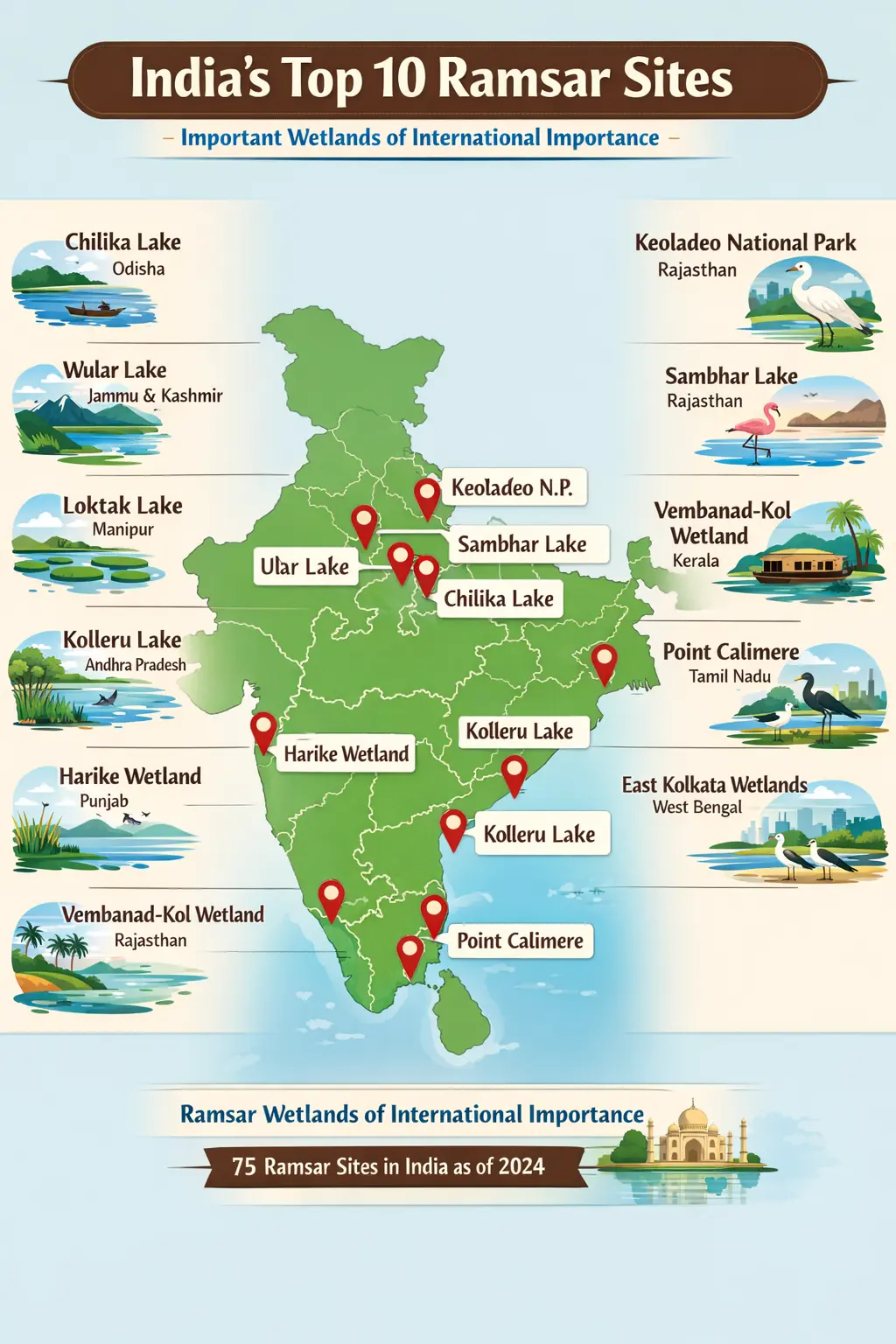
You should remember at least 10 major Ramsar Sites with one identifying feature each.
- Chilika Lake
Asia’s largest brackish water lagoon - Keoladeo National Park
Famous bird sanctuary and UNESCO World Heritage Site - Wular Lake
One of Asia’s largest freshwater lakes - Loktak Lake
Known for floating islands called phumdis - Kolleru Lake
Located between the Krishna and Godavari rivers - Vembanad Kol Wetland
Longest lake system in India - Harike Wetland
Located at the confluence of the Beas and the Sutlej rivers - Sambhar Lake
The largest saline lake in India - Point Calimere
Coastal wetland is famous for migratory birds - East Kolkata Wetlands
Acts as a natural wastewater treatment system
Exam Strategy Tip
For prelims, focus on location + unique feature.
For mains, link these wetlands with:
- Biodiversity
- Climate change
- Livelihoods
- Ramsar Convention and Ramsar Award
This section alone can help you clear multiple environment questions confidently.
Ramsar Award 2022 Winners
The Ramsar Wetland Conservation Awards 2022 were presented during the 14th Meeting of the Conference of the Contracting Parties (COP14) to the Ramsar Convention, held in Wuhan, China, and Geneva, Switzerland, in a hybrid format. The 2022 edition recognised outstanding individuals and organisations whose contributions have left a lasting impact on global wetland conservation.
Here is a detailed list of the Ramsar Award 2022 winners:
| Category | Awardee | Contribution |
|---|---|---|
| Wise Use Award | Ms. Jayshree Vencatesan (India) | First Indian recipient of the Ramsar Award, honoured for her pioneering work in the wise use of wetlands and for strengthening wetland conservation policies in India. |
| Innovation Award | Danone Fund for Nature (France) | Recognised for supporting innovative financing and restoration projects, linking private sector responsibility with wetland sustainability. |
| Young Wetland Champions | Mr. Fabián Pacheco (Costa Rica) | Honoured for engaging youth and communities in sustainable agricultural practices that protect wetlands. |
| Indigenous Peoples’ Wise Use | Comité Nacional de Humedales (Argentina) | Awarded for community-led projects promoting the protection and traditional sustainable use of wetlands by Indigenous groups. |
| Merit Award | Prof. Royal Gardner (United States) | Acknowledged for his long-term contribution to wetland policy, law, and international cooperation under the Ramsar Convention. |
The 2022 Ramsar Award ceremony showcased winners from across the world, including grassroots activists, indigenous communities, international organisations, and policymakers. This wide range of winners highlighted an important message. Protecting wetlands requires a combined effort of science, strong policies, community participation, and respect for local cultures. Only by working together can wetlands be preserved for future generations.
Exam-Oriented Questions and Answers
Practice these questions carefully. They are highly probable for UPSC, State PSC, and other competitive exams.
Question 1
What is the significance of the Ramsar Convention for India?
Answer
The Ramsar Convention is an international treaty aimed at conserving wetlands through sustainable use.
India became a party to the convention in 1982, showing its commitment to wetland protection. The convention helps India by giving international recognition to important wetlands, providing technical guidance, and improving access to global conservation knowledge.
India has designated 75 Ramsar Sites, including Chilika Lake and Keoladeo National Park. These sites support biodiversity, water security, and livelihoods. The Ramsar Convention also helps India achieve broader environmental goals related to climate change, biodiversity protection, and sustainable development.
Question 2
Discuss the major threats faced by wetlands in India.
Answer
Indian wetlands face multiple threats.
Rapid urbanisation and encroachment have reduced wetland areas. Pollution from industries, sewage, and solid waste degrades water quality. Agricultural runoff, including pesticides and fertilisers, harms aquatic life.
Climate change affects rainfall patterns and increases floods and droughts, damaging wetlands. Invasive species also disrupt native ecosystems.
For example, urban wetlands around major cities are shrinking rapidly. Addressing these threats requires strong laws, community involvement, and scientific management.
Question 3
How does wetland conservation contribute to climate change mitigation?
Answer
Wetlands act as major carbon sinks. Although they cover a small area, they store large amounts of carbon. Protecting wetlands prevents the release of stored carbon into the atmosphere.
Wetlands also reduce the impact of climate disasters by absorbing floodwaters and protecting coastlines. This supports disaster risk reduction.
Wetland conservation aligns with India’s climate commitments and helps achieve long-term climate resilience through nature-based solutions.
Government Initiatives for Wetland Protection
Understanding government schemes is very important for exams.
National Plan for Conservation of Aquatic Ecosystems
The National Plan for Conservation of Aquatic Ecosystems is a centrally sponsored scheme.
Key points
- Covers wetlands and lakes
- Provides 100 percent central assistance for Ramsar Sites
- Promotes community participation
Wetland Conservation Rules 2017
These rules provide the legal framework for wetland protection in India.
They
- Prohibit harmful activities in wetlands
- Create State Wetland Authorities
- Require mapping and boundary demarcation
National Wetland Inventory and Assessment
This programme maps wetlands using satellite data and field surveys.
It helps in
- Identifying wetlands that need protection
- Monitoring changes in the wetland area
- Planning conservation strategies
Challenges in Wetland Conservation
A strong answer must mention challenges.
Major challenges include
- Lack of awareness, where wetlands are seen as wastelands
- Conflicting land use for farming, cities, and infrastructure
- Insufficient funding and trained staff
- Weak enforcement of existing laws
- Climate change impacts, including sea level rise
- Inter-state coordination issues for shared wetlands
The Way Forward: Solutions and Recommendations
Good main answers always end with solutions.
Key steps forward
- Strengthen the implementation of Wetland Conservation Rules
- Increase funding for restoration and monitoring
- Involve local communities using models like that of Jayshree Vencatesan
- Use technology such as satellite monitoring and digital tools
- Increase education and public awareness
- Provide economic incentives to communities that protect wetlands
- Improve research and documentation for better policymaking
Your Action Plan for Exam Preparation
For Prelims
- Memorise key dates and numbers
- Practise MCQs on Ramsar Convention
- Remember current affairs like the Ramsar Award in March 2025
- Know locations and features of major Ramsar Sites
For Mains
- Practise writing 150-word and 250-word answers
- Use clear frameworks
- Link wetlands with climate change, SDGs, and water security
- Use recent data and examples
For Interview
- Read wetland conservation success stories
- Understand the wise use concept clearly
- Be aware of local wetland issues
- Have balanced opinions on government policies
Conclusion: Why This Matters Beyond Exams
The Ramsar Award given to Jayshree Vencatesan is not just a current affairs point. It reflects India’s growing commitment to environmental protection and highlights the power of grassroots conservation.
Wetlands support livelihoods, protect biodiversity, regulate climate, and reduce disasters. The facts you learn for exams are connected to real challenges that future administrators and policymakers must solve.
Keep this guide for quick revision before exams. It contains everything you need to confidently answer questions on the Ramsar Award, wetlands, and conservation in simple and clear language.
Good luck with your preparation. You are now fully ready to handle any exam question on this topic.
Quick Revision Points (Save This Section)
- Ramsar Award winner
Jayshree Vencatesan, March 2025
First Indian to receive the Ramsar Award - Award given for
Outstanding wetland conservation using the wise use approach - Ramsar Convention
Signed in 1971
India joined in 1982 - Total Ramsar Sites in India
75 sites as of 2024 - State with the highest Ramsar Sites
Tamil Nadu with 18 sites - World Wetlands Day
Celebrated on February 2 - Key concept to remember
Wise use means sustainable use, not zero human use - Major threats to wetlands
Urbanisation
Pollution
Climate change - Important government scheme
National Plan for Conservation of Aquatic Ecosystems - Legal framework for wetlands in India
Wetland Conservation Rules, 2017
Also Read:
Frequently Asked Questions About Ramsar Award
1. What is the Ramsar Award?
The Ramsar Award is an international recognition given to individuals, organisations, or governments for exceptional contributions to the conservation, wise use, and restoration of wetlands.
2. When was the Ramsar Award established?
The award was established in 1996 by the Ramsar Convention on Wetlands to celebrate outstanding global achievements in wetland protection.
3. Who can receive the Ramsar Award?
Recipients can be individuals, communities, organisations, or governments that demonstrate significant efforts in wetland conservation and sustainable management.
4. What are the main categories of the Ramsar Award?
The main categories include:
a) Wise Use Award
b) Innovation Award
c) Young Wetland Champions
d) Indigenous Peoples’ Wise Use
e) Merit / Long-Term Contribution
5. Is there a monetary reward for the Ramsar Award?
Yes, the Evian Special Prize provides each awardee with USD 10,000 to support further wetland conservation initiatives.
6. How often are the Ramsar Awards presented?
The awards are typically presented at each Conference of the Contracting Parties (COP) of the Ramsar Convention, held every three years.
7. Why are the Ramsar Awards important?
They raise global awareness about wetland conservation, encourage sustainable practices, foster youth leadership, and influence environmental policy.
8. Can young people win the Ramsar Award?
Yes, the Young Wetland Champions category recognises exceptional efforts by youth, generally between 18 and 30 years old, who actively contribute to wetland conservation.
9. How are award recipients selected?
A panel of international experts reviews nominations based on impact, innovation, sustainability, and community engagement in wetland conservation.
10. What is the long-term impact of receiving the Ramsar Award?
Recipients gain global recognition, funding opportunities, and influence, enabling them to expand conservation initiatives, inspire communities, and shape wetland policies worldwide.