



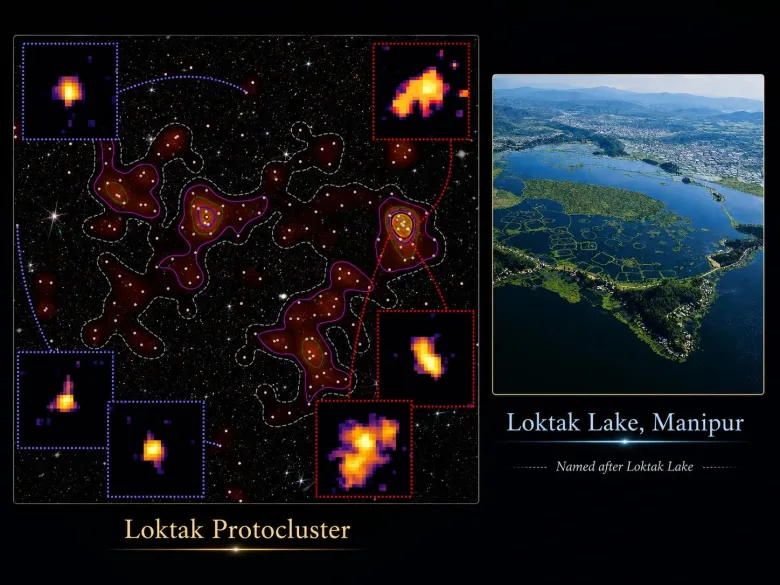
Loktak Protocluster Discovery Reveals Ancient Galaxy Structure

Loktak Protocluster Discovery has brought global attention to an important achievement in astronomy. A team of international researchers led by Manipuri astrophysicist Ronaldo Laishram has discovered an ancient galaxy structure that dates back about 12.6 billion years. Named the Loktak Protocluster, this remarkable finding offers scientists a rare glimpse into the early stages of the Universe.
The discovery is especially significant because it helps researchers understand how galaxies formed and evolved billions of years ago. By studying such ancient structures, scientists can learn more about the history of the cosmos and the forces that shaped it.

Loktak Protocluster Discovery Led by an Indian Scientist
The discovery was led by Ronaldo Laishram, a researcher at the National Astronomical Observatory of Japan. Working with an international team of astronomers, he identified a massive structure that existed when the Universe was only about 1.2 billion years old.

Today, scientists estimate that the Universe is around 13.8 billion years old. Finding a structure that formed so early in cosmic history provides valuable information about the conditions that existed shortly after the birth of the Universe.
The research has attracted attention from the scientific community because it adds new knowledge about how large-scale galaxy systems developed over time.
What Is the Loktak Protocluster?
The Loktak Protocluster is a collection of galaxies that are grouped together in the early stages of their development. Scientists call such a structure a protocluster because it is believed to grow into a much larger galaxy cluster over billions of years.
Galaxy clusters are among the largest structures in the Universe. They can contain hundreds or even thousands of galaxies connected through gravity. Studying protoclusters allows astronomers to observe how these enormous cosmic systems begin to form.
The newly discovered structure contains four connected concentrations of galaxies, making it an important example of an early galaxy assembly.
Inspiration Behind the Name Loktak Protocluster
The name of the structure comes from Loktak Lake, a famous freshwater lake in Manipur. The researchers chose this name because the arrangement of galaxies reminded them of the lake’s unique floating islands known as phumdis.
Phumdis are floating masses made up of vegetation, soil and organic matter. These natural floating formations create interconnected patterns across the surface of Loktak Lake.
Scientists noticed a similar pattern in the newly discovered protocluster. The galaxies appeared connected in a way that resembled the linked phumdis of the lake, making the name both meaningful and culturally significant.
Advanced Telescopes Made the Discovery Possible
The Loktak Protocluster Discovery was made possible through observations from some of the world’s most advanced astronomical instruments.
Researchers used data collected by the Subaru Telescope, an 8.2-meter optical and infrared telescope located in Hawaii. This telescope is known for its ability to observe distant galaxies and deep-space objects with great precision.
The team also used information from the James Webb Space Telescope, one of the most powerful space observatories ever built. Launched in 2021, the telescope specializes in infrared observations and allows scientists to see objects that formed in the early Universe.
By combining observations from both telescopes, researchers were able to identify and study the ancient galaxy structure in remarkable detail.
Loktak Protocluster Discovery and the Early Universe
One of the most exciting aspects of this discovery is its connection to the early Universe. Because light takes billions of years to travel across space, looking at distant galaxies is similar to looking back in time.

The galaxies within the Loktak Protocluster are seen as they existed around 12.6 billion years ago. This period represents a time when galaxies were still forming and evolving.
Scientists believe that galaxies in crowded environments often develop differently from galaxies that are more isolated. Factors such as gravity, gas supply and interactions with nearby galaxies can strongly influence their growth.
The Loktak Protocluster provides a valuable opportunity to study these processes and understand how galaxy clusters began to emerge during the Universe’s early years.
Importance of the Loktak Protocluster Discovery
The discovery adds a significant new structure to the growing list of known ancient galaxy systems. Every new protocluster found by astronomers helps improve scientific understanding of cosmic evolution.
Researchers hope that continued observations will reveal more details about the galaxies within the protocluster and how they interact with one another. These studies may help answer important questions about the formation of stars, galaxies and large-scale cosmic structures.
The finding also highlights the contribution of Indian scientists to global space research. Ronaldo Laishram’s leadership in this international project has brought recognition to both Indian astronomy and the scientific significance of Manipur’s famous Loktak Lake.
The research findings were published in The Astrophysical Journal Letters, adding another important chapter to the study of the Universe’s earliest structures.