




Basel Norms: International Banking Rules Explained Simply

Basel Norms are international banking rules made to keep banks safe and stable. These rules help banks manage risks and protect people’s money. They are created by the Basel Committee on Banking Supervision (BCBS) to improve banking systems around the world. The main goal of Basel Norms is to reduce the chances of bank failure and financial crises.
Thank you for reading this post, don't forget to subscribe!What are Basel Norms?
Basel Norms, also called Basel Accords, are a set of banking regulations followed by many countries. These rules tell banks how much capital they must keep as safety reserves against possible losses.
Banks accept money from people as deposits and also raise money from markets through shares and bonds. Then they lend this money to businesses and individuals. But every loan carries some risk because borrowers may fail to repay. If too many borrowers do not repay, the bank can face serious losses.
To protect banks from such risks, Basel Norms require them to keep a certain amount of extra capital. This acts like a safety cushion during difficult times.
In simple words, Basel Norms help ensure that banks stay strong even during financial stress.
What is the Basel Committee on Banking Supervision?
The Basel Committee on Banking Supervision (BCBS) is the main global organization that creates banking standards.
It was formed in 1974 by the central bank governors of the Group of Ten (G10) countries. Its purpose is to improve banking supervision and create common rules for banks across countries.

Today, the committee has 45 members from 28 jurisdictions, including central banks and banking regulators.
The committee provides a platform where countries discuss important banking issues and work together to improve financial safety worldwide.
Why is it Called Basel?
The name “Basel” comes from Basel, a city in Switzerland.
Basel is home to the Bank for International Settlements (BIS), which supports cooperation among central banks. BIS works to maintain global financial stability.
The Basel Committee operates from BIS headquarters in Basel, which is why these banking rules are called Basel Norms.
Why Are Basel Norms Important?
Banks face different types of risks while lending money. Some common risks include:
- Credit Risk – Borrower fails to repay loan
- Market Risk – Loss due to changes in market prices
- Operational Risk – Loss due to system failure, fraud, or human error
If banks do not manage these risks properly, they may collapse. This can affect millions of people who keep their savings in banks.
Basel Norms help by ensuring banks:
- Keep enough capital
- Manage risks properly
- Maintain liquidity
- Avoid financial collapse
These rules improve trust in the banking system.
Different Basel Norms
The Basel Committee has introduced three major frameworks:
- Basel I
- Basel II
- Basel III
Let us understand each one.
Basel I
Basel I was introduced in 1988.
This was the first international banking regulation focused mainly on credit risk.
Credit risk means the possibility that a borrower may fail to repay a loan. If this happens, the bank loses money.
Basel I introduced the idea of Risk Weighted Assets (RWA).
Different loans carry different levels of risk. For example:
| Loan Type | Risk Level |
|---|---|
| Home loan with collateral | Low |
| Personal loan without security | High |
| Government bonds | Very low |
Basel I required banks to maintain minimum capital equal to 8% of Risk Weighted Assets.
This means if a bank has risky loans worth ₹100 crore, it must keep at least ₹8 crore as reserve capital.
India adopted Basel I in 1999.
Basel II
Basel II was introduced in 2004.
It improved Basel I by making risk management more advanced. Basel II was based on three pillars.
Pillar 1: Minimum Capital Requirement
Banks must maintain minimum capital equal to 8% of risk-weighted assets.
This ensures banks can absorb losses.
Pillar 2: Supervisory Review
Regulators monitor banks to ensure they properly manage risks.
Banks must improve systems for managing:
- Credit risk
- Market risk
- Operational risk
Pillar 3: Market Discipline
Banks must disclose important financial information such as:
- Capital Adequacy Ratio (CAR)
- Risk exposure
- Financial health
This improves transparency.
Basel II encouraged banks to become more responsible and improve risk management.
Basel III
Basel III was introduced in 2010 after the Global Financial Crisis.
The 2008 crisis showed that many banks in developed countries were:

- Under-capitalized
- Over-leveraged
- Dependent on short-term funding
This made the financial system weak.
Basel III was created to make banks stronger.
It focuses on four major areas:
- Capital
- Leverage
- Funding
- Liquidity
Capital Requirements in Basel III
Under Basel III, banks need stronger capital reserves.
Important requirements include:
| Capital Type | Requirement |
| Tier 1 Capital | 10.5% |
| Tier 2 Capital | 2% |
| Capital Conservation Buffer | 2.5% |
The total capital adequacy requirement is around 12.9%.
This ensures banks have enough money to survive losses.
Leverage Ratio
Basel III introduced the Leverage Ratio.
Leverage ratio compares a bank’s core capital with its total assets.
The minimum leverage ratio must be 3%.
This prevents banks from taking excessive debt.
Liquidity Rules Under Basel III
Liquidity means how easily a bank can meet short-term cash needs.
Basel III introduced two important liquidity measures.
1. Liquidity Coverage Ratio (LCR)
LCR requires banks to hold enough high-quality liquid assets to survive 30 days of stress.
This protects banks during sudden cash withdrawals.
Purpose:
- Prevent bank runs
- Maintain short-term stability
2. Net Stable Funding Ratio (NSFR)
NSFR ensures banks use stable funding sources for long-term operations.
Minimum NSFR requirement is 100%.
Difference:
| Ratio | Time Period |
| LCR | 30 Days |
| NSFR | 1 Year |
LCR protects short-term liquidity, while NSFR ensures long-term stability.
What is a Bank Run?
A bank run happens when many customers rush to withdraw money from a bank at the same time.
This usually happens when people fear the bank may fail.
When too many people withdraw money together, the bank may run out of cash.
This increases the chance of collapse.
Basel III helps reduce such situations by improving liquidity management.
Countercyclical Capital Buffer (CCCB)
The Countercyclical Capital Buffer (CCCB) is an additional capital reserve.
Its purpose is to help banks during economic downturns.
How it works:
- During good economic times, banks keep extra capital
- During bad times, this extra capital can be used to absorb losses
This helps banks continue lending even during recessions.
The Reserve Bank of India (RBI) proposed CCCB in 2015 as part of Basel III. However, the buffer requirement has remained at 0% in India so far.
RBI decides this based on indicators such as:
- Credit growth
- GDP trends
- Bad loans (GNPA)
- Industry outlook
Tier 1 Capital vs Tier 2 Capital
Banks mainly maintain two types of capital.
Tier 1 Capital
Tier 1 is the strongest form of capital.
It includes:
- Equity capital
- Retained earnings
- Disclosed reserves
This capital helps banks absorb losses without stopping operations.
Example: If a bank suffers sudden losses, Tier 1 capital acts as the first protection layer.
Tier 2 Capital
Tier 2 is supplementary capital.
It includes:
- Undisclosed reserves
- Revaluation reserves
- Subordinated debt
Tier 2 capital is considered less reliable than Tier 1 because it is harder to convert into cash quickly.
Basel Norms in India
India follows Basel banking regulations through the Reserve Bank of India.
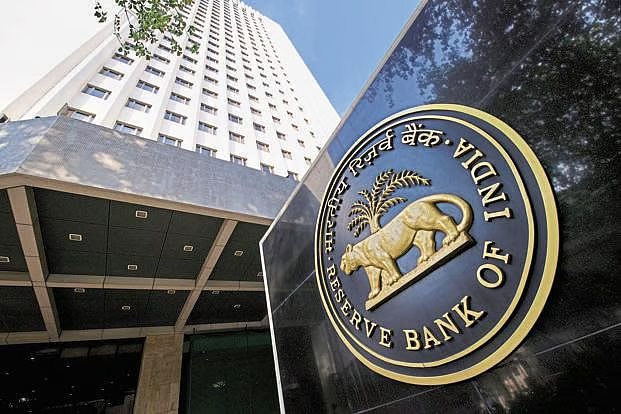
Indian banks have gradually adopted:
- Basel I
- Basel II
- Basel III
The Basel III implementation deadline in India was initially March 2019, later extended to March 2020.
Due to the COVID-19 Pandemic, RBI gave additional time for implementation.
This reduced pressure on banks because they needed extra capital to deal with rising Non-Performing Assets (NPAs).
Basel Norms continue to play a major role in strengthening India’s banking sector.
Why Basel Norms Matter Today
In today’s economy, banks are deeply connected to businesses, industries, and households. A weak banking system can damage the entire economy.
Basel Norms help by:
- Reducing banking risks
- Increasing financial stability
- Protecting depositors
- Preventing financial crises
- Improving trust in banks
Because of these benefits, Basel Norms remain one of the most important global banking regulations.
FAQs
Q1. What are Basel Norms?
Basel Norms are international banking rules created to make banks stronger and safer by ensuring they maintain enough capital to handle financial risks.
Q2. Who created Basel Norms?
Basel Norms were created by the Basel Committee on Banking Supervision (BCBS), an international body that sets banking standards.
Q3. Why are Basel Norms important?
Basel Norms help reduce banking risks, protect depositors’ money, and prevent financial crises by improving the strength of banks.
Q4. How many Basel Norms are there?
There are three major Basel frameworks:
- Basel I
- Basel II
- Basel III
Q5. What is Basel I?
Basel I was introduced in 1988 and focused mainly on credit risk. It required banks to maintain minimum capital equal to 8% of risk-weighted assets.
Q6. What is Basel II?
Basel II was introduced in 2004 and improved risk management using three pillars: capital requirement, supervisory review, and market discipline.
Q7. Why was Basel III introduced?
Basel III was introduced in 2010 after the Global Financial Crisis to make banks more resilient against economic shocks.
Q8. What is Tier 1 Capital?
Tier 1 Capital is a bank’s core capital, including equity and reserves, used to absorb losses during financial stress.