




Credit Rating in India: Meaning, Importance, Challenges and Recent Reforms

Credit Rating in India plays an important role in the financial system. It helps investors, banks, and other lenders understand whether a company, individual, or government can repay borrowed money on time. Credit ratings act as a guide for making investment and lending decisions. In India, credit rating agencies evaluate the financial strength of borrowers and assign ratings based on their ability to meet debt obligations.
In recent years, concerns about the reliability of credit ratings have increased. Cases such as the crisis involving Infrastructure Leasing & Financial Services raised questions about the effectiveness of credit rating agencies because the company had received a high rating shortly before facing financial difficulties. This led regulators to review the functioning of credit rating agencies and introduce stricter guidelines.

What is Credit Rating?
A credit rating is an assessment of the ability of a borrower to repay debt and fulfill financial obligations on time. It reflects the level of risk associated with lending money to a particular borrower.
A credit rating can be assigned to:
- Individuals
- Companies
- Financial institutions
- State governments
- Central governments
Higher ratings indicate lower risk, while lower ratings suggest a higher possibility of default.
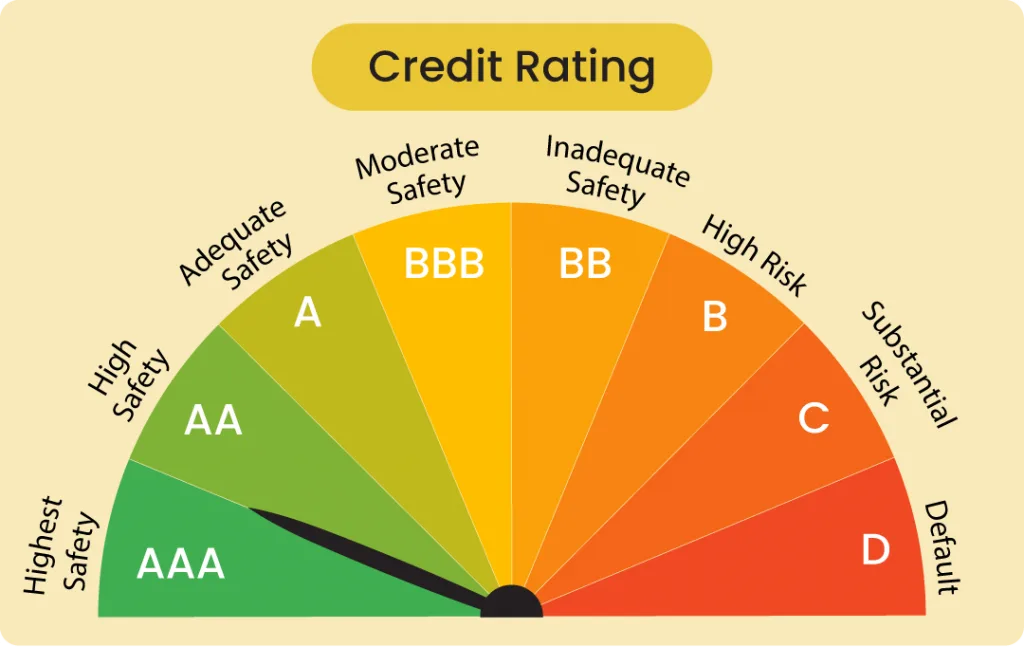
Example of Credit Ratings
| Rating | Meaning |
|---|---|
| AAA | Highest level of safety and very low risk |
| AA | High degree of safety |
| A | Adequate safety |
| BBB | Moderate safety |
| BB and Below | Higher risk of default |
| D | Default or failure to repay debt |
A company with an AAA rating is generally considered more reliable than a company with a BBB rating.
What are Credit Rating Agencies?
Credit Rating Agencies (CRAs) are organizations that evaluate the financial condition of borrowers and assign ratings to their debt instruments.
Their main objective is to provide an independent opinion regarding the creditworthiness of borrowers and the likelihood of repayment.
Major Credit Rating Agencies in India
The following credit rating agencies are registered with Securities and Exchange Board of India:
| Credit Rating Agency | Main Function |
|---|---|
| CRISIL | Credit ratings and financial research |
| ICRA | Risk assessment and ratings |
| CARE Ratings | Credit and risk analysis |
| SMERA | Ratings for small and medium enterprises |
| Fitch Ratings India | Credit and market analysis |
| Brickwork Ratings | Credit evaluation services |
These agencies study financial statements, business performance, management quality, market conditions, and future risks before assigning ratings.
How Do Credit Rating Agencies Work?
Credit rating agencies use both qualitative and quantitative analysis.
Quantitative Analysis
This includes:
- Revenue and profits
- Debt levels
- Cash flow position
- Liquidity status
- Financial ratios
Qualitative Analysis
This includes:
- Quality of management
- Industry position
- Business strategy
- Market competition
- Regulatory environment
After studying these factors, the agency assigns a rating that indicates the probability of repayment and default risk.
Importance of Credit Rating in India
Credit ratings benefit both lenders and borrowers.
Benefits for Lenders and Investors
1. Better Investment Decisions
Credit ratings help investors understand the risk associated with investing in bonds, debentures, and other financial instruments.
2. Risk Assessment
Investors can compare different investment opportunities and choose those that match their risk appetite.
3. Increased Safety
Higher-rated instruments provide greater confidence regarding timely repayment of principal and interest.
4. Efficient Allocation of Funds
Credit ratings help channel investments toward financially sound companies.
Benefits for Borrowers
1. Easier Loan Approval
Companies and individuals with strong credit ratings can obtain loans more easily from banks and financial institutions.
2. Lower Borrowing Cost
A better rating often allows borrowers to secure funds at lower interest rates.
3. Improved Reputation
A high credit rating increases confidence among investors, lenders, and business partners.
4. Access to Capital Markets
Companies with strong ratings can raise funds through bonds and debt instruments more easily.
Role of Credit Ratings in Economic Development
Credit ratings contribute significantly to the growth of the financial system.
Key Contributions
- Promote financial discipline among borrowers.
- Improve transparency in financial markets.
- Help investors make informed decisions.
- Encourage efficient use of capital.
- Support innovation in financial products.
- Strengthen confidence in debt markets.
A well-functioning credit rating system is essential for economic stability and investment growth.
Major Challenges of Credit Rating in India
Despite their importance, credit rating agencies face several challenges.
1. Lack of Uniformity
Different agencies may assign different ratings to the same company or financial instrument.
This creates confusion among investors and makes comparison difficult.
2. Lack of Standardized Fee Structure
There is no completely uniform fee structure across rating agencies. This may lead to inconsistencies in services and methodologies.
3. Limited Transparency
Many investors do not fully understand how ratings are determined.
Greater transparency in rating models is necessary to improve trust.
4. Reliability Concerns
Some highly rated companies have faced financial problems despite receiving favorable ratings.
This has raised doubts about the accuracy and effectiveness of credit assessments.
5. Conflict of Interest
One of the most significant issues is the “issuer-pays model.”
Under this model, the company seeking a rating pays the rating agency for its services.
This may create a conflict of interest because agencies could feel pressure to provide favorable ratings to retain clients.
6. Rate Shopping
Companies sometimes approach multiple agencies and choose the one that provides the most favorable rating.
This practice can reduce the objectivity of ratings.
7. Limited Competition
High entry barriers make it difficult for new rating agencies to enter the market.
As a result, competition remains limited.
8. Lack of Accountability
A common question often raised is:
“Who will rate the rating agencies?”
Currently, there are limited mechanisms to hold rating agencies directly accountable when major rating failures occur.
The IL&FS Crisis and Credit Rating Concerns
The financial crisis involving Infrastructure Leasing & Financial Services became a major turning point in India’s credit rating sector.
The company had received high ratings shortly before it started facing repayment issues.
This incident highlighted:
- Weaknesses in rating methodologies
- Delayed response to changing financial conditions
- Need for stronger monitoring systems
- Greater accountability of rating agencies
As a result, regulators initiated reforms to strengthen the credit rating framework.
Recent Regulatory Reforms by SEBI
To improve the quality and reliability of ratings, Securities and Exchange Board of India introduced several measures.
Monitoring Liquidity Conditions
Credit rating agencies must now closely examine:
- Cash flow position
- Liquidity levels
- Debt repayment schedules
- Asset-liability mismatches
Disclosure of External Support
Agencies must disclose whether a company relies on support from:
- Parent companies
- Business groups
- Government entities
for meeting debt obligations.
Focus on Future Risks
Ratings should not rely only on historical performance.
Agencies must also assess:
- Current market conditions
- Emerging financial risks
- Future business prospects
Improved Transparency
SEBI has encouraged agencies to provide more detailed explanations of rating decisions and methodologies.
Measures Needed to Strengthen Credit Ratings
Several reforms can further improve the system.
Separate Advisory and Rating Functions
Credit rating agencies should avoid providing advisory services to companies they rate.
This will reduce conflicts of interest.
Fixed Fee Structure
A standardized fee structure can reduce unhealthy competition based on pricing and encourage competition based on quality.
Stronger Surveillance Mechanisms
Continuous monitoring of rated entities is necessary to identify financial stress early.
Increased Accountability
Regulators can impose penalties or restrictions on agencies that repeatedly fail to identify risks.
Better Disclosure Standards
Investors should receive clear information about:
- Rating assumptions
- Risks involved
- Methodologies used
Encouraging Competition
More competition among rating agencies can improve quality and innovation.
Future of Credit Rating in India
The Indian financial market is expanding rapidly, and the role of credit ratings is becoming increasingly important.
Modern rating systems are expected to:
- Use advanced data analytics
- Monitor risks in real time
- Improve transparency
- Strengthen investor confidence
- Enhance market stability
With stronger regulations and better accountability, credit rating agencies can play a more effective role in supporting India’s economic growth and financial development.
FAQs on Credit Rating in India
1. What is a credit rating?
A credit rating is an assessment of a borrower’s ability to repay debt and meet financial obligations on time.
2. Who provides credit ratings in India?
Credit ratings are provided by registered credit rating agencies such as CRISIL, ICRA, CARE Ratings, SMERA, Fitch Ratings India, and Brickwork Ratings.
3. What does AAA rating mean?
AAA is the highest credit rating and indicates the strongest capacity to repay debt with very low risk.
4. Why are credit ratings important?
They help investors and lenders assess risk, make informed decisions, and allocate funds efficiently.
5. What is the issuer-pays model?
Under the issuer-pays model, the borrower or company seeking a rating pays the credit rating agency for its services.
6. What problems exist in the credit rating system?
Major issues include conflicts of interest, lack of transparency, rate shopping, limited competition, and accountability concerns.
7. Which regulator oversees credit rating agencies in India?
The Securities and Exchange Board of India (SEBI) regulates credit rating agencies in India.
8. How did the IL&FS crisis impact credit ratings?
The crisis raised concerns about rating accuracy and led to stricter regulations and monitoring requirements for rating agencies.