Unemployment in India: Causes, Types, Effects and Solutions

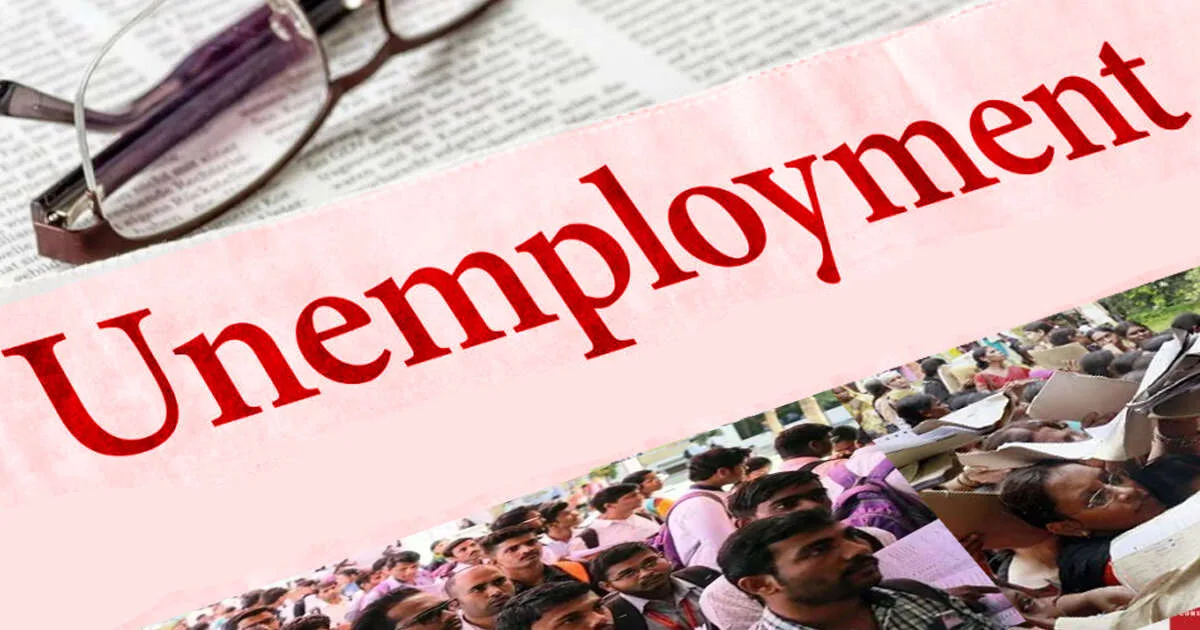
Unemployment in India is one of the biggest socio-economic challenges facing the country today. India has a large population and a growing workforce, but the availability of quality jobs has not increased at the same pace. As a result, many people who are willing and able to work are unable to find suitable employment. Unemployment not only affects individuals and families but also slows down the overall growth of the nation.
According to various employment surveys, unemployment remains a major concern, especially among young people and educated job seekers. While the government has introduced several schemes to create employment opportunities, the issue still requires long-term planning and effective implementation.

What is Unemployment?
Unemployment refers to a situation where a person is willing to work, actively searching for a job, but cannot find employment. It is an important indicator of a country’s economic health.
The unemployment rate is calculated using the following formula:
A high unemployment rate generally indicates economic problems, while a lower rate suggests better employment opportunities and economic stability.
Understanding the Labour Force
The labour force includes:
- People who are employed and engaged in economic activities.
- People who are unemployed but actively looking for work.
People who are neither working nor seeking work are not considered part of the labour force.
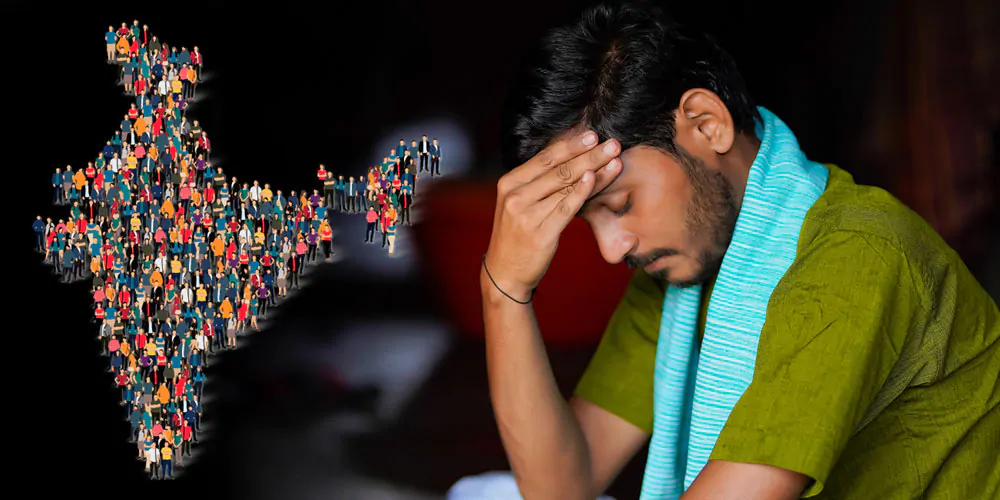
Types of Unemployment in India
India experiences different forms of unemployment due to its diverse economy and population structure.
1. Disguised Unemployment
Disguised unemployment occurs when more people are engaged in a job than actually required.
For example, if five people can complete agricultural work but eight people are working on the same land, the extra three workers are considered disguised unemployed.
This type is commonly seen in agriculture and informal sectors.
2. Seasonal Unemployment
Seasonal unemployment happens when people get work only during specific seasons.
Agricultural workers often face this problem because farming activities are limited to particular periods of the year. During the off-season, many workers remain unemployed.
3. Structural Unemployment
Structural unemployment occurs when the skills possessed by workers do not match the skills required by employers.
Many educated youth remain unemployed because industries demand specialized technical skills that they do not possess.
4. Cyclical Unemployment
This type of unemployment is linked to economic cycles.
During economic slowdowns or recessions, businesses reduce production and may lay off workers. Employment generally improves when the economy recovers.
5. Technological Unemployment
Technological unemployment occurs when machines, automation, or advanced technology replace human labour.
For example, automated manufacturing systems can reduce the need for manual workers.
6. Frictional Unemployment
Frictional unemployment is temporary unemployment that occurs when a person leaves one job and searches for another.
It is a normal part of the job market and usually lasts for a short period.
7. Vulnerable Employment
Many people in India work without formal contracts, social security benefits, or legal protection.
Although they may be working, their jobs are unstable and often not officially recorded. Such employment is known as vulnerable employment.
How is Unemployment Measured in India?
The National Sample Survey Office (NSSO) measures unemployment using different methods.
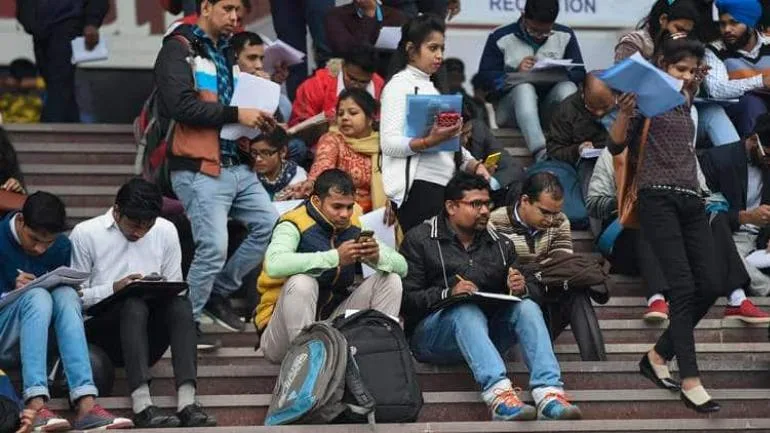
Usual Status Approach
This method considers a person unemployed if they did not have gainful work for a major part of the previous 365 days.
Weekly Status Approach
A person is considered unemployed if they did not work even for one hour during the week before the survey.
Daily Status Approach
This method measures employment status on a daily basis. If a person does not get work for even one hour in a day, they are considered unemployed for that day.
Major Causes of Unemployment in India
Lack of Education and Skills
One of the biggest reasons for unemployment is the lack of proper education and skill training. Many workers do not have the qualifications required by modern industries.
Rapid Population Growth
India’s population continues to grow rapidly. Every year millions of young people enter the labour market, creating pressure on available jobs.
Dependence on Agriculture
A large section of India’s population depends on agriculture for livelihood. Since agriculture often provides seasonal work, many workers remain unemployed during certain months.
Decline of Cottage and Small Industries
Traditional industries such as handicrafts and small-scale manufacturing have faced challenges from large-scale industrial production and global competition.
As these industries decline, employment opportunities decrease.
Low Labour Mobility
Many people prefer to stay close to their families and hometowns. Language differences, cultural factors, and living conditions often discourage workers from moving to areas where jobs are available.
Weaknesses in the Education System
Many educational institutions focus more on theoretical knowledge than practical skills. As a result, graduates often find it difficult to meet industry requirements.
Economic Slowdowns
When economic growth slows, companies reduce hiring and investment. This leads to fewer employment opportunities.
Effects of Unemployment
Unemployment affects individuals, families, and society in several ways.
Increase in Poverty
Without a stable income, families struggle to meet their basic needs such as food, education, and healthcare.
Rise in Crime
Long periods of unemployment may push some individuals toward illegal activities to earn money.
Social Problems
Unemployment can lead to frustration, stress, and social unrest. It can weaken confidence in social and democratic institutions.
Health Issues
Prolonged unemployment often causes mental stress, anxiety, depression, and other health-related problems.
Economic Loss
Unemployed workers cannot contribute fully to economic production. As a result, national income and economic growth are affected.
Wastage of Human Resources
Educated and skilled individuals who remain unemployed represent a loss of valuable human resources for the country.
Government Initiatives to Reduce Unemployment
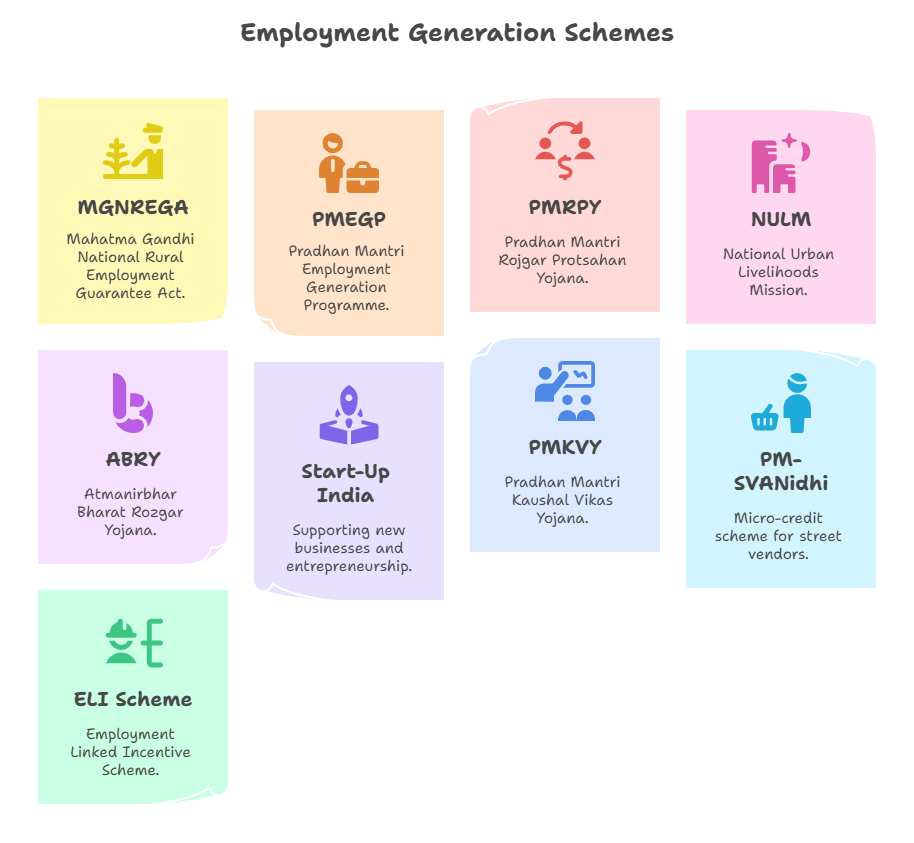
The Government of India has launched several schemes to create employment opportunities and improve skills.
Integrated Rural Development Programme (IRDP)
Launched to create employment opportunities and improve living standards in rural areas.
Training of Rural Youth for Self-Employment (TRYSEM)
This program focused on providing vocational skills to unemployed rural youth.
RSETI and RUDSETI
These institutions provide training for self-employment and entrepreneurship development among rural youth.
Jawahar Rozgar Yojana (JRY)
The scheme aimed to generate wage employment in rural areas through public works projects.
Mahatma Gandhi National Rural Employment Guarantee Act (MGNREGA)
MGNREGA guarantees at least 100 days of wage employment annually to rural households willing to do unskilled work.
Pradhan Mantri Kaushal Vikas Yojana (PMKVY)
This scheme provides industry-relevant skill training to youth, helping them improve their employability.
Start-up India
The Start-up India initiative promotes entrepreneurship and supports innovative business ideas through funding and policy support.
PM-DAKSH
This program focuses on skill development for marginalized communities and economically weaker sections.
SMILE Scheme
The Support for Marginalized Individuals for Livelihood and Enterprise (SMILE) scheme helps vulnerable groups improve their livelihoods through training and employment opportunities.
Solutions to Reduce Unemployment in India
Promote Labour-Intensive Industries
Industries such as textiles, food processing, leather, and handicrafts can create large numbers of jobs.
Improve Skill Development
Training programs should focus on practical and industry-relevant skills.

Strengthen Entrepreneurship
Young people should be encouraged to start businesses through easier access to loans, training, and mentorship.
Develop Rural Areas
Creating industries and infrastructure in rural regions can reduce migration and generate local employment.
Increase Women’s Participation
Removing social and workplace barriers can help more women join the workforce.
Reform the Education System
Educational institutions should align their courses with modern industry requirements.
Support Small and Medium Enterprises (SMEs)
SMEs play a major role in job creation and should receive financial and policy support.
Implement Employment Policies Effectively
Programs such as Skill India, Make in India, Start-up India, and Stand-Up India need strong implementation and regular monitoring.
Create a National Employment Policy
A comprehensive employment policy can help coordinate efforts across education, industry, and labour sectors to generate sustainable employment opportunities.
The Importance of Employment for India’s Future
India has one of the world’s youngest populations. This demographic advantage can become a major strength if enough jobs are created. Skilled and employed youth can drive economic growth, innovation, and social development.
However, if unemployment remains high, it may lead to economic challenges and social problems. Therefore, creating employment opportunities, improving education, and strengthening skill development must remain national priorities.
FAQs on Unemployment in India
1. What is unemployment?
Unemployment is a situation in which a person willing and able to work cannot find a suitable job.
2. What are the main types of unemployment in India?
The major types are disguised, seasonal, structural, cyclical, technological, frictional, and vulnerable unemployment.
3. Why is unemployment a major problem in India?
Rapid population growth, lack of skills, dependence on agriculture, and limited job opportunities make unemployment a major challenge.
4. What is disguised unemployment?
It occurs when more people are employed in a job than actually required for the work.
5. How does unemployment affect the economy?
It reduces production, lowers income levels, increases poverty, and slows economic growth.
6. What is MGNREGA?
MGNREGA is a government scheme that guarantees 100 days of wage employment annually to rural households.
7. How can skill development reduce unemployment?
Skill development improves employability by providing industry-relevant training and practical knowledge.
8. What role does entrepreneurship play in reducing unemployment?
Entrepreneurship creates new businesses and generates employment opportunities for others.