




Industrial Corridors in India: Meaning, Importance, Benefits and Challenges

Industrial Corridors in India are becoming one of the most important parts of the country’s development strategy. The Government of India has approved several major industrial corridor projects to boost manufacturing, improve infrastructure, create jobs, and support planned urban growth. These projects are being developed through the National Industrial Corridor Development and Implementation Trust (NICDIT).
Industrial corridors are designed to connect industries with modern transport systems like roads, railways, ports, and airports. This helps industries move goods faster and at lower cost. As a result, businesses become more productive and competitive in both Indian and global markets.

What is an Industrial Corridor?
An industrial corridor is a large area where industries are developed along a major transport route such as a highway, railway, or freight corridor. It acts like a backbone for economic activity.
Goods produced in factories are transported through railways and roads connected to this corridor. Industries located within around 100–150 km of the corridor can easily access transport services through feeder roads and rail links. This improves last-mile connectivity.
The main goal of an industrial corridor is to reduce logistics costs and improve industrial efficiency. When transport becomes faster and cheaper, companies can focus more on production and innovation.
Industrial corridors combine industrial growth with modern infrastructure, which supports both economic and social development.
Features of Industrial Corridors
Industrial corridors usually include world-class infrastructure such as:
- High-speed road and railway networks
- Modern ports with advanced cargo systems
- Airports for domestic and international connectivity
- Special economic and industrial zones
- Logistics parks and transport hubs
- Knowledge parks for research and skill development
- Industrial townships and housing projects
- Smart urban infrastructure
These facilities help industries operate smoothly and attract both Indian and foreign investments.
Why Are Industrial Corridors Important for India?
India wants to become a global manufacturing hub. To achieve this, industrial corridors play a major role.
The manufacturing sector contributes around 16% to India’s economy. The government aims to increase this share to 25% by expanding industrial activity.
Industrial corridors support this goal by:
- Increasing industrial production
- Encouraging investment
- Creating employment
- Developing smart cities
- Improving infrastructure
- Supporting exports
Smart cities are also being built near these corridors. These cities provide homes, schools, hospitals, and other facilities for workers employed in industrial sectors.
Five Major Industrial Corridors in India
The Government of India has launched five major industrial corridor projects.
1. Delhi-Mumbai Industrial Corridor (DMIC)
Delhi-Mumbai Industrial Corridor is one of India’s largest industrial projects.
It connects Delhi and Mumbai over a distance of about 1,483 km.
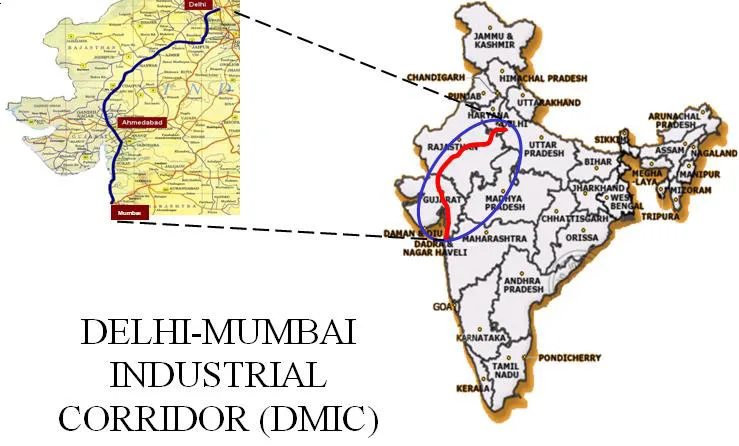
It covers the states of:
- Uttar Pradesh
- Haryana
- Rajasthan
- Madhya Pradesh
- Gujarat
- Maharashtra
This project is worth around 100 billion US dollars.
Funding comes from:
- Government of India
- Japanese loans
- Japanese companies
- Investments through financial instruments
Its main objective is to build futuristic industrial cities using the Western Dedicated Freight Corridor.
2. Chennai-Bengaluru Industrial Corridor (CBIC)
Chennai-Bengaluru Industrial Corridor connects southern India.

It covers:
- Tamil Nadu
- Andhra Pradesh
- Karnataka
The project receives support from Japan International Cooperation Agency (JICA).
This corridor aims to strengthen manufacturing and improve transport across South India.
3. Bengaluru-Mumbai Economic Corridor (BMEC)
Bengaluru-Mumbai Economic Corridor connects:
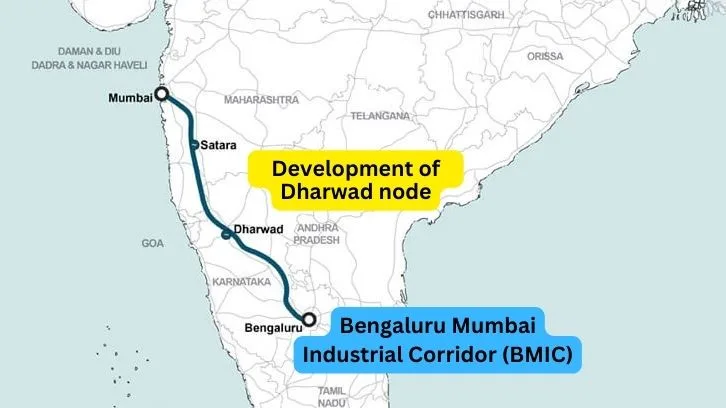
- Maharashtra
- Karnataka
This corridor is being developed with support from the United Kingdom.
Its goal is to improve economic activities between major industrial cities and attract investment into manufacturing.
4. Amritsar-Kolkata Industrial Corridor (AKIC)
Amritsar-Kolkata Industrial Corridor stretches from Amritsar to Dankuni.
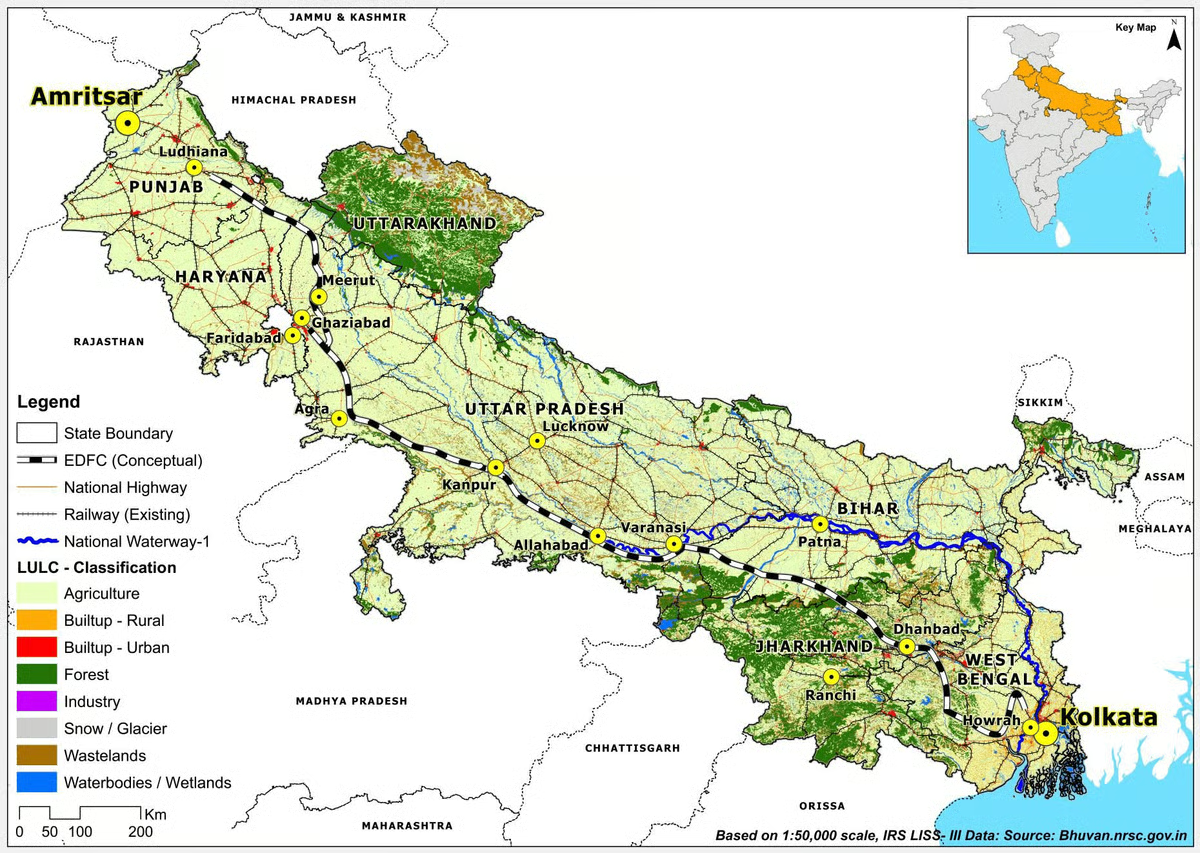
Length: 1,839 km
States covered:
- Punjab
- Haryana
- Uttarakhand
- Uttar Pradesh
- Bihar
- Jharkhand
- West Bengal
The backbone of this corridor is the Eastern Dedicated Freight Corridor.
This project is expected to transform industrial development in eastern and northern India.
5. East Coast Economic Corridor (ECEC)
East Coast Economic Corridor covers India’s eastern coast.
States included:
- West Bengal
- Odisha
- Andhra Pradesh
- Tamil Nadu
Its Phase-1 is the Vizag-Chennai Industrial Corridor (VCIC).
Vizag-Chennai Industrial Corridor is India’s first coastal economic corridor.
It covers more than 800 km of Andhra Pradesh’s coastline.
This corridor is very important for India’s Act East Policy, which aims to improve trade with Southeast Asian countries.
The Asian Development Bank (ADB) approved major funding for infrastructure development in this corridor.
Importance of Industrial Corridors in India
Economic Benefits
1. Boost to Exports
Industrial corridors reduce transportation costs. This lowers production costs for industries.
When products become cheaper to produce, Indian goods become more competitive in international markets.
This increases exports and strengthens the economy.
2. More Job Opportunities
Industrial growth creates large numbers of jobs.
People can find work near their hometowns instead of migrating to faraway cities for employment.
This reduces distress migration and improves local economies.
3. Better Logistics
Industrial corridors improve movement of goods.
Benefits include:
- Faster delivery
- Lower transport cost
- Reduced storage cost
- Better supply chain management
This improves efficiency for businesses.
4. Increased Private Investment
Industrial corridors attract private companies to invest in:
- Roads
- Warehouses
- Ports
- Power supply
- Manufacturing plants
This helps accelerate development.
Environmental Importance
Industries concentrated in one area can damage the environment.
Industrial corridors spread industries across wider regions instead of clustering them in one city.
This reduces pressure on land, water, and air in a single location.
Better planning also allows eco-friendly infrastructure and pollution control.
Social Benefits
Industrial corridors improve social development too.
Development around corridors often includes:
- Schools
- Colleges
- Hospitals
- Housing
- Markets
- Public transport
These improve people’s quality of life.
Local employment also helps families stay together and strengthens social bonds.
Challenges of Industrial Corridors
Although industrial corridors offer many benefits, they also face several challenges.
1. Land Acquisition Problems
Large industrial projects require huge amounts of land.
Acquiring land is difficult because of:
- Legal disputes
- Compensation issues
- Farmer resistance
- Delays in approvals
This slows project implementation.
2. Lack of Advanced Technology
India still depends on foreign technology in some sectors.
To compete globally, industries need:
- Automation
- Robotics
- Artificial intelligence
- Smart manufacturing systems
Foreign Direct Investment (FDI) can help bring advanced technology.
3. Tax and Policy Issues
Foreign investors need clear tax rules.
Unclear regulations create uncertainty and discourage investment.
Stable policies are necessary to attract long-term industrial investments.
4. Economic Stability
Industrial corridors need massive funding.
Investors prefer stable economic conditions such as:
- Stable currency
- Controlled inflation
- Strong banking system
Economic instability increases investment risk.
5. Displacement of People
Large industrial projects may force people to relocate.
This can affect:
- Villages
- Farmers
- Tribal communities
- Local livelihoods
Proper rehabilitation and fair compensation are necessary.
6. Loss of Agricultural Land
Many industrial projects require fertile land.
This may reduce agricultural production and affect food security.
Balanced planning is needed to protect farmland.
7. Rural-Urban Inequality
Rapid industrial growth can increase the gap between urban and rural areas.
Cities may develop faster while villages remain underdeveloped.
This can create inequality in:
- Income
- Education
- Healthcare
- Living standards
Inclusive development is essential.
National Investment and Manufacturing Zones (NIMZ)
National Investment and Manufacturing Zones (NIMZs) are an important part of India’s manufacturing policy launched in 2011.
These are large industrial zones with advanced infrastructure built to promote world-class manufacturing.
Main Objective of NIMZ
The main goals are:
- Increase manufacturing growth
- Generate employment
- Improve industrial competitiveness
- Attract domestic and foreign investment
Difference Between NIMZ and SEZ
Special Economic Zones (SEZs) mainly focus on exports.
NIMZ focuses on:
- Industrial growth
- Manufacturing expansion
- Job creation
- Partnership with state governments
NIMZs are larger and have more planned infrastructure than SEZs.
Approved NIMZ Locations in India
The Government has given approval to 14 NIMZs outside the DMIC region.
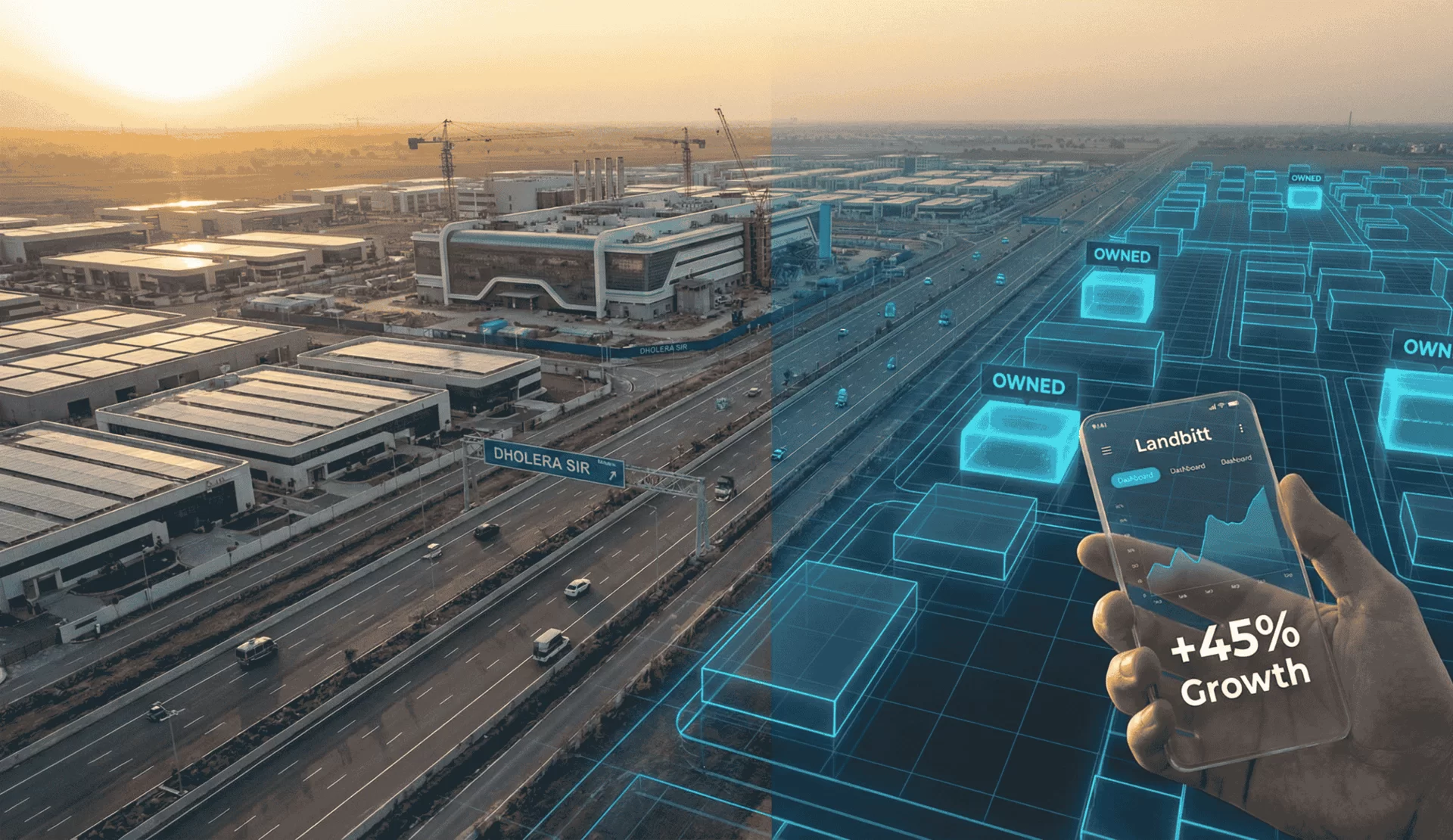
Major locations include:
- Nagpur (Maharashtra)
- Prakasam (Andhra Pradesh)
- Chittoor (Andhra Pradesh)
- Medak (Telangana)
- Hyderabad Pharma Zone (Telangana)
- Tumkur (Karnataka)
- Kolar (Karnataka)
- Bidar (Karnataka)
- Gulbarga (Karnataka)
- Kalinganagar (Odisha)
- Ramanathapuram (Tamil Nadu)
- Ponneri (Tamil Nadu)
- Auraiya (Uttar Pradesh)
- Jhansi (Uttar Pradesh)
Future of Industrial Corridors in India
Industrial corridors will play a major role in India’s future growth.
The world is entering Industry 4.0, where manufacturing is driven by advanced technologies such as:
- Smart robotics
- Artificial intelligence
- 3D printing
- Big data analytics
- Internet of Things (IoT)
India must adopt these technologies to remain competitive.
If industrial corridors are developed successfully, India can become one of the world’s leading manufacturing nations. These corridors can strengthen the economy, create millions of jobs, improve infrastructure, and accelerate overall national development.
FAQs
Q1. What are industrial corridors in India?
Industrial corridors are large areas developed along transport routes like highways and railways where industries, logistics hubs, and infrastructure are built to boost manufacturing and trade.
Q2. Why are industrial corridors important for India?
Industrial corridors help increase industrial production, reduce logistics costs, create jobs, attract investments, and support economic growth.
Q3. How many major industrial corridors are there in India?
India has five major industrial corridor projects:
- Delhi-Mumbai Industrial Corridor
- Chennai-Bengaluru Industrial Corridor
- Bengaluru-Mumbai Economic Corridor
- Amritsar-Kolkata Industrial Corridor
- East Coast Economic Corridor
Q4. What is the main objective of industrial corridors?
The main objective is to improve manufacturing, build modern infrastructure, reduce transportation costs, and increase employment opportunities.
Q5. What are the challenges of industrial corridors?
Major challenges include land acquisition issues, displacement of people, loss of agricultural land, funding needs, and environmental concerns.
Q6. What is NIMZ?
National Investment and Manufacturing Zones (NIMZ) refers to large industrial zones created under India’s manufacturing policy to promote industrial growth and job creation.
Q7. How do industrial corridors create jobs?
They attract industries and investments, leading to new factories, logistics centers, and service sectors that generate direct and indirect employment.
Q8. How do industrial corridors help exports?
By reducing transport and production costs, industrial corridors make Indian products more competitive in global markets, which boosts exports.