


Reservation in India: Understanding the Reservation System

Reservation in India is one of the most important social justice policies in the country. It was introduced to provide equal opportunities to people who have faced discrimination and social exclusion for centuries. The reservation system helps certain sections of society gain access to education, government jobs, and political representation.
Thank you for reading this post, don't forget to subscribe!India has a long history of social inequality based on caste. Many communities were denied access to education, employment, and basic rights. To address these historical injustices, the Constitution of India introduced reservation as a form of affirmative action.
Reservation is not simply about providing special privileges. Its primary aim is to create a level playing field so that disadvantaged groups can participate equally in the country’s development.
What is Reservation in India?
Reservation is a system through which a certain percentage of seats in educational institutions, government jobs, and legislative bodies are reserved for specific groups of people.
The main beneficiaries of reservation are:
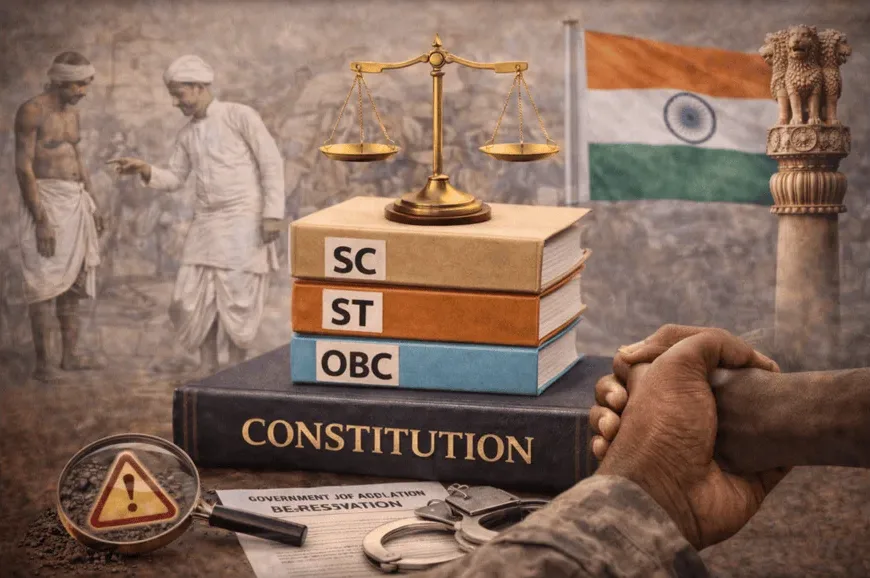
- Scheduled Castes (SCs)
- Scheduled Tribes (STs)
- Other Backward Classes (OBCs)
- Economically Weaker Sections (EWS)
The objective is to improve social equality and ensure fair representation of these groups in public life.
Historical Background of Reservation
The idea of reservation did not begin after independence. Its roots can be traced back to the nineteenth century.
Early Ideas
In 1882, social reformers like Jyotirao Phule highlighted the need to provide opportunities to backward communities. They argued that education and employment should be made accessible to all sections of society.
Communal Award of 1933
The modern reservation system began during British rule when British Prime Minister Ramsay MacDonald announced the Communal Award in 1933.
The award provided separate electorates for various communities, including:
- Muslims
- Sikhs
- Christians
- Anglo-Indians
- Dalits
Poona Pact
The Communal Award led to intense debate. After discussions between Mahatma Gandhi and Dr. B.R. Ambedkar, the Poona Pact was signed in 1932.
The agreement replaced separate electorates with reserved seats within a common electoral system.
Reservation After Independence
After India became independent in 1947, reservation was initially provided only to SCs and STs.
Later, the demand for reservation for other socially and educationally backward communities increased, leading to the formation of the Mandal Commission.
Mandal Commission and Its Impact
The Mandal Commission was established in 1978 under the chairmanship of B.P. Mandal under Article 340 of the Constitution.
Objectives of the Commission
The commission was asked to:
- Identify socially and educationally backward classes.
- Suggest measures for their development.
- Recommend policies for improving their representation in government services.
Findings
The commission estimated that OBCs formed around 52% of India’s population.
Based on this estimate, it recommended:
- 27% reservation in government jobs for OBCs.
Indicators Used
The commission developed eleven indicators based on:
- Social conditions
- Educational status
- Economic conditions
The commission also identified backward communities among non-Hindu groups such as Muslims, Christians, Sikhs, and Buddhists.
Implementation
In 1990, the government decided to implement the Mandal Commission recommendations, leading to widespread debates and protests across the country.
Indra Sawhney Case (1992)
The Indra Sawhney case is one of the most important judgments related to reservation.
The Supreme Court made several important observations:
Key Decisions
- Upheld 27% reservation for OBCs.
- Introduced the concept of the Creamy Layer.
- Ruled that total reservation should generally not exceed 50%.
- Held that reservation should normally apply to appointments and not promotions.
Creamy Layer Concept
The creamy layer refers to the economically advanced and socially better-off members within OBC communities.
The court ruled that such individuals should not receive reservation benefits because they are no longer socially disadvantaged.
Economic Reservation and the 103rd Constitutional Amendment
In 2019, the government introduced a major change through the 103rd Constitutional Amendment Act.
Main Features
- Introduced 10% reservation for Economically Weaker Sections (EWS).
- Applied to people who do not belong to SC, ST, or OBC categories.
- Reservation is based on economic criteria.
This amendment added clauses to Articles 15 and 16, allowing reservation for economically weaker individuals.
The EWS reservation is provided in addition to existing reservations.
Constitutional Provisions Related to Reservation
The Indian Constitution contains several provisions that support reservation and social justice.
Article 15(4)
Allows the State to make special provisions for socially and educationally backward classes, SCs, and STs.
Article 16(4)
Permits reservation in government employment for backward classes that are not adequately represented.
Article 16(4A)
Introduced through the 77th Constitutional Amendment Act, 1995.
It allows reservation in promotions for SCs and STs.
Article 16(4B)
Added through the 81st Constitutional Amendment Act, 2000.
It allows carrying forward unfilled reserved vacancies to future years.
Article 330 and 332
Provide reservation of seats for SCs and STs in:
- Parliament
- State Legislative Assemblies
Article 243D
Provides reservation in Panchayats.
Article 243T
Provides reservation in Municipalities.
Article 335
States that the claims of SCs and STs should be considered while maintaining administrative efficiency.
Important Supreme Court Judgments
State of Madras vs Champakam Dorairajan (1951)
This was the first major reservation case.
The Supreme Court ruled against caste-based reservation in educational institutions under the existing constitutional provisions.
As a result, the First Constitutional Amendment introduced Article 15(4).
Indra Sawhney Case (1992)
This judgment established:
- 27% OBC reservation.
- Creamy layer exclusion.
- 50% reservation ceiling.
M. Nagaraj Case (2006)
The Supreme Court upheld reservation in promotions but stated that the government must justify such reservations with adequate evidence.
Jarnail Singh Case (2018)
The Court ruled that creamy layer exclusion can apply to SCs and STs in certain cases involving promotions.
Karnataka Reservation Promotion Case (2019)
The Supreme Court upheld Karnataka’s law providing reservation in promotions for SCs and STs with consequential seniority.
Why is Reservation Needed?
Supporters of reservation believe it remains necessary for several reasons.
Correcting Historical Injustice
Many communities faced discrimination for centuries. Reservation helps compensate for these disadvantages.
Equal Opportunities
People from privileged backgrounds often have better access to education, resources, and opportunities. Reservation helps create a more equal starting point.
Better Representation
Reservation ensures participation of disadvantaged groups in:
- Government services
- Educational institutions
- Political bodies
Social Inclusion
It helps marginalized communities become active participants in economic and social development.
Promoting Equality
True equality means providing support to those who start from unequal positions.
Arguments Against Reservation
Despite its objectives, reservation remains a subject of debate.
Impact on Merit
Critics argue that reservation may reduce the importance of merit in admissions and recruitment.
Continuation of Caste Identity
Some believe that caste-based reservation keeps caste divisions alive rather than eliminating them.
Political Misuse
Reservation is sometimes used as a political tool to gain support from specific communities.
Unequal Distribution of Benefits
Often, the more advanced members within reserved categories receive most of the benefits, while the poorest remain disadvantaged.
Frustration Among Non-Reserved Groups
Economically poor individuals from non-reserved categories may feel excluded from benefits.
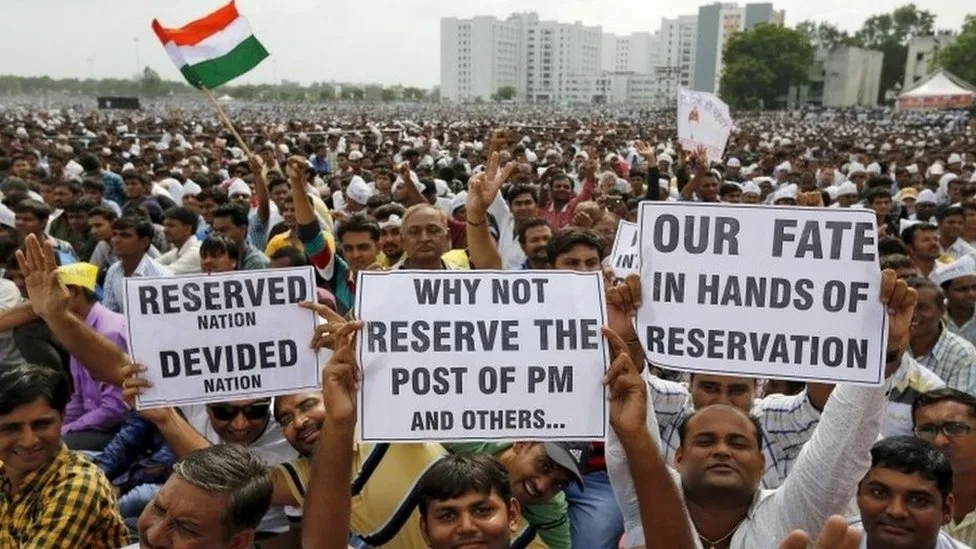
Reasons for Growing Reservation Demands
In recent years, several communities have demanded reservation.
Economic Challenges
Many people face:
- Unemployment
- Agricultural distress
- Rising living costs
Reservation is often viewed as a solution to these problems.
Fear of Losing Opportunities
Some groups believe they are losing access to government jobs and educational opportunities.
Slow Employment Growth
Limited government job creation has intensified competition, increasing demands for reservation.
Development Imbalances
Even in economically developed states, many people feel left behind and seek reservation benefits.
Challenges in the Reservation System
Although reservation has achieved many objectives, several challenges remain.
Benefits Concentrated Among a Few
The same families often continue receiving benefits generation after generation.
Lack of Awareness
Many eligible individuals do not know how to access reservation benefits.
Quality of Education
Reservation alone cannot solve problems caused by poor school education and lack of resources.
Social Tensions
The debate over reservation sometimes creates divisions among communities.
Balancing Merit and Social Justice
Finding the right balance between merit and affirmative action remains a difficult task.
Suggestions for Improvement
Strengthen Education
Quality education at the primary and secondary levels should be improved.
Exclude Advanced Sections
The creamy layer principle should be effectively implemented to ensure benefits reach the truly needy.
Focus on Economic Need
Economic conditions should also be considered while designing welfare policies.
Increase Awareness
Governments should spread awareness about reservation schemes and eligibility criteria.
Regular Review
Reservation policies should be reviewed periodically to ensure they serve their intended purpose.
Skill Development
Providing training and skill development opportunities can help disadvantaged communities become self-reliant.
Future of Reservation in India
The debate over reservation is likely to continue in the coming years. India’s challenge is to balance social justice, equality, and merit.
Reservation has played an important role in improving representation and opportunities for many marginalized communities. However, reforms may be needed to ensure that benefits reach those who genuinely require support.
The goal should not only be providing reservations but also creating conditions where every citizen has equal access to quality education, healthcare, employment, and opportunities.
Conclusion
Reservation in India is an important tool for promoting social justice and equality. It was introduced to address historical discrimination and provide opportunities to disadvantaged communities. Over the years, it has helped millions of people gain access to education, jobs, and political representation.
At the same time, challenges such as unequal distribution of benefits, political misuse, and debates over merit continue to exist. Therefore, reservation policies must be implemented carefully and reviewed regularly.
A balanced approach that combines social justice, economic support, quality education, and equal opportunities can help India build a more inclusive and fair society for future generations.
10 FAQs on Reservation in India
1. What is Reservation in India?
Reservation in India is a system that provides quotas in education, government jobs, and legislatures for socially and economically disadvantaged groups.
2. Why was the reservation system introduced in India?
It was introduced to reduce historical social inequalities and provide equal opportunities to marginalized communities.
3. Which groups receive reservation benefits in India?
Scheduled Castes (SC), Scheduled Tribes (ST), Other Backward Classes (OBC), and Economically Weaker Sections (EWS).
4. What is the Mandal Commission?
The Mandal Commission identified socially and educationally backward classes and recommended 27% reservation for OBCs.
5. What is the Creamy Layer concept?
The Creamy Layer refers to financially and socially advanced members of OBC communities who are excluded from reservation benefits.
6. What is the maximum reservation limit in India?
The Supreme Court generally fixed a 50% reservation limit, though certain exceptions and amendments exist.
7. What is the EWS reservation?
EWS reservation provides 10% quota in education and government jobs for economically weaker individuals from the unreserved category.
8. Does the Constitution support reservation?
Yes. Several constitutional provisions, including Articles 15, 16, 330, 332, 243D, and 243T, support reservation policies.
9. Is reservation available in promotions?
Reservation in promotions is available for SCs and STs under specific constitutional provisions and court guidelines.
10. What are the main criticisms of reservation?
Critics argue that it may affect meritocracy, encourage caste-based politics, and sometimes benefit the already privileged sections within reserved categories.