


Schools of Indian Philosophy: Understanding India’s Ancient Wisdom

Schools of Indian Philosophy are among the oldest systems of thought in the world. They explain important questions about life, truth, knowledge, the soul, and the universe. Indian philosophy began as a deep search to understand human existence and the meaning of life.
Thank you for reading this post, don't forget to subscribe!India has a rich tradition of philosophical thinking that developed over thousands of years. Great sages and thinkers tried to answer questions such as: Who are we? Why are we born? What happens after death? What is the path to happiness and liberation?
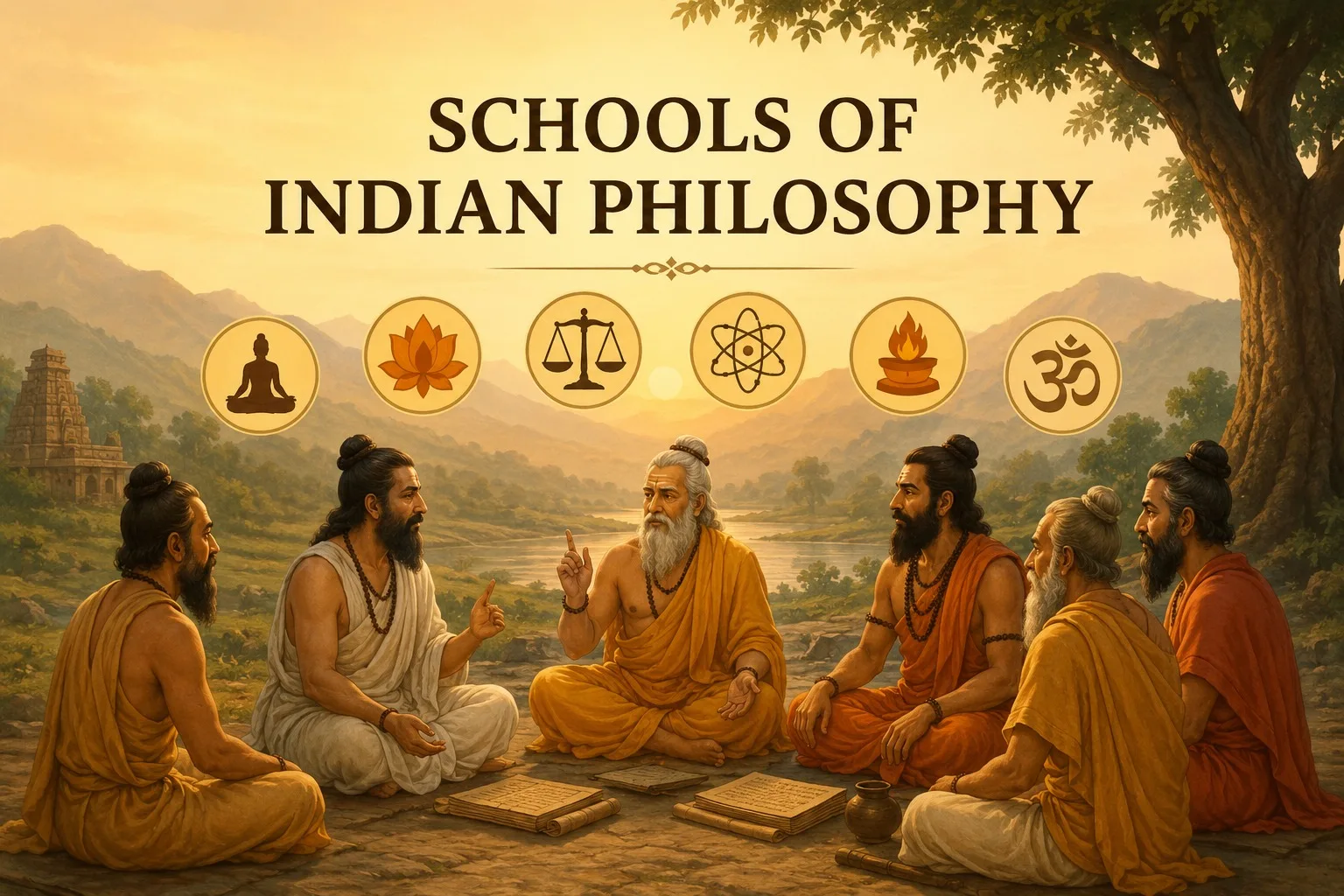
Indian philosophy is mainly divided into two groups: Orthodox (Astika) schools and Unorthodox (Nastika) schools.
The Orthodox schools accept the authority of the Vedas, while the Unorthodox schools do not accept the Vedas as the highest authority.
Orthodox Schools of Indian Philosophy
The Orthodox schools are also connected with Sanatana Dharma, which is now commonly called Hinduism. There are six major orthodox schools:
- Samkhya
- Yoga
- Nyaya
- Vaisheshika
- Purva Mimamsa
- Vedanta
These schools were developed by famous sages like Kapila, Patanjali, Gautama, Kanada, Jaimini, and Vyasa.
1. Samkhya Philosophy
Samkhya, founded by Sage Kapila, is considered one of the oldest schools of Indian philosophy.
Samkhya says that the universe is made of two main realities:
- Purusha – the soul or consciousness
- Prakriti – matter or nature
According to this philosophy, Purusha is eternal and unchanging, while Prakriti keeps changing and creates everything in the material world.
In simple words, Samkhya explains that the soul remains pure, but the physical world around us constantly changes. Human suffering happens when we fail to understand the difference between soul and matter.
2. Yoga Philosophy
Yoga, founded by Sage Patanjali, is one of the most famous Indian philosophies.
The word Yoga means “union.” It refers to the union of body, mind, and soul. Yoga teaches self-discipline and control over thoughts and senses.
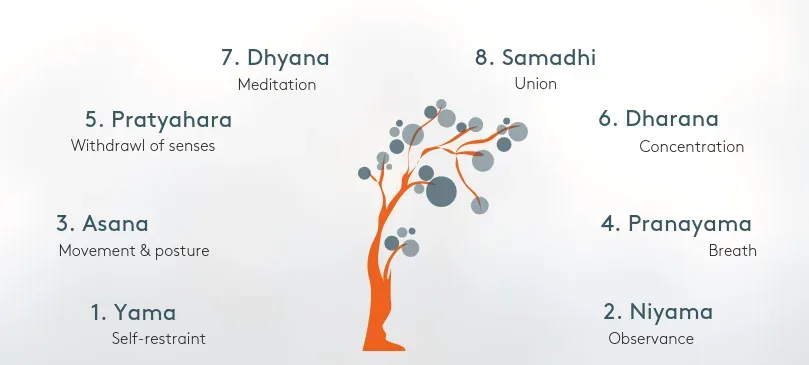
Patanjali explained eight steps of Yoga, known as Ashtanga Yoga:
- Yama – Self-control
- Niyama – Following good rules
- Asana – Physical postures
- Pranayama – Breath control
- Pratyahara – Controlling senses
- Dharana – Concentration
- Dhyana – Meditation
- Samadhi – Complete spiritual absorption
Yoga helps people achieve peace, balance, and liberation (Mukti). This philosophy also accepts the existence of God as a spiritual guide.
3. Nyaya Philosophy
Nyaya, founded by Gautama Muni, focuses on logic and reasoning.
Nyaya teaches that something should only be accepted if it is supported by reason and experience. Because of this, Nyaya is often called the school of logical thinking.
According to Nyaya, there are four ways to gain valid knowledge:
- Perception – Knowledge through senses
- Inference – Reaching conclusions through reasoning
- Comparison – Understanding by comparing things
- Verbal testimony – Learning from trusted sources
Nyaya encourages critical thinking and scientific understanding.
4. Vaisheshika Philosophy
Vaisheshika, founded by Sage Kanada, explains the physical universe.
This philosophy says that everything in the universe is made up of atoms. Long before modern science, Vaisheshika thinkers discussed atomic theory.
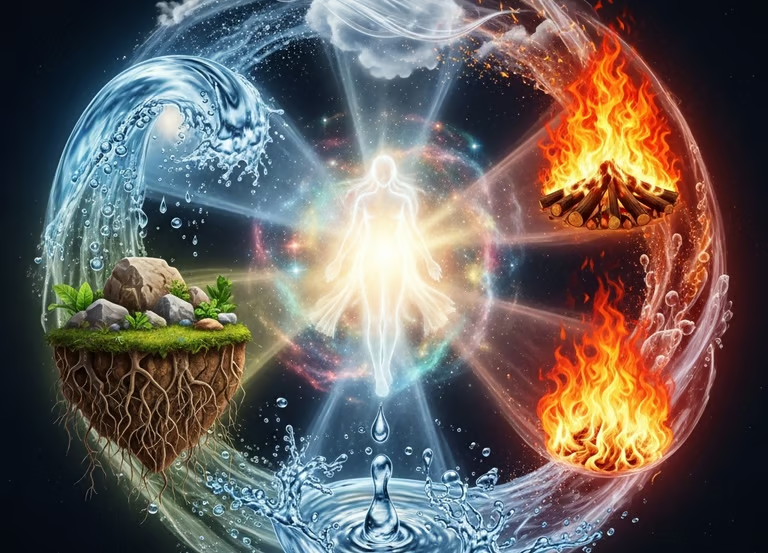
According to Vaisheshika, all objects are made from five elements:
- Earth
- Water
- Fire
- Air
- Ether (Space)
This school also explains reality through categories such as:
- Substance
- Quality
- Action
- Generality
- Particularity
- Inherence
Vaisheshika believes that God guides the universe, and every living being faces rewards or punishment according to the law of karma.
Because Vaisheshika and Nyaya had similar ideas, these two schools later became closely connected.
5. Purva Mimamsa Philosophy
Purva Mimamsa, founded by Sage Jaimini, strongly supports the authority of the Vedas.
This philosophy teaches that the Vedas are eternal and contain all knowledge needed for life.
Purva Mimamsa focuses mainly on:
- Duties
- Rituals
- Moral actions
- Dharma
According to this school, the main purpose of life is to follow Dharma, which means righteous duty.
By performing duties honestly and following Vedic teachings, a person gains merit (punya) and reaches higher spiritual states after death.
6. Vedanta Philosophy
Vedanta, also called Uttara Mimamsa, is one of the most influential schools of Indian philosophy.
It is mainly based on the Upanishads, which discuss deep spiritual truths.
Vedanta focuses on the relationship between:
- Atman (individual soul)
- Brahman (ultimate reality or universal soul)
Over time, Vedanta developed into several sub-schools.
Advaita Vedanta – Adi Shankaracharya
Advaita means “non-dual.”
It teaches that Atman and Brahman are one. The feeling of separation is caused by ignorance. Liberation comes through true knowledge.
Vishishtadvaita – Ramanuja
This philosophy says that diversity exists, but everything is part of one ultimate reality.
It teaches unity with distinction.
Dvaita – Madhvacharya
Dvaita means “dualism.”
It says Atman and Brahman are different. Devotion (Bhakti) is the path to salvation.
Dvaitadvaita – Nimbarka
This school says the soul is both different and connected to Brahman.
Shuddhadvaita – Vallabhacharya
This philosophy teaches that God and soul are essentially the same.
Achintya Bheda Abheda – Chaitanya Mahaprabhu
This school says the soul is both different and not different from Brahman at the same time.
This relationship is beyond complete human understanding.
Unorthodox Schools of Indian Philosophy
The Unorthodox (Nastika) schools do not accept the authority of the Vedas.
The major unorthodox schools are:
- Charvaka
- Buddhism
- Jainism
1. Charvaka Philosophy
Charvaka, associated with Brihaspati, is a materialistic philosophy.
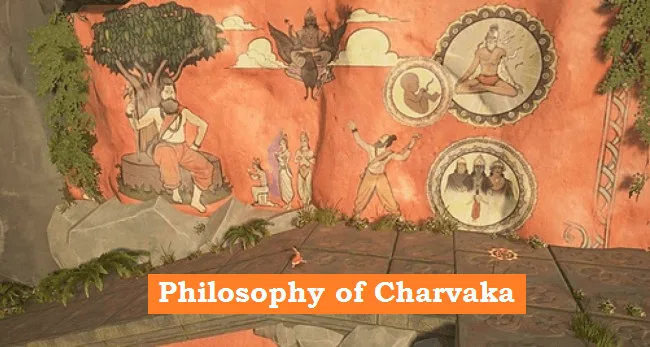
It rejects:
- God
- Soul
- Rebirth
- Afterlife
Charvaka believes that only the material world exists.
According to this philosophy:
- There is no life after death
- Pleasure is the main goal of life
- Direct perception is the only true source of knowledge
Because it focused on common life and practical experience, Charvaka is also called Lokayata, meaning “philosophy of the people.”
2. Buddhist Philosophy
Buddhist philosophy, founded by Siddhartha Gautama, focuses on ending suffering.
Buddha taught that life contains suffering caused by desire and attachment.
The main goal of Buddhism is to achieve Nirvana, a state free from suffering.
Buddha explained the Four Noble Truths and the Eightfold Path as the path to liberation.
Buddhism does not focus heavily on God. Instead, it teaches:
- Right thinking
- Right action
- Compassion
- Meditation
- Wisdom
Buddha also criticized blind faith and encouraged people to seek truth through personal understanding.
3. Jain Philosophy
Jain philosophy, taught by Mahavira, emphasizes non-violence and truth.
One important idea in Jainism is Anekantavada.
This means truth can be seen from different viewpoints. No single viewpoint gives the complete truth.
Jainism teaches important values such as:
- Ahimsa (Non-violence)
- Truth
- Self-control
- Non-attachment
According to Jain philosophy, only enlightened beings with complete knowledge can fully understand reality.
Importance of Schools of Indian Philosophy
The Schools of Indian Philosophy continue to influence Indian culture, spirituality, and moral values even today. These philosophies teach logic, discipline, duty, meditation, compassion, and self-realization.
They help us understand life from different angles and guide us toward wisdom and inner peace. Even in modern times, these ancient teachings remain valuable for building a meaningful life.
FAQs
Q1. What are the Schools of Indian Philosophy?
Schools of Indian Philosophy are ancient systems of thought that explain life, truth, knowledge, soul, and the universe.
Q2. How many orthodox schools of Indian Philosophy are there?
There are six orthodox schools of Indian Philosophy: Samkhya, Yoga, Nyaya, Vaisheshika, Purva Mimamsa, and Vedanta.
Q3. What is the difference between orthodox and unorthodox schools?
Orthodox schools accept the authority of the Vedas, while unorthodox schools do not accept the Vedas as the highest authority.
Q4. Who founded Samkhya philosophy?
Samkhya philosophy was founded by Kapila.
Q5. What is the main idea of Yoga philosophy?
Yoga philosophy teaches control of body, mind, and senses to achieve peace and liberation.
Q6. What is Nyaya philosophy known for?
Nyaya philosophy is known for logic, reasoning, and scientific thinking.
Q7. What are the major unorthodox schools of Indian Philosophy?
The major unorthodox schools are Charvaka, Buddhism, and Jainism.
Q8. Who founded Buddhism?
Buddhism was founded by Siddhartha Gautama.
Q9. What is Anekantavada in Jainism?
Anekantavada means truth can be understood from different viewpoints, and no single view is completely true.
Q10. Why are Schools of Indian Philosophy important today?
They help people understand ethics, spirituality, self-discipline, and the deeper meaning of life.