


Universal Basic Income: A New Approach to Social Welfare in India

Universal Basic Income (UBI) is one of the most discussed social welfare ideas in the modern world. It proposes that every citizen should receive a fixed amount of money from the government regularly without any conditions. The main goal is to ensure that every person has enough income to meet basic needs and live with dignity.
In a country like India, where poverty, unemployment, and income inequality remain major challenges, the idea of Universal Basic Income has gained significant attention. Economists, policymakers, and social activists have debated whether UBI can become an effective solution for improving people’s lives and reducing poverty.

What is Universal Basic Income?
Universal Basic Income is a system in which the government provides a regular cash payment to every citizen, regardless of their income, employment status, caste, religion, or social background.
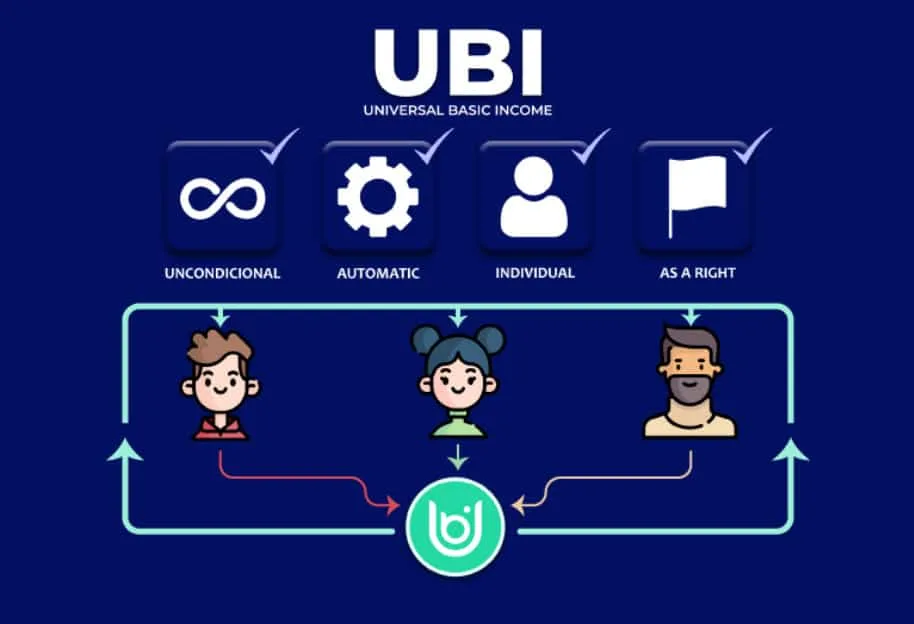
The concept is based on three important principles:
1. Universality
Every citizen receives the benefit without discrimination.
2. Unconditionality
People receive the money without fulfilling any conditions such as employment, education, or income limits.
3. Individual Agency
Recipients are free to decide how they want to use the money according to their needs.
Unlike traditional welfare schemes that provide food, fuel, or other benefits, UBI provides direct cash support.
Why is Universal Basic Income Important?
Many people struggle to meet their daily needs due to low income, job insecurity, inflation, and economic uncertainty. UBI aims to create a minimum financial safety net for every citizen.
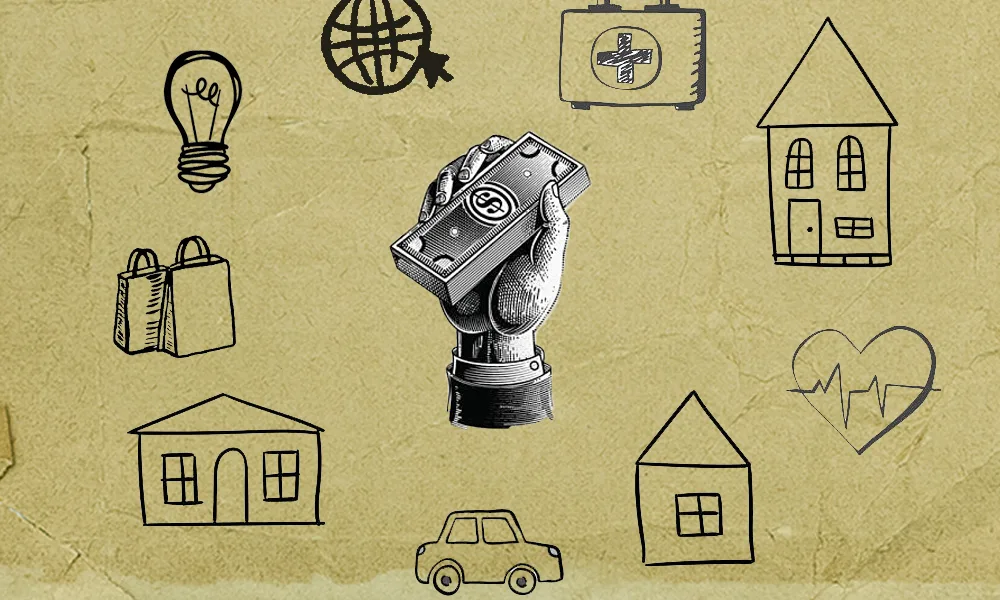
The idea recognizes that every person deserves access to basic necessities such as:
- Food
- Shelter
- Healthcare
- Education
- Clothing
- Transportation
A guaranteed income can help families manage these necessities more effectively.
Is Universal Basic Income a New Idea in India?
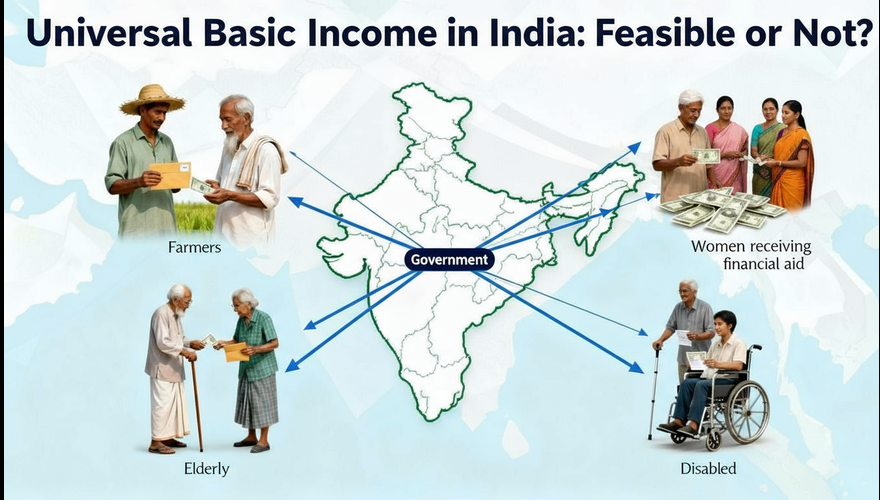
Although India has not implemented a full UBI program, several government schemes already provide direct financial assistance to specific groups.
National Old Age Pension Scheme (NOAPS)
This scheme provides financial support to elderly citizens living below the poverty line.
Indira Gandhi National Widow Pension Scheme (IGNWPS)
Financial assistance is given to widows who need economic support.
Indira Gandhi National Disability Pension Scheme (IGNDPS)
The scheme helps persons with disabilities through regular cash assistance.
Rythu Bandhu Scheme
Implemented in Telangana, this program provides financial support to land-owning farmers for agricultural investments.
Direct Benefit Transfer (DBT)
Under DBT programs such as LPG subsidy transfers, benefits are directly credited to beneficiaries’ bank accounts.
These initiatives show that direct cash transfers are already part of India’s welfare system.
Economic Survey and UBI
The Economic Survey of 2016-17 described Universal Basic Income as a conceptually attractive idea.
The survey suggested that instead of running numerous welfare schemes, the government could gradually transfer benefits directly as cash payments. This approach may simplify administration and reduce leakages.
The survey argued that universal coverage could help reduce exclusion errors, ensuring that deserving people are not left out.
UBI Pilot Projects in India
India has already witnessed experiments with cash transfer programs.
SEWA-UNICEF Pilot Project
The Self Employed Women’s Association (SEWA), with support from UNICEF, conducted cash transfer experiments in rural villages.
The results showed improvements in:
- Nutrition
- Health
- Education
- Housing conditions
- Economic activity
- Infrastructure development
These findings strengthened arguments in favor of direct cash transfers.
Arguments in Favor of Universal Basic Income
Reduction in Poverty
One of the strongest arguments supporting UBI is its ability to reduce poverty.
A guaranteed income can help poor households meet basic expenses and improve their standard of living.
Freedom of Choice
People know their needs better than government agencies.
Cash transfers allow individuals to spend money on what they consider most important, whether it is food, education, healthcare, or small business investments.
Better Social Security
UBI can provide protection against unexpected challenges such as:
- Illness
- Job loss
- Crop failure
- Natural disasters
- Economic downturns
A guaranteed income can help families survive difficult situations.
Improved Financial Inclusion
Direct cash transfers encourage people to open and use bank accounts.
This strengthens the banking system and promotes digital financial services.
Psychological Benefits
Financial insecurity often causes stress and anxiety.
A stable income can reduce uncertainty and improve mental well-being.
Administrative Simplicity
India currently operates numerous welfare schemes.
A UBI system could reduce paperwork, duplication, and administrative costs by replacing multiple programs with a single transfer mechanism.
Arguments Against Universal Basic Income
Despite its advantages, UBI also faces criticism.
Risk of Reduced Work Motivation
Some critics argue that guaranteed income may reduce people’s willingness to work.
They fear that some individuals may choose not to seek employment if they receive regular financial support.
Possibility of Wasteful Spending
There are concerns that some households may spend the money on non-essential items instead of necessities.
However, evidence from many cash transfer programs shows mixed results regarding this concern.
Gender Inequality
In some households, men may control spending decisions, limiting women’s ability to benefit equally from UBI payments.
Fiscal Burden
Implementing UBI for India’s large population would require enormous financial resources.
The government would need to carefully balance welfare spending with investments in infrastructure and development.
Inflation Concerns
If large amounts of money are injected into the economy, prices of goods and services could rise, reducing the actual value of the transfers.
Political Challenges
Once introduced, a UBI program may become politically difficult to modify or discontinue, even if financial conditions change.
Major Challenges in Implementing UBI in India
Large Population
India’s population exceeds 1.4 billion people.
Providing a guaranteed income to every citizen would require a huge budget.
Geographic Diversity
India’s diverse geography creates challenges in delivering services.
Remote villages, hilly regions, islands, and tribal areas may face difficulties in accessing markets and banking facilities.
Banking Infrastructure
Although financial inclusion has improved, some areas still have limited banking access.
A successful UBI program requires reliable banking and digital payment systems.
Federal Structure
Implementation would require coordination between the Central Government and State Governments regarding funding and administration.
Public Acceptance
Some citizens may question why wealthy individuals should receive benefits under a universal system.
This remains one of the biggest debates surrounding UBI.
Potential Benefits of Universal Basic Income
Reduction in Income Inequality
UBI can help narrow the gap between rich and poor by providing additional income to economically weaker sections.
Better Human Development
Increased household income can improve:
- Education levels
- Healthcare access
- Nutrition
- Living conditions
These improvements contribute to better human development outcomes.
Economic Growth
Poor households generally spend most of their income on essential goods and services.
Higher spending increases demand, which can stimulate economic growth and create jobs.
Social Stability
Financial security can reduce social tensions caused by economic hardship and inequality.
Support During Economic Changes
Technological advancements, automation, and artificial intelligence are changing labor markets worldwide.
UBI can help workers adapt during periods of economic transition.
Common Myths About Universal Basic Income
Myth 1: UBI Will Make People Lazy
Research from several pilot programs suggests that most people continue working even when they receive basic income support.
People generally seek employment for additional income, personal growth, and social recognition.
Myth 2: Income Should Always Depend on Employment
Modern economies already allow various forms of non-work income, including pensions, inheritance, dividends, and investments.
UBI extends financial security to all citizens rather than only specific groups.
Myth 3: UBI Rewards People Who Do Not Contribute
Many forms of unpaid work contribute significantly to society.
Examples include:
- Homemaking
- Childcare
- Elder care
- Community service
UBI can recognize these contributions indirectly.
Examples of UBI Experiments Around the World
Namibia
A pilot project in the villages of Otjievero and Omitara showed positive outcomes.
The program reduced child malnutrition and increased school attendance.
Finland
Finland conducted a two-year UBI experiment beginning in 2017.
The study found improvements in well-being and a small positive impact on employment.
Canada
The province of Ontario launched a guaranteed income experiment involving selected participants.
The project aimed to study the impact of regular income support on living standards.
Netherlands
Several Dutch cities have experimented with forms of unconditional cash assistance.
Spain
The city of Barcelona tested various anti-poverty measures, including direct cash transfers.
These international experiences provide valuable lessons for future policy discussions.
Universal Basic Income and the Future of India
India continues to face challenges related to poverty, unemployment, income inequality, and economic uncertainty. At the same time, technological changes are transforming industries and employment patterns.
Universal Basic Income offers a possible solution by providing a minimum level of financial security to every citizen. Supporters view it as a tool for reducing poverty and improving human welfare, while critics highlight concerns regarding costs and implementation.
The debate surrounding UBI is likely to continue as governments worldwide search for new ways to promote inclusive growth and social protection. While India may not adopt a nationwide UBI immediately, discussions and pilot projects can help policymakers understand its potential benefits and limitations.
As the economy evolves, Universal Basic Income remains one of the most important ideas in the conversation about social justice, economic security, and inclusive development in the 21st century.
FAQs
Q1. What is Universal Basic Income (UBI)?
UBI is a system where every citizen receives a fixed amount of money regularly from the government without any conditions.
Q2. What are the main features of UBI?
The three main features are universality, unconditionality, and individual choice.
Q3. Has India implemented Universal Basic Income?
No, India has not implemented a nationwide UBI, but several cash transfer schemes work on similar principles.
Q4. What are the benefits of Universal Basic Income?
UBI can reduce poverty, improve financial security, increase consumer spending, and support social welfare.
Q5. What are the challenges of implementing UBI in India?
Major challenges include high costs, India’s large population, banking infrastructure, and coordination between states and the central government.
Q6. Which countries have tested UBI?
Countries such as Finland, Canada, Namibia, Spain, and the Netherlands have conducted UBI experiments.
Q7. Can UBI reduce poverty?
Supporters believe that regular cash support can help families meet basic needs and reduce poverty levels.
Q8. Why is UBI being discussed globally?
Growing concerns about automation, unemployment, income inequality, and economic uncertainty have increased interest in UBI.