Mauryan Art and Architecture – Detailed Study (Part 1)

Mauryan Art and Architecture reached its peak during the rule of Ashoka in the 3rd century BCE. After embracing Buddhism, Ashoka actively promoted it through massive construction projects such as stupas, pillars, and monasteries. These structures not only served religious purposes but also helped spread moral values and administrative messages throughout the empire.
Thank you for reading this post, don't forget to subscribe!This period marks the beginning of monumental stone architecture in India. Before the Mauryan period, most structures were made of wood, which did not survive over time. The Mauryan rulers introduced the use of polished stone, which gave durability and artistic beauty to their creations.
Background of the Mauryan Empire
The Mauryan Empire was founded in 321 BCE by Chandragupta Maurya with the guidance of Chanakya, the author of the famous treatise Arthashastra. He overthrew the Nanda Dynasty and established one of the largest empires in Indian history.
Key Features of the Mauryan Empire:
- First empire to unify most of the Indian subcontinent
- Strong centralized administration
- Expansion into Central Asia and Persia
- Well-organized political and economic system
After Chandragupta, his son Bindusara expanded the empire further, except for the region of Kalinga.
Later, Bindusara was succeeded by Ashoka, who initially followed a policy of conquest. However, the brutal Kalinga War changed his life. Witnessing the destruction and loss of life, Ashoka adopted a policy of non-violence (Ahimsa) and embraced Buddhism.
Mauryan Art and Architecture: An Overview
Mauryan Art and Architecture can broadly be divided into two categories:

1. Court Art
These were works commissioned by the kings for political, administrative, and religious purposes.
2. Popular Art
These were created by common people and included local artistic traditions such as terracotta figures, pottery, and small sculptures.
In this part, we mainly focus on Court Art, which includes palaces, pillars, and stupas.
Mauryan Court Art
1. Mauryan Palaces
The palaces of the Mauryan rulers were considered architectural wonders of their time.
- The Greek historian Megasthenes described them as some of the finest creations ever built.
- The Chinese traveler Fa-Hien praised them as divine or god-like structures.
Features of Mauryan Palaces:
- Built mainly using wood
- Highly polished surfaces
- Grand halls and pillars
- Strong influence of Persian architecture
The palace of Chandragupta Maurya was inspired by the Achaemenid palaces of Persepolis in Iran.
Important Examples:
- Pataliputra Palace (modern Patna)
- Kumrahar Palace (associated with Ashoka)
2. Mauryan Pillars
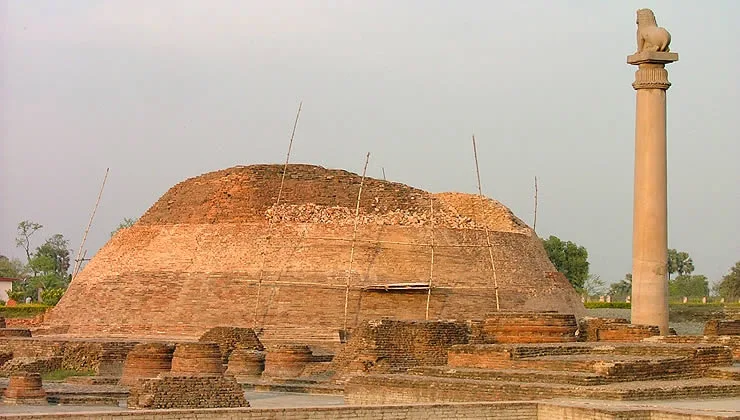
Mauryan pillars are among the most iconic symbols of Indian history. These pillars were mainly erected by Ashoka across his empire.
Purpose of Pillars:
- Spread Buddhist teachings
- Announce royal orders
- Promote moral values (Dhamma)
Material Used:
- Made of finely polished sandstone, especially from Chunar
Structure of Mauryan Pillars:
- Shaft – A tall, monolithic (single stone) column
- Capital – Bell-shaped or lotus-shaped top
- Abacus – Platform above the capital
- Animal Figures – Lion, bull, elephant, etc.
The most famous example is the Sarnath Lion Capital, which is now the national emblem of India.
Comparison with Achaemenid (Persian) Pillars
Similarities:
- Use of polished stone
- Decorative motifs like lotus
- Inscriptions for royal messages
- Writing style beginning in third person
Differences:
| Feature | Mauryan Pillars | Persian Pillars |
|---|---|---|
| Structure | Monolithic (single stone) | Made of multiple pieces |
| Surface | Smooth | Fluted (ridged) |
| Design | Simple and standalone | Part of large structures |
| Capital Figures | Simple animal figures | More elaborate |
| Ornamentation | Less complex | Highly decorative |
Pillar Edicts and Inscriptions
The inscriptions on pillars are known as Edicts of Ashoka. These provide valuable information about governance, morality, and religion.
Language Used:
- Mostly Prakrit and Pali
- Some in Greek and Aramaic
Major Pillar Edicts
Ashoka issued seven major pillar edicts, each focusing on different aspects of Dhamma:
- Protection of people
- Definition of Dhamma (moral values)
- Condemnation of sins like anger and cruelty
- Duties of officials (Rajukas)
- Protection of animals
- Policy of Dhamma
- Welfare activities
Minor Pillar Inscriptions
- Rummindei Inscription: Records Ashoka’s visit to Lumbini (birthplace of Buddha)
- Nigalisagar Inscription: Mentions expansion of a stupa
Important Pillar Sites:
- Sarnath (Uttar Pradesh)
- Vaishali (Bihar)
- Lauriya Nandangarh (Bihar)
- Allahabad Pillar
Mauryan Stupas
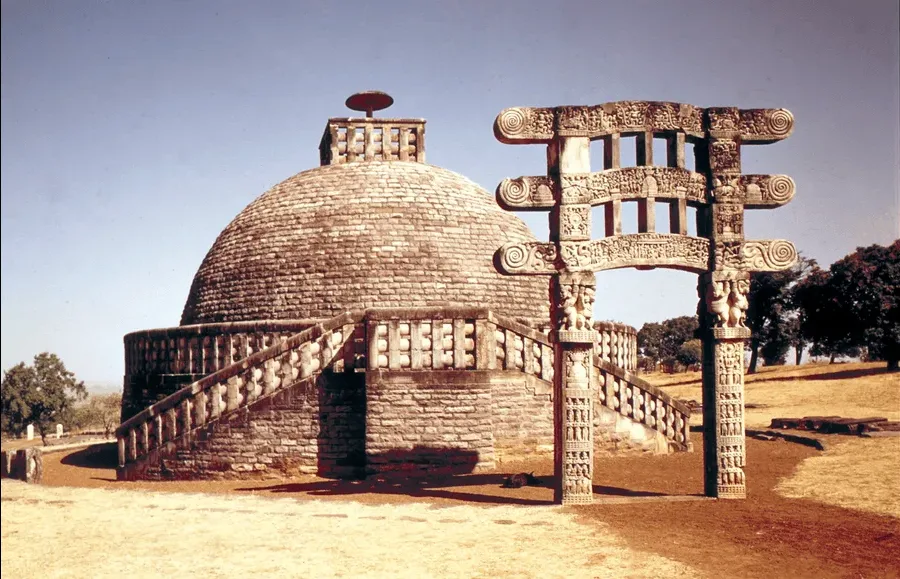
Stupas are dome-shaped structures built to preserve the relics of Gautama Buddha.
Origin:
Stupas existed even before Buddhism, but Ashoka popularized them across India.
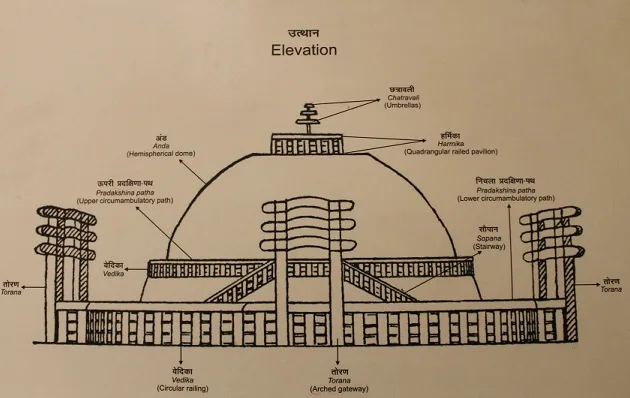
Structure of a Stupa:
- Anda – Hemispherical dome
- Harmika – Square railing on top
- Chhatra – Umbrella-like structure
- Medhi – Circular path for walking
- Torana – Decorative gateways
Materials Used:
- Inner core: Unburnt bricks
- Outer layer: Burnt bricks and plaster
- Decoration: Wood carvings and sculptures
Important Examples of Stupas:
- Sanchi Stupa – Most famous
- Piprahwa Stupa (Uttar Pradesh) – Oldest
- Bairat Stupa (Rajasthan)
Other stupas were built at places associated with Buddha’s life such as:
- Rajagriha
- Vaishali
- Kapilavastu
- Kushinagar
Depiction of Buddha in Mauryan Art
In early Mauryan art, Gautama Buddha was not shown in human form.
Symbolic Representation:
- Footprints
- Lotus
- Wheel (Dharma Chakra)
- Empty throne
Later, stories from Buddha’s previous births, known as Jataka Tales, were depicted.
Popular Jataka Stories:
- Chhadanta Jataka
- Sibi Jataka
- Ruru Jataka
- Vessantara Jataka
- Shama Jataka
Key Events of Buddha’s Life in Art:
- Birth
- Renunciation
- Enlightenment
- First sermon (Dharmachakra Pravartana)
- Mahaparinirvana
Conclusion
Mauryan Art and Architecture laid the foundation for Indian artistic traditions. It marked the transition from wood-based structures to durable stone monuments. The works of Ashoka not only reflected political power but also carried deep moral and spiritual messages.
From majestic pillars and grand palaces to symbolic stupas, the Mauryan period represents a golden age of Indian art and architecture. Its influence can still be seen in modern India, especially in the national emblem derived from the Sarnath Lion Capital.
FAQs
1. What is Mauryan Art and Architecture?
It refers to the art and architectural developments during the Mauryan Empire, especially under Ashoka.
2. Who was the main promoter of Mauryan architecture?
Emperor Ashoka was the main promoter.
3. What are Ashokan pillars made of?
They are made of polished sandstone.
4. What is the most famous Mauryan stupa?
The Sanchi Stupa is the most famous.
5. How was Buddha represented in early art?
Through symbols like footprints, lotus, and wheel instead of human form.