New Coelacanth Species China Discovered in Anhui Reveals Ancient Evolutionary Secrets

New Coelacanth Species China has become a remarkable addition to paleontological records, revealing new insights into one of Earth’s oldest surviving lineages of fishes. Palaeontologists from the Chinese Academy of Sciences have identified a new species of coelacanth from the Early Triassic deposits in Anhui Province, eastern China. Named Whiteia anniae, this discovery marks the first record of the genus Whiteia in Asia, significantly extending its known geographical range and deepening our understanding of the evolutionary history of these ancient lobe-finned fishes.
Thank you for reading this post, don't forget to subscribe!The finding provides crucial data about post-extinction marine life recovery following the Permian-Triassic extinction event, often referred to as the “Great Dying.” This discovery not only highlights the adaptability of coelacanths but also reaffirms their importance as evolutionary icons bridging prehistoric and modern aquatic life.
New Coelacanth Species: Ancient Survivors with Evolutionary Significance
Coelacanths belong to the subclass Sarcopterygii, a group of lobe-finned fishes that appeared over 400 million years ago during the Early Devonian period. These fishes are evolutionary cousins of the first land-dwelling vertebrates and are crucial to understanding how life transitioned from water to land.
Coelacanths reached their peak diversity during the Early Triassic, shortly after the largest mass extinction in Earth’s history wiped out nearly 90% of marine species. Despite such catastrophic events, these ancient fishes endured, evolving slowly but persistently.
Once believed to have vanished around 66 million years ago during the Cretaceous-Paleogene extinction, coelacanths were dramatically rediscovered in 1938 off the coast of South Africa. The species Latimeria chalumnae astonished scientists, earning coelacanths the title of “living fossils.”
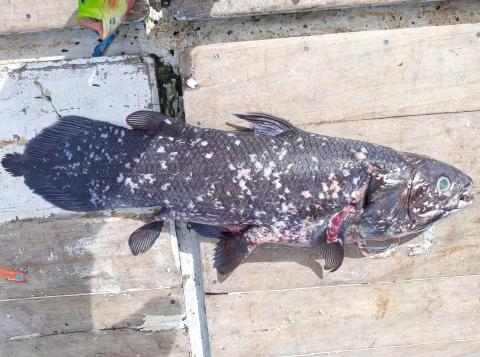
Their distinctive limb-like fins, hinged skulls, and electrosensory organs make them living windows into ancient evolutionary processes. Yet, as the discovery of Whiteia anniae shows, these fishes were far from uniform; their evolutionary history is richer and more varied than previously imagined.
New Coelacanth Species: Discovery of Whiteia anniae in Anhui Province
The newly identified species, Whiteia anniae, lived approximately 249 million years ago during the Smithian age of the Early Triassic period. The fossils were excavated from marine rock layers at Maoshankou, Anhui Province, an area well-known for its early Triassic marine deposits.
Researchers unearthed two exceptionally well-preserved specimens, revealing a body length of 41 to 46 centimeters, making Whiteia anniae noticeably larger than many of its known relatives. Most previous species of Whiteia ranged between 11.5 cm and 27 cm, while only the North American species Whiteia giganteus exceeded one meter in length.
According to the study, the newly discovered specimens exhibit distinct cranial and fin features, confirming that they represent a new species within the genus. Their size and morphology suggest they may have occupied a unique ecological niche, possibly preying on smaller fish and invertebrates in the shallow Triassic seas.
New Coelacanth Species: Expanding the Range of an Ancient Genus
Before this discovery, the genus Whiteia had been documented in fossil records from Madagascar, South Africa, Canada, and Greenland. The identification of Whiteia anniae from China represents the first known occurrence in Asia, expanding the geographic distribution of this genus across multiple continents.
This significant find implies that coelacanths were more widespread during the Early Triassic than previously thought. It also supports the hypothesis that marine ecosystems were quick to recover and diversify after the Permian-Triassic extinction.
The study further suggests that Whiteia anniae may act as an evolutionary bridge between the smaller Whiteia species of Europe and Africa and the giant forms found in North America, demonstrating a continuous evolutionary gradient across early Triassic marine habitats.
New Coelacanth Species: Exam-Oriented Facts
- Scientific Name: Whiteia anniae
- Age: Approximately 249 million years old (Early Triassic period)
- Location: Maoshankou, Anhui Province, China
- Length: 41–46 cm, larger than most known Whiteia species
- Published: October 17, 2025, in the journal Scientific Reports
- Discovery By: Chinese Academy of Sciences, led by Dr. Guang-Hui Xu
- Significance: First record of Whiteia genus in Asia
These factual details make the discovery particularly relevant for academic and competitive examination purposes, highlighting its geological and evolutionary importance.
New Coelacanth Species: Revising the Understanding of Coelacanth Diversity
According to lead researcher Dr. Guang-Hui Xu, the discovery of Whiteia anniae challenges the long-held notion that coelacanths were morphologically conservative over millions of years. Instead, fossil evidence now indicates that these ancient fishes exhibited greater morphological diversity than scientists previously believed.
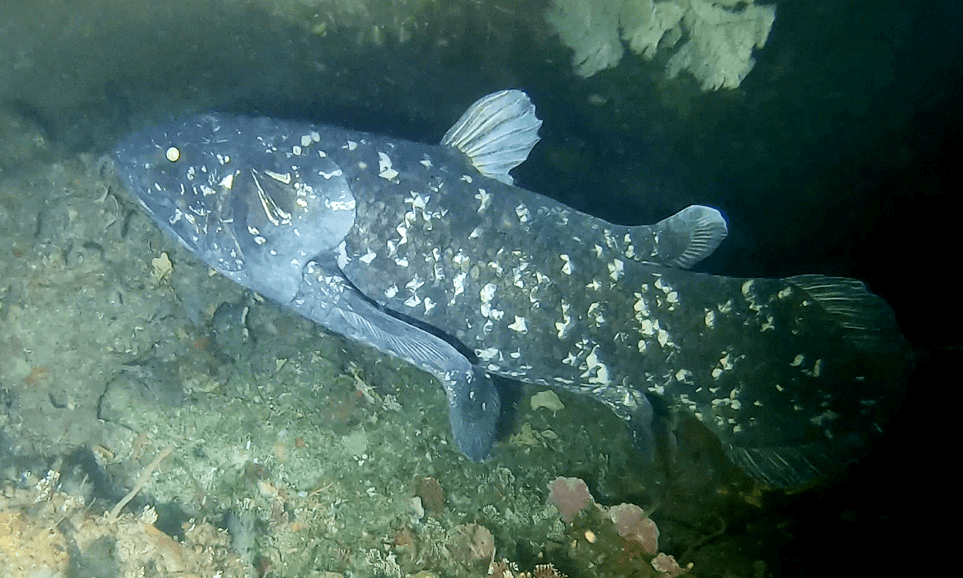
Dr. Xu emphasized that the coelacanth lineage demonstrates both evolutionary adaptability and ecological resilience, characteristics that enabled their survival through multiple global extinction events. The new species adds depth to our understanding of how ancient fishes evolved diverse body forms and adapted to changing marine environments.
This research reinforces the idea that evolutionary stability does not equate to stagnation even species considered “living fossils” possess complex evolutionary histories shaped by environmental pressures and genetic variation.
New Coelacanth Species: Broader Evolutionary Implications
The discovery of Whiteia anniae carries implications far beyond taxonomy. It provides valuable insight into post-extinction marine recovery and the recolonization patterns of vertebrates following catastrophic events. Coelacanths, with their long evolutionary timeline, serve as key indicators for studying resilience and adaptation in ancient ecosystems.
Furthermore, the Asian origin of this new species opens new avenues for exploring continental connections and marine dispersal routes during the Triassic period. The findings may help paleontologists reconstruct ancient ocean currents and understand how species migrated across prehistoric seas.
With advanced imaging technologies and continued fossil exploration, future research in China’s Anhui province and nearby regions may reveal even more surprises about these enigmatic fishes and their role in shaping vertebrate evolution.