


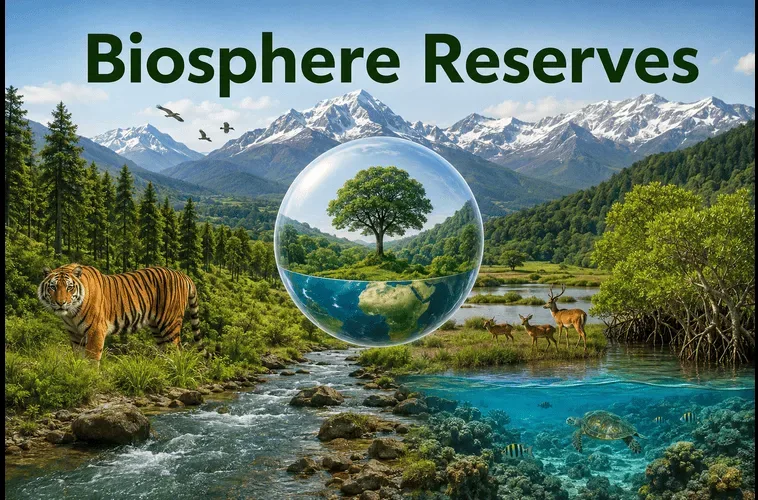
Biosphere Reserves in India: Meaning, Zones, Functions and List

Biosphere Reserves in India are special protected areas created to conserve nature, wildlife, plants, and traditional human lifestyles. These reserves help maintain a balance between environmental protection and human development. They are important because they show how humans and nature can live together without harming each other.
Thank you for reading this post, don't forget to subscribe!India is one of the world’s most biodiverse countries. It has mountains, forests, deserts, rivers, wetlands, and coastal regions. Because of this rich natural wealth, protecting these ecosystems is very important. Biosphere reserves play a major role in preserving these natural resources for future generations.
What is a Biosphere Reserve?
A Biosphere Reserve (BR) is a large protected area recognized by the United Nations Educational, Scientific and Cultural Organization (UNESCO). These areas include land, coastal, or marine ecosystems where biodiversity is protected while allowing sustainable human activities.
The main purpose of a biosphere reserve is to:
- Protect plants and animals
- Preserve natural ecosystems
- Support sustainable development
- Protect cultural traditions of local communities
Biosphere reserves are living examples of peaceful coexistence between people and nature.
Why are Biosphere Reserves Important?
Biosphere reserves are important for several reasons:
- They protect rare and endangered species.
- They preserve forests, rivers, wetlands, and other ecosystems.
- They help scientists study nature and climate change.
- They support local communities through sustainable livelihoods.
- They preserve traditional tribal knowledge and culture.
These reserves help ensure that natural resources are used wisely without destroying the environment.
Criteria for Designation of Biosphere Reserve
An area must meet certain conditions to be declared a biosphere reserve.
1. Protected Core Area
The region must have a protected core area that remains mostly undisturbed. This area should have high ecological value.
2. Rich Biodiversity
The area should contain many species of plants and animals, including rare or endangered species.
3. Large Ecological Region
The region must be large enough to support complete ecosystems and maintain food chains.
4. Community Participation
Local communities should actively participate in conservation activities.
5. Traditional Sustainable Living
The area should have potential to preserve traditional lifestyles that use natural resources responsibly.
Three Main Zones of Biosphere Reserve
Every biosphere reserve is divided into three zones.
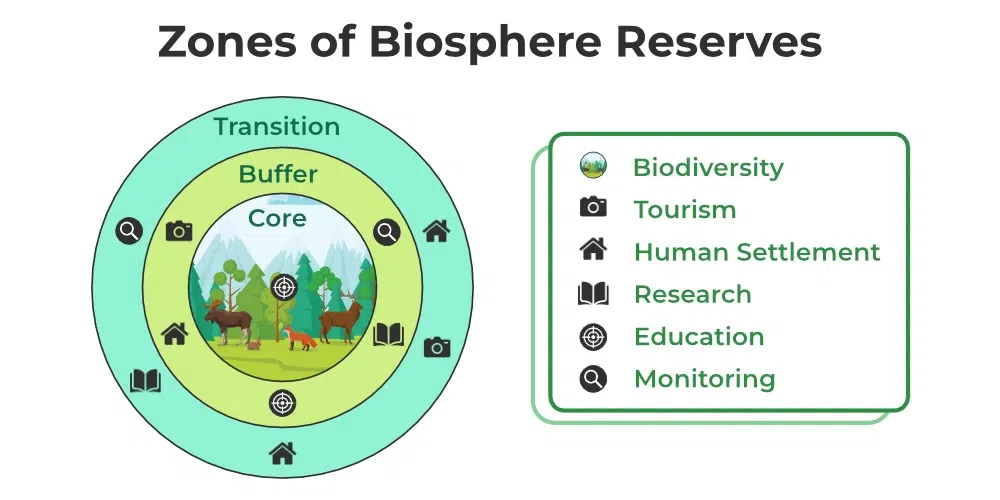
1. Core Zone
The core zone is the most protected area of a biosphere reserve.
Features of the core zone:
- No human activity is allowed
- Contains rare and endemic species
- Protected under wildlife laws
- Used mainly for conservation and research
This zone often includes national parks or wildlife sanctuaries.
Example: Tigers, elephants, and rare medicinal plants may live in the core area.
2. Buffer Zone
The buffer zone surrounds the core zone.
Allowed activities include:
- Research
- Education
- Tourism
- Grazing
- Fishing (limited)
- Restoration work
These activities are controlled so they do not harm the core zone.
The main purpose of the buffer zone is to reduce pressure on the core area.
3. Transition Zone
The transition zone is the outermost area.
This zone includes:
- Villages
- Agricultural land
- Managed forests
- Human settlements
- Economic activities
In this area, people live and work while following sustainable practices.
This zone promotes cooperation between humans and conservation efforts.
Functions of Biosphere Reserves
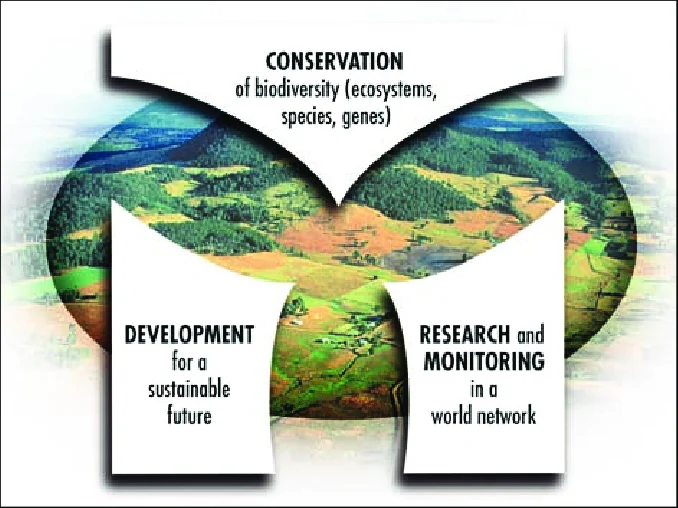
Biosphere reserves perform three major functions.
1. Conservation Function
The first role is conservation.
This includes protecting:
- Biodiversity
- Ecosystems
- Forests
- Wildlife
- Genetic resources
They help prevent species extinction and reduce human-animal conflicts.
They also protect tribal culture and traditional knowledge.
2. Development Function
The second function is sustainable development.
This means promoting economic growth without damaging nature.
It supports:
- Eco-friendly farming
- Sustainable tourism
- Forest-based livelihoods
- Traditional industries
The goal is to balance economic growth with environmental safety.
3. Logistic Support Function
The third function is scientific and educational support.
This includes:
- Environmental research
- Monitoring ecosystems
- Training programs
- Awareness campaigns
- Education
Scientists use biosphere reserves to study climate change, biodiversity, and ecosystem health.

Biosphere Reserves in India
India currently has 18 Biosphere Reserves.
| Biosphere Reserve | State/Region |
|---|---|
| Cold Desert | Himachal Pradesh |
| Nanda Devi | Uttarakhand |
| Khangchendzonga | Sikkim |
| Dehang-Debang | Arunachal Pradesh |
| Manas | Assam |
| Dibru-Saikhowa | Assam |
| Nokrek | Meghalaya |
| Panna | Madhya Pradesh |
| Pachmarhi | Madhya Pradesh |
| Achanakmar-Amarkantak | Madhya Pradesh / Chhattisgarh |
| Kachchh | Gujarat |
| Similipal | Odisha |
| Sundarban | West Bengal |
| Seshachalam | Andhra Pradesh |
| Agasthyamala | Kerala / Tamil Nadu / Karnataka |
| Nilgiri | Tamil Nadu / Kerala |
| Gulf of Mannar | Tamil Nadu |
| Great Nicobar | Andaman and Nicobar Islands |
Important Facts
- Largest Biosphere Reserve in India: Kachchh
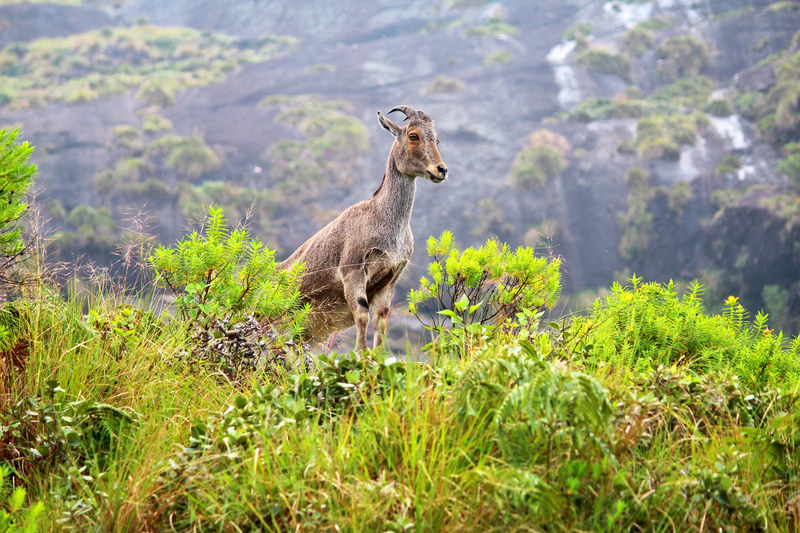
- First Biosphere Reserve in India: Nilgiri
International Status of Biosphere Reserves
UNESCO gives international recognition to selected biosphere reserves under the Man and Biosphere (MAB) Programme.
These reserves meet global standards for conservation and sustainable development.
Worldwide, there are hundreds of biosphere reserves across many countries.
India has 12 biosphere reserves recognized internationally by UNESCO under the MAB Programme.
These include:
- Nilgiri
- Gulf of Mannar
- Sundarban
- Nanda Devi
- Nokrek
- Pachmarhi
- Similipal
- Achanakmar-Amarkantak
- Great Nicobar
- Agasthyamala
- Khangchendzonga
- Panna
What is Man and Biosphere Programme?
The Man and Biosphere Programme (MAB) was launched by United Nations Educational, Scientific and Cultural Organization in 1971.
Its goal is to improve the relationship between humans and nature.
This programme combines:
- Natural science
- Social science
- Economics
- Education
The purpose is to create sustainable solutions that improve human life while protecting ecosystems.
MAB encourages environmentally friendly development that respects culture and local traditions.
Biosphere Conservation in India
The Government of India started the Biosphere Reserve scheme in 1986.
Under this scheme, financial support is provided for:
- Conservation
- Maintenance
- Research
- Development activities
Funding pattern:
- 90:10 ratio for Northeastern states and Himalayan states
- 60:40 ratio for other states
State governments prepare management plans, which are monitored by the Central MAB Committee.
Challenges Facing Biosphere Reserves
Even though biosphere reserves are protected, they face several challenges.
Human Pressure
Increasing population creates pressure on forests and natural resources.
Illegal Activities
Poaching, illegal logging, and encroachment harm biodiversity.
Climate Change
Rising temperatures, floods, and droughts affect ecosystems.
Invasive Species
Foreign species entering ecosystems can damage native plants and animals.
Example: Invasive plants in the Nilgiri Biosphere Reserve have affected local biodiversity.
Development Projects
Roads, mining, and industries may disturb wildlife habitats.
Way Forward for Better Conservation
Several steps can strengthen biosphere reserve conservation.
Protect Tribal Rights
Forest-dependent communities should get secure land rights.
Promote Eco-Friendly Livelihoods
Local products such as spices, herbs, and handicrafts can be marketed with special biosphere labels.
Control Invasive Species
The government should remove harmful alien species.
Increase Awareness
Students and citizens should learn about conservation.
Better Research and Monitoring
Modern scientific tools should be used for regular monitoring.
Strong conservation policies and public participation are necessary for long-term success.
Biosphere reserves are not just protected lands. They are living systems where humans, animals, forests, and culture stay connected. They remind us that development and conservation should go together. Protecting these reserves means protecting our future.
FAQs
1. What are Biosphere Reserves in India?
Biosphere reserves are large protected areas created to conserve biodiversity while supporting sustainable human activities.
2. How many biosphere reserves are there in India?
India has 18 biosphere reserves.
3. Which is the first biosphere reserve in India?
Nilgiri is the first biosphere reserve in India.
4. Which is the largest biosphere reserve in India?
Kachchh in Gujarat is the largest biosphere reserve.
5. What are the three zones of a biosphere reserve?
Core zone, Buffer zone, and Transition zone.