Money Laundering: Meaning, Process, Impacts and Prevention

Money Laundering is one of the biggest financial crimes in the modern world. It affects the economy, society, and even national security. Illegal money earned through crimes such as drug trafficking, corruption, robbery, smuggling, and fraud is often hidden and made to look legal through money laundering. This process allows criminals to use illegal money without raising suspicion.
Recently, the issue of money laundering gained global attention when the Asia-Pacific Group on Money Laundering (APG) placed Pakistan in its “Enhanced Expedited Follow-Up List” due to failure to meet anti-money laundering standards. This shows how seriously the world is treating financial crimes.

What is Money Laundering?
Money laundering is the process of hiding the real source of illegally earned money and making it appear as if it came from legal activities. In simple words, criminals try to “clean” dirty money so they can use it openly.
For example, if a person earns money through illegal drug sales, they cannot directly deposit large amounts into a bank without attracting attention. Instead, they move the money through several channels so it looks legal.
According to the International Monetary Fund (IMF), money laundering worldwide is estimated to be around 2% to 5% of global GDP, which means trillions of dollars are laundered every year.
How Does Money Laundering Work?
Money laundering usually happens in three major stages:
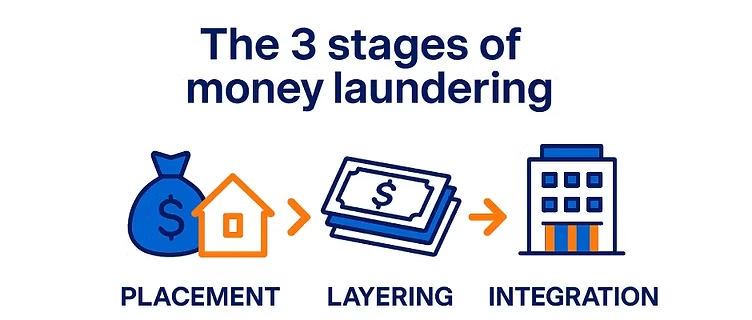
1. Placement
This is the first step where illegal money enters the financial system.
Criminals deposit cash into banks, buy valuable items, or use businesses that handle a lot of cash. The main goal is to move dirty money away from the crime source.
Example:
A criminal deposits small amounts of illegal cash into different bank accounts to avoid suspicion.
2. Layering
This is the most complex stage.
In this step, criminals move money through many transactions to hide its original source. They may transfer money between multiple accounts, countries, or shell companies.
The goal is to make tracking difficult.
Example:
Money is transferred from one company to another, then to offshore accounts, making it hard to trace.
3. Integration
This is the final stage.
After many transactions, the money appears legal and can be used freely.
Example:
The laundered money may be used to buy real estate, luxury cars, or businesses.
Common Methods of Money Laundering
Money laundering happens in many forms. Some common methods include:
Structuring (Smurfing)
Large amounts of cash are broken into smaller deposits to avoid bank reporting limits.
Bulk Cash Smuggling
Physical cash is moved across borders secretly.
Cash-Intensive Businesses
Businesses like restaurants, casinos, and parking services can mix illegal money with legal earnings.
Trade-Based Laundering
False invoices, fake imports, or exports are used to move money internationally.
Shell Companies
Fake companies are created only to transfer money without real business activities.
Round Tripping
Money is sent abroad and brought back as legal foreign investment.
Gambling
Illegal money is used in gambling and later shown as winnings.
Black Salaries
Employees are paid unofficially in cash to avoid taxes.
Tax Amnesties
Some criminals use tax settlement schemes to legalize hidden wealth.
Transaction Laundering
Illegal transactions are processed through legal payment systems.
Impacts of Money Laundering
Money laundering creates serious problems in many areas.
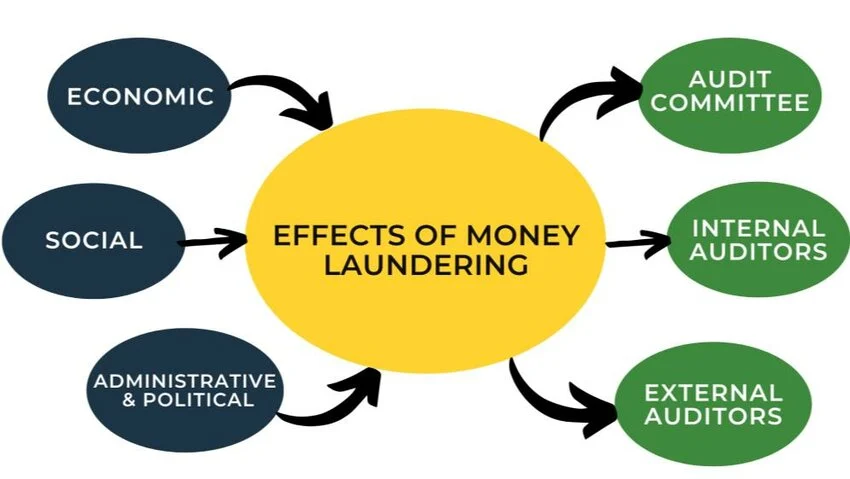
Economic Impacts
Weakens Private Businesses
Illegal businesses can unfairly compete with honest companies.
Damages Financial Markets
Banks and financial institutions may lose trust if used for illegal activities.
Loss of Economic Control
Governments may struggle to manage financial systems properly.
Economic Instability
Large illegal fund movements can create sudden financial instability.
Loss of Government Revenue
Tax evasion reduces government income.
Price Rise
Illegal money entering markets can increase the prices of property and goods.
Exchange Rate Fluctuation
Unexpected movement of large funds can affect currency value.
Reduced Trade Growth
Money laundering harms trade and foreign investment.
Social Impacts
Increase in Crime
Money laundering supports criminal activities like trafficking and corruption.
Lower Human Development
Funds that could help society are diverted to illegal activities.
Wrong Use of Resources
Resources move toward criminal businesses instead of useful sectors.
Loss of Public Trust
People may lose trust in banks and financial institutions.
Moral Decline
Criminal activities weaken social values and lawfulness.
Political Impacts
Political Instability
Illegal money can influence political decisions.
Criminalisation of Politics
Criminal groups may fund political campaigns and gain power.
Corruption Growth
Money laundering often increases corruption in government systems.
Steps Taken by India to Prevent Money Laundering
India has introduced several laws and institutions to fight money laundering.
Criminal Law Amendment Ordinance, 1944
This law deals with property obtained through crimes like corruption, cheating, and breach of trust.
Smugglers and Foreign Exchange Manipulators Act, 1976
This law allows the government to confiscate properties obtained through smuggling and illegal foreign exchange activities.
Narcotic Drugs and Psychotropic Substances Act, 1985
It provides punishment for illegal drug trade and confiscation of related property.
Prevention of Money Laundering Act (PMLA), 2002
This is India’s main law against money laundering.
Important features:
- Provides legal action against money laundering
- Applies to banks, financial institutions, insurance companies, and mutual funds
- Allows investigation and property seizure
PMLA Amendment Act, 2012
This amendment strengthened anti-money laundering rules.
Key changes:
- Introduced the term reporting entity
- Includes banks, intermediaries, and financial institutions
- Removed the earlier fine limit of ₹5 lakh
- Allowed attachment and confiscation of suspicious properties
Financial Intelligence Unit – India (FIU-IND)
Financial Intelligence Unit – India collects and analyzes suspicious financial transactions.
It reports directly to the Economic Intelligence Council.
Enforcement Directorate (ED)
Enforcement Directorate investigates economic crimes and money laundering cases.
Major functions:
- Investigates money laundering offences
- Seizes illegal assets
- Prosecutes criminals under PMLA
India is also a member of the Financial Action Task Force (FATF) and follows global anti-money laundering standards.
Global Efforts to Combat Money Laundering
Many international organizations work together to reduce money laundering.
Vienna Convention
It requires member countries to criminalize money laundering related to drug trafficking.
Council of Europe Convention (1990)
This created a common international policy against money laundering.
Basel Committee Principles
The Basel Committee on Banking Supervision issued banking principles to prevent illegal financial activities.
IOSCO
The International Organization of Securities Commissions encourages member countries to stop money laundering in securities markets.
FATF
The Financial Action Task Force was established in 1989 by G-7 countries.
Main roles:
- Monitors countries’ progress
- Sets anti-money laundering standards
- Issues the famous 40 Recommendations
FATF plays a major role in identifying countries with weak anti-money laundering systems.
IMF
The IMF urges countries to follow global standards to stop money laundering and terrorist financing.
United Nations Office on Drugs and Crime
The United Nations Office on Drugs and Crime (UNODC) works to identify and stop money laundering worldwide.
Future Challenges and Way Forward
Money laundering methods are changing rapidly due to modern technology. Criminals now use cryptocurrencies, digital payments, online fraud, and global networks to hide illegal money.
To stop this, countries must use advanced tools such as:
- Artificial Intelligence (AI)
- Big Data analysis
- Real-time transaction monitoring
- Strong cybersecurity systems
- Better international cooperation
Governments, banks, law enforcement agencies, and global organizations must improve data sharing and work together. Strong laws, modern technology, and public awareness are necessary to reduce money laundering and protect the financial system.
Money laundering is not just a financial crime it is a major threat to economic growth, public trust, and national security.
FAQs
Q1. What is money laundering?
Money laundering is the process of hiding illegally earned money and making it appear as if it came from legal sources.
Q2. What are the three stages of money laundering?
The three stages are Placement, Layering, and Integration. These steps help criminals hide the source of illegal money.
Q3. Why is money laundering dangerous?
Money laundering supports crimes like corruption, drug trafficking, and fraud. It also harms the economy and financial systems.
Q4. Which law deals with money laundering in India?
The main law is the Prevention of Money Laundering Act (PMLA), 2002, which helps prevent and punish money laundering activities.
Q5. What is the role of the Enforcement Directorate (ED)?
The Enforcement Directorate (ED) investigates money laundering cases, seizes illegal assets, and prosecutes offenders.
Q6. What is FATF?
The Financial Action Task Force (FATF) is an international organization that sets standards to combat money laundering and terrorist financing.
Q7. How does money laundering affect the economy?
It reduces government revenue, increases corruption, disturbs financial markets, and weakens economic stability.
Q8. Can digital technology increase money laundering risks?
Yes, cryptocurrencies, online banking, and digital payments can be misused by criminals to hide illegal money.